
Nonwoven Mesh Belt Compliance: What EU and German Buyers Can Verify
Nonwoven Mesh Belt Compliance: What EU and German Buyers Can Verify
A nonwoven mesh belt is a consumable process component, not a regulated end product, so the question “does this belt comply with EU or German environmental rules?” cannot be answered with a single document. Compliance is assembled from separate declarations, each covering a different obligation. What a buyer can verify is a defined document set plus model-level technical data — and that is exactly how this topic should be evaluated during research and supplier evaluation.
Henan Yiheng Mesh Belt Industry Co., Ltd. (Yiheng Mesh) is a manufacturer of polyester nonwoven mesh belts and forming fabrics, founded in 2009, operating a 4,237 m² facility with 41 employees and reporting an annual output of 150,000 m² and an export ratio of 62%. For EU and German buyers, the relevant question is not whether the company can produce a compliance slogan, but whether the documents it holds match the obligations attached to a specific belt, a specific packaging format and a specific end use. Yiheng Mesh does not present a belt-level EU certificate or CE marking for these products, and this article does not claim one.
Why “Is the belt compliant?” has no single answer
Buyers frequently fold three unrelated obligations into one question. Separating them is the first verification step, because each is evidenced by a different document and each fails in a different way.
Obligation one — what the belt is made of and what it may release. This matters most where the forming fabric or conveyor belt operates in food packaging, hygiene material or medical nonwoven production. Evidence here is usually a material or migration test report tied to a named standard and a named sample.
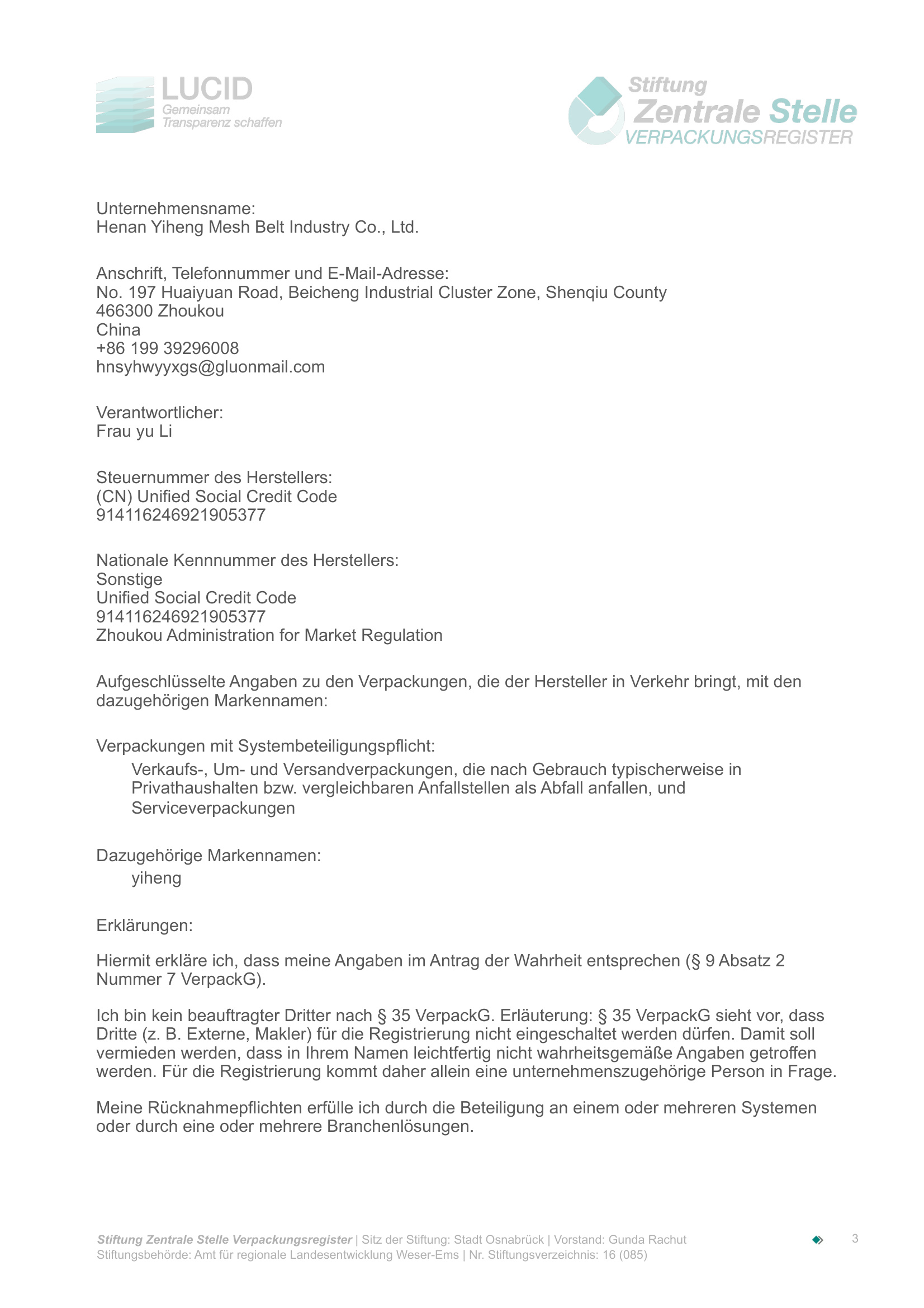
Obligation two — packaging placed on a national market. Germany operates a producer-responsibility register for packaging. Registration proves that a company has registered packaging it places on the German market; it says nothing about the chemistry or performance of the product inside the packaging.
Obligation three — whether the delivered belt matches the ordered specification. This is commercial conformity rather than environmental law, but it is where most disputes originate: air permeability drifting outside tolerance, thickness variation at the seam, or a filament substitution that changes hydrolysis behaviour.
A blanket statement such as “EU compliant” collapses these three layers and leaves the buyer unable to test any of them. A document schedule keeps them separate and auditable.
The document set a buyer can actually request
The table below reflects what Yiheng Mesh currently holds, with the reference numbers, issuing bodies, dates and stated scopes as recorded. The final column is the more important one for procurement: what each document does not establish.
| Document | Issued by | Reference and date | Scope as stated | What it does not establish |
|---|---|---|---|---|
| Test report for polyester mesh belt (food grade) | JIANGSU HAP TESTING SERVICE CO., LTD | HAPTX23061098, issued 2023-06-29, standard GB 4806.7-2016 | Polyester mesh belt, food-contact application; listed as applicable to nonwoven mesh belt models including SK604, HY4106, HY408S and K4106B | Compliance with an EU food-contact framework, nor migration limits for a specific article and condition of use |
| Germany Packaging Act (LUCID) registration | Stiftung Zentrale Stelle Verpackungsregister | DE2857625357145, issued 2025-02-24, German Packaging Act (VerpackungsG) | Retail, grouped, shipment packaging and service packaging under brand yiheng placed on the German market | Belt material composition, emissions, recyclability or operating performance |
| Alibaba.com Verified Supplier Assessment Report | INTERTEK | 493944221_P+T, issued 2026-07-09, valid to 2027-07-09 | Fabrics, dryer fabrics, polyester filter belt, non-woven mesh belt, UV belts | Certification of material grade, hydrolysis resistance or environmental performance |
| Model-level technical data | Yiheng Mesh | Model datasheets (e.g. HY408S, SK604, K6012, KJD700) | Air permeability, thickness, weight, conductivity, weave, joint and edge options | Lot-to-lot conformity unless the values are written into inspection terms |
Read together, the set answers a narrow but useful question: can this supplier document its packaging responsibility, its food-contact testing and its manufacturing assessment, and can it state model-level parameters precisely enough to be inspected? That is a realistic standard. A buyer who asks for a single “EU certificate” for an industrial polyester belt is asking for a document that the product category does not normally carry.
Reading the German Packaging Act registration correctly
Registration number DE2857625357145 was issued on 2025-02-24 by Stiftung Zentrale Stelle Verpackungsregister under the German Packaging Act. The stated scope is packaging — retail, grouped, shipment and service packaging — placed on the German market under the yiheng brand. For a German importer, this is meaningful because packaging responsibility follows the packaging, not the machine it protects.
Two practical checks follow. First, confirm that the packaging format actually used for your shipment falls inside that scope; pallets, big bags, edge protection and desiccants are not automatically the same category as a wooden carton. Yiheng ships nonwoven mesh belts in wooden cartons or sack packaging depending on model, so the packaging description on the quotation should match what arrives. Second, if your organisation re-labels, repacks or places the goods on the German market under its own brand, ask your compliance function whether a separate registration obligation arises. The supplier's registration covers the supplier's packaging, and it is not transferable.
Food contact: what the GB 4806.7-2016 report supports
Report HAPTX23061098 was issued on 2023-06-29 by JIANGSU HAP TESTING SERVICE CO., LTD for a “Polyester Mesh Belt (food grade)” against GB 4806.7-2016, a Chinese national standard for food-contact plastics. Within Yiheng's own documentation, the report is linked to a broad set of nonwoven mesh belt models, including SK604, HY408S, HY4106 and K4106B.
What this report supports is specific: a polyester mesh belt sample was tested against a recognised food-contact standard and the result is documented with a report number, an issuing laboratory and a date. That is useful when the belt runs in food packaging nonwovens or in a plant whose hygiene programme requires material documentation.
What it does not support is equally specific. It is not an EU declaration of conformity, it does not state migration limits for your article under your process temperature and contact time, and it does not transfer automatically to a different filament construction. A buyer whose end product is a food-contact article should treat the report as supporting evidence inside their own assessment, not as a substitute for it. And where the belt is used for hygiene, medical or wipe substrates rather than food, food-contact testing is background documentation, not the controlling requirement.
Where anti-hydrolysis construction enters the conversation
Hydrolysis is the degradation pathway that matters most in humid, high-temperature nonwoven plants, and it is a material property rather than a regulatory status. Polyester mesh belts are named by their filament construction precisely because that construction governs how long the belt survives steam, water jets and hot air before it fails.
Yiheng's hydrolysis-oriented models document that selection at filament level. HY408S uses 0.50 mm red anti-hydrolysis warp filaments with a three-filament hybrid weft: 0.70 mm red anti-hydrolysis, 0.35 mm black and 0.35 mm blue anti-hydrolysis, in an above-3 below-5 weave, 1.5 layers, 1.85 mm thick, 1,100 g/m², at 680±30 CFM (127 Pa/20 cm²), with conductivity of 10⁵–10⁶ Ω and millet-ring or double-pin joints. SK604 combines anti-hydrolysis PET round, conductive PET and carbon fibre PET filaments in the same above-3 below-5 structure, 1.85 mm thick, 1,030 g/m², 700±30 CFM, 10⁶ Ω surface resistivity, double-pin joint and melt-glue or AB-glue edge. K6012 uses anti-hydrolysis PET round with conductive PET in a heavier above-6 below-6, 2.5-layer, 2.8 mm, 1,200 g/m² construction at 750±30 CFM. KJD700 adds carbon fibre PET for the highest conductivity band in the range, 10³–10⁴ Ω, at 600±30 CFM, 2.34 mm and 1,030 g/m².
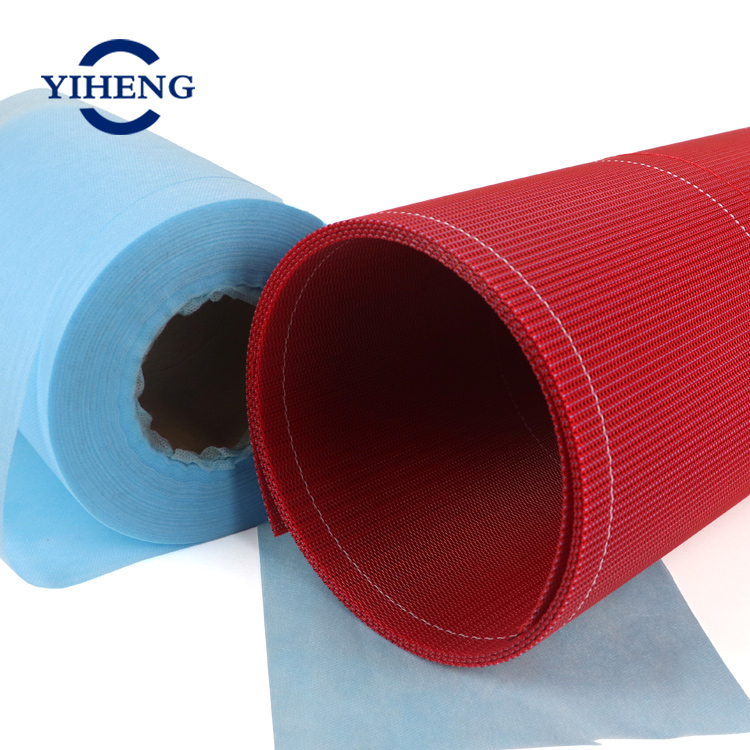
The buyer-relevant consequence is a service-interval argument, not a compliance argument. Yiheng states that its mesh belts typically last three to six months under standard operating conditions, with cleaning and tracking checks used to extend that interval. A belt that resists hydrolysis for longer reduces the number of replacements a line consumes per year, and therefore reduces the belt material scrapped and the changeover downtime absorbed during each replacement. That is a defensible resource-efficiency case. It is not an environmental certification, and it should not be written into a purchase order as one.
Acceptance criteria: converting documents into inspectable values
A document set protects the buyer only when the ordered product can be checked against stated numbers. The parameters below are drawn from Yiheng's model specifications and are precise enough to serve as incoming-inspection criteria, provided the test condition travels with the value.
| Parameter | Documented example | What to fix in the purchase order |
|---|---|---|
| Filament construction | HY408S: 0.50 mm red anti-hydrolysis warp; 0.70 mm red anti-hydrolysis, 0.35 mm black and 0.35 mm blue anti-hydrolysis weft. SK604: anti-hydrolysis PET round, conductive PET, carbon fibre PET | Name the filament types and diameters. Do not accept “anti-hydrolysis” as an unqualified adjective |
| Air permeability | HY408S 680±30 CFM; SK604 700±30 CFM; K6012 750±30 CFM; KJD700 600±30 CFM, measured at 127 Pa/20 cm² | State the value, the tolerance, the pressure differential and the measuring area; state that deviation applies across the full width |
| Thickness and weight | HY408S 1.85 mm / 1,100 g/m²; SK604 1.85 mm / 1,030 g/m²; K6012 2.8 mm / 1,200 g/m²; KJD700 2.34 mm / 1,030 g/m² | Set a measuring method and sampling position, including a separate seam check |
| Surface conductivity | HY408S 10⁵–10⁶ Ω; SK604 10⁶ Ω; KJD700 10³–10⁴ Ω | Specify the acceptable band, not a single point, and agree the measurement method in advance |
| Weave and layers | HY408S and SK604 above-3 below-5, 1.5 layers; K6012 above-6 below-6, 2.5 layers; KJD700 above-4 below-8, 1.5 layers | Record the structure so a substitution cannot happen silently |
| Joint and edge | HY408S millet-ring or double-pins; SK604 and KJD700 double-pins; 2 cm glue brushing on both welding edges for HY408S and KJD700; melt glue or AB glue for SK604 | Fix the joint type and edge treatment; seam thickness consistency is a quality criterion, not a preference |
| Dimensions | Length under 50 m: ±5 cm; width under 5 m: ±1 cm | Carry the tolerances into the order text and the inspection record |
Yiheng states that heat-setting keeps air-permeability fluctuation within ±5% — a manufacturer claim that becomes verifiable only when the buyer measures at the stated pressure differential rather than accepting the catalogue figure. That distinction between a stated control and a verified control is the whole point of writing acceptance criteria.
Purchasing terms: a clause checklist
Once the documents and parameters are separated, they can be turned into contract language. The following sequence is ordered from evidence to enforcement.
- Document schedule at quotation stage. Require the reference numbers, issuing bodies and dates for every document the supplier intends to rely on, plus a one-line statement of scope for each. A schedule that lists a registration number without its scope invites the packaging-versus-product confusion described above.
- Model designation and construction. Order by model (for example HY408S or SK604) and repeat the filament specification in the order text. Model names alone do not prevent a construction change between batches.
- Performance values with conditions. Air permeability at 127 Pa/20 cm², thickness, weight and conductivity band, each with tolerance and measuring method.
- Dimensional tolerances. ±5 cm on lengths under 50 m and ±1 cm on widths under 5 m, stated as acceptance limits rather than as nominal capability.
- Joint and edge specification. Joint type, edge treatment and a requirement that seam thickness is consistent with the belt body, since seam irregularity drives both fabric marking and vibration at speed.
- Application-linked documentation. If the belt touches food-contact material, reference the food-contact test report and confirm in writing that the ordered construction is within its scope. If the shipment enters Germany, confirm that the packaging actually used falls within the registered packaging scope.
- Change notification. Require written notice before any change to filament source, weave or joint process, because a document set does not automatically follow a construction change.
- Inspection and traceability. Confirm pre-shipment inspection arrangements and whether third-party on-site inspection is available for your order; record the inspection result against the agreed parameters.
Market context behind the documentation push
Documentation requirements rise with capacity and cross-border volume, and both are growing in this category. Dataintelo values the global nonwoven production line market at USD 5.3 billion in 2024 and projects USD 9.8 billion by 2033. Grand View Research places spunlaid technology — the spunbond and meltblown processes these belts serve — at 48.4% of the global nonwoven technology market in 2023. Smithers projects the nonwoven fabric market reaching USD 90.8 billion by 2030, a 6.2% CAGR from 2025. These are third-party estimates with different scopes; the production-line figure counts machinery and the fabric figure counts output, so they should not be combined.
Two practical consequences follow for buyers. First, more lines in more jurisdictions means more shipments crossing borders, and customs classification becomes part of the document pack: industrial nonwoven mesh belts are commonly classified under HS code 3926.90.29 or 5910.00.00 depending on material coating and reinforcement, so the product description on the invoice should be consistent with the classification your broker applies. Second, published performance references are rising with machine capability — one commercial source describes high-performance forming belts running at up to 1,000 m/min and withstanding up to 180°C — which makes filament-level specification, not a generic durability claim, the useful basis for comparison. Note that such figures are general market references, not a Yiheng model specification.
Limitations the buyer should keep in view
- Supplier-level is not lot-level. The INTERTEK assessment report 493944221_P+T covers a production and trading assessment valid to 2027-07-09; it does not certify the chemistry of an individual belt.
- Packaging registration is not product compliance. DE2857625357145 addresses packaging placed on the German market under the yiheng brand and nothing else.
- The food-contact report has a standard and a date. It was issued on 2023-06-29 against GB 4806.7-2016; whether that evidence satisfies a specific EU or member-state requirement depends on the application and remains the buyer's determination.
- Performance figures are nominal with tolerances. Field life depends on line speed, temperature, humidity, cleaning regime, tension and tracking; the stated three-to-six-month service expectation is a general operating figure, not a guaranteed interval for a specific line.
- Anti-hydrolysis is a material property. It supports service-life and scrap-reduction reasoning; it is not a recyclability, emissions or eco-label claim.
- No blanket claim is made. Yiheng does not present an EU-wide product certification, CE marking or environmental approval for these belts, and none should be inferred from the documents described here.
Outlook
As spunlaid capacity expands and more buyers source forming fabrics across borders, the expectation is that document schedules and model-level acceptance criteria become standard parts of the quotation rather than late-stage requests. That is a reasonable inference from the market data above, not a forecast of new regulation. For evaluating buyers, the practical move is to fix the document list, the parameter list and the change-notification clause before the first order — and to treat any supplier that answers a compliance question with a single unqualified sentence as an invitation to ask for the underlying paperwork.
Frequently asked questions
Does a nonwoven mesh belt require CE marking to be sold in the EU?
CE marking applies to product categories covered by specific EU harmonisation legislation, and it is the manufacturer's or importer's determination whether a given product falls inside such a category. Yiheng Mesh does not claim CE certification for its nonwoven mesh belts, and no CE mark should be expected on the documentation described in this article. Buyers should confirm applicability for their own product and use with their compliance function rather than relying on a supplier statement.
What exactly does the LUCID registration DE2857625357145 cover?
It is a registration under the German Packaging Act (VerpackungsG), issued on 2025-02-24 by Stiftung Zentrale Stelle Verpackungsregister. The stated scope is retail, grouped, shipment and service packaging placed on the German market under the yiheng brand. It concerns packaging responsibility and does not cover the belt's material composition, emissions or operating performance.
Is the food-contact test report valid for EU food-contact applications?
Report HAPTX23061098 was issued on 2023-06-29 by JIANGSU HAP TESTING SERVICE CO., LTD for a polyester mesh belt (food grade) against GB 4806.7-2016, a Chinese national standard for food-contact plastics. It documents testing of a polyester belt against that standard and is linked to models including SK604, HY4106, HY408S and K4106B. Whether it satisfies a specific EU or member-state food-contact requirement depends on the article, contact conditions and the buyer's own assessment, so it should be treated as supporting evidence rather than a substitute declaration.
How should hydrolysis resistance be written into a purchase order?
Specify it at filament level rather than as an adjective. A workable clause names the model and the construction — for example HY408S with 0.50 mm red anti-hydrolysis warp filaments and a hybrid weft of 0.70 mm red anti-hydrolysis, 0.35 mm black and 0.35 mm blue anti-hydrolysis — and pairs it with inspectable values such as 680±30 CFM at 127 Pa/20 cm², 1.85 mm thickness, 1,100 g/m² and 10⁵–10⁶ Ω conductivity. Add a change-notification requirement so a filament substitution cannot occur without written notice.
What does the INTERTEK report actually certify?
Report 493944221_P+T is an Alibaba.com Verified Supplier Assessment Report issued by INTERTEK, valid from 2026-07-09 to 2027-07-09, with a scope listing fabrics, dryer fabrics, polyester filter belt, non-woven mesh belt and UV belts. It is a supplier and production assessment. It does not certify material grade, hydrolysis resistance or environmental performance of an individual belt.
Documents, sources and further reading
Company information and model specifications are published by Henan Yiheng Mesh Belt Industry Co., Ltd. A downloadable company brochure covering the nonwoven mesh belt range is available here: Yiheng Mesh company brochure (PDF).
Third-party market references cited above: Dataintelo, nonwoven production line market report 2033; Grand View Research, nonwoven fabrics market report 2030; Smithers, the future of global nonwovens to 2030; Zauba, HS code classification data. All third-party figures retain their original scope and are not statements about Yiheng Mesh products.
Have Questions or Need More Details?
Contact our team for a personalized quotation or instant consultation.
Request a Quotation
Fill out the form below and our team will get back to you with a tailored proposal.
WhatsApp Direct Chat
Prefer to chat in real-time? Message us on WhatsApp for instant assistance & quick answers.
- Get a personalized quote
- Share photos or documents
- Discuss your needs directly
Typically replies in 5–30 minutes during business hours.