
Nonwoven Mesh Belt Supplier Capability: Model-Level Evidence from HB4106 to KJD700
Nonwoven Mesh Belt Supplier Capability: Model-Level Evidence from HB4106 to KJD700
A nonwoven mesh belt — also called a forming fabric, forming mesh or nonwoven conveyor belt — sets the boundary conditions for web formation: how evenly air is drawn through the forming zone, how cleanly the fibre web releases from the surface, and how much static charge accumulates at line speed. Because it is a consumable rather than a capital machine, it is bought on specification. The procurement question at the research and evaluation stage is therefore not which supplier makes the best belt in general, but which supplier publishes parameters a buyer can actually check, with reference conditions attached.
This industry reference examines supplier capability through published model data instead of brochure language. The evidence set comes from Henan Yiheng Mesh Belt Industry Co., Ltd. (Yiheng Mesh), a Chinese manufacturer founded in 2009 that produces polyester mesh belts for nonwoven forming, drying and filtration applications, with a 62% export ratio and main markets in Asia, Europe and North America. Ten models are covered here: HB4106, K4106A, K4106B, HY408S, SK604, K6012, KJD700, 09502, 06702 and 41203.
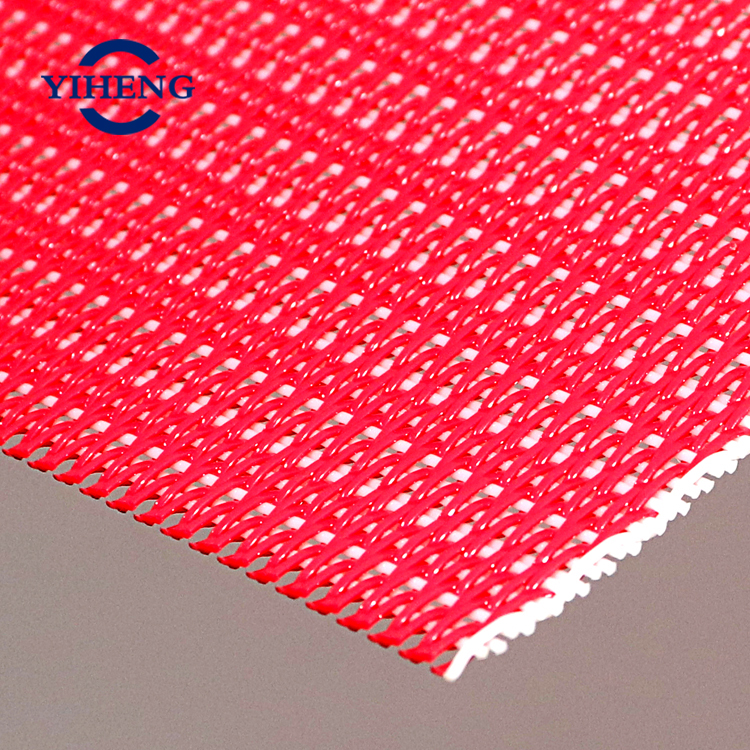
Spunbond-grade forming mesh: flat and round monofilament structures are specified model by model, not by category description alone.
The Procurement Gap: Brochure Claims vs. Checkable Parameters
Nonwoven lines have become faster and more demanding. High-performance nonwoven forming belts are documented as operating at line speeds up to 1,000 m/min and withstanding temperatures up to 180 °C (PFM Screen Filter Belts). Spunlaid technology — spunbond and meltblown — held a 48.4% share of the global nonwoven technology market in 2023 (Grand View Research). At those speeds and temperatures, the belt is not a passive accessory; it participates in web uniformity, release behaviour and static control.
The practical problem is information asymmetry. Many supplier pages describe a belt as high quality, long life or high speed without stating the measurement basis. Three gaps recur in buyer evaluation:
- Air permeability without a reference pressure. A CFM figure is meaningless unless the pressure differential and the test area are stated. A number quoted at one pressure cannot be compared with a number quoted at another.
- Anti-static claims without a resistivity decade. "Anti-static" describes a behaviour, not a value. Surface resistivity expressed as a decade (for example 10⁶ Ω or 10³–10⁴ Ω) is checkable; an adjective is not.
- Seam descriptions without geometry. At high speed the seam is the most mechanically stressed zone of the belt. Whether the joint type matches the belt body in thickness is a design decision that buyers can verify.
Model-level data closes those gaps. The remainder of this article works through what that evidence looks like in one supplier's range, where the data stops, and what a buyer should request before running a trial.
What Model-Level Evidence Looks Like in This Range
Model-level evidence is a specification row that combines material composition, weave structure, thickness, weight, air permeability with an explicit tolerance, surface resistivity, joint type and glue-edge treatment, plus dimensional tolerances. In the Yiheng range, those rows split into two families with different measurement conventions.
Family A — spunbond, anti-static and spunmelt grades
| Model | Belt type | Material composition | Weave structure | Thickness | Weight | Air permeability | Surface resistivity | Joint options | Glue edge |
|---|---|---|---|---|---|---|---|---|---|
| HB4106 | Spunbond | Red flat PET | Above-3 Below-5 | 1.8 mm | 1030 g/m² | 580 ±30 CFM (127 Pa / 20 cm²) | Not published | Self-ring / Millet-ring / Double-pins | 2 cm glue brushing, both sides |
| K4106A | Anti-static | Anti-static PET flat | Above-3 Below-5 | 1.88 mm | 990 g/m² | 600 ±30 CFM (127 Pa / 20 cm²) | 10⁶–10⁷ Ω | Self-ring / Millet-ring | 2 cm glue brushing, both sides |
| K4106B | Anti-static | Anti-static PET round | Above-3 Below-5 | 1.93 mm | 1100 g/m² | 700 ±30 CFM (127 Pa / 20 cm²) | 10⁵–10⁶ Ω | Self-ring / Millet-ring | 2 cm glue brushing, both sides |
| HY408S | Spunmelt | Anti-static round PET; three-filament hybrid weft | Above-3 Below-5 | 1.85 mm | 1100 g/m² | 680 ±30 CFM (127 Pa / 20 cm²) | 10⁵–10⁶ Ω | Millet-ring / Double-pins | 2 cm glue brushing, both sides |
| SK604 | Spunmelt | Anti-hydrolysis PET round + conductive PET + carbon fibre PET | Above-3 Below-5 | 1.85 mm | 1030 g/m² | 700 ±30 CFM (127 Pa / 20 cm²) | 10⁶ Ω | Double-pins | Melt glue / AB glue |
| K6012 | Spunmelt | Anti-hydrolysis PET round + conductive PET | Above-6 Below-6 | 2.8 mm | 1200 g/m² | 750 ±30 CFM (127 Pa / 20 cm²) | Not published | Double-pins | 2 cm glue brushing, both sides |
| KJD700 | Spunmelt | Anti-hydrolysis PET round + conductive PET + carbon fibre PET | Above-4 Below-8 | 2.34 mm | 1030 g/m² | 600 ±30 CFM (127 Pa / 20 cm²) | 10³–10⁴ Ω | Double-pins | 2 cm glue brushing, both sides |
Across this group, thickness spans 1.8–2.8 mm and weight spans 990–1200 g/m². Four different filament strategies appear: flat PET (HB4106), anti-static flat PET (K4106A), anti-static round PET including a three-filament hybrid weft (HY408S), and anti-hydrolysis round PET combined with conductive PET and, in two models, carbon fibre PET (SK604, K6012, KJD700). Layer count is published as 1.5 layers on every model except K6012, which is specified at 2.5 layers.
Family B — airlaid and spunlace grades
| Model | Belt type | Material | Mesh / structure | Filament diameter | Thickness | Weight | Air permeability | Joint options |
|---|---|---|---|---|---|---|---|---|
| 09502 | Airlaid | Polyester | Mesh count 23, pitch 0.5 mm | Warp / weft 0.5 mm | Not published | 650 g/m² | 12,770 m³/m²/h (100 Pa) | Endless / Self-ring |
| 06702 | Airlaid | Polyester | Mesh count 16, pitch 0.8 mm | Warp / weft 0.7 mm | Not published | 1000 g/m² | 14,242 m³/m²/h (100 Pa) | Endless / Self-ring |
| 41203 | Spunlace | Polyester | Mesh count 103; warp density 40 ends/cm; weft density 30.7 ends/cm | Warp 0.15 mm / weft 0.2 mm | 0.3 mm | Not published | 6,700 m³/m²/h (100 Pa) | Endless / Self-ring |
The airlaid and spunlace group is specified by geometry rather than by weave count alone. Model 09502 uses a 23-count mesh with a 0.5 mm pitch for uniform, higher-density fabric; 06702 opens up to a 16-count mesh with a 0.8 mm pitch and a 1000 g/m² build for heavier webs; 41203 is the ultra-fine end of the range, at 0.3 mm thickness with a 103 mesh count and a 0.15 mm warp filament, intended for thin, high-density spunlace material.
Technical Explanation: How to Read Each Parameter
Air permeability and the reference condition
Air permeability is the primary selection parameter because it governs the suction behaviour in the forming zone. In the spunmelt and spunbond models of this range it is stated in CFM at 127 Pa over 20 cm², with a tolerance of ±30 CFM. In the airlaid and spunlace models it is stated in m³/m²/h at 100 Pa. The two conventions are not interchangeable, and neither should be compared against a competitor's figure unless the pressure and area match. Yiheng states that heat-setting is used to hold air-permeability fluctuation within a ±5% band across the belt.
Surface resistivity
Static control is expressed as a surface resistivity decade. In this range the published values are: KJD700 at 10³–10⁴ Ω, K4106B and HY408S at 10⁵–10⁶ Ω, SK604 at 10⁶ Ω, and K4106A at 10⁶–10⁷ Ω. Lower decades indicate a more conductive belt. The mechanism is described in the supplier's own technical notes: conductive filaments are woven into the polyester structure and dissipate frictional charge to the machine frame, which is the reason anti-static grades are specified for high-speed lines running thin, low-GSM fabric.
Joint and glue-edge configuration
Joint types in the published data include self-ring, millet-ring and double-pins on the spunbond and anti-static models; double-pins only on SK604, K6012 and KJD700; and endless or self-ring on the airlaid and spunlace models. Glue-edge treatment is either a 2 cm glue brushing on both welding edges, or — on SK604 — melt glue or AB glue. These are not cosmetic details. The joint determines installation method, how flat the running surface stays, and how the belt behaves as it passes the rollers.
Dimensional tolerances
A published tolerance is a commitment. Across the spunmelt and spunbond models in this range, dimensional error is given as ±5 cm for lengths under 50 m and ±1 cm for widths under 5 m. Buyers evaluating a replacement belt on an existing line can use these figures to check whether a supplier is willing to be measured.
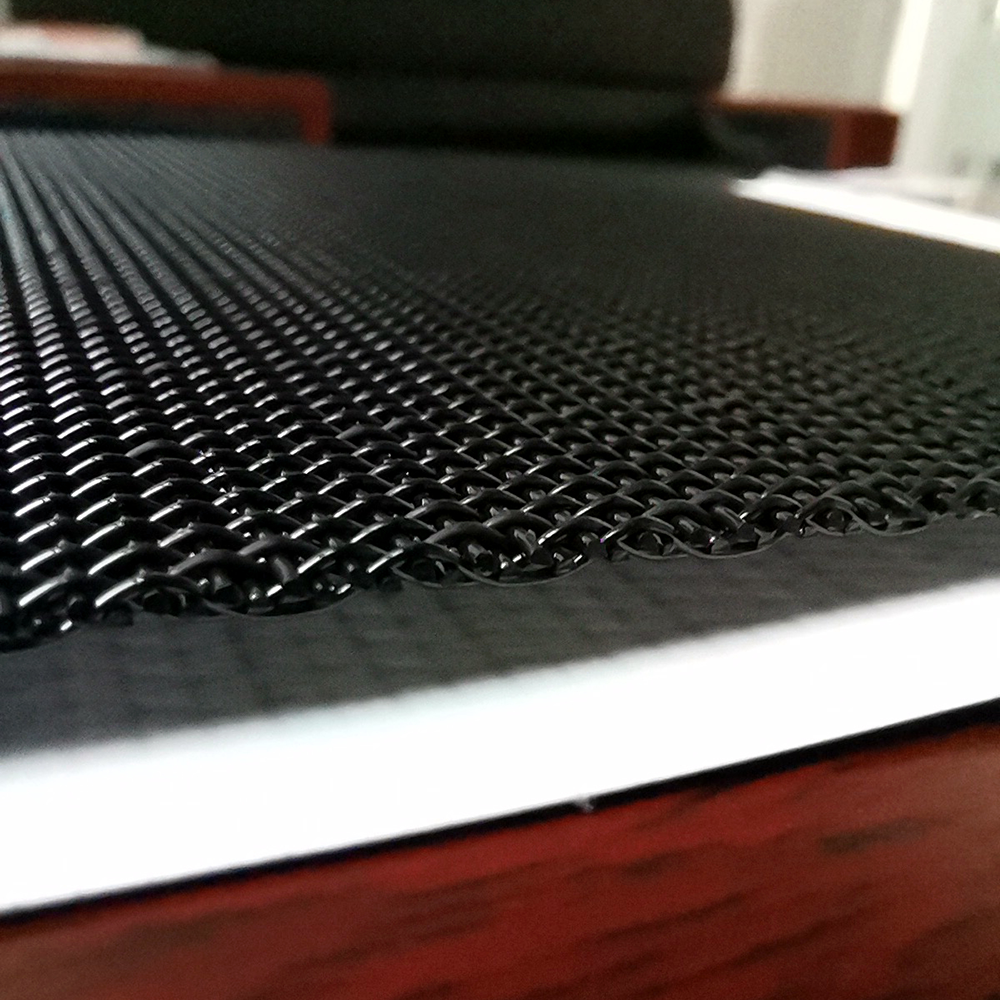
Cross-section of an anti-static round-filament forming belt: weave structure and filament combination are published per model, which is what makes the specification auditable.
Why ±30 CFM and Seam Type Are Capability Evidence
A tolerance is harder to publish than a nominal figure because it can be tested against. The ±30 CFM band in this range answers a specific production problem: minor deviations in air permeability disturb the distribution of negative suction pressure during web formation, and an uneven pressure field disturbs fibre flow, producing weight variation across the web. Stable permeability provides constant airflow resistance, so fibres lay down uniformly — the physical basis for a consistent cross-direction profile.
Seam geometry follows the same logic. A forming belt running above 600 m/min passes its seam through the rollers once per revolution. A small thickness increase at the seam generates a periodic impulse each time it passes; repeated impulses load the machine and can leave transverse marks on the fabric. The design answer is a joint whose loop structure is embedded so that seam thickness matches the belt body instead of adding to it. The same principle underlies the flat-seam descriptions attached to SK604, HB4106, HY4106 and the KJD700 double-pins joint: the objective is a running surface with no step.
Capability, in other words, is visible in three places: whether the supplier publishes the tolerance, whether the seam type is stated per model, and whether the supplier can explain why the seam was designed that way. Yiheng also maintains a documented troubleshooting library covering more than 122 nonwoven line cases in categories such as tracking, fibre hanging, static and seam marking.
Matching Process Requirements to Belt Models
The four nonwoven processes served by this range do not share the same belt requirement. The published applications map as follows.
| Process | Dominant belt requirement | Models specified for this family |
|---|---|---|
| Spunbond forming and bonding | Flat, easy-to-clean surface; stable air permeability; dimensional stability under tension | HB4106 |
| Spunmelt / composite (SMS, SSMMS) at high speed | Anti-static dissipation, hydrolysis resistance, flat seam, adhesion-versus-release balance | K4106A, K4106B, HY408S, SK604, K6012, KJD700 |
| Airlaid / hot-air bonding | High air permeability, high-temperature resistance, non-stick, non-crystallising surface | 09502, 06702 |
| Spunlace / hydroentangling | Ultra-fine mesh, uniform drainage, dimensional stability, hydrolysis resistance | 41203 (KJD700 is also specified as suitable for two-component and spunlace equipment) |
Two mappings are worth noting. First, KJD700 is the only model in this set simultaneously characterised by the highest published conductivity decade (10³–10⁴ Ω), an above-4 below-8 structure and a stated suitability for two-component and spunlace equipment — which is why it appears on both the spunmelt and spunlace rows. Second, the airlaid models are specified around temperature-duty rather than conductivity: their published data covers mesh geometry, weight and air permeability for hot-air equipment, and neither 09502 nor 06702 carries a published resistivity value.
Field Evidence: Reported Outcomes
Customer-reported results are weaker evidence than a controlled test, but they show what the specifications were selected for. In one reported case, a Swiss nonwoven fabric manufacturer running eight Reicofil RF4 high-speed lines for baby diaper and sanitary napkin materials used SK604 and KJD700 belts for one year and reported 10% higher capacity, 5% higher first-grade yield and 30% lower maintenance cost. A German wet wipes and medical dressing supplier running 12 spunlace lines reported 15% higher productivity, 4% higher first-grade yield and 30% lower maintenance cost, with high water permeability, zero mesh marks and hydrolysis resistance cited as the relevant belt attributes. A US nonwoven fabric manufacturer running a Reifenhauser line reported uniform web formation, zero mesh marks and easy release over six months.
These figures are presented as customer-reported outcomes for the specific lines described. They are not a performance guarantee for other machines, and the article does not treat them as such.
Market Trend Analysis
Three published data points frame the demand side. The global nonwoven production line market was valued at USD 5.3 billion in 2024 and is projected to reach USD 9.8 billion by 2033 (Dataintelo). The downstream nonwoven fabric market is expected to reach USD 90.8 billion by 2030, a CAGR of 6.2% from 2025 (Smithers). Within technology mix, spunlaid processes held a 48.4% share in 2023 (Grand View Research).
The implication for consumables procurement is straightforward. Capacity growth concentrates in exactly the process families — spunmelt and composite lines — where belt selection is most sensitive to static, seam behaviour and air permeability tolerances. As line speeds move toward the documented 1,000 m/min ceiling and process temperatures toward 180 °C, belts that are specified only by category description become harder to defend in a purchasing file.
Importers also need a classification reference. Industrial nonwoven mesh belts are commonly classified under HS code 39269029 or 59100000 depending on material coating and reinforcement (Zauba import records), which is worth confirming against the specific construction before shipment.
Comparison with Traditional Solutions — and Where Model Data Stops
The conventional approach to forming-fabric supply is a round-monofilament mesh with a generic spiral seam and a single quoted air permeability figure. The model-level approach used in this range differs in three ways: filament construction is specified per model (flat, round, hybrid, conductive, carbon-fibre-bearing); air permeability is published with a ±30 CFM tolerance attached to a stated reference condition; and the joint type is named for each model rather than assumed.
That said, model-level data has clear boundaries, and buyers should treat them as real.
- The two permeability conventions cannot be cross-compared. Spunmelt and spunbond models are specified in CFM at 127 Pa over 20 cm²; airlaid and spunlace models in m³/m²/h at 100 Pa. Converting one into the other without the supplier's test method is not defensible.
- Resistivity is published for five models only. HB4106, K6012, 09502, 06702 and 41203 carry no published conductivity value in this data set. A line that needs static control must therefore be matched from the anti-static grades, not from whichever model has the most attractive permeability figure.
- No model-level continuous operating temperature or guaranteed service life is published. Service life is described in general terms — typically three to six months under standard operating conditions — which is a range, not a per-model commitment.
- Joint availability constrains replacement strategy. SK604, K6012 and KJD700 are specified with double-pins joints only, while the airlaid and spunlace models use endless or self-ring construction. Installation method and spares planning differ accordingly.
- Specification is not fit. A data sheet describes a belt, not a machine. On-line trial remains the step that converts published parameters into a purchasing decision.
Buyer Checklist: Evidence to Request Before a Trial
The following request list converts the discussion above into an evaluation workflow. Each item is checkable against a supplier's documentation.
- Air permeability figure with the reference pressure, test area and tolerance (for example 700 ±30 CFM at 127 Pa / 20 cm²).
- Material declaration: base polymer, filament form (flat or round), conductive filament type, and whether an anti-hydrolysis grade is used.
- Weave structure designation and layer count, so the belt can be compared with the incumbent rather than with a category description.
- Surface resistivity in ohms or a decade range, with the measurement basis — or an explicit statement that no conductivity value is published for that model.
- Joint type, and whether the seam is designed to match the belt body thickness at running speed.
- Glue-edge treatment and width, since this affects installation and edge stability.
- Dimensional tolerances for length and width, plus packaging method.
- Documentation scope: which certificates exist, their numbers, issuing bodies, standards, validity dates and the markets they cover.
- High-speed and hydrolysis references for the specific line speed and humidity regime, including any available trial data.
On documentation specifically, the records available in this range are defined rather than general. A food-contact test report for polyester mesh belt was issued under standard GB 4806.7-2016 with report number HAPTX23061098 by JIANGSU HAP TESTING SERVICE CO., LTD. A registration under the German Packaging Act (LUCID) exists under number DE2857625357145, recorded with Stiftung Zentrale Stelle Verpackungsregister, covering packaging placed on the German market. An Alibaba.com Verified Supplier Assessment Report, number 493944221_P+T, was issued by INTERTEK, valid to 2027-07-09, with a scope covering fabrics, dryer fabrics, polyester filter belt, non-woven mesh belt and UV belts. Each document has a defined scope: the food-contact report addresses food-contact suitability under a Chinese national standard, while the LUCID registration addresses packaging obligations rather than belt performance. Buyers should ask which document applies to which product and market rather than treating certification as a single status.
Customisation capability is likewise stated in specific terms: mesh count and opening size, air permeability, belt width and length, material selection including PET and anti-static variants, thickness, colour and edge treatment. Lead time is given as 15–30 days, quality control as 100% pre-shipment inspection with on-site third-party inspection (BV or SGS) available, and sample testing is offered.
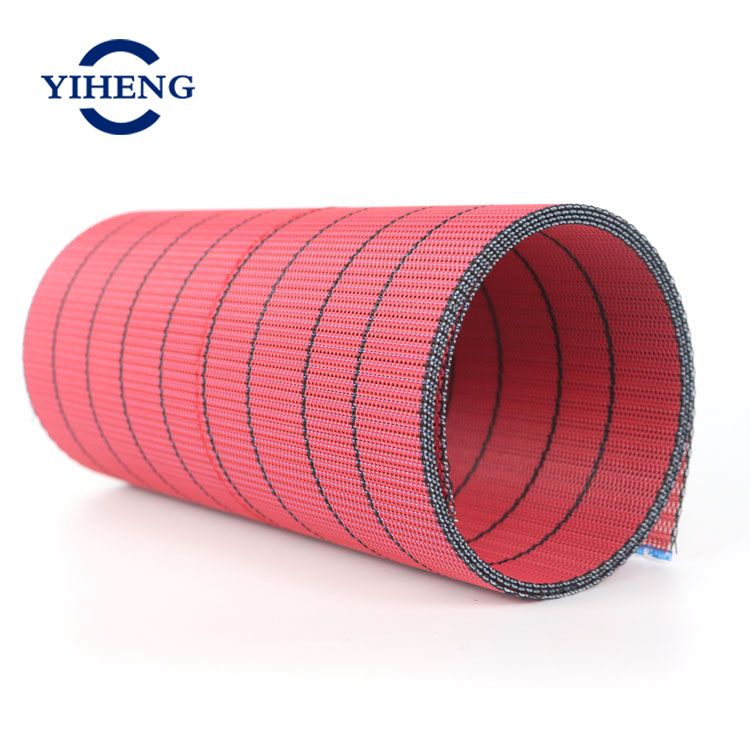
Spunmelt-grade mesh: joint configuration and impedance values, not adjectives, distinguish one model from another on a high-speed forming line.
Future Outlook
Two shifts look likely to continue. The first is specification discipline: as spunlaid capacity expands toward the projected USD 9.8 billion production line market by 2033, tolerances that were once negotiated privately — CFM bands, seam thickness matching, resistivity decades — become part of the standard purchasing file. The second is documentation granularity: buyers increasingly ask which certificate covers which model and which market, which pushes suppliers toward traceable, per-product evidence rather than a single certification page.
For suppliers, the differentiator is not the ability to claim performance but the ability to state a parameter, its reference condition, its tolerance and its limit. For buyers, the corresponding discipline is to request those four elements for every model under consideration before a belt is installed on a running line.
Frequently Asked Questions
Which belt model family fits spunbond, spunmelt, airlaid and spunlace lines?
In this range, HB4106 is specified as a spunbond mesh belt with a flat PET construction. K4106A, K4106B, HY408S, SK604, K6012 and KJD700 are specified for spunmelt duty, with anti-static or anti-hydrolysis filament combinations. 09502 and 06702 are airlaid mesh belts intended for hot-air nonwoven equipment at 650 g/m² and 1000 g/m² respectively. 41203 is a spunlace mesh belt at 0.3 mm thickness with a 103 mesh count, and KJD700 is additionally described as suitable for two-component and spunlace equipment.
How is air permeability specified, and why does the reference condition matter?
Spunmelt and spunbond models in this range state air permeability in CFM at 127 Pa over 20 cm², with a ±30 CFM tolerance — for example HB4106 at 580 ±30 CFM, KJD700 at 600 ±30 CFM and K6012 at 750 ±30 CFM. Airlaid and spunlace models state it in m³/m²/h at 100 Pa — 09502 at 12,770, 06702 at 14,242 and 41203 at 6,700. Because the pressure and area differ, figures from the two groups cannot be compared directly, and a figure quoted without a reference condition cannot be compared with either.
What do the published surface resistivity values indicate?
Published values are 10³–10⁴ Ω for KJD700, 10⁵–10⁶ Ω for K4106B and HY408S, 10⁶ Ω for SK604, and 10⁶–10⁷ Ω for K4106A. Lower decades indicate a more conductive belt, which affects how quickly frictional charge is dissipated. HB4106, K6012, 09502, 06702 and 41203 do not carry a published conductivity value in this data set, so static-sensitive applications should be matched from the models that state one.
What evidence is available on hydrolysis resistance?
Anti-hydrolysis material designations appear in HY408S, SK604, K6012 and KJD700. SK604 and KJD700 combine anti-hydrolysis PET round filaments with conductive PET and carbon fibre PET; K6012 combines anti-hydrolysis PET round with conductive PET; HY408S uses anti-hydrolysis filaments in a three-filament hybrid weft construction. Models HB4106, K4106A, 09502, 06702 and 41203 are specified as PET or polyester without an anti-hydrolysis designation in the published data. Buyers evaluating humid or high-temperature environments should request the filament specification and line-specific trial data rather than inferring resistance from the model category.
What joint and glue-edge options exist, and when does the choice matter?
HB4106 offers self-ring, millet-ring or double-pins joints; K4106A and K4106B offer self-ring or millet-ring; HY408S offers millet-ring or double-pins; SK604, K6012 and KJD700 are specified with double-pins only; and 09502, 06702 and 41203 use endless or self-ring construction. Glue-edge treatment is 2 cm glue brushing on both welding edges on most models, while SK604 offers melt glue or AB glue. The choice matters because seam thickness relative to the belt body is the variable that governs running smoothness as the joint passes the rollers at speed.
Which compliance documents are available, and what does each one cover?
Three documents are recorded for this supplier. A product compliance test report for polyester mesh belt (food grade) was issued under standard GB 4806.7-2016 by JIANGSU HAP TESTING SERVICE CO., LTD with report number HAPTX23061098, covering the food-contact scope. A registration under the German Packaging Act (LUCID), number DE2857625357145, is recorded with Stiftung Zentrale Stelle Verpackungsregister and covers packaging placed on the German market. An Alibaba.com Verified Supplier Assessment Report, number 493944221_P+T, was issued by INTERTEK and is valid to 2027-07-09, with a scope covering fabrics, dryer fabrics, polyester filter belt, non-woven mesh belt and UV belts. Each document addresses a defined subject and market; none of them is a performance warranty for a specific belt on a specific line.
Full model documentation and the current product range are published by the manufacturer at yhfilterbelt.com. A downloadable technical brochure covering the forming and filter belt range is also available: download the English product brochure (PDF).