
Nordic Style Bathroom Cabinets: What Buyers Must Verify
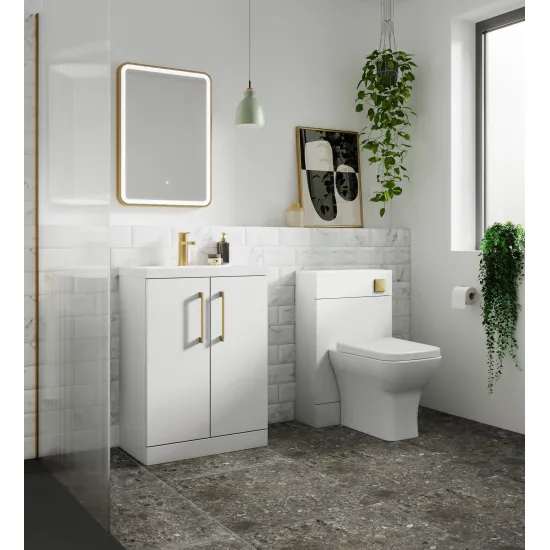
A complete bathroom furniture set normally combines a wash basin cabinet, a mirror or mirror cabinet with an anti-fog mirror lamp, and shower partitioning specified for the same room.
A Nordic style bathroom cabinet is a light-toned, matte-finished vanity unit designed to sit inside a wider bathroom furniture set rather than as a standalone piece. In European specification practice that set usually contains a bathroom wash basin cabinet, a mirror cabinet or LED mirror with an anti-fog lamp, and some form of shower partitioning. The style brief is the simple part. The procurement work sits in the dimensions, the material behaviour in a humid room, the certificate scope and the order parameters — and those are the constraints this reference sets out.
Where the Nordic brief meets real bathroom conditions
A bathroom cabinet is never used in a dry room. In the residential working conditions typical of the UK, Ireland, France, Belgium, the Netherlands, Luxembourg and Germany, a bathroom cabinet sits in continuous ambient high humidity with intermittent water splashing at the wash area; an LED mirror lamp in the same room runs from a mains supply in a splash-prone zone; and the shower enclosure is exposed to hot water spray. The functional requirements that follow are consistent across the set: moisture- and water-resistant cabinet panels, surfaces that tolerate cleaning agents, mildew-resistant cabinet interiors, moisture- and fog-resistant mirror lighting, and waterproof sealing with safety glass in the shower zone.
Against those conditions, a pale matte finish is more than a colour decision. A painted surface on a wood-based panel, the way its edges are treated, and the hardware that carries a mirrored door determine whether a Nordic style bathroom cabinet still performs as specified after several years of heating and showering cycles.
The gap between a Nordic look and a Nordic specification
Light-toned cabinetry is easy to copy cosmetically. Moisture behaviour is not. That gap is where most buyer risk in this category sits, and it produces two practical consequences for anyone at the research or evaluation stage.
First, a number of the complaints that reach suppliers after installation are installation-related by definition. Mildew and swelling at cabinet cut-out edges arise when cut edges are not waterproof-sealed after on-site cutting — sealing of cut edges belongs to site installation work, and mildew at unsealed edges is not a factory product defect. A drawer that sticks and will not close fully is usually recoverable by pulling the drawer fully out, cleaning debris out of the runner and re-engaging the drawer until it clicks home, rather than replacing the whole drawer assembly. Poor door closure and offset gaps are normally resolved by tightening the mirror-door reinforcing screws and calibrating the hinge before any cabinet replacement is considered.
Second, the reason those adjustments exist is tolerance. Wall-mount installation brings minor assembly deviation from drilling and bracket fitting, and dual-direction hinges correct horizontal and vertical position separately — which is also why uneven door gaps usually trace back to construction tolerance rather than to a manufacturing defect. A mirrored door made of toughened glass weighs considerably more than a plain wooden door, so dedicated reinforcing fasteners are required to hold connection strength under repeated opening and closing, consistent with the component-strength expectation behind EN 14749.
The buyer-side opportunity is straightforward: turn these behaviours into written requirements before the order — sealed cut edges, correct fasteners for mirrored doors, and a named party responsible for each installation step.
Cabinet configuration: floor-standing and wall-mounted formats
PTB Technical Sanitary Ware (Jiangsu) Co., Ltd. is a bathroom sanitary ware manufacturer based in Dagong Town, Hai'an City, Nantong, Jiangsu Province, China, producing bathroom cabinets, shower enclosures and LED mirrors, with operations relocated to its current 33,000 m² plant in 2018 and roughly 95% of output exported to Western European markets including the United Kingdom, France and Ireland. Its Classique range covers the floor-standing format of the Nordic-leaning brief.
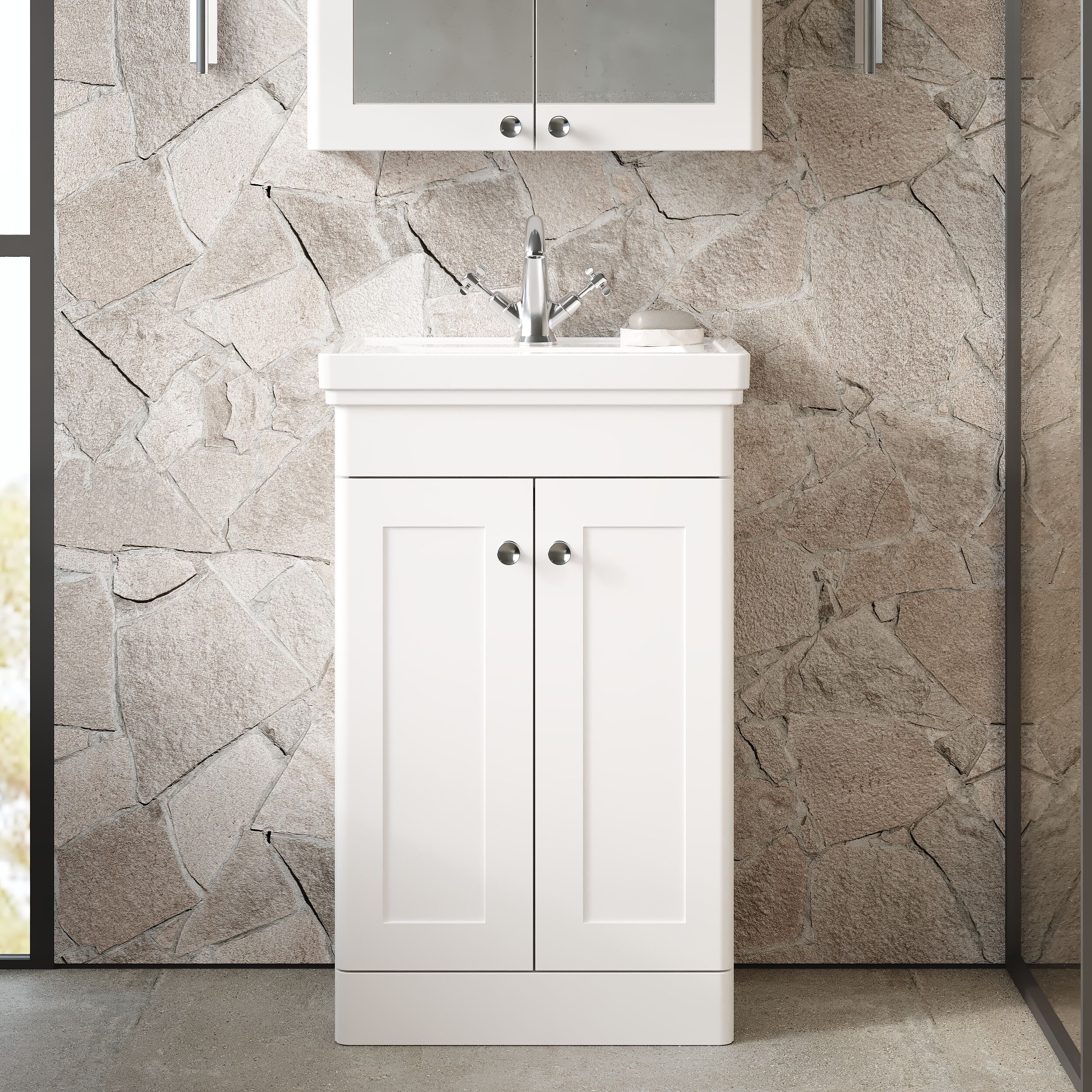
Bathroom cabinet CLA123 — a 500 mm floor-standing vanity unit in MDF with a painted matt Satin White finish, two hinged soft-close doors and one internal shelf.
| Specification | Bathroom cabinet CLA123 (Classique range) |
|---|---|
| Mount type | Floor-standing |
| Dimensions | 500 mm width × 390 mm depth × 800 mm height |
| Product weight | 21 kg |
| Material | MDF with painted matt finish (Satin White) |
| Panel thickness | 16 mm cabinet, 18 mm fascia |
| Doors and shelving | 2 hinged soft-close doors, 1 shelf, knob handle |
| Construction | Rigid; cam and wood dowel joint |
| Supplied with | Fixings included, handle included, no assembly required |
| Not included | Worktop and basin sold separately; tap and waste sold separately |
| Guarantee | 5-year manufacturer guarantee |
The configuration choice changes the load path, not only the look. A floor-standing unit such as CLA123 carries its 21 kg through the floor. A wall-hung or wall-mounted cabinet transfers that load into the wall instead, so wall load-bearing capacity has to be verified before mounting, and the wall fixings are not supplied with the cabinet. Practical guidance for wall-mounted formats also includes removing the drawer box before lifting the cabinet into position to reduce weight, and sealing every cut edge for water resistance.
Format preference is moving. Grand View Research projects wall-mounted and floating vanity units to grow at a CAGR of 7.26% through 2031 in the US market — a regional signal rather than a global one, but an indication that buyers will increasingly be asked to quote both a floor-standing and a wall-hung version of the same family for one project.
Mirror cabinets and anti-fog mirror lamps: the compliance-heavy component
In many bathroom furniture set specifications the mirror is treated as an accessory. In practice it carries the most electrical and certification content, which is why it deserves its own line in the evaluation checklist.
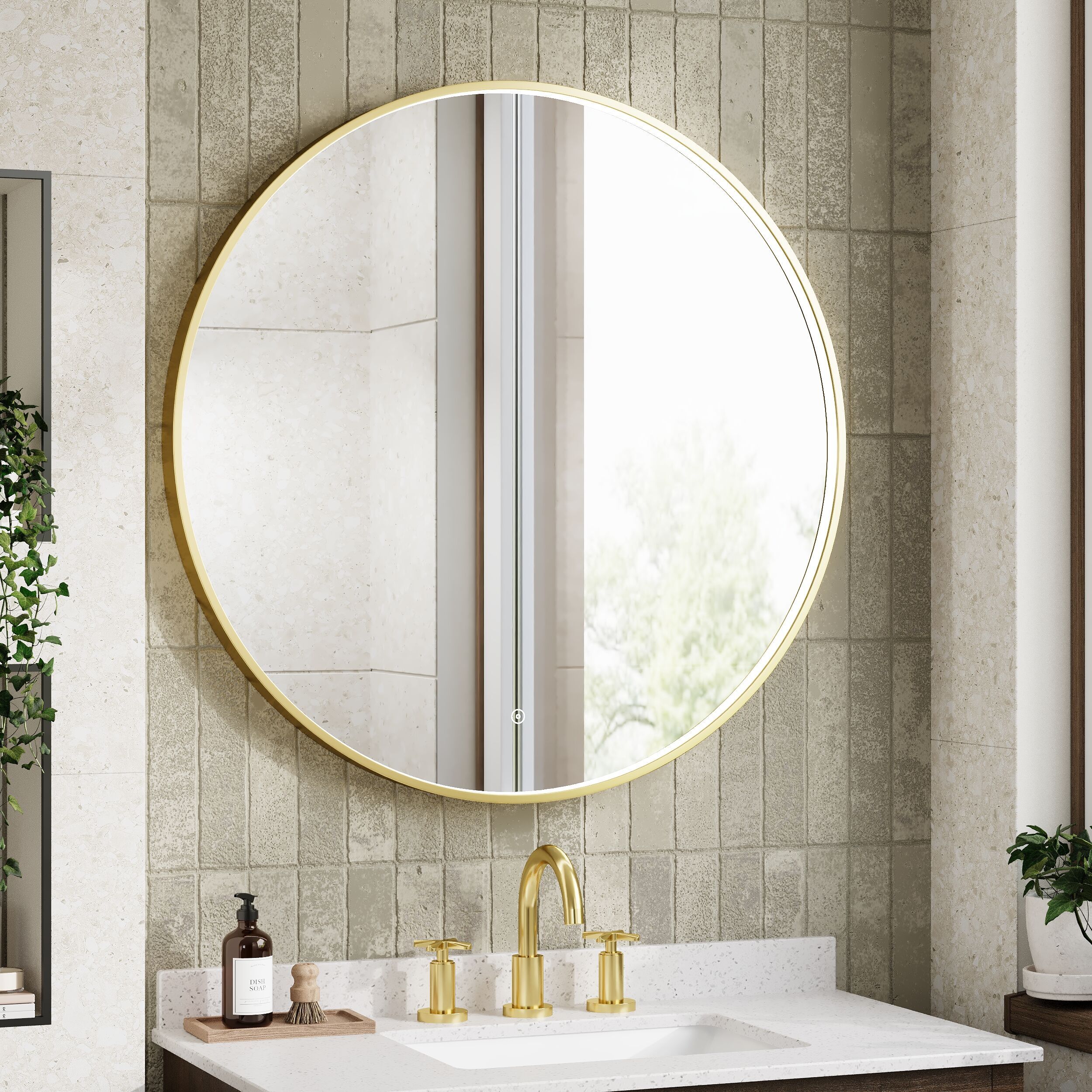
LED mirror LQ752 — 800 × 800 mm round portrait mirror with a brushed brass inset frame, aluminium body, demister pad and touch sensor, rated IP44.
PTB's LED mirror LQ752 is an 800 × 800 mm brushed brass inset frame LED mirror with a round portrait orientation, an aluminium body, 47 mm depth and a 6.5 kg weight. It uses two 21 W LEDs at 6000K, is mains powered, and mounts to the wall or surface. Its functional features are a demister pad and a touch sensor; the mirror uses film-backed glass for added safety and is rated IP44 for splash protection.
- Certification: CE plus EMC, LVD, RoHS and WEEE certification are recorded for the LED mirror, with a UKCA Attestation of Conformity for the UK market issued by TUV on 16 December 2025 under certificate No. E8AUK 113019 0004 Rev. 01, covering LED mirror and LED mirror cabinet against EN IEC 55015:2019/A11:2020, EN IEC 61547:2023, EN IEC 61000-3-2:2019/A2:2024 and EN 61000-3-3:2013/A2:2021. The corresponding CE Attestation of Conformity is No. E8A 113019 0003 Rev. 01, also issued by TUV.
- Control logic: the demister pad activates together with the mirror light rather than through an independent switch, which removes the dry-heating risk created when a separate demister switch is left on.
- Rating boundary: IP44 protection is intended for Bathroom Zone 2 and outside zones only. An IP20 luminaire is not acceptable in the same position, because water vapour and splash can penetrate the enclosure and degrade insulation under EN 60529.
- Installation constraint: wiring must be completed by a qualified electrician in line with IEE wiring rules and bathroom zoning, with the mains isolated before wiring and reliable earthing confirmed. Portrait and landscape orientation are both supported, with bracket drilling following the back-plate spacing.
- Guarantee: 1-year manufacturer guarantee — shorter than the 5-year cabinet guarantee and the lifetime shower enclosure guarantee, a difference worth carrying into the project warranty schedule.
Two service notes are worth passing to end users. Touch-sensor unresponsiveness is frequently caused by heavy water residue or dense mist over the touch area rather than a failed module, and wiping the surface restores operation. Where the lighting still works but the demister pad does not heat, the pad can be replaced separately under warranty. Daily cleaning should use a soft damp cloth only; strong acidic or alkaline detergents are unsuitable for the coated surfaces.
Shower partitioning inside the same set
Dry-wet separation is usually the largest single item in a bathroom furniture set, and the one where configuration, geometry and glass standard interact most tightly. PTB supplies the shower enclosure AQU9-E6, a 900 mm chrome quadrant enclosure with a square T-shape handle, 880 mm depth, 880 mm width, 1850 mm height and a 538 mm radius. It uses 6 mm toughened glass in a framed aluminium construction with two sliding doors and dual quick-release wheels; wall adjustment runs from 860 mm to 880 mm, and the product carries CE marking with a lifetime manufacturer guarantee.
Configuration language in this category is broader than a single model. Corner installations commonly use quadrant or curved enclosures, while straight-wall positions more often take hinged or sliding doors, and folding doors appear where door-swing clearance is very limited. Frame material matters for corrosion resistance, which is why aluminium alloy frames and hardware are specified for wet zones, and glass specification is non-negotiable: under EN 12150-1, toughened safety glass breaks into blunt granules rather than the sharp large fragments produced by ordinary glass.
Three installation rules recur in supplier guidance and belong in the site method statement. The shower tray must be level before anything is fixed. Silicone sealant should be applied on the exterior side only — sealing the inner side traps water, blocks drainage and accelerates seal failure. And adjustable top rollers exist because building work always introduces tolerance in wall plumbness and tray level; they allow the door to be fine-tuned on site for even gaps and a clean seal, consistent with the expectations associated with EN 14428. Wall plugs and fixing screws are not supplied with the enclosure, so fixings must be selected for the actual wall build-up.
Certification constraints that decide market access
For a Nordic style bathroom cabinet destined for the UK or EU, certification is a scope question before it is a marketing claim. Each document covers a defined product boundary, and no single certificate validates an entire bathroom furniture set.
| Certificate | Issuing body / number | Scope and validity |
|---|---|---|
| ISO 9001:2015 quality management system | China Quality Certification Center, No. 00125Q39056R1M/3200 | Production of shower rooms and bathroom cabinets; recorded validity 12 December 2025 to 13 December 2028 |
| UKCA Attestation of Conformity | TUV, No. E8AUK 113019 0004 Rev. 01 | LED mirror and LED mirror cabinet for the UK market; issued 16 December 2025 |
| CE Attestation of Conformity | TUV, No. E8A 113019 0003 Rev. 01 | LED mirror for the European market |
| FSC-COC chain of custody | SGS Hong Kong Limited, SGSHK-COC-320595 | Purchasing, manufacturing and sales of FSC-certified MDF/HDF bathroom cabinet, toilet seat and furniture parts; recorded validity 4 July 2024 to 3 July 2029, against FSC-STD-40-004 V3-1 and FSC-STD-50-001 |
Read together, the scopes say something specific. The UKCA and CE attestations address the electrical mirror, not the cabinetry. The FSC-COC certificate addresses the wood-based panel content of the MDF/HDF bathroom cabinet, toilet seat and furniture parts. The ISO 9001:2015 certificate covers the quality management system behind the production of shower rooms and bathroom cabinets. A buyer assembling a full set therefore has to reconcile several documents against the actual bill of materials rather than accept one certificate as blanket coverage. At company level, PTB additionally holds WRAS water approval, EU CE safety certification, FSC forest sustainability certification, AEO advanced certification, ISO 9001, British SEDEX advanced certification and Grade III work safety standardisation certification, and passed an IKEA factory audit in 2023 — buyers comparing suppliers should ask which of these apply to the exact models being quoted.
A useful external checklist exists in GB 24977-2010, the Chinese bathroom furniture standard, whose reproduced text sets out classification, requirements, test methods, inspection, marking, packaging, transport, storage and use instructions for furniture used in toilets and bathrooms. Its clauses translate well into RFQ language: accessible parts and accessories must have no burrs, sharp ends, sharp edges or sharp corners; opening and closing components must operate smoothly after installation; and there must be no seepage or water leakage under normal use. One caution — the current official status of that standard version should be confirmed with the standards database before it is written into a contract.
Trade classification adds a second constraint. Bathroom furniture, mirrors, lighting, glass shower enclosures and plastic sanitary ware do not all fall under one HS code; furniture sits under HS 94 and plastic sanitary ware including baths, shower-baths, sinks and wash-basins under HS 3922. Product-by-product classification should be settled before import markets, tariffs or unit values are compared.
Order parameters: MOQ, lead time and customisation
| Parameter | Recorded specification |
|---|---|
| Production mode | OEM / ODM |
| Customisation | Style, logo and colours |
| Monthly capacity | Bathroom cabinet 30,000 units; shower enclosure 30,000 units; LED mirror lamp 3,000 units |
| Lead time | 30–45 days |
| Minimum order quantity | 30 units |
| Quality control | 100% test |
| Export markets | EU |
| After-sales | Remote support |
Two commercial details affect project planning more than they look. First, monthly capacity for LED mirror lamps at 3,000 units is an order of magnitude below cabinet and enclosure capacity, so mirror requirements should be released early in a mixed container plan. Second, sample terms carry cost: sample orders are accepted for quality testing and marketing, mixed samples are acceptable, but samples are not supplied free of charge and the buyer bears the freight.
Market trend analysis
Grand View Research valued the global bathroom furniture market at USD 135.9 billion in 2024 and estimated it would reach USD 148.9 billion by 2026, with bathroom cabinets accounting for approximately 50% of segment share in 2023. Separately, Next Move Strategy Consulting valued the global shower enclosure and cubicles market at USD 3.51 billion in 2023, forecast to reach USD 5.38 billion by 2030.
Those two figures should not be added, compared, or used to size the same opportunity. They cover different sub-sectors — cabinetry, vanities and storage on one side, shower enclosures and cubicles on the other — and the definitions diverge further once ceramic sanitary ware is included or excluded. The practical takeaway is structural rather than arithmetic: cabinetry remains the largest component of a bathroom furniture set, while growth in mounting format is shifting toward wall-hung designs in at least one major market.
Application scenarios
PTB's recorded project experience sits mainly in multi-unit residential and hospitality work in Western Europe, where tolerance, repeatability and documentation matter most.
| Client type | Application | Recorded outcome |
|---|---|---|
| Serviced apartment and hotel fit-out (UK, DE, FR, IE) | 200 LED mirror units for grooming lighting at the bathroom cabinet | Uniform flicker-free lighting with stable moisture and fog resistance; 1-year return rate below 1%; design life of 5 years or more; IP44 rated with anti-fog film and diffused lighting, touch switch and low energy consumption |
| Residential developer and senior living (GB, IE, DE, FR) | 200 bathroom cabinets for washing, storage and countertop use | Moisture-resistant cabinet without mildew and durable hinges and slides over a design life of 8 years or more; MDF with moisture-proof edge sealing, E0 level environmental protection and a scratch-resistant, easy-clean countertop |
| High-end hotel and residential developer (GB, IE, DE, FR) | 120 shower enclosures for wet-dry separation in hotel bathrooms | Reliable waterproof sealing, no glass self-breakage complaints and a maintenance rate below 2% over a 10-year-plus design life; tempered safety glass with anti-explosion film, corrosion-resistant hardware and zero leakage after installation |
These are company-reported programme outcomes rather than independently audited statistics. Their value for a buyer is narrower and still useful: they indicate that the specification mix — IP44 mirror, sealed MDF cabinetry, 6 mm toughened glass — has been repeated across units rather than proven once on a sample.
Comparison with traditional solutions, and the limits of this format
Compared with bespoke joinery made to measure by a local cabinet maker, a standardised Nordic style bathroom cabinet trades flexibility for consistency, documentation and lead time. A manufacturer with a certified quality system and a fixed specification list can deliver repeatable units across a multi-unit project; a bespoke workshop can fit an irregular alcove that a modular range cannot. Which is correct depends on whether the project is driven by volume tolerance or by geometry.
The limits of the standardised format are real and should be stated before purchase:
- Fixed footprints. CLA123 is 500 mm wide, 390 mm deep and 800 mm high. Rooms with irregular alcoves or non-standard basin positions may need a bespoke solution instead.
- Incomplete box. Worktop and basin are sold separately for CLA123, and tap and waste are also sold separately; all must be planned as separate line items and matched to the cabinet.
- Responsibility boundary at the cut edge. Sealing of cut edges is site installation work, and mildew at unsealed edges is not a factory defect, so the installation contract must name who seals the edges.
- Panel behaviour. MDF-based cabinetry is designed for intermittent splashing and ambient humidity, not sustained direct wetting or standing water. Ventilation remains part of the performance specification.
- Guarantee asymmetry. The bathroom cabinet carries a 5-year manufacturer guarantee, the shower enclosure a lifetime guarantee, and the LED mirror a 1-year guarantee. One warranty statement cannot cover the set.
- Certificate scope. UKCA and CE attestations cover the LED mirror and LED mirror cabinet, while the FSC-COC certificate covers MDF/HDF bathroom cabinet, toilet seat and furniture parts. An electrical certificate is not evidence of cabinet compliance.
- Electrical zone limits. The IP44 mirror is intended for Bathroom Zone 2 and outside zones only and requires a qualified electrician; it is not a Zone 1 product.
- Order economics. A 30-unit MOQ and a 30–45 day lead time suit project and trade volumes, not single-unit purchases.
- Corner geometry. The AQU9-E6 quadrant enclosure requires a corner position and occupies roughly an 880 mm × 880 mm footprint with a 538 mm radius; a straight-wall bathroom needs a different enclosure type.
Future outlook
Two directions look durable for this category. The first is integration. The mirror is becoming a powered, specified component with demisting, sensing and lighting functions rather than a passive panel, and the certification file follows it. PTB holds multiple structural patents and core technical patents for smart mirrors, and its independently developed detachable energy-storage smart LED mirror is described as supporting energy conservation, low carbon emission and energy storage in line with EU environmental and energy consumption requirements — a direction driven by regulatory pressure as much as by consumer preference.
The second is documentation as a purchasing gate. As buyers in the UK, France and Ireland continue to import complete bathroom furniture sets rather than individual pieces, the ability to produce scoped certificates, installation rules and service procedures per product family will separate suppliers who can enter retail and project procurement programmes from those who cannot. Companies such as PTB Technical Sanitary Ware (Jiangsu) Co., Ltd. — with a 33,000 m² plant, 156 employees, annual output of 360,000 sets, a six-engineer R&D team, long-term technical collaboration with UK-based NIKO DISTRIBUTION and a 2023 IKEA factory audit — illustrate the operating model that documentation-heavy procurement tends to favour.
The range lookbook documents the cabinet, mirror and shower enclosure specifications referenced above, including finishes and configurations: PTB product lookbook (PDF).
Frequently asked questions
1. Which certificates should be checked before ordering a bathroom furniture set?
Check scope by product family rather than by document count. For the LED mirror and LED mirror cabinet, the relevant documents are the UKCA Attestation of Conformity issued by TUV under No. E8AUK 113019 0004 Rev. 01 on 16 December 2025, and the CE Attestation of Conformity No. E8A 113019 0003 Rev. 01. For MDF/HDF bathroom cabinet, toilet seat and furniture parts, the relevant document is the FSC-COC certificate SGSHK-COC-320595 issued by SGS Hong Kong Limited, recorded as valid from 4 July 2024 to 3 July 2029. For the production system behind shower rooms and bathroom cabinets, the relevant document is ISO 9001:2015 certificate No. 00125Q39056R1M/3200 issued by the China Quality Certification Center, recorded as valid to 13 December 2028. No single certificate covers an entire bathroom furniture set.
2. What are the dimensions and materials of the CLA123 floor-standing bathroom cabinet?
Bathroom cabinet CLA123 is 500 mm wide, 390 mm deep and 800 mm high, with a product weight of 21 kg. It is made of MDF with a painted matt finish in Satin White, using a 16 mm cabinet panel and an 18 mm fascia. It has two hinged soft-close doors, one shelf and a knob handle, is constructed rigid with cam and wood dowel joints, and is supplied without assembly required. It is a floor-standing unit covered by a 5-year manufacturer guarantee.
3. Are the basin, worktop, tap and waste included with the cabinet?
No. For CLA123 the worktop and basin are sold separately, and the tap and waste are also sold separately. Fixings and the handle are included. Basin, tap and waste therefore need to be planned as separate line items and matched to the cabinet's 500 mm width before ordering.
4. What are the minimum order quantity, lead time and sample terms?
The recorded minimum order quantity is 30 units and the recorded lead time is 30–45 days, under an OEM/ODM production mode with customisation of style, logo and colours. Monthly capacity is 30,000 bathroom cabinets, 30,000 shower enclosures and 3,000 LED mirror lamps. Sample orders are accepted for quality testing and marketing, and mixed samples are acceptable, but samples are not free of charge and the buyer bears the freight.
5. Is the LED mirror suitable for a humid bathroom?
LED mirror LQ752 has an IP44 splash-proof rating, which is intended for Bathroom Zone 2 and outside zones only, not Zone 1. Its recorded certifications include CE plus EMC, LVD, RoHS and WEEE certification, and it uses film-backed glass for added safety. Installation must be carried out by a qualified electrician in line with IEE wiring rules, with the mains isolated before wiring and earthing confirmed. The demister pad activates together with the light, which avoids the dry-heating risk of an independently switched pad. The manufacturer guarantee for the mirror is 1 year.
6. What causes swelling or mildew at cabinet cut edges, and is it a factory defect?
Bathroom cabinets use wood-based panels that absorb moisture through exposed edges. On-site cutting removes the original moisture-proof facing, and exposed cut edges then take in vapour and splash water, which can cause swelling, delamination and mildew. Sealing of cut edges is site installation work, so mildew at unsealed edges is not a factory product defect. The corrective steps are to remove the affected material, apply full waterproof sealing to all exposed cut faces, and improve ventilation to reduce ambient humidity.
7. How should a small bathroom choose between a quadrant and a hinged shower enclosure?
Configuration should follow room geometry first. Corner positions typically take quadrant or curved enclosures; straight-wall positions more often take hinged or sliding doors, and folding doors suit tight swing clearance. Shower enclosure AQU9-E6 is a quadrant model measuring 880 mm by 880 mm with a height of 1850 mm, a 538 mm radius and wall adjustment from 860 mm to 880 mm, using 6 mm toughened glass with two sliding doors. Sliding formats avoid the door-swing clearance that hinged formats require. Whatever the type, the tray must be level and silicone should be applied on the exterior side only.
Have Questions or Need More Details?
Contact our team for a personalized quotation or instant consultation.
Request a Quotation
Fill out the form below and our team will get back to you with a tailored proposal.
WhatsApp Direct Chat
Prefer to chat in real-time? Message us on WhatsApp for instant assistance & quick answers.
- Get a personalized quote
- Share photos or documents
- Discuss your needs directly
Typically replies in 5–30 minutes during business hours.