
OD01, BD02, EB01: Which Retail Channel Fits Each Diaper
OD01, BD02, EB01: Which Retail Channel Fits Each Diaper
Baby diaper buyers rarely choose a model on absorbency alone. The sales channel decides which technical features actually carry weight: a newborn-focused mother and baby store, a supermarket volume programme, a cross-border e-commerce listing and a US or EU import all place different demands on the same product architecture. Matching a diaper model to a channel is therefore a specification exercise before it is a branding one.
The market context explains why that exercise has become more structured. Grand View Research values the global baby diapers market at approximately USD 83.3 billion in 2025 and projects it to reach USD 141.8 billion by 2033, while Fortune Business Insights estimates that Asia Pacific accounted for 61.92% of that market in 2025, or roughly USD 50.01 billion. Within that supply base, Fujian Province accounts for 63.9% of China's total baby diaper exports, with export value reaching 8.74 billion yuan in 2024, according to Xiamen Customs data cited by Jiayue. Channel-fit decisions are increasingly resolved inside one concentrated manufacturing region, which makes comparable, model-level specifications more valuable to buyers.
This article examines three baby diaper models from Quanzhou ERA Sanitary Products Co., Ltd. and maps each to the channel scenario its published specification is designed for: ONePcDRY OD01, my A+ BD02 and EcoBingo EB01.
Quanzhou ERA Sanitary Products Co., Ltd. is a disposable hygiene products manufacturer based in Jinjiang, Quanzhou, Fujian Province, China. It produces baby diapers, pull-up pant diapers, sanitary pads, adult diapers, wet wipes and tissue paper, and operates brands including my A+, OnePcDry, Alotof, EcoBingo, my ERA and Binnions. The company reports a 100,000 m² facility, 220 employees, a 15-engineer R&D team, annual output of 200,000,000 pieces and an export ratio of 100%, with markets across Europe, the USA, Southeast Asia, Central Asia, South America, Africa and the Middle East.

Channel feedback from retail and e-commerce markets is one practical input when matching a diaper model to a sales scenario.
Why the Sales Channel Reshapes Specification Priorities
The same diaper construction can be sold through different channels, but the channel changes the weighting applied to each feature. Manufacturer application data for this product category describes the intended working conditions as indoor daily home use, all climate conditions and normal ambient temperature, with operation running around the clock for home daily and overnight care, travel and childcare centres, and short-term medical use. Supporting components named in that data include a disposable waistband, an absorbent core, a non-woven top sheet and a breathable backsheet. That is the technical baseline; channel selection adds commercial and compliance layers on top of it.
- Mother and baby retail. Newborn and small sizes dominate the early purchase cycle, top-sheet softness is inspected by hand in store, and a wetness indicator supports caregiver guidance at the point of sale.
- Supermarket distribution. Repeatability across long production runs matters more than any single feature, the backsheet doubles as a print surface, and core stability under stacked shelf storage affects perceived quality.
- Cross-border e-commerce. The listing carries the claim, so documentable specifications and consistent fit matter; sizing failures surface quickly as returns and rating drops.
- US and EU imports. Documentation, restricted-substance requirements and packaging format move from marketing detail to entry conditions.
This is why two diapers with an identical size range can fit different channels. The differences that matter to a channel buyer are usually in the core, the top sheet, the backsheet and the documentation package, not in the marketing tier.
Reading a Diaper Specification the Way a Channel Buyer Does
A practical way to compare models is to map each construction component to the channel where it is tested hardest. The table below reflects the components that appear in the published specifications of the models discussed in this article.
| Component | What it does | Channel where it dominates the buying decision |
|---|---|---|
| Top sheet (hot air super soft, embossed, or bamboo fiber) | Skin contact layer; softness and surface dryness perception | Mother and baby retail; premium e-commerce listings |
| Absorbent core (floated core, 100% SAP paper, Sumitomo and Sandia SAP) | Liquid lock-up and core stability during wear | Overnight and long-wear positioning; supermarket volume packs |
| Backsheet (clothlike breathable or hot air super soft) | Breathability, hand feel, print surface | Supermarket and retail branding |
| Waistband and fastening (spandex elastic waistband, S shape magic tapes) | Fit, repositioning, leakage control at the waist | Cross-border e-commerce, where fit drives returns |
| Leak guard (double leak guard) | Containment at the legs and back | All channels; decisive for overnight claims |
| Wetness indicator | Caregiver signal for changing | Mother and baby retail; newborn segments |
| Packaging (for example a biodegradable kraft paper bag) | Disposal profile and shelf presentation | Eco-positioned retail and e-commerce |
Read this way, a specification sheet becomes a channel-fit document. The sections below apply it to OD01, BD02 and EB01.
OD01: A 100% SAP Paper Core for Retail and Cross-Border Channels
OD01 is a baby diaper under the ONePcDRY brand, made of fluff pulp. Its core is described as a floated core using full 100% SAP paper, with Sumitomo and Sandia SAP combined in a specified ratio. Both the top sheet and the back sheet are hot air super soft, and the specification lists a double leak guard, a wetness indicator and an ammonia-removed 3D technology. Available sizes are NB, S, M, L and XL, and the stated channel scope is baby care, mother and baby retail, supermarket and cross-border e-commerce.
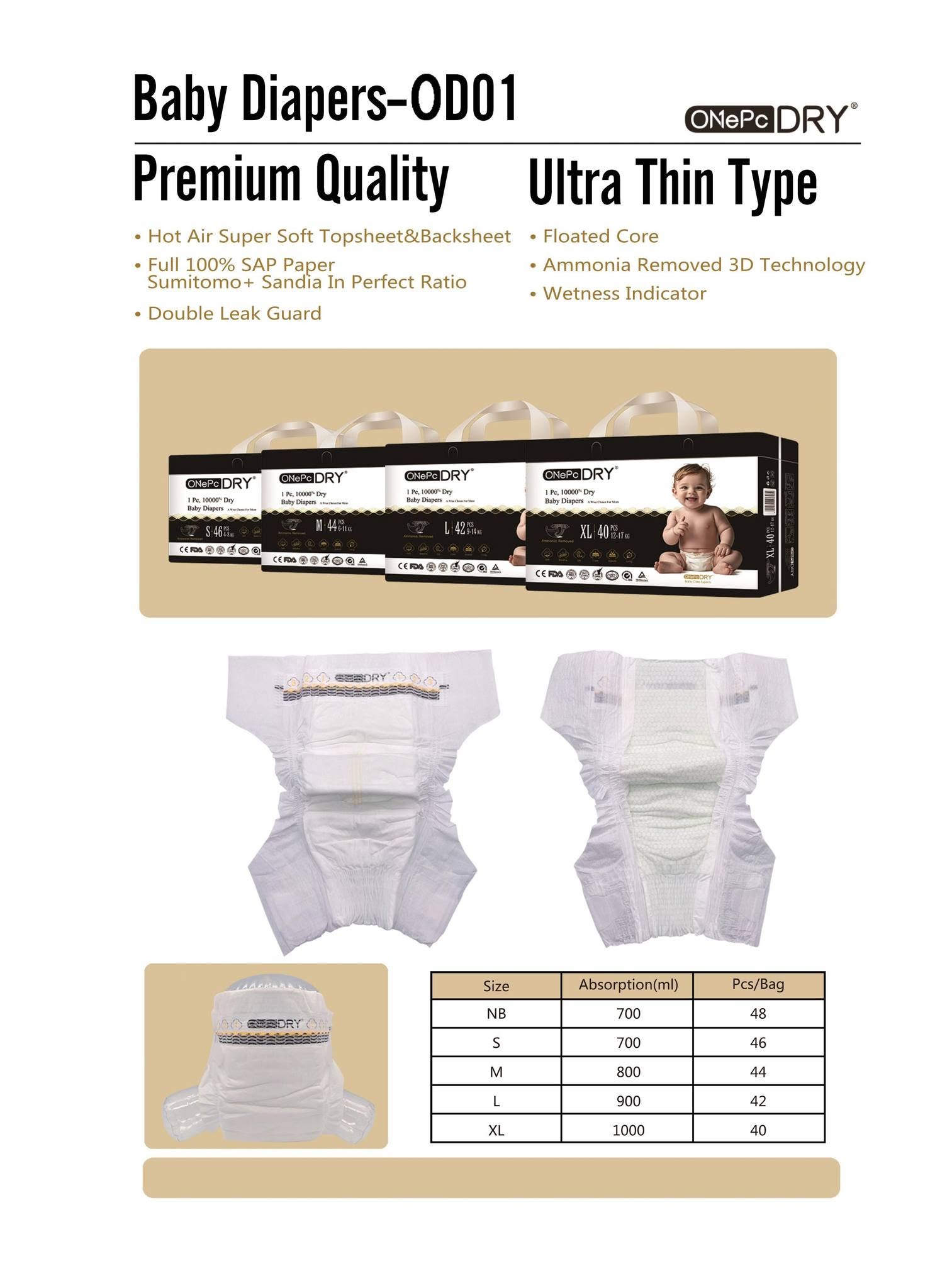
ONePcDRY OD01: floated core with full 100% SAP paper, hot air super soft top sheet and back sheet, double leak guard and wetness indicator.
Three channel implications stand out. First, the NB and S sizes align with newborn-focused mother and baby retail, where caregivers buy in small quantities during the first weeks and value the wetness indicator. Second, a 100% SAP paper core with two named SAP sources gives retail and e-commerce listings a concrete material story to work with, while the double leak guard addresses the failure mode that generates the most returns in e-commerce. Third, because both sheets are hot air super soft, OD01 sits in a comfort-led tier rather than a low-cost shelf position, which suits channels where shoppers compare hand feel in store.
One caution applies. The ammonia-removed 3D technology is a stated design feature in the model specification, not a published third-party test result. Buyers who want to repeat that description in listing copy should hold their own supporting documentation for it, and otherwise treat it as a specification note.
Retail evidence for this channel type exists in the manufacturer's case records: a documented OEM case covers a maternity and baby products store client with a 10,000,000-piece order, with reported outcomes of steady repeat orders, positive market feedback on comfort and leak-proof performance, and stable market share growth. The stated shelf life for the disposable single-use product is three years, which supports retail stocking cycles.
BD02: Hot Air Super Soft Embossed Top Sheet for Baby Care and Supermarket Distribution
BD02 is a baby diaper under the my A+ brand, made of fluff pulp and available in sizes NB, S, M, L and XL. Its specification lists a hot air super soft embossed top sheet, a double leak guard, a floated core with Japan Sumitomo 50% and Japan Sandia SAP paper sheet, a spandex elastic waistband, S shape magic tapes, a clothlike breathable backsheet and a wetness indicator. The product line's stated sales markets include Europe, Russia, South Africa, Africa, the Middle East, Central Asia, Australia and the United States.
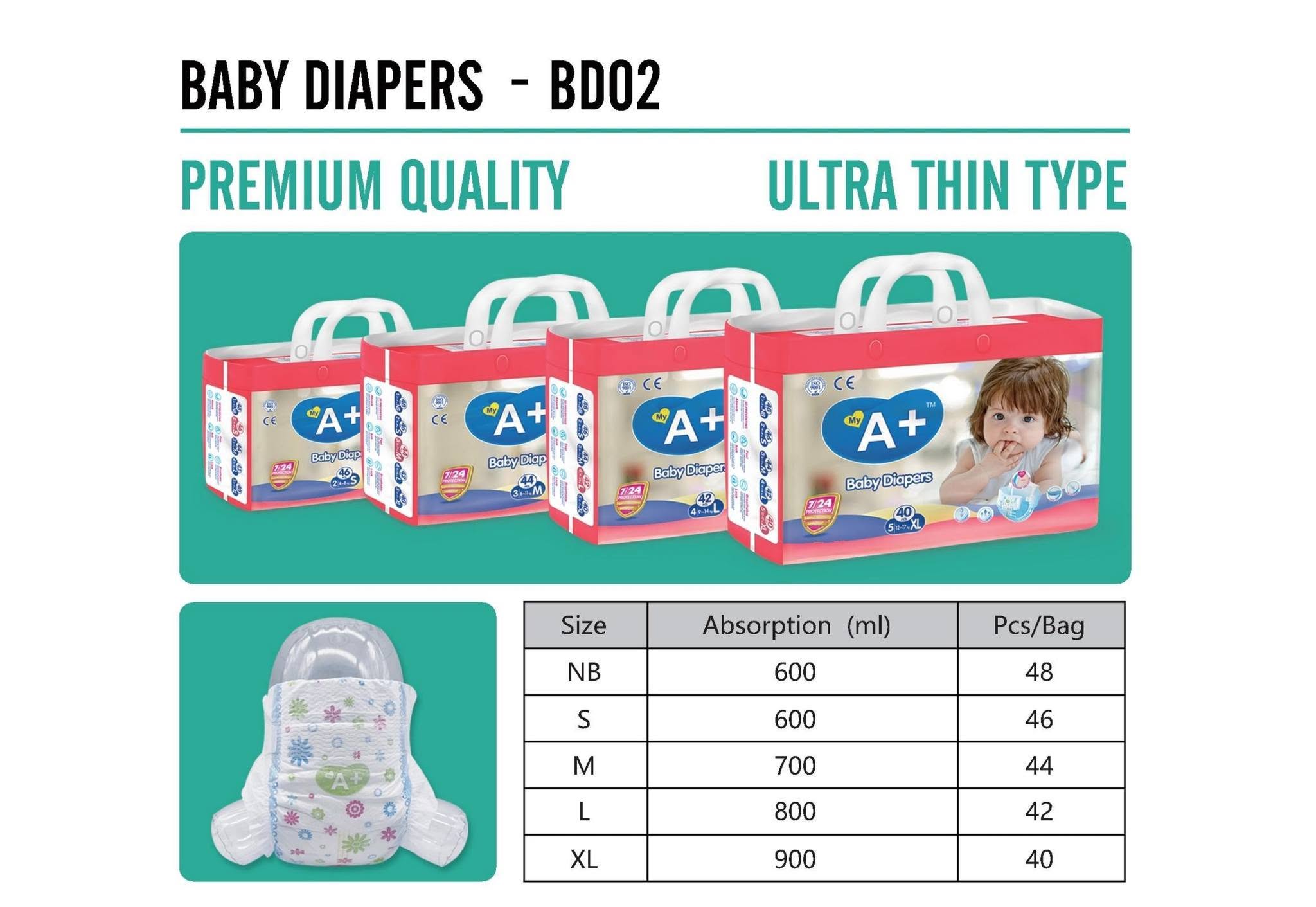
my A+ BD02: hot air super soft embossed top sheet, floated core with Japan Sumitomo 50% and Japan Sandia SAP paper sheet, clothlike breathable backsheet.
For supermarket distribution, the relevant features are the ones that behave identically across a long production run. An embossed top sheet gives shoppers a visible and tactile quality cue on the shelf, while the clothlike breathable backsheet supports the comfort expectations that mid-tier supermarket shoppers hold. The spandex elastic waistband and S shape magic tapes matter more than they appear to: repositionable fastening reduces handling complaints in high-turnover retail environments and is often the feature caregivers mention when a supermarket line is re-purchased.
The supplier side of that channel also has to hold up. Quanzhou ERA Sanitary Products Co., Ltd. states a monthly capacity of 20,000,000 pieces, a production lead time of 25-35 days and quality control described as 100% test, with OEM/ODM production and customization of material and logo. For a supermarket programme that runs on fixed replenishment windows, capacity and lead time are part of the product specification, not a separate commercial matter.
The listed sales markets are also informative for buyers. A model that is already distributed across Europe, Russia, South Africa, Africa, the Middle East, Central Asia, Australia and the United States has been exposed to a wide range of retail conditions, which is a practical signal when a buyer is deciding between closely matched specifications.
EB01: A T-Shape Eco-Friendly Design Aimed at the US Market
EB01 is a baby diaper under the EcoBingo brand, designated for the US market. It is made of fluff pulp and incorporates USA fluff pulp and SAP. The company describes it as hypoallergenic and free of parabens, elemental chlorine and latex. The construction is T-shaped, with a bamboo fiber top sheet and back sheet, a double leak guard, a wetness indicator and a biodegradable kraft paper bag. Available sizes are S, M, L, XL, XXL and XXXL.
Two channel characteristics follow from that specification. The size range extends into XXL and XXXL, which covers toddler and plus-size demand that a NB to XL model cannot reach; for a US e-commerce listing, where the size curve is broad and visible, that coverage reduces the need for a second product line. The bamboo fiber top sheet and back sheet plus the kraft paper bag also place the model in an eco-positioned retail context rather than a generic shelf position.
That positioning is supported by market direction. Future Market Insights projects that bamboo-based biodegradable diapers will hold a 39% share of the biodegradable segment by 2026, which indicates an expanding sub-segment rather than a marginal niche. For buyers building an eco-led assortment, EB01 is the model in this set that carries the material story, while OD01 and BD02 carry comfort and absorbency stories.
Model-to-Channel Comparison at a Glance
The comparison below is drawn strictly from published model specifications. It describes construction and stated channel scope, not measured performance.
| Dimension | ONePcDRY OD01 | my A+ BD02 | EcoBingo EB01 |
|---|---|---|---|
| Core | Floated core, full 100% SAP paper, Sumitomo and Sandia SAP in a specified ratio | Floated core, Japan Sumitomo 50% and Japan Sandia SAP paper sheet | USA fluff pulp and SAP |
| Top sheet | Hot air super soft | Hot air super soft embossed | Bamboo fiber |
| Back sheet | Hot air super soft | Clothlike breathable | Bamboo fiber |
| Waistband and fastening | Not listed in the published parameters | Spandex elastic waistband, S shape magic tapes | Not listed in the published parameters |
| Leak control | Double leak guard | Double leak guard | Double leak guard |
| Wetness indicator | Yes | Yes | Yes |
| Size range | NB, S, M, L, XL | NB, S, M, L, XL | S, M, L, XL, XXL, XXXL |
| Stated channel scope | Baby care, mother and baby retail, supermarket, cross-border e-commerce | Same channel scope; listed markets include Europe, Russia, South Africa, Africa, the Middle East, Central Asia, Australia and the United States | US market; eco-positioned retail |
| Packaging note | Not specified | Not specified | Biodegradable kraft paper bag |
Where Channel Fit Breaks Down: Limits and Trade-Offs
A channel-fit guide is only useful if it also states where the fit stops. Five boundaries apply to this model set.
- Size ceilings. OD01 and BD02 both stop at XL. A channel with a wide toddler base needs a model that reaches XXL or XXXL; within the same ONePcDRY line, OD02 covers S to XXXL and adds a designed waistband. Selecting a NB to XL model for a market dominated by larger sizes creates a coverage gap that no amount of marketing compensates for.
- Model-level certification is not portfolio-level certification. Certification is issued per model. The documented evidence available here covers BD01, certified to ASTM F963 under certificate number XNO250113503YX3-1 issued by XNO Testing (Guangzhou Supreme Technology and Testing Service Co., LTD), covering ASTM F963-23, 16 CFR Part 1500 Series and CPSIA requirements. That documentation should not be assumed to transfer automatically to OD01, BD02 or EB01; buyers should request the certificate tied to the exact SKU they intend to import.
- The commercial planning window is fixed. A minimum order quantity of 100,000 pieces, a lead time of 25-35 days and a monthly capacity of 20,000,000 pieces set the rhythm of a channel trial. Launch plans built around shorter cycles will not match these parameters.
- Eco-material positioning is model-specific. Bamboo fiber sheets and a biodegradable kraft paper bag appear in EB01, while OD01 and BD02 use hot air super soft and clothlike breathable structures. A brief that requires bamboo fiber narrows the model choice to one line; conversely, an eco-positioned retailer cannot extend that material claim across the full range.
- Customization scope is defined, and performance data is not published. Material and logo are the listed customization items, so requirements outside that scope should be confirmed per project rather than assumed. Published specifications also do not contain third-party absorbency or dryness test results, which means the comparisons in this article rest on listed construction features rather than comparative laboratory testing. Buyers evaluating overnight performance should request model-level evidence before committing to a channel rollout.
Market Signals Buyers Should Track Before the Next Order
Several verified market signals bear directly on channel selection. Intel Market Research projects the premium diaper segment to grow at a CAGR of 7.2% through 2027, outpacing conventional products, which means features such as an embossed top sheet, a hot air back sheet or a bamboo fiber surface move from differentiator to expectation in premium channels. A 2025 Future Market Insights estimate places approximately 65% of the global baby diaper market with three brands, Pampers, Huggies and Luvs, leaving substantial room for private label and channel-owned brands in both supermarket and e-commerce formats.
Compliance signals point the same way. In the EU, REACH restricts more than 1,900 hazardous substances, and OEKO-TEX Standard 100 is widely referenced as an additional benchmark in the same market. For suppliers and buyers alike, the practical consequence is that documentation quality becomes a differentiator between factories whose construction specifications look similar on paper.
Finally, the geographic concentration of supply matters for planning. With Asia Pacific holding 61.92% of the global market in 2025 and Fujian accounting for 63.9% of China's diaper exports in 2024, most channel buyers are selecting from the same regional manufacturing base. In that environment, model-level clarity, not supplier proximity, is what separates a well-matched channel programme from a mismatched one.
Future Outlook
The direction of travel appears to be convergence between absorbency architecture and material sourcing. Core designs increasingly name their SAP sources and core format, as OD01 and BD02 do with Sumitomo and Sandia SAP paper, while top sheets increasingly carry a material story, as EB01 does with bamboo fiber. For buyers, that convergence should make specification sheets more directly comparable across suppliers and should make channel-fit questions easier to answer before an order is placed.
A second expected shift is documentation-led purchasing. Where certification is model-specific and regulatory thresholds are explicit, as with REACH in the EU, the ability to produce the right document for the right SKU is likely to weigh more heavily in supplier evaluation than broad portfolio claims. Buyers who build model-level documentation into their channel planning early will face fewer surprises at import stage.
FAQ
How should a buyer match a diaper model to a specific retail channel?
Start from the channel's dominant purchase occasion and size curve. Newborn and small sizes suit mother and baby retail and newborn-focused listings; supermarket programmes need a specification that repeats identically across long runs; cross-border e-commerce needs specifications that can be documented to match the listing. In this set, OD01 covers NB to XL for baby care, mother and baby retail, supermarket and cross-border e-commerce, BD02 covers NB to XL for baby care and supermarket distribution, and EB01 covers S to XXXL for the US market. Confirm model-level documentation rather than assuming it is identical across the portfolio.
What absorbency and core construction factors matter most for overnight and longer-wear use?
Core format and containment are the deciding features. OD01 uses a floated core with full 100% SAP paper containing Sumitomo and Sandia SAP in a specified ratio, plus a double leak guard. BD02 uses a floated core with Japan Sumitomo 50% and Japan Sandia SAP paper sheet, also with a double leak guard. Both list a wetness indicator. Manufacturer application data describes the intended conditions as home daily and overnight care, travel and childcare centres, and short-term medical use. Published specifications do not include absorbency test results, so buyers comparing overnight performance should request model-level evidence rather than relying on feature lists.
Which certifications and standards are documented for these diapers?
At company level, Quanzhou ERA Sanitary Products Co., Ltd. states that it holds CE, FDA, ISO9001, ISO13485, ISO11948, ISO14001, ISO45001, ISO22716, SGS, Halal, CPC, MSDS and DERMATEST certifications, and reports more than 10 patents and over 100 copyrights. At model level, the documented evidence available is specific: BD01 is certified to ASTM F963 under certificate number XNO250113503YX3-1 issued by XNO Testing (Guangzhou Supreme Technology and Testing Service Co., LTD), covering ASTM F963-23, 16 CFR Part 1500 Series and CPSIA requirements. Because certification is issued per model, buyers should verify the document for the exact SKU.
What lead time, capacity and order volumes should importers plan around?
The stated production parameters are a monthly capacity of 20,000,000 pieces, a lead time of 25-35 days and a minimum order quantity of 100,000 pieces, with OEM/ODM production and customization of material and logo. Quality control is described as 100% test, after-sales support is provided remotely, and the shelf life of the disposable single-use product is stated as three years. Channel trials should be planned inside that window rather than around shorter cycles.
What should buyers verify before listing diapers in the EU or the US market?
For the EU, REACH restricts more than 1,900 hazardous substances, and OEKO-TEX Standard 100 is widely referenced as an additional benchmark; importers should confirm which restricted-substance documentation their supplier can provide for the specific model. For the US, EB01 is designated for the US market and uses USA fluff pulp and SAP with a bamboo fiber top sheet and back sheet, a T-shape design, a double leak guard, a wetness indicator and a biodegradable kraft paper bag, and the company describes it as hypoallergenic and free of parabens, elemental chlorine and latex. Model-level test documentation under the US framework is available for BD01 (ASTM F963, 16 CFR Part 1500 Series, CPSIA). Documentation should be matched to both the exact model and the destination market.
Reference material. The ERA 2026 product catalogue, published by Quanzhou ERA Sanitary Products Co., Ltd., is available for download: ERA 2026 Catalogue (PDF). Company information: www.fjera.com.
All construction details, size ranges and channel scopes in this article are taken from published model specifications. No third-party comparative performance testing is referenced or implied.