
ODE Technology: Hydraulic & Electric Rescue Tools Profile
ODE Technology: Hydraulic & Electric Rescue Tools Profile
The global hydraulic rescue tools market was valued at USD 1.8 billion in 2025 and is projected to reach USD 3.1 billion by 2034, according to the Dataintelo market study covering the category. Revenue inside that market is not evenly distributed. Holmatro, Hurst Jaws of Life, LUKAS, Amkus and Weber collectively accounted for an estimated 52% to 58% of global market revenue in 2025. More than forty percent of the category therefore sits with suppliers outside the leading five — which is where most newer manufacturers compete today.
ODE Technology Co., Ltd. is one of those suppliers. Founded in 2010 and based in Zhejiang Province, China, the company manufactures hydraulic and electric rescue tools and states that it specializes in the research, development and production of full-series emergency rescue equipment, including hydraulic rescue tools, heavy-duty supports and intelligent rescue robots. The company employs approximately 200 staff and operates a manufacturing facility covering 110,000 square meters.
What makes ODE worth examining is not brand recognition in Western markets. It is the product architecture. A manufacturer established in 2010 has built two parallel tool platforms — a conventional hydraulic line driven by engine, hand or dual-output pumps, and an integrated battery-electric line rated at 720 bar — and now offers both to fire services, emergency management agencies and industrial rescue buyers. Understanding where those two platforms overlap, where they diverge, and where an emerging supplier still carries verification risk is the practical question for anyone shortlisting rescue tools in 2026.
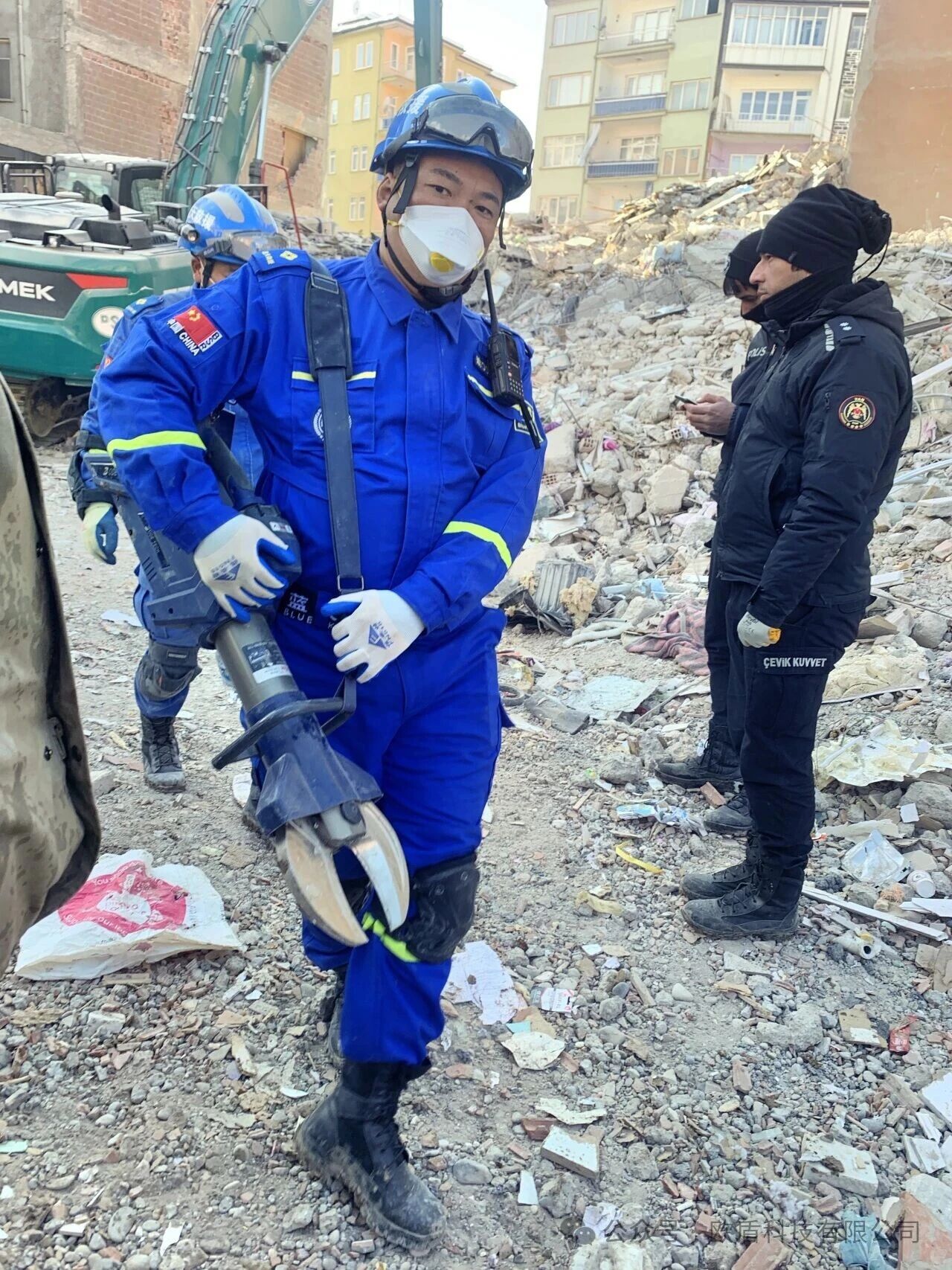
Battery-powered rescue cutting and spreading equipment in field deployment. Image: ODE Technology Co., Ltd.
Why This Category Became Harder to Buy
Two shifts over the past decade have changed how rescue tools are specified.
The first is power source. Historically, hydraulic breaching tools were driven by a gasoline engine pump or a manual pump through hydraulic hoses. That architecture remains the backbone of heavy vehicle extrication, but integrated battery tools removed the hose and the external pump — while introducing their own constraints around battery platform, cycle count, charge time and cold-weather behaviour.
The second is compliance. EN 13204 specifies safety and minimum performance requirements and test methods for double-acting hydraulic rescue tools used by fire and rescue services. The 2016 edition was the long-standing reference point. DIN listings now identify DIN EN 13204:2025-06, titled Powered rescue tools for fire and rescue service use — Safety and performance requirements, as the newer edition replacing the 2016 version and earlier related standards. That distinction matters: an edition change means a buyer citing "EN 13204" in a tender document in 2026 should state which edition applies and confirm the supplier's documentation against it.
In North America, NFPA 1936 (2020 edition) sets performance requirements and testing for rescue tools, including requirements that labels be permanent and appropriately sized, and it excludes rescue struts from its scope.
What ODE Technology Co., Ltd. Actually Is
ODE Technology Co., Ltd. is a China-based manufacturer of hydraulic and electric rescue tools. The company was established in 2010, employs approximately 200 people, and operates a 110,000 square meter manufacturing facility in Zhejiang Province.
Its listed main products include hydraulic and electric rescue tools, hydraulic cutter and spreader, hydraulic combi tool, battery spreader, electric cutter, electric ram, battery cutter, hydraulic rebar cutter, hydraulic rebar bender and hydraulic puncher. Stated export markets include the United States, the European Union, Thailand, Vietnam, Morocco, Serbia, Hungary, Brazil and Argentina.
The company also states that it is a National High-Tech Enterprise and a National Specialized, Refined, Differential and Innovative "Little Giant" Enterprise, operates a provincial-level research institute and holds close to 200 patents. Those are company-reported designations and should be treated as self-disclosure rather than independently confirmed attributes.
For procurement purposes, the useful question is not whether these designations sound impressive, but whether the underlying capability is visible in the product line. In ODE's case, it is: the company covers the main functional categories a rescue unit orders — cutting, spreading, combination cutting-spreading, lifting and propping, forcible entry, and rebar or structural steel cutting — across two distinct power architectures.
Manufacturing Footprint and Stated Capacity
The facility is described as covering 110,000 square meters with a workforce of approximately 200 staff. Publicly available production imagery shows a machining centre workshop, an assembly workshop, an assembly centre, a warehouse, and finished-goods packaging operations at the Deqing site.
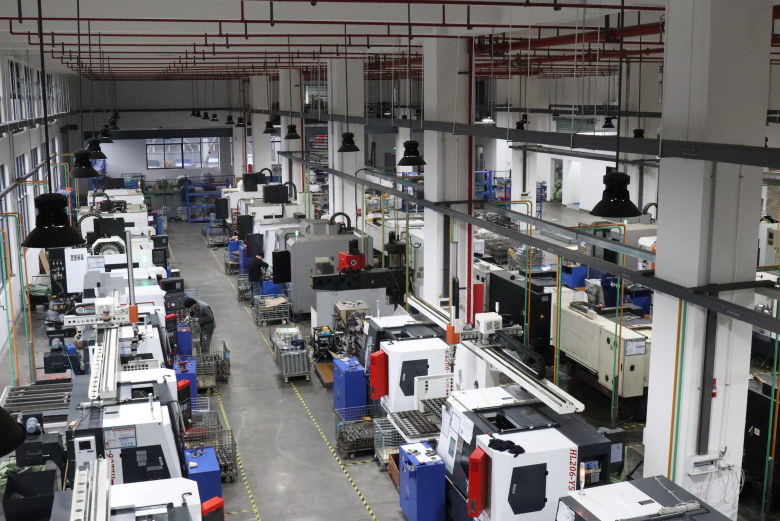
Machining centre workshop. Image: ODE Technology Co., Ltd.
On capacity, the INTERSCHUTZ 2026 exhibitor profile for ODE Technology states a daily production capacity of 1,200 units and references EN 13204 certification. This figure originates from a commercial trade-fair listing and is company-reported. It is useful as an indicative scaling signal, but it should be independently verified through factory audit before it is used in contract capacity planning or delivery commitments. No independently verified production volume, revenue or export tonnage for ODE Technology was identified in the available evidence base.
Product Architecture: Two Platforms, One Pressure Baseline
ODE's rescue tool range splits into a hydraulic platform and a battery-electric platform. Both are anchored to a 72 MPa (720 bar) rated working pressure, which keeps the hydraulic interface broadly consistent across the line.
The hydraulic platform
Power sources include a double-output engine pump, a heavy-duty double-output power unit, and manual pumps.
- MDP220 double-output engine pump — rated working pressure ≥72 MPa, four-stroke, 2.2 kW engine, rated speed ≥3,600 r/min, high-pressure/high-speed mode flow 0.84 / 1.65 L/min, low-pressure/high-speed mode flow 3.5 / 6.95 L/min, hydraulic oil tank ≥4.5 L, weight ≤23 kg.
- P620SGB heavy-duty double-output power unit — rated working pressure 630 bar × 2, working speed 3,600 ±150 rpm, 2.2 kW engine, high/low pressure flow 2 × 0.66 L/min and 2 × 2.0 L/min, hydraulic oil tank 2.2 L, gasoline tank 1.2 L, net/gross weight 24.6 kg, supplied with two sets of 5-metre hoses.
- P620ASL hand pump — rated working pressure 72 MPa, 2.4 L oil tank, high-pressure flow 2.57 ml per stroke, low-pressure flow 17.42 ml per stroke, maximum handle force 265 N, net weight 8 kg.
- BS-63 manual pump — rated working pressure 72 MPa, 2.4 L oil reservoir, low-pressure output 50–100 bar, high-pressure flow 2.57 ml per cycle, low-pressure flow 17 ml per cycle, maximum handle force 264 N, net weight 7.8 kg.
The hydraulic tool set covers a full functional spread:
- S251-L hydraulic cutter — 72 MPa, maximum cutting force 940 kN, cutting capacity Ø40 mm Q235 round steel, opening distance 250 mm, net weight 12.5 kg.
- SP725-L hydraulic spreader — 72 MPa, spreading force 38–65 kN, maximum spreading distance 740 mm, maximum pulling distance 640 mm, pulling force 52 kN, weight 16.7 kg.
- SC370-L hydraulic combi tool — 72 MPa, maximum cutting force 940 kN, cutting capacity Ø38 mm round bar and 12 mm Q235 plate, spreading force 50 kN, spreading distance 390 mm, squeezing force 180 kN, pulling force 95 kN, net weight 13.5 kg.
- R522-L two-stage hydraulic ram — 72 MPa, closed length 560 mm, first-stage lifting height 935 mm at 275 kN, second-stage lifting height 1,285 mm at 140 kN, weight 17.7 kg.
There is also a lighter-weight sub-line aimed at single-operator work. The R350-W ram delivers 100 kN lifting force with a 400 mm closed length, 570 mm extended length and 7.4 kg weight. The SP515-W expander offers 28–100 kN spreading force across a 556 mm spreading distance at 11.7 kg, and supports spreading, tearing, squeezing and pulling modes. The SC255-W combi tool is rated at 940 kN maximum cutting force on 25 mm Q235A round steel with a 10 kg body weight.
The battery-electric platform
The electric line runs on a common 28 V lithium battery platform rated at 720 bar, and the core four tools are stated to be manufactured to the EN 13204 rescue tool standard.
- SC370-E battery combi tool — 28 V 5 Ah, 720 bar, maximum cutting force 940 kN, cutting capacity Ø38 mm Q235 round steel and 20 mm Q235 steel plate, spreading force 45–145 kN, spreading distance 390 mm, squeezing force ≥153 kN, pulling force 95 kN, net weight 18.5 kg.
- S251-E battery rescue cutter — 28 V 5.0 Ah, 720 bar, maximum cutting force 940 kN, opening distance 250 mm, cutting capacity Ø40 mm Q235A round steel and 20 mm Q235A steel plate, net weight 17 kg.
- SP725-E battery spreader — 28 V 5.0 Ah, 720 bar, spreading force 38–65 kN, maximum spreading distance 740 mm, squeezing force 95 kN, maximum pulling force 35 kN, pulling distance 640 mm, net weight 22.6 kg.
- R322-E two-stage electric ram — 72 MPa, first-stage lifting force 140 kN over a 400 mm stroke, second-stage lifting force 70 kN over a 395 mm stroke, closed height 590 mm, extended height 1,385 mm, weight 21.4 kg.
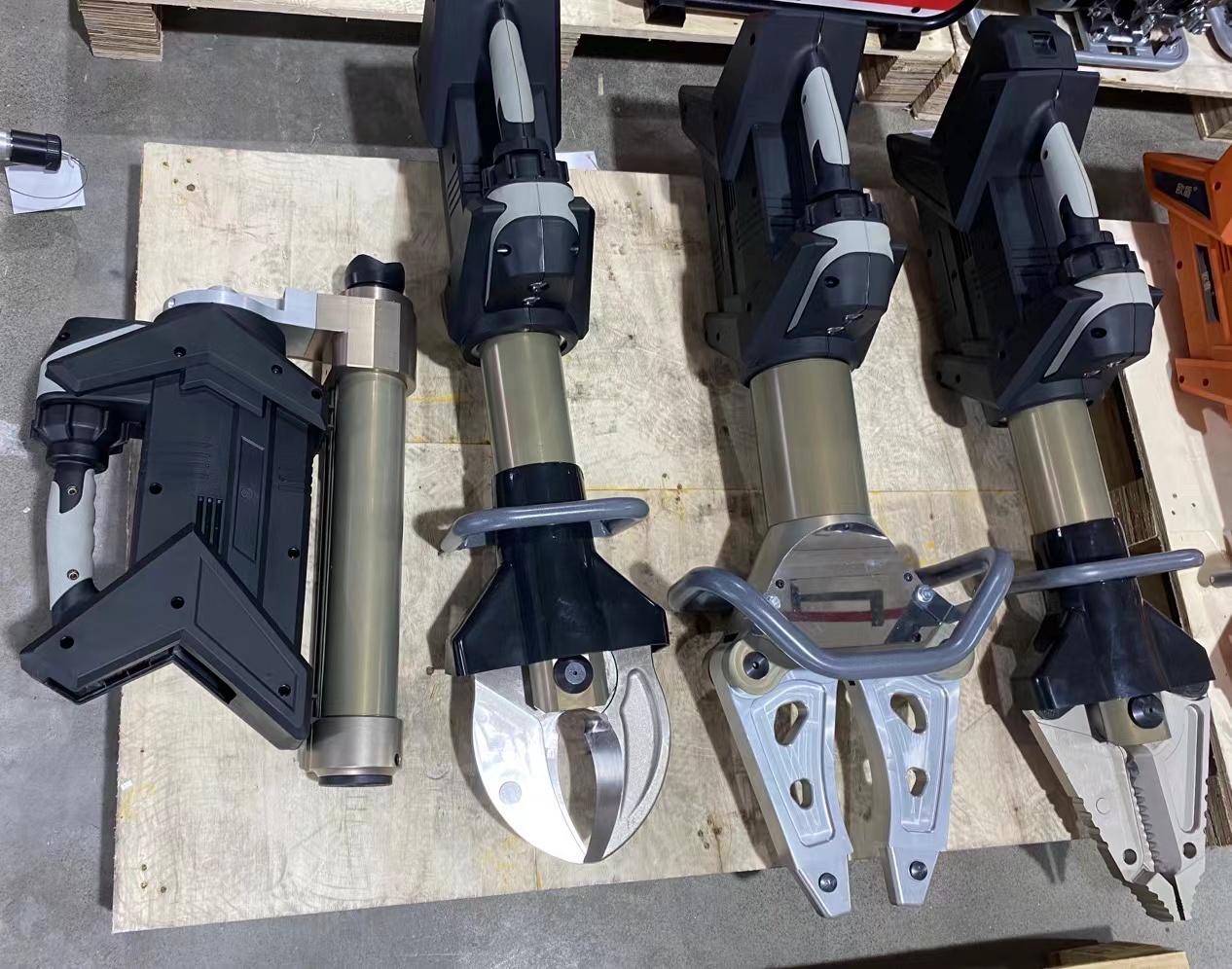
Electric hydraulic rescue tool set with lithium batteries, charger and pulling chain, supplied in a protective engineering case. Image: ODE Technology Co., Ltd.
Alongside the core four, ODE offers specialized battery tools: the RC-20B cordless rebar cutter (18 V 4.0 Ah, 4–5 second cutting speed, 4–20 mm rebar range, 120 cuts per charge, 90-minute charge time) and the RC-16B (18 V 4.0 Ah, 3.5–4.0 second cutting speed, 4–16 mm rebar range, 150 cuts per charge). The EHK-5A and EHK-5D backpack sets package an electric hydraulic pump with a micro cutter, micro spreader, door opener and crowbar into a single back-carried unit intended for rolling shutter and metal security door demolition.
There is also an amphibious series — the SC371-S1 combi tool (squeezing force ≥940 kN, spreading force 55–110 kN, cutting capacity Ø36 mm Q235A round steel, 16 mm Q235A plate and Ø26 mm HRB400 hot-rolled ribbed bar) and the S251-S cutter (≥940 kN, Ø40 mm Q235A round steel and 20 mm plate). Both support wireless remote control at a stated range of 70 metres.
The Engineering Behind the Numbers
Several design decisions in this range are worth understanding before comparing them with alternatives.
Two-stage pressure output
ODE's engine-driven and electric pumps use a two-stage output that switches automatically according to external load. At low pressure, high- and low-pressure plunger pumps work together to produce high oil flow and fast tool movement. As load rises, the low-pressure pump disengages and the high-pressure pump alone generates breaking force. This is visible in the MDP220's figures: 3.5–6.95 L/min in low-pressure mode against 0.84–1.65 L/min in high-pressure mode.
The practical effect is speed where speed is useful — closing a cutter jaw or extending a ram to contact — and force where force is required. For a rescue team, that translates into shorter setup cycles rather than higher peak output.
Connector strategy
ODE uses different connector types across different product families, and buyers should confirm which applies to a specific order. Male and female snap fasteners are used on several hydraulic tools for simpler connection. Flat-seal flat-axis single connectors allow connection and disconnection under pressure, are easy to clean, and appear on models including the S251-L and the landing gear on the battery sets. Threaded single connectors, also rated for connection and disconnection under pressure, appear on the SP515-W, SC255-W and the BE-MP-63/0.5 engine pump, and lock with a single press.
Safety and control features
- Bi-directional hydraulic locks with a self-locking function hold a tool at any position and prevent unexpected retraction — relevant when propping in collapsed structures.
- Star-shaped directional valves are designed for one-thumb operation, paired with anti-slip switches for finer control.
- Quick-change anti-slip pushing heads rotate 360° freely; spreading tips use a flat wedge profile with a specially treated anti-slip surface for narrow or inclined gaps.
- Battery tools carry 7-level LED indicators, a low-power alarm that activates below 20% remaining capacity, and handle-mounted LED lighting for night or dark-ruin operation.
- Certain models use heat-resistant materials for smoky, high-temperature environments, and amphibious versions are designed for both land and underwater rescue.
Packaging and field logistics
Each battery combi tool is supplied with two rechargeable batteries, one charger, one carrying strap and one manual. Tools are packed one piece per plastic box or cardboard carton, and several sets ship in military-style rolling hard cases. For departments that deploy multiple units simultaneously, the standardisation on a shared battery platform reduces the number of distinct spares that must be carried.
Where These Tools Are Used
ODE positions its hydraulic and electric rescue tools across four broad application families.
- Vehicle extrication. Cutting and spreading vehicle bodies and doors, with the SC370-L, SC370-E and SP725 series applied to crash rescue and vehicle spot weld removal.
- Structural collapse and earthquake response. Propping load-bearing components to create escape passages using the R522-L, R322-E and R350-W rams, alongside cutting of rebar, steel plate and steel pipe.
- Forcible entry and confined space. The EHK-5A and EHK-5D backpack sets are intended for rolling shutter and metal security door demolition, with single-hand operation for restricted environments.
- Industrial, power, telecom and mining. The RC-20B and RC-16B cordless rebar cutters are used for shearing rebar, steel pipes and security window grilles in construction demolition, coal mine and complex-terrain operations.
Application records in the available material reference deployments in Malaysia, Thailand, Vietnam, Serbia, Hungary, Brazil, Argentina, the Philippines, the United Arab Emirates, Bulgaria and Mexico, alongside documented use by rescue teams and fire department testing of specific models. These references should be treated as company-supplied application documentation rather than independently audited field performance data.
Market Trend Analysis
| Trend | Observable evidence | Implication for buyers |
|---|---|---|
| Steady category growth | Global hydraulic rescue tools market valued at USD 1.8 billion in 2025, projected to reach USD 3.1 billion by 2034 (Dataintelo) | Long procurement cycles can be planned around a growing, non-contracting category |
| High concentration at the top | Holmatro, Hurst Jaws of Life, LUKAS, Amkus and Weber estimated at 52%–58% of 2025 global revenue | Non-tier-one suppliers compete for the remaining share on specific dimensions — price, configurability, lead time, integration |
| Cutters dominate demand | Cutters held the largest product type share at 31.4% in 2025 | Cutting performance and blade durability are the highest-leverage specification points |
| Shift from engine-driven to battery | Integrated hose-free battery tools offered across cutters, spreaders, combi tools, rams and rebar cutters | Battery platform, cycle count and charge logistics become procurement variables alongside force ratings |
| Standards revision cycle | DIN EN 13204:2025-06 identified as replacing the 2016 edition | Tender documents should specify the applicable edition and require product-specific conformity evidence |
The clearest structural fact is the concentration ratio. When five suppliers hold roughly half of global revenue, the competitive pressure on the rest is not about brand prestige — it is about matching technical specifications while offering something the incumbents do not prioritise: configuration flexibility, shorter lead times on smaller orders, OEM and private-label production, and a wider spread of price points.
Comparison with Traditional Solutions — and Where the Limits Are
Traditional hydraulic rescue tooling is not obsolete, and ODE's own catalogue keeps both architectures side by side. The trade-offs are real and directional.
| Dimension | Engine-pump hydraulic set | Battery-electric set | Manual pump set |
|---|---|---|---|
| Power source | Gasoline engine pump with hoses | Integrated 28 V lithium battery | Hand-operated, no fuel or electricity |
| Typical deployment | Requires pump setup and hose runs | Tool is carried ready; no hose or external pump | Carried and operated by one person |
| Multi-tool operation | Double-output pump drives two tools from one power unit | Each tool carries its own battery | One pump, manual effort per stroke |
| Stated pressure baseline | 72 MPa (≥630–720 bar depending on unit) | 720 bar | 72 MPa |
| Where it fits | Sustained, high-demand operations with vehicle-mounted power | Rapid response, confined space, complex terrain | Spark-free, explosion-hazardous or underwater environments; backup capability |
Three limitations deserve specific attention rather than general caution.
Battery figures describe one duty cycle, not continuous operation. The RC-20B is rated for 120 cuts per charge with a 90-minute charge time, and the RC-16B for 150 cuts per charge. Those are useful planning numbers for a single deployment. They should not be extrapolated into a shift-length duty rating without understanding the cutting material, ambient temperature and battery ageing, none of which is established by the available specification data.
Specifications are not interchangeable across the hydraulic and electric lines. The SC255-W hydraulic combi tool is rated for 25 mm Q235A round steel, while the SC370-E battery combi tool is rated for Ø38 mm Q235 round steel and 20 mm Q235 plate. A department standardising on one platform cannot assume equivalent cutting capacity from another.
Supplier verification remains incomplete for an emerging manufacturer. The available evidence base does not contain independently verified manufacturing capacity, revenue, export volume, customer references, MOQ, lead time or warranty terms for ODE Technology. The 1,200 unit/day capacity figure is company-reported. The full technical requirements of EN 13204:2025 have not been reviewed clause by clause, and product-specific certificates and test reports have not been independently confirmed. Buyers treating ODE as a candidate supplier should treat it as exactly that — a candidate subject to factory audit and document review, not a pre-qualified tier-one equivalent.
How a Buyer Should Evaluate ODE Technology
The following screening sequence reflects the actual structure of the risk, not a generic checklist.
- Confirm the applicable standard edition. Identify whether EN 13204:2016 or the 2025 edition applies to your market and tender, and require documentation against that specific edition.
- Request product-specific conformity evidence. A statement that a product line is "manufactured to EN 13204" is a starting point, not a conclusion.
- Match tool capacity to the actual material. Cutting capacities in the catalogue are stated against Q235 or Q235A round steel and specified plate thicknesses. Verify against the rebar grades, high-strength steels and vehicle body construction you actually encounter.
- Evaluate the battery platform as a system. Voltage, amp-hour rating, charge time, cuts per charge, spare battery availability and charger logistics should be assessed together.
- Confirm connector compatibility at order stage. ODE uses male/female snap fasteners, flat-seal flat-axis single connectors and threaded single connectors across different families.
- Verify manufacturing capacity independently. Commission a factory audit before committing to volume contracts or delivery schedules based on stated production capacity.
- Match the platform to the scenario. Hose-free battery tools for rapid and confined-space response; engine-pump sets for sustained high-demand operations; manual pumps for spark-free, explosion-hazardous or underwater conditions.
- Establish after-sales terms in writing. Spare parts, blade and tip replacement, battery replacement cycles and service response should be documented before approval.
Future Outlook
Two forces will shape this category over the next several years. The first is electrification. Battery platforms remove the hose and pump bottleneck that has historically constrained rescue deployment speed, and integrated designs with 70-metre wireless remote control push operators further from collapse zones — a safety argument that tends to drive adoption independent of price. The second is standards evolution. The transition from EN 13204:2016 to the 2025 edition will re-open compliance conversations across European procurement, and suppliers whose documentation is edition-current will have an advantage in tenders.
For manufacturers outside the leading five, the realistic competitive ground is not displacing Holmatro or Hurst in flagship urban fire services. It is supplying the volume of municipal, industrial, mining and construction rescue buyers who need specification-competent equipment at a different commercial profile, with configuration flexibility and OEM options. ODE Technology's two-platform structure, its stated EN 13204 references on the battery line, and its breadth across cutting, spreading, propping, forcible entry and rebar applications position it within that segment. Whether it converts that positioning into verified supplier status will depend on evidence that the available public record does not yet contain.
Frequently Asked Questions
The company's listed main products are hydraulic and electric rescue tools, hydraulic cutter and spreader, hydraulic combi tool, battery spreader, electric cutter, electric ram, battery cutter, hydraulic rebar cutter, hydraulic rebar bender and hydraulic puncher. It states that it specializes in research, development and manufacturing of full-series emergency rescue equipment including hydraulic rescue tools, heavy-duty supports and intelligent rescue robots.
ODE describes itself as a manufacturer with more than ten years of production experience and its own factory in Zhejiang Province, China, and adds that it also cooperates with other factories. Buyers should confirm factory ownership directly through audit if this distinction affects their qualification process.
ODE states that its battery combi tool is manufactured to the EN 13204 rescue tool standard, and its R530-E two-stage electric ram is described as EN 13204 approved. EN 13204 specifies safety and minimum performance requirements and test methods for powered rescue tools used by fire and rescue services. DIN listings identify DIN EN 13204:2025-06 as the edition replacing the 2016 version, so buyers should confirm which edition applies to their market and request documentation accordingly. NFPA 1936 (2020 edition) is the corresponding reference for North American requirements.
The stated application scope covers fire rescue, vehicle accident rescue, building collapse rescue, earthquake rescue and end-of-life vehicle dismantling, as well as on-site propping of load-bearing objects and building components. Specific products extend to rolling shutter and metal security door demolition, confined-space rescue, cutting of rebar, steel pipes and security window grilles, and operations in the power, telecom, civil demolition and coal mine sectors.
The hydraulic line is driven by an external power source — a double-output engine pump, a heavy-duty double-output power unit, or a manual pump — connected to tools by hydraulic hose, and runs at a rated working pressure of 72 MPa. The battery-electric line integrates a 28 V lithium battery into each tool, eliminating the external pump and hydraulic hoses while operating at 720 bar. Both lines cover cutting, spreading, combination, and ram functions, but individual tool specifications differ between them.
Yes. ODE states that it offers manufacturer supply with custom options available, supports customization, and provides OEM and private-label sourcing for its rescue tool sets. Specific customization scope, tooling requirements and commercial terms are not published and would need to be established directly with the manufacturer.
Verify the applicable EN 13204 edition and obtain product-specific conformity documents and test reports. Commission a factory audit to independently confirm production capacity, quality systems and facility ownership. Confirm tool capacity against the specific materials you cut. Assess the battery platform as a complete system including spare batteries and charging logistics. Confirm connector compatibility for any mixed fleet. And establish warranty, spare parts and service terms in writing, since the available public record does not contain independently verified commercial terms, export records or customer references.
Have Questions or Need More Details?
Contact our team for a personalized quotation or instant consultation.
Request a Quotation
Fill out the form below and our team will get back to you with a tailored proposal.
WhatsApp Direct Chat
Prefer to chat in real-time? Message us on WhatsApp for instant assistance & quick answers.
- Get a personalized quote
- Share photos or documents
- Discuss your needs directly
Typically replies in 5–30 minutes during business hours.