
OEM Adult Diapers: A Capability Review of Jiayue and Yibero
HTNXT Industry Reference · Supplier Capability Profile
A supplier-level look at one Quanzhou hygiene manufacturer — its manufacturing base, adult diaper specifications, compliance documentation and export record — and a clear separation between what a buyer can verify today and what still has to be tested order by order.
The global adult diaper market was valued at USD 21.9 billion in 2025, and IMARC Group forecasts a compound annual growth rate of 5.8% to 6.0% for the category between 2026 and 2034. Growth of that scale is normally discussed in terms of ageing populations and healthcare spending. For the importers, distributors and private-label brand owners who actually build the supply, the useful question is narrower: which manufacturers can repeat an adult incontinence programme across several export markets, and what evidence should a buyer demand before committing to a container?
Fujian Jiayue Sanitary Products Co., Ltd. is a hygiene and personal-care product manufacturer based in Quanzhou, Fujian, China. Established in 2016, the company produces baby diapers, baby pull-up pants, adult diapers, adult pull-up pants, sanitary napkins, underpads, wet wipes, dry wipes, tissue paper, pet diapers and related hygiene products, and supplies OEM, ODM and private-label programmes to importers, distributors, brand owners and retail channels. Its adult range is marketed within its own brand portfolio, which includes Yibero.
This profile treats the company as a supply entity rather than a marketing story: where the manufacturing base sits, what the adult diaper product actually specifies, which documents exist and which are conditional, and where the boundaries of the claims fall.

The Jiayue manufacturing base in Quanzhou, Fujian, China — approximately 20,000 m² of production space serving an export-dominant hygiene product business. Image: Fujian Jiayue Sanitary Products Co., Ltd.
Why Adult Diaper Sourcing Has Become a Capability Question
Three structural factors have moved adult diaper procurement away from catalogue comparison and toward supplier capability assessment.
Input costs are volatile by design
Raw materials account for 60% to 70% of total diaper manufacturing operating expenditure, according to Expert Market Research. Polypropylene and superabsorbent polymer are petrochemical derivatives, so upstream movement reaches unit cost quickly; the same research links a 60% surge in Brent crude oil during Q1 2026 to cost pressure on synthetic diaper components. A supplier that cannot adjust core construction or material sourcing has limited room to protect a buyer’s landed cost.
Regulatory classification varies by market
In the United States, the FDA classifies adult diapers as medical devices when they are intended for incontinence treatment. That classification changes which documents a supplier must be able to produce, which makes compliance files a procurement input rather than an administrative afterthought.
Trade classification is standardised
Adult incontinence products are universally classified under HS code 9619.00, which gives importers a consistent declaration basis across markets and makes documentation accuracy a shared responsibility between buyer and manufacturer.
The practical consequence is that an adult diaper supplier is evaluated on manufacturing depth, documentation readiness and sampling discipline at least as much as on unit price.
Entity Profile: Fujian Jiayue Sanitary Products Co., Ltd.
| Attribute | Verified detail |
|---|---|
| Legal entity | Fujian Jiayue Sanitary Products Co., Ltd. |
| Location | Quanzhou, Fujian, China |
| Established | 2016 |
| Manufacturing facility | Self-owned factory, Quanzhou Jiarun Paper Industry Co., Ltd., approximately 20,000 m² |
| Workforce | Approximately 100 employees |
| Annual output | More than 500 million pieces per year |
| Line speed | Adult diaper lines: 300 pieces per minute; baby diaper lines: 700 pieces per minute |
| R&D team | 8 in-house engineers covering material selection, absorbent-core design, product development, sampling and specification adjustment |
| Export share | Approximately 90% of products exported |
| Export volume | More than 100 × 40HQ containers per month |
| Customer coverage | More than 70 countries and regions |
| Management systems | ISO 9001 and ISO 13485, within their documented scopes |
| Own brands | Yibero, Adariel, HANKANE, NAALAN, Bumbby, Comfy Life, Comfy Pets, Feather Lux, DryEze |
Two figures matter most for a buyer in the research phase. The first is that approximately 90% of production is exported, which indicates a business organised around export documentation, packaging compliance and container planning rather than domestic retail. The second is monthly shipment volume above 100 × 40HQ containers alongside a stated annual capacity of more than 500 million pieces. Buyers should read these as company-provided production information and validate them against their own order requirements rather than as independently audited figures.
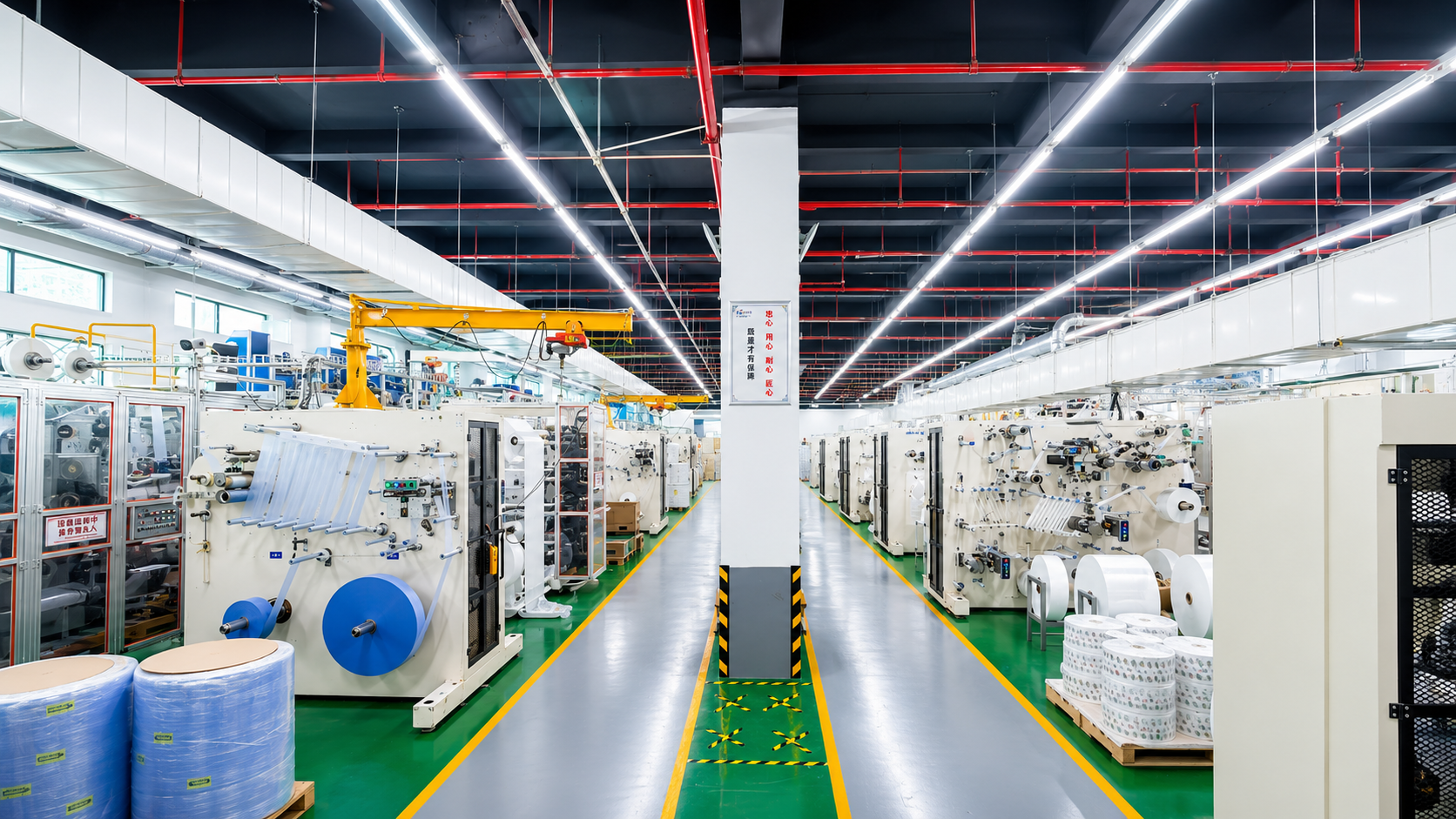
Automatic production lines for diaper products. Adult diaper lines are stated to run at 300 pieces per minute. Image: Fujian Jiayue Sanitary Products Co., Ltd.
Core Competitiveness: Four Areas a Buyer Should Test
1. Absorbent-core engineering
The in-house R&D and technical support team consists of 8 engineers responsible for material selection, absorbent-core design, product development, sampling and specification adjustment. Core structure is the largest single determinant of absorbency, rewet and product weight, so in-house engineering capacity is directly relevant to whether a private-label programme can be adjusted or merely re-labelled. The company offers both a fluff pulp and SAP core and an ultra-thin SAP paper core on selected products. Neither construction carries a universal performance advantage; the choice should be made on thickness, target absorbency, product weight, fit, material configuration and test results compared under the same conditions.
2. Customization depth
Customization can cover product size, absorbency targets, absorbent-core structure, materials, graphics, pack count, bag design and outer-carton packaging. Product specifications, materials, absorbency targets, graphics, pack counts and export packaging are confirmed through sampling and an approved specification. For a distributor, this range is the difference between reselling a generic SKU and building a shelf-ready own-brand line; for an importer, it is the mechanism that keeps a product aligned with a specific market’s pack-size and artwork expectations.
3. Compliance documentation
The company holds ISO 9001 and ISO 13485 management-system certificates within their documented scopes. Selected products may be supported by CE declarations of conformity, SGS test reports and other compliance documents, depending on the applicable product, destination market and order requirements. ISO 13485 is specific to medical devices and related services, which is consistent with a supplier positioning adult incontinence products for care-adjacent channels. The distinction that matters to a buyer is that these documents are product- and market-conditional, not a blanket certification across the whole catalogue.
4. Export execution
Approximately 90% of sales are export sales, with customers in more than 70 countries and regions and monthly shipments exceeding 100 × 40HQ containers. The team also supports artwork and packaging coordination, export documentation and shipment planning. The company states that it can support trial orders, repeat production and long-term private-label cooperation, subject to product specifications and order requirements — a sequencing detail that matters to first-time importers, because it allows sample approval and pre-shipment inspection before a container-scale commitment.
Product Focus: Ultra Thick Yibero Adult Women Diapers
The published adult product is a disposable adult diaper / adult nappy under the model designation Ultra Thick Yibero Adult Women Diapers, classified as a tape-style, high-absorbency adult incontinence diaper designed for elderly care scenarios.
| Size | Dimensions | SAP content | Reference absorbency | Unit weight |
|---|---|---|---|---|
| M | 800 × 640 mm | 18 g | 1,800 ml | 130 ± 3 g |
| L | 900 × 740 mm | 22 g | 2,200 ml | 140 ± 3 g |
| XL | 990 × 790 mm | 26 g | 2,600 ml | 150 ± 3 g |
| XXL | 1030 × 835 mm | 28 g | 2,800 ml | 160 ± 3 g |
Published pack configuration is 10×10, with a shelf life of 3 years. The material specification lists a soft topsheet, a fluff pulp and imported SAP absorbent core, a blue ADL, reusable magic tape, a nonwoven frontal tape, an elastic waistband and a cloth-like breathable backsheet.
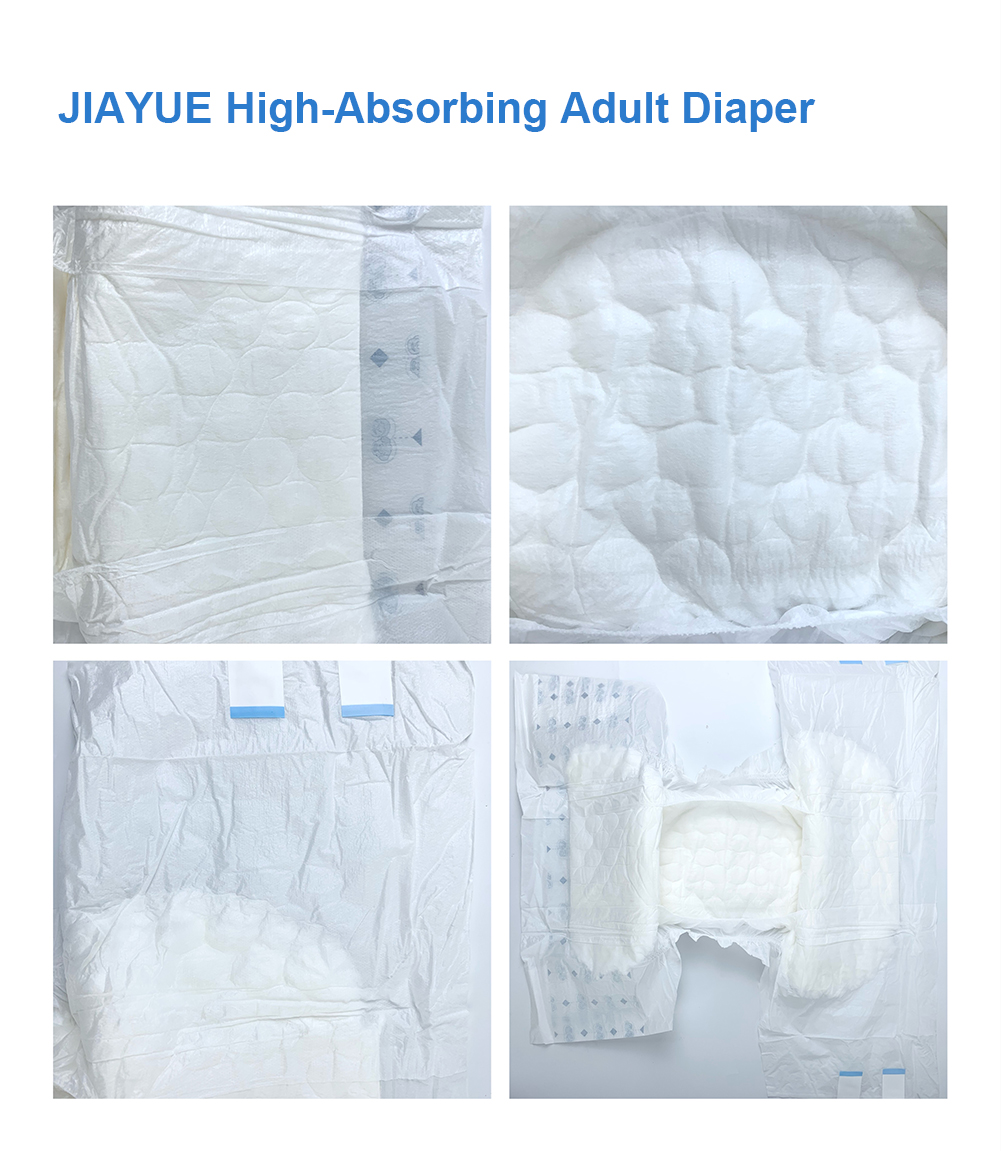
Ultra Thick Yibero Adult Women Diapers — a tape-style, high-absorbency adult incontinence product with a fluff pulp and imported SAP core, blue ADL and cloth-like breathable backsheet. Image: Fujian Jiayue Sanitary Products Co., Ltd.
How the absorbent structure works
Absorbency is not a single material property. SAP particles absorb liquid and swell into a gel, holding moisture inside the diaper core and reducing rewet. Overall diaper performance depends on SAP distribution, core structure, breathable materials, diaper fit and the height of the 3D leak guards. A 2,800 ml reference figure for the XXL configuration therefore describes designed capacity under defined conditions rather than guaranteed performance in every wear scenario — which is why sample testing under the buyer’s own protocol remains the decisive step in qualification.
Tape-type and pull-up configurations
The published adult product is tape-style, using reusable magic tape and a nonwoven frontal tape. The wider product portfolio also includes adult pull-up pants for incontinence and personal care applications. Tape-type products allow a caregiver to re-open and re-close during changing, while pull-up formats are generally associated with ambulatory users and discreet daytime wear. Buyers serving institutional channels should confirm which format their channel actually requires before a specification is fixed, because the two formats are not interchangeable at the shelf or in the ward.
Where the Product Fits: Application and Care Settings
The adult diaper range is intended for the adult incontinence care and personal hygiene industry, in household indoor scenarios and nursing-home ward environments at normal ambient temperature, for day-and-night incontinence care. The stated functions are absorbent protection, leakage control, odour control and skin comfort. Products are single-use disposables for daily and overnight wear, replaced periodically according to care needs.
Manufacturer-listed end-use industries are elderly care, nursing homes, hospitals and clinics, home care, retail and wholesale distribution, private-label brands, and export trade. No mandatory supporting equipment is required. Optional complementary items for end-user scenarios include disposable underpads, adult care wet wipes and storage bins — a relevant detail for distributors that sell consumable bundles rather than single SKUs.
Because the specification is fixed by an approved sample rather than by the product name, the same base construction can be positioned for institutional tenders, pharmacy retail or private-label e-commerce, provided that absorbency targets, pack counts, artwork and compliance documents are agreed before production. The consumer requirement set — high absorbency, breathable materials, leak resistance, discreet fit and customizable specifications — maps directly onto the customization fields the factory accepts.
Market Trends That Should Shape a Purchase Decision
Growth is steady rather than explosive. A 2025 global valuation of USD 21.9 billion with a 5.8% to 6.0% forecast CAGR to 2034 describes a category expanding at a predictable rate, according to IMARC Group. That pattern rewards suppliers with stable capacity and repeatable specifications more than it rewards speculative inventory build-up.
Cost pass-through is the live commercial risk. With raw materials at 60% to 70% of manufacturing operating expenditure, and a 60% Brent crude surge in Q1 2026 feeding into polypropylene and SAP pricing, quoted unit costs are exposed to input movement. Procurement teams should treat material-index exposure as a contract term, not a footnote.
Regulatory attention follows the product into healthcare channels. FDA classification of incontinence-intended adult diapers as medical devices signals that market entry increasingly depends on document readiness — technical files, test reports and declarations — rather than on price alone.
Stated capability is abundant; verified capability is not. Private-label and OEM adult incontinence products appear as a stated offering from multiple suppliers in the public record, including Easy Hygienic (adult diapers, pull-up pants, pads and underpads) and LOVINHUG (OEM/ODM adult incontinence products with absorbent-core customization and private-label packaging). Critically, the available evidence base contains no independently verified supplier ranking and no comparable capacity, MOQ, price, lead-time or export-performance data across suppliers. Buyers must therefore construct their own comparison from certificates, samples and quotations.
Comparison With Traditional Sourcing Routes
Importers building an adult diaper line generally choose between three routes, and each resolves a different risk.
| Sourcing route | What the buyer controls | Where it fails |
|---|---|---|
| Trading intermediary / sourcing agent | Low front-end cost; minimal documentation burden | Specification usually defaults to whatever the factory already runs; certificates and test files are passed through rather than owned |
| Importing finished branded goods | Speed to shelf | No specification control, no brand ownership, margin set by the brand owner |
| OEM / private-label manufacturer programme | Size, absorbency target, core structure, materials, graphics, pack count and carton design | Higher front-end work: specification drafting, artwork, sampling, compliance mapping and sample approval |
The OEM route is not automatically superior. It transfers specification risk to the buyer: if the approved sample is unrepresentative, or if artwork, pack count and absorbency targets are not confirmed in writing, the buyer carries the cost of rework. It also requires order discipline.
Limitations and Verification Boundaries
- Compliance is product-specific. ISO 9001 and ISO 13485 certificates apply within their documented scopes, and selected products may be supported by CE declarations, SGS test reports and other documents depending on the product, market and order. The available materials do not publish certificate numbers or a full scope map for every destination.
- Commercial terms are not constants. Final capacity, MOQ, lead time, testing requirements and payment terms are confirmed in the quotation, the approved sample and the sales contract. A new buyer cannot assume a fixed figure in advance.
- Absorbency values are reference figures. Published absorbency for the M–XXL configurations is confirmed through the signed specification and approved sample, and should not be read as guaranteed field performance.
- Performance depends on wear conditions. SAP distribution, core structure, breathable materials, fit and 3D leak guard height all influence results, so lab reference data and real-world outcomes can diverge.
- Public capability data is largely self-reported. The available evidence base does not include independent verification of factory ownership, line utilisation, audit results or export records. Factory audit and sample validation remain buyer-side tasks.
A Practical Buyer Evaluation Framework
| Dimension | What to request | Why it matters |
|---|---|---|
| Production capability | Current production information for the specific adult diaper line, plus order-specific capacity confirmation in the quotation | Line speed and annual output are company-provided; available capacity is order-specific |
| Compliance | ISO 9001 and ISO 13485 certificates with scope statements, plus product-specific CE declarations and SGS test reports for the destination market | Certificate scope determines which products and facilities are actually covered |
| Product specification | Signed specification covering size, absorbency target, core structure, materials, pack count and shelf life; approved sample retained by both parties | Reference absorbency is confirmed only through sampling and an approved specification |
| Core design | Written clarification of fluff pulp and SAP core versus ultra-thin SAP paper core | Neither has a universal advantage; the correct choice depends on thickness, weight, fit and same-condition test results |
| Commercial terms | Quotation stating MOQ, lead time, testing requirements, Incoterm and payment terms | These are confirmed per order and are not published constants |
| Logistics | Artwork and packaging coordination, export documentation set and container loading plan | Export-dominant suppliers handle documentation as part of the programme, not as an add-on |
Future Outlook
A 5.8% to 6.0% forecast CAGR through 2034 keeps manufacturing capacity relevant, but it does not shield buyers from input-cost volatility. As long as polypropylene and SAP remain petrochemical-linked, suppliers with in-house core engineering and multiple material pathways will have more room to adjust a specification than those that simply re-label a fixed construction.
Regulatory classification is likely to keep pushing documentation into the procurement stage. Where adult diapers are treated as medical devices for incontinence treatment, the supplier’s ability to produce scoped certificates, declarations and test reports becomes a gating factor rather than a differentiator.
The clearest structural shift is in how buyers evaluate the market. Manufacturer self-description is widely available and increasingly similar across suppliers; independently verified capacity, MOQ and lead-time benchmarks are not. Over the next cycle, the importers who build their own evidence set — certificate scopes, retained samples, same-condition test results and written specifications — will be better insulated than those who select on quoted price alone.
Frequently Asked Questions
What is the difference between a fluff pulp and SAP core and an ultra-thin SAP paper core in diapers?
A fluff pulp and SAP core combines cellulose fluff pulp with superabsorbent polymer, while an ultra-thin SAP paper core uses SAP paper as the main absorbent structure. Both core options are offered for selected diaper products. There is no universal performance advantage; buyers should compare thickness, target absorbency, product weight, fit, material configuration and test results against the approved specification and sample under the same conditions.
What sizes and reference absorbency levels does the Ultra Thick Yibero Adult Women Diapers range cover?
The published range covers sizes M, L, XL and XXL with dimensions of 800×640 mm, 900×740 mm, 990×790 mm and 1030×835 mm respectively. SAP content is 18 g, 22 g, 26 g and 28 g; reference absorbency is 1,800 ml, 2,200 ml, 2,600 ml and 2,800 ml; unit weight is 130±3 g, 140±3 g, 150±3 g and 160±3 g. Published pack configuration is 10×10 and shelf life is 3 years.
Which management-system certificates does the manufacturer hold?
The company holds ISO 9001 and ISO 13485 management-system certificates within their documented scopes. Selected products may additionally be supported by CE declarations of conformity, SGS test reports and other compliance documents, depending on the applicable product, destination market and order requirements.
What should importers know before placing an OEM adult diaper order?
Documents depend on the product and the destination market. Monthly capacity exceeds 100 × 40HQ containers. Free samples are prepared in 1–3 working days, with buyers paying courier costs. Quality control includes specification review, sample approval, in-process checks and pre-shipment inspection. Typical lead time is about 30–45 days. Payment methods include T/T, L/C at sight and Alibaba Trade Assurance. Final capacity, MOQ, lead time, testing requirements and payment terms are confirmed in the quotation, approved sample and sales contract.
Can a container load mix multiple sizes?
For baby-diaper containers, the company states that a load may mix 3–4 sizes. For adult diaper and other product lines, the container loading arrangement should be confirmed per order, because it depends on the finalized pack count, carton dimensions and order quantity.
Are adult diapers regulated as medical devices?
In the United States, the FDA classifies adult diapers as medical devices when they are intended for incontinence treatment. For international trade, adult incontinence products are universally classified under HS code 9619.00. Both classifications affect the documentation a supplier must be able to provide for a specific destination market.