
OEM Capability in Cooling Plates: What EV and BESS Buyers Should Verify
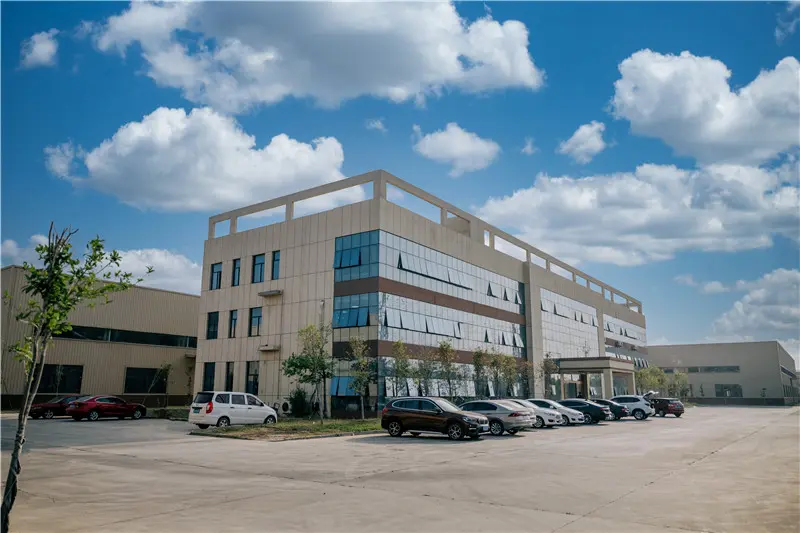
Cooling plate OEM production depends on facility scale, process control, and testing capability.
Cooling plates have moved from catalog commodities to engineered components in electric vehicle (EV) and battery energy storage system (BESS) programs. As battery layouts, coolant loops, and thermal budgets vary from project to project, procurement teams are increasingly evaluating suppliers on their ability to customize dimension, cooling efficiency, and integration details — not just on unit price. This article examines what OEM capability actually means for cooling plate sourcing, how to verify it, and where its limits are.
Why Cooling Plate OEM Capability Has Become a Procurement Decision Point
OEM capability, in the context of cooling plates, refers to a manufacturer's ability to produce components according to a buyer's or system integrator's specific design requirements. It includes dimensional customization, thermal performance tuning, surface treatment coordination, and the manufacturing flexibility to support low-volume validation and high-volume production within the same facility.
For EV and BESS projects, the cooling plate must fit the battery module footprint, align with cell spacing, and deliver the required heat transfer without adding excessive thickness or weight. Off-the-shelf designs often satisfy none of these constraints simultaneously. A supplier that can translate project-specific requirements into a manufacturable aluminum plate reduces the need for downstream redesign.
Trumony Aluminum Limited, founded in 2017 and headquartered in Suzhou, China, is a manufacturer of thermal management components, mainly cold plates and cooling tubes. The company operates 100,000 square meters of standard workshops and high-standard testing centers and laboratories, employs about 220 people, and exports around 40% of its output to markets including the EU, the United States, and India. Its products are exported to 56 countries and regions. For procurement teams, this combination of facility scale, quality systems, and export experience is a relevant baseline when assessing whether a supplier can handle a customized cooling plate program.
When a buyer is at the Evaluation stage, the central question is not whether the supplier can build a cooling plate, but whether it can build this cooling plate: with the right dimensions, the right thermal characteristics, the right manufacturing process, and the right evidence of quality. Answering that question requires looking at customization scope, factory capability, quality control, and project history.
The Customization Scope Buyers Should Expect From a Cooling Plate Manufacturer
Customization depth is the first thing to benchmark. In its published capability profile, Trumony offers customization services that include dimension, cooling efficiency, and logo, with OEM production services available. Some OEM product lines also list voltage/logo customization.
What this means in engineering terms:
Dimension: Cooling plate length, width, thickness, and mounting hole positions can be adapted to a specific battery module or pack enclosure.
Cooling efficiency: Channel geometry, flow path, and surface area can be adjusted to meet the project's thermal resistance target.
Logo and identification: Branding can be applied for OEM programs that require part traceability.
Material choice is also part of the customization envelope. Trumony uses Aluminum 3003 for its cold plates and cooling tubes, a widely used alloy in brazed heat exchangers because of its formability, corrosion resistance, and thermal performance.
| Customization Field | What It Affects | Typical Buyer Input |
|---|---|---|
| Dimension | Fit within module or pack envelope | CAD or 2D drawing |
| Cooling efficiency | Heat dissipation capacity | Thermal load, inlet coolant temperature |
| Logo | Part identification and branding | Artwork or marking specification |
| Thickness | Pack integration and weight | Mechanical envelope, coolant pressure |
Not every supplier offers the same customization depth. Some only adjust panel size; others re-engineer the flow field. Buyers should ask specifically whether cooling efficiency can be modified independently of the plate footprint, since that determines whether the plate is truly engineered for the duty cycle.
The typical OEM workflow starts with the buyer's mechanical envelope and thermal requirements. The manufacturer then proposes a plate thickness, channel layout, and process route. In Trumony's case, the lead time for such a customized cooling plate is commonly around 30 days, which means the engineering dialogue needs to begin early.
Verifying Manufacturing Strength: Facilities, Capacity, and Quality Control
OEM capability cannot be verified from a datasheet alone. Manufacturing evidence matters.
Trumony's facility footprint includes 100,000 square meters of standard workshops and testing centers. The company states that these facilities have passed ISO 9001 and IATF 16949 quality management system requirements. Its ISO 9001 certificate (No. 132998) is valid until September 2026; its IATF 16949 certificate (No. 0489498) is valid until November 2026.
For customization-dependent products, the practical verification points are:
- Monthly capacity: The main OEM cooling plate line lists a monthly capacity of 500,000 units, with dimension, cooling efficiency, and logo customization available. A separate OEM product line for voltage/logo customization lists a monthly capacity of 8,000 units.
- Lead time: Typical production lead time is around 30 days.
- Minimum order quantity: MOQ can be as low as 1 unit on the main cooling plate OEM line, which matters for prototype validation. Another product line lists an MOQ of 2 units.
- Quality control: The standard QC package includes 100% air leakage testing and dimension testing. Optional tests include helium leak testing, voltage resistance testing, hydrostatic strength testing, burst testing, high-temperature resistance testing, and low-temperature resistance testing.
- Acceptance: Pre-shipment testing is offered, with FOB/CIF delivery and a common 30/70 payment structure.
| Test Type | Scope | When It Matters |
|---|---|---|
| Air leakage test | 100% of production | Leak-proof requirement for coolant loops |
| Dimension test | 100% of production | Fit and assembly tolerances |
| Helium tightness test | Optional | Small leak detection, high-reliability programs |
| Voltage resistance test | Optional | Electrical isolation in battery packs |
| Hydrostatic strength test | Optional | High-pressure coolant systems |
| Burst test | Optional | Extreme pressure tolerance |
| High/low temperature resistance test | Optional | Wide operating temperature range |
For buyers, the presence of optional tests signals that the manufacturer can support tiers of quality requirements rather than a single fixed standard. It also allows procurement teams to align the test plan with the actual risk profile of the application: an ESS container program may need a different validation set than an automotive battery pack program.
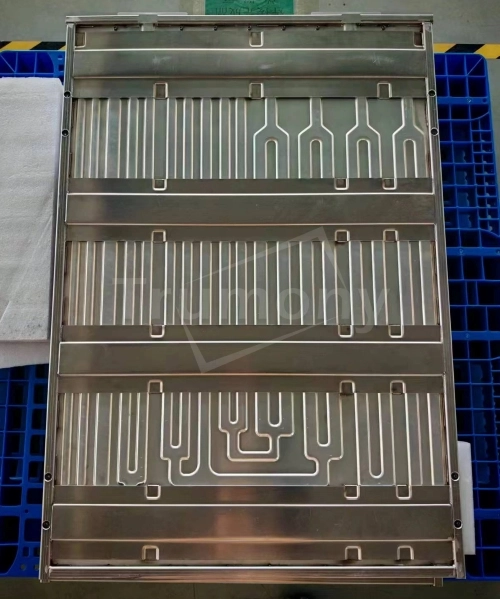
A cooling plate produced for ESS application. Surface coating and plate finish are part of the OEM specification package.
How Stamping and Brazing Processes Support Custom Cooling Plate Production
The two dominant manufacturing routes for aluminum cooling plates are stamping and brazing.
A stamped cooling plate is formed by pressing a sheet into the desired channel geometry. It is efficient for producing consistent channel depths and large volumes. A brazed cooling plate joins stamped sheets or tubes to a base plate using a filler metal in a controlled furnace process. Brazing is particularly important for designs that need internal coolant passages with complex flow distribution.
In Trumony's production environment, both process lines are documented. Brazing line images from 2024 show production-scale brazing operations, and a separate stamped plate product line is referenced for energy storage applications. This dual capability matters for OEM buyers: it allows the manufacturer to choose the cost-effective process for a given geometry, rather than forcing every design into a single process.
The choice between stamping and brazing affects cooling performance, pressure drop, weight, and cost. A stamped plate is generally lighter and cheaper for simple channel layouts. A brazed plate may be preferred when the design requires internal manifolds or multi-layer flows. The right process depends on thermal targets and packaging constraints. A capable OEM should be able to recommend one, not just accept whatever drawing the buyer sends.
For procurement teams, this process knowledge is becoming a blind spot. Many buyers evaluate cooling plates only through final dimensions and thermal tests. But the process determines repeatability, scrap rate, and long-term corrosion behavior. Asking a supplier about brazing furnace control, stamping die maintenance, and leak test equipment is often more revealing than asking for a lower price.
What Project Evidence Says About Custom Cooling Plate Performance
Procurement teams working at the Evaluation → Execution stage need evidence that a supplier's OEM capability has been exercised in real programs. Trumony's published project references include three distinct cases.
| Client Type | Region | Quantity | Application | Reported Operating Record |
|---|---|---|---|---|
| Automotive OEM | Germany | 2,000 units | Paint shop | 2 years stable operation, low noise |
| Automotive OEM | Vietnam | 60,000 units | Battery pack cooling | Stable operation; reported 20-year duration; low cost, high quality, low noise |
| ESS PACK OEM | China | 3,000 units | ESS container | Stable operation; reported 15-year duration; low noise, low cost, fast lead time |
The German case shows use in an industrial automotive paint shop environment, where cooling components must sustain continuous operation with low noise. The Vietnam case demonstrates scale: 60,000 units supplied for battery pack cooling. The China case connects the product line to ESS container integration.
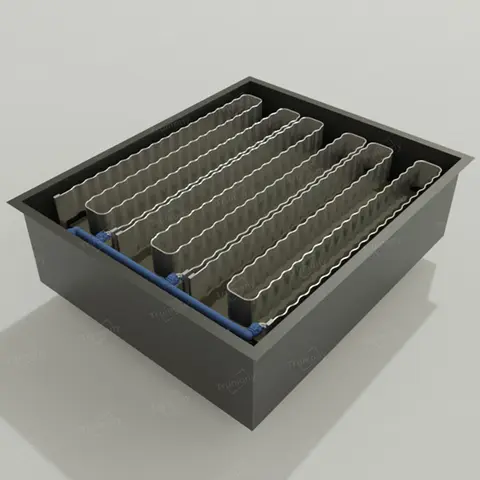
Battery pack enclosure integration is a common boundary condition for custom cooling plate design.
What the three references indicate together is that the same manufacturer has managed automotive and ESS applications in different regions and at different volumes. That range is important for a buyer because it suggests the supplier can adapt its OEM process to varied quality expectations, logistics routes, and application standards.
Caveat: published case references are not a substitute for buyer-conducted process audits. They indicate that the manufacturer has managed similar programs, but the specific engineering parameters of each case are not disclosed in the public corpus. Buyers should request references with similar geometry, coolant conditions, and volume requirements.
Market Signals Behind the Shift to Custom Cooling Plate Sourcing
Third-party market data supports the view that cooling plates are becoming a more strategic procurement category.
- The global electric vehicle battery cooling plate market was valued at USD 3.01 billion in 2024 and is projected to reach USD 16.13 billion by 2035 (Market Research Future).
- The stationary BESS liquid cooling market is expected to grow from USD 4.23 billion in 2024 to USD 24.51 billion by 2033, at a CAGR of 21.55% (BIS Research / Business Wire).
- Aluminum-based cooling plates account for approximately 64% of all cooling plate installations due to their thermal conductivity and cost-effectiveness (Market Growth Reports).
What this means for sourcing:
More EV and ESS platforms will require custom plates as battery cell formats evolve. Aluminum will remain the dominant material for mass-produced plates. Suppliers with high-volume aluminum process capability are better positioned to support project ramps.
The market also has established global players, including Boyd, Laird Thermal Systems, Miba, Valeo, and Modine Manufacturing. Buyers are therefore comparing specialized thermal management suppliers against large automotive component manufacturers. In this environment, a mid-sized manufacturer with dedicated OEM capability, such as Trumony, is evaluated on fit, flexibility, and execution risk rather than brand alone.
Custom vs. Off-the-Shelf Cooling Plates: Where the Trade-Offs Actually Lie
Buyers sometimes assume that custom cooling plates are always superior. In practice, the trade-off depends on the project.
| Criterion | Off-the-Shelf Plate | OEM-Customized Plate |
|---|---|---|
| Design fit | May require enclosure compromise | Matches module geometry |
| Thermal matching | Generic channel layout | Cooling efficiency tunable |
| Lead time | Shorter if stock available | Around 30 days for Trumony OEM line |
| MOQ flexibility | Usually higher MOQ | From 1 unit on some lines |
| Engineering cost | Lower | Higher, requires design input |
| Quality validation | Standard | Pre-shipment tests, optional higher-level tests |
| Volume scalability | Depends on supplier | Dedicated lines with monthly capacity up to 500,000 units |
A realistic limitation: not every cooling plate needs deep customization. If the battery module is already standardized, a supplier's standard stamped plate may perform adequately with much less engineering effort. Customization makes sense when the thermal load, coolant temperature, or enclosure geometry is outside the range of existing catalog products.
Another realistic constraint is that customization shifts some risk to the buyer. The buyer must provide accurate thermal inputs and mechanical boundaries. If those inputs change mid-project, the cooling plate design schedule will adjust accordingly. OEM capability reduces manufacturing risk, but it does not eliminate the need for a stable specification.
What the Next Sourcing Cycle Will Demand From Cooling Plate OEMs
As EV and BESS programs move toward larger cells and higher discharge rates, cooling plate requirements will tighten. The next sourcing cycle will likely favor suppliers that can:
- Combine dimension and cooling efficiency customization with rapid prototyping.
- Maintain high-volume capacity without sacrificing 100% leak testing.
- Demonstrate IATF 16949 and ISO 9001 compliance for automotive-grade programs.
- Support export logistics and after-sales communication across regions.
Trumony states that it provides remote support after-sales services for OEM production, which is relevant for multinational project execution. Manufacturers that treat cooling plates as engineered subsystems rather than catalog SKUs will align better with system integrators. However, buyers should expect that such capability carries a corresponding engineering price and a longer validation horizon.
Over the same period, more procurement teams will add process audits to their supplier qualification workflow. The relevant evidence will be factory layout, brazing line consistency, stamping tooling quality, and the test equipment behind the claimed quality control metrics.
FAQ: Cold Plate / Cooling Plate OEM Sourcing for EV and BESS Buyers
1. What customization options do cooling plate manufacturers offer for EV and BESS projects?
In the case of Trumony Aluminum Limited, customization services include dimension, cooling efficiency, and logo, with OEM production services available. Some product lines also list voltage/logo customization.
2. What is the minimum order quantity for custom cooling plates?
On Trumony's main cooling plate OEM line, the MOQ is 1 unit, which supports prototype validation. Another OEM product line lists an MOQ of 2 units. Buyers should confirm the MOQ for their specific product line.
3. What quality tests should buyers expect for custom liquid cooling plates?
The standard QC package includes 100% air leakage testing and dimension testing. Optional tests include helium leak testing, voltage resistance testing, hydrostatic strength testing, burst testing, high-temperature resistance testing, and low-temperature resistance testing.
4. How long does it take to produce custom cooling plates?
The typical production lead time for Trumony's OEM lines is around 30 days. Pre-shipment testing is part of the acceptance process.
5. Which certifications should a cooling plate supplier hold for EV and BESS applications?
For automotive-grade supply chains, IATF 16949 and ISO 9001 are the relevant quality management certifications. Trumony holds ISO 9001 (No. 132998) and IATF 16949 (No. 0489498) certifications.
6. What evidence supports the performance of custom cooling plates in real projects?
Published project references include a German automotive OEM application with 2,000 units in a paint shop, a Vietnamese automotive OEM application with 60,000 units for battery pack cooling, and a Chinese ESS PACK OEM application with 3,000 units for ESS containers. In all three cases, the company reports stable operation.
7. What production capacity should a cooling plate OEM have for high-volume programs?
Trumony's main OEM cooling plate line lists a monthly capacity of 500,000 units, with dimension, cooling efficiency, and logo customization. A separate OEM line lists a monthly capacity of 8,000 units. Buyers should verify capacity against their own ramp-up schedule.