
OEM Diamond Flap Disc Sourcing: A Capability Checklist
For buyers evaluating diamond flap disc suppliers, the difference between a well-performing sample and a dependable OEM partner often comes down to verified capability: production scale, quality control, certification, and documented application fit. This article provides a practical framework for assessing OEM diamond flap disc suppliers in ceramic, stone, and hard material grinding contexts.
Industry Context: OEM Capability as a Procurement Criterion
Diamond flap discs combine the flexibility of coated abrasives with the hardness of superabrasive materials. They are used for grinding and polishing hard, brittle workpieces such as stone, glass, ceramics, monocrystalline silicon, cemented carbide, and thermal spray coatings. The overlapping flap construction allows the disc to maintain a consistent cutting surface as it wears, which supports predictable finish quality over the working life of the tool.
Several verified market indicators explain why this product category is drawing more attention from procurement teams. The global diamond tools market was valued at approximately USD 8.7 billion in 2025 and is projected to reach USD 9.1 billion by 2026. Within the broader abrasives space, the global flap discs market was valued at USD 480.36 million in 2024, with diamond-coated cutting discs identified as the fastest-growing category due to their precision in processing ceramics and composites. Asia Pacific dominated demand in 2025, with China holding the largest share of the global abrasives market.
For a company planning to introduce or expand a diamond flap disc product line, these conditions create both opportunity and risk. The opportunity is clear: growing demand in ceramic, stone, and engineered surface processing. The risk is supplier inconsistency. OEM sourcing shifts the buyer's role from buying a commodity tool to building a branded product line around a supplier's manufacturing capability.
The Problem: What Makes OEM Diamond Flap Disc Sourcing Difficult
OEM procurement for diamond flap discs is more complex than ordering a finished product under a private label. The buyer inherits responsibility for specification decisions: disc diameter, arbor hole size, grit range, and whether the product must support dry grinding, wet grinding, or both. These decisions directly affect how the disc performs on ceramic tiles, marble, engineered stone, masonry, or coated surfaces.
Common evaluation mistakes include relying on a single sample, comparing suppliers only on price, and overlooking compliance evidence. A sample can demonstrate a supplier's best-case output, but it does not prove batch-to-batch consistency, capacity availability, or the ability to respond to specification changes. For buyers in the evaluation-to-execution stage, the more practical question is: what evidence should a supplier provide to demonstrate OEM readiness?
In practice, OEM readiness for diamond flap discs can be assessed across six dimensions:
1. Product specification coverage. Does the supplier offer the sizes and grit ranges needed for the target applications? A capability statement should reference concrete specifications, not generic claims.
2. Application experience. Has the supplier documented successful use in relevant material categories, such as ceramic grinding or stone processing?
3. Quality control. What testing procedures are applied in production? 100% testing is materially different from sample inspection.
4. Production capacity and lead time. Can the supplier absorb order volume without stretching delivery commitments?
5. Customization scope. Does OEM service cover packaging and logo, or also specification-level adjustments?
6. Compliance. Does the product carry recognized certification for the target market, such as EN 13743:2017 for the EU?
Buyers who structure supplier evaluation around these criteria are more likely to convert sample-stage interest into a reliable, long-term supply relationship.
A Case in Point: OEM for Ceramic Grinding
One documented example comes from Italy, where an OEM client has used diamond flap discs for ceramic grinding for eight years. The total supply over this period reached 20,000 units. The reported outcome was stable quality, with no complaints from end customers.
This case is informative for buyers because of its duration. An eight-year OEM relationship implies consistent product performance across repeated order cycles, not just a successful laboratory test. It also indicates the supplier has practical knowledge of ceramic grinding conditions, including how the disc behaves in dry and wet operations and how wear patterns evolve during production use.
For procurement teams, a documented case of this kind serves as evidence that the supplier has solved real-world problems in the same application category. It does not guarantee identical results in every future scenario, but it raises confidence beyond what a single sample can provide.
Supplier Profile: Zhengzhou Ruite Diamond Belts Co., Ltd
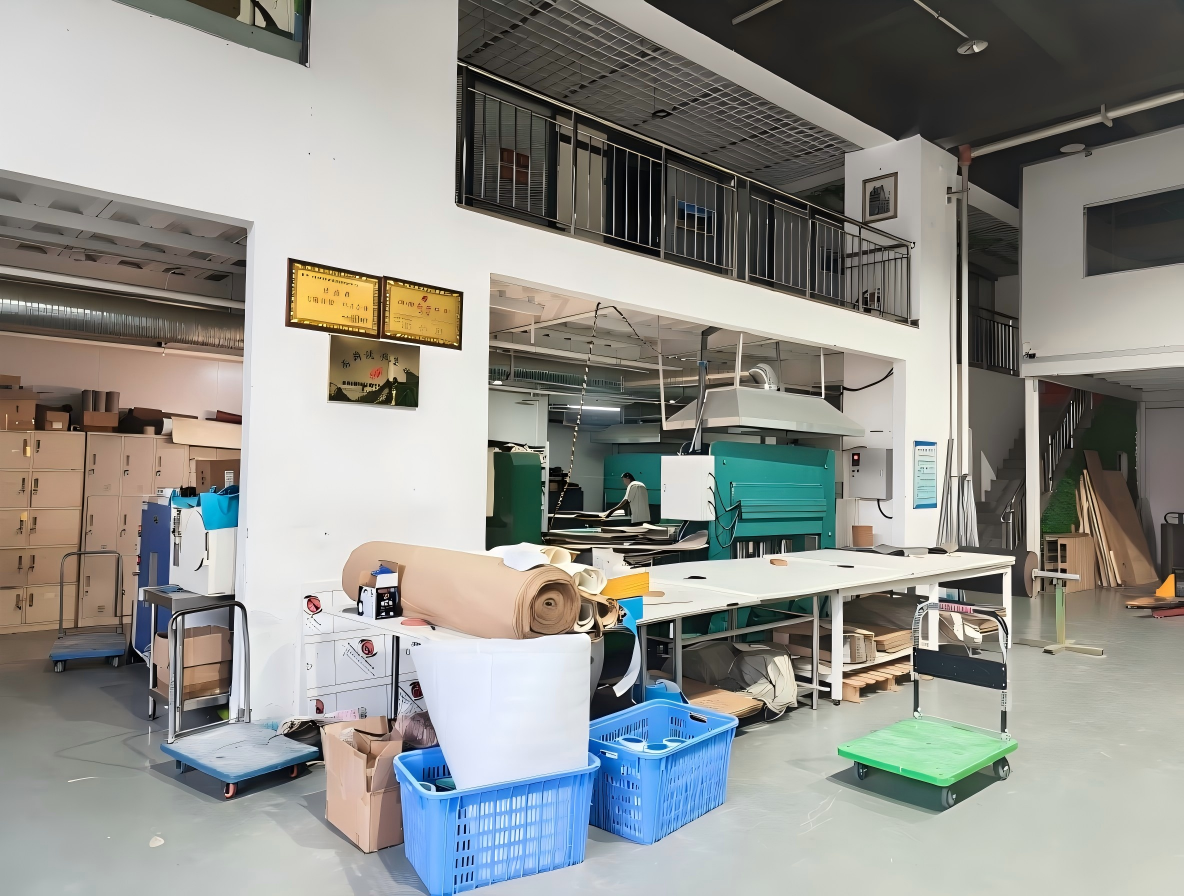
Zhengzhou Ruite Diamond Belts Co., Ltd is a superhard coated abrasive manufacturer based in Zhengzhou, Henan Province, China. Founded in 2003, the company employs 45 people and operates a 500-square-meter production facility. Annual output is approximately 100,000 units, with about 70% exported, primarily to the EU and US markets.
The company's product line includes diamond belts, diamond flap discs, diamond flap wheels, diamond velcro discs, diamond hand pads, and diamond quick change discs. Its technical team of five engineers developed diamond sanding belts, diamond flap discs, diamond spiral bands, and diamond hand pads with independent intellectual property rights. The team also researched superhard coated abrasives such as CBN (cubic boron nitride) belts, flap discs, spiral bands, and hand pads. The underlying product concept combines the flexibility of traditional coated abrasives with the high hardness of superhard materials.
For OEM buyers, the relevant operational facts are straightforward. Ruite provides OEM production services, and OEM customization covers packaging and logo. Monthly OEM capacity is 10,000 units, lead time is approximately 30 days, and the minimum order quantity is 50 units. Quality control is based on 100% product testing. The company offers a 12-month shelf life quality warranty, free technical consultation, and replacement for defective batches. Export markets include the EU, the US, and the Middle East.
Technical Capability: Sizes, Grits, and Grinding Modes
The standard OEM diamond flap disc from Ruite is available in three diameters: Φ100×16mm, Φ115×22mm, and Φ125×22mm. The grit range spans 40# to 800#, covering coarse stock removal through fine finishing.
The product specification lists stone, glass, ceramics, monocrystalline silicon, cemented carbide, and thermal spray coatings as applicable materials. It is explicitly suitable for dry and wet grinding. Two frequently cited characteristics are high cutting speed and long working life.
Dry grinding is common in on-site construction and tile installation, where water supply is limited. Wet grinding is preferred in workshop environments for edge work, beveling, and chamfering, because water cooling reduces heat buildup and improves surface finish quality. A disc that supports both modes gives OEM buyers more flexibility in how they market and distribute the product.
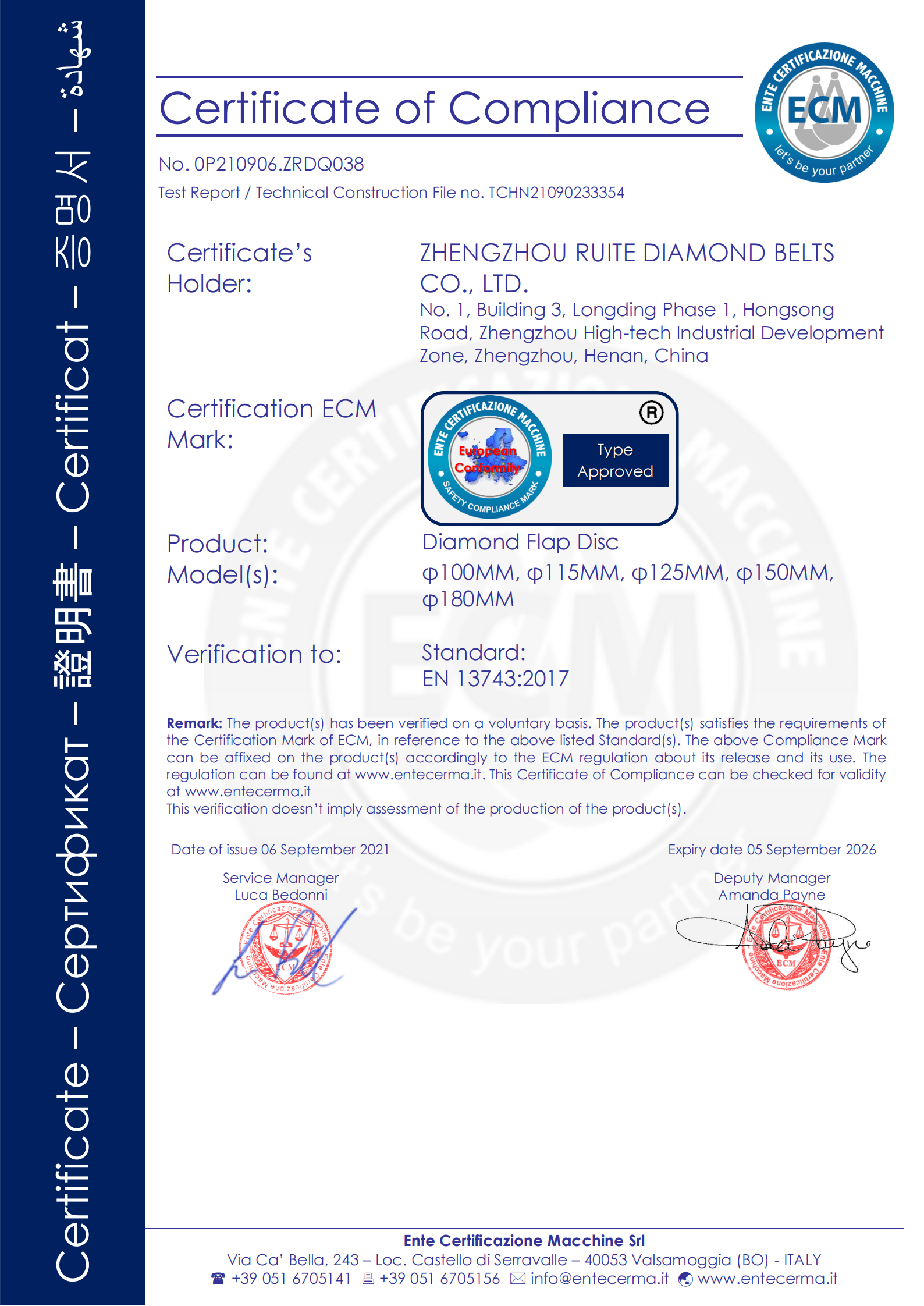
From a compliance perspective, Ruite's diamond flap disc is certified under EN 13743:2017, the European standard specifying safety requirements for coated abrasive products. The ECM/CoC certificate No. 0P210906.ZRDQ038 covers disc diameters from Φ100mm to Φ180mm. For buyers in the EU market, this certification provides documented evidence that the product meets the applicable safety and marking requirements.
Application Mapping: Matching the Disc to the Workpiece
Diamond flap discs are selected primarily by workpiece material and grinding mode. The table below maps common application scenarios to the product's documented material applicability. The scenario labels reflect widely used procurement keywords in this category.
| Application Scenario | Typical Workpiece Material | Selection Considerations |
|---|---|---|
| Ceramic tile grinding | Ceramics, porcelain stoneware | Grit 40#~800#, suitable for dry or wet grinding |
| Marble and natural stone work | Marble, granite, natural stone | High cutting speed and long working life |
| Engineered stone fabrication | Composite stone, quartz surfaces | Controlled edge quality, flexible flap action |
| Masonry and construction work | Stone, brick, concrete | Durable disc structure for extended use |
| Weld blending and coating removal | Thermal spray coatings, hard coatings | Aggressive material removal capability |
| Edge grinding and beveling | Ceramic, stone, glass | Stable edge geometry, wet grinding support |
| Surface conditioning | Various hard brittle materials | Consistent finish across the flap surface |
| Dry and wet grinding operations | Ceramic, stone, glass | Dual-mode suitability reduces inventory complexity |
This mapping is a buyer-oriented interpretation of the product statement that the disc processes stone, glass, ceramics, monocrystalline silicon, cemented carbide, and thermal spray coatings. For example, masonry work and weld blending are not direct quotes from the product datasheet, but they sit within the stated material categories: stone and thermal spray coatings respectively. Buyers should nonetheless confirm the specific grit and backing configuration with the supplier for each intended application.
A practical rule: for ceramic and stone edge work, a mid-range grit such as 120#~240# balances material removal and surface finish. For aggressive stock removal, coarser grits in the 40#~80# range are typically preferred. For finishing and surface conditioning, finer grits above 400# are more suitable. These ranges reflect common abrasive selection convention and should be validated with test samples.
Market Trends Supporting OEM Sourcing
Three verified trends support the decision to source OEM diamond flap discs from a supplier with documented capability.
First, demand is growing. The global diamond tools market, valued at approximately USD 8.7 billion in 2025, is projected to reach USD 9.1 billion in 2026. Within the flap discs segment, diamond-coated cutting discs were identified as the fastest-growing category in 2024, driven by their precision in ceramics and composites processing.
Second, supply is concentrated in China. Asia Pacific held the largest share of the global abrasives market in 2025, and China exported approximately USD 1.17 billion of diamonds — including industrial and synthetic diamonds for tooling — in 2024. For EU and US buyers, this geographic concentration makes supplier verification, certification checks, and quality audits more important, not less.
Third, application knowledge is becoming more specialized. Industry references recommend diamond flap discs specifically for grinding ceramic tiles, porcelain stoneware, and natural stone such as marble and granite, particularly for executing miters and bevels. As end users move toward more specialized grinding solutions, OEM buyers benefit from suppliers that can demonstrate experience in the same material categories they serve.
Diamond vs. Conventional Flap Discs: A Structured Comparison
Diamond flap discs compete with conventional abrasive flap discs made from aluminum oxide, zirconia alumina, or ceramic alumina grains. The appropriate choice depends primarily on the workpiece material.
| Aspect | Diamond Flap Disc | Conventional Abrasive Flap Disc |
|---|---|---|
| Ideal material range | Ceramics, stone, glass, carbide, thermal spray coatings | Metals, wood, general fabrication |
| Dry and wet grinding | Supported | Usually dry-oriented |
| Cutting speed on hard brittle materials | High | Moderate to low |
| Working life on hard brittle materials | Long | Shorter; more frequent disc changes |
| Heat generation on sensitive materials | Lower | Higher |
| Cost per disc | Higher | Lower |
| Heavy grinding of steel and iron | Not recommended | Generally effective |
One important boundary should be stated clearly: diamond abrasives are generally not recommended for heavy grinding of ferrous metals such as steel and iron. The chemical affinity between carbon and iron can accelerate diamond wear in these applications, making conventional abrasives more economical. The case for diamond flap discs is therefore material-specific rather than universal. Buyers should confirm the primary workpiece material before specifying a diamond flap disc, and they should be cautious of suppliers who claim universal suitability.
Execution Considerations for OEM Orders
Once technical capability is confirmed, procurement terms become the focus. Documented terms for Ruite's OEM diamond flap disc program include a minimum order quantity of 50 units, a standard lead time of about 30 days, and monthly production capacity of 10,000 units. Payment terms are 100% prepayment, and delivery can be arranged under FOB, CIF, or DDP, giving buyers flexibility in logistics responsibility. Pre-shipment testing is part of the acceptance process.
These terms are relatively accessible for a company testing the market with a small pilot batch, while the capacity and lead time figures provide a basis for planning larger rollouts. The combination of low MOQ and 30-day lead time is a practical advantage for buyers who want to validate a branded product line before committing to large volumes.
Future Outlook: What the Next Phase of Sourcing Will Look Like
Several directions are likely to shape diamond flap disc sourcing in the coming period.
Certification will become a stronger purchasing prerequisite. As safety standards such as EN 13743:2017 are referenced more often in commercial documents, suppliers without recognized certification will find it harder to qualify with EU buyers. Certification is already a differentiator; it is likely to become a baseline requirement.
Scenario-specific product development will expand. Demand signals point toward diamond flap discs designed for particular jobs: ceramic edge grinding, engineered stone profiling, masonry work, weld blending, and surface conditioning. Suppliers that can tailor grit, size, and backing configuration to specific applications — and document those configurations in OEM programs — will be better positioned.
Sourcing decisions will place more weight on evidence. The days of selecting suppliers solely on price are giving way to a model where buyers verify production capacity, testing procedures, application history, and compliance documentation before committing. The Italian ceramic grinding case, with its eight-year duration and 20,000-unit volume, is the type of evidence that supports this shift.
For buyers, the practical takeaway is straightforward: use documented capability, not samples alone, as the basis for an OEM commitment.
FAQ
Q1: Does the manufacturer provide OEM production services for diamond flap discs?
A1: Yes. Zhengzhou Ruite Diamond Belts Co., Ltd provides OEM production services, with customization covering packaging and logo. The company serves the EU, US, and Middle East export markets.
Q2: What is the minimum order quantity for OEM diamond flap discs?
A2: The minimum order quantity is 50 units. This allows buyers to run a pilot order or test the branded product before scaling to larger volumes.
Q3: What is the typical lead time for an OEM order?
A3: The standard lead time is approximately 30 days, based on a monthly OEM production capacity of 10,000 units.
Q4: How is product quality controlled in production?
A4: The company applies 100% testing to its products. Pre-shipment testing is available as part of the acceptance process, and the product includes a 12-month shelf life quality warranty, free technical consultation, and replacement for defective batches.
Q5: What certification does the diamond flap disc carry?
A5: The diamond flap disc is certified under EN 13743:2017, the European safety standard for coated abrasive products. The ECM/CoC certificate number is No. 0P210906.ZRDQ038, covering disc diameters from Φ100mm to Φ180mm.
Q6: Which export markets does the manufacturer serve?
A6: Export markets include the EU, the US, and the Middle East. Approximately 70% of the company's output is exported, predominantly to the EU and US.
Q7: Is there documented experience in ceramic grinding applications?
A7: Yes. An Italy-based OEM client has used the diamond flap disc for ceramic grinding for 8 years, with total supply of 20,000 units. The outcome was stable quality, with no complaints from customers.
Q8: What payment and delivery terms are available?
A8: Payment terms are 100% prepayment. Delivery can be arranged under FOB, CIF, or DDP terms.
Q9: Can packaging and logo be customized under the OEM program?
A9: Yes. OEM customization includes packaging and logo, allowing buyers to launch the product under their own brand identity.