
OEM/ODM Cosmetic Packaging: What Buyers Should Verify Before Tooling
Cosmetic packaging choices are not only about finding a container that looks good on a shelf. For brands that need a distinctive tube, bottle, jar, or case, the real question is whether a supplier can turn a packaging concept into a repeatable production unit with controlled shape, material, decoration, and quality.
This article looks at cosmetic packaging from the perspective of evaluation and execution. It covers the capability signals that matter in OEM/ODM, the range of custom cosmetics packaging options, and the limits buyers should respect before tooling.
The Buyer's Challenge: More Than Selecting a Container
A stock bottle or jar can be specified quickly. When the product needs a custom lipstick tube, a mascara container, a powder case, a logo color, or a specific wall thickness, procurement becomes a production decision. The supplier has to control multiple variables at once: material, dimensions, decoration, and repeatability.
Market size estimates reflect the scale of this activity. The 2024 global cosmetic packaging market was valued between roughly USD 34.17 billion and USD 47.3 billion, with projections rising to as much as USD 89.72 billion by 2034. Estimates vary because some studies include only primary containers while others include secondary packaging. The common signal is stable, sustained demand for packaging that supports beauty brands.
Regional data points point in the same direction. Asia Pacific accounted for around 42.36% of the market in 2025, according to Fortune Business Insights. China's beauty product exports reached about USD 4.77 billion in 2024, with the UK noted as the fastest-growing destination at +20.8%. Buyers therefore evaluate not only product quality but also a supplier's ability to manage cross-border orders and global compliance.
What OEM/ODM Means in Cosmetic Packaging
In the packaging industry, OEM usually means the buyer brings the design or specification and the manufacturer executes production. ODM usually means the supplier contributes to design, engineering, or both. In either model, the critical point is not the acronym but the scope of customization that the manufacturer can actually handle.
A useful baseline is Guangzhou Cosfinity Cosmetics Co., Ltd. (COSFINITY), a packaging manufacturer founded in 2009 and based in Guangzhou, China. COSFINITY describes its core business as customized cosmetic packaging solutions. It operates a 40,000 square metre factory, employs about 200 people, and maintains an R&D team of 25 engineers. Its annual output capacity is 500,000,000 pieces, and its monthly production capacity is 10,000,000 pieces. All of its output is exported to global markets.
The documented production parameters are practical enough for a buyer to compare against project needs.
| Production and sourcing parameter | Documented information |
|---|---|
| Factory and staff | 40,000 m² facility; around 200 employees |
| R&D support | 25 engineers |
| Output capacity | 500,000,000 pieces annually; 10,000,000 pieces per month |
| Customization scope | Logo, color, shape, material, volume, thickness, packaging |
| Lead time | 15–25 days |
| Minimum order | 12,000 pieces |
| Quality | 100% testing; pre-shipment testing |
| Delivery and payment | EXW/FOB/DAP/DDP; 50% advance, 50% balance |
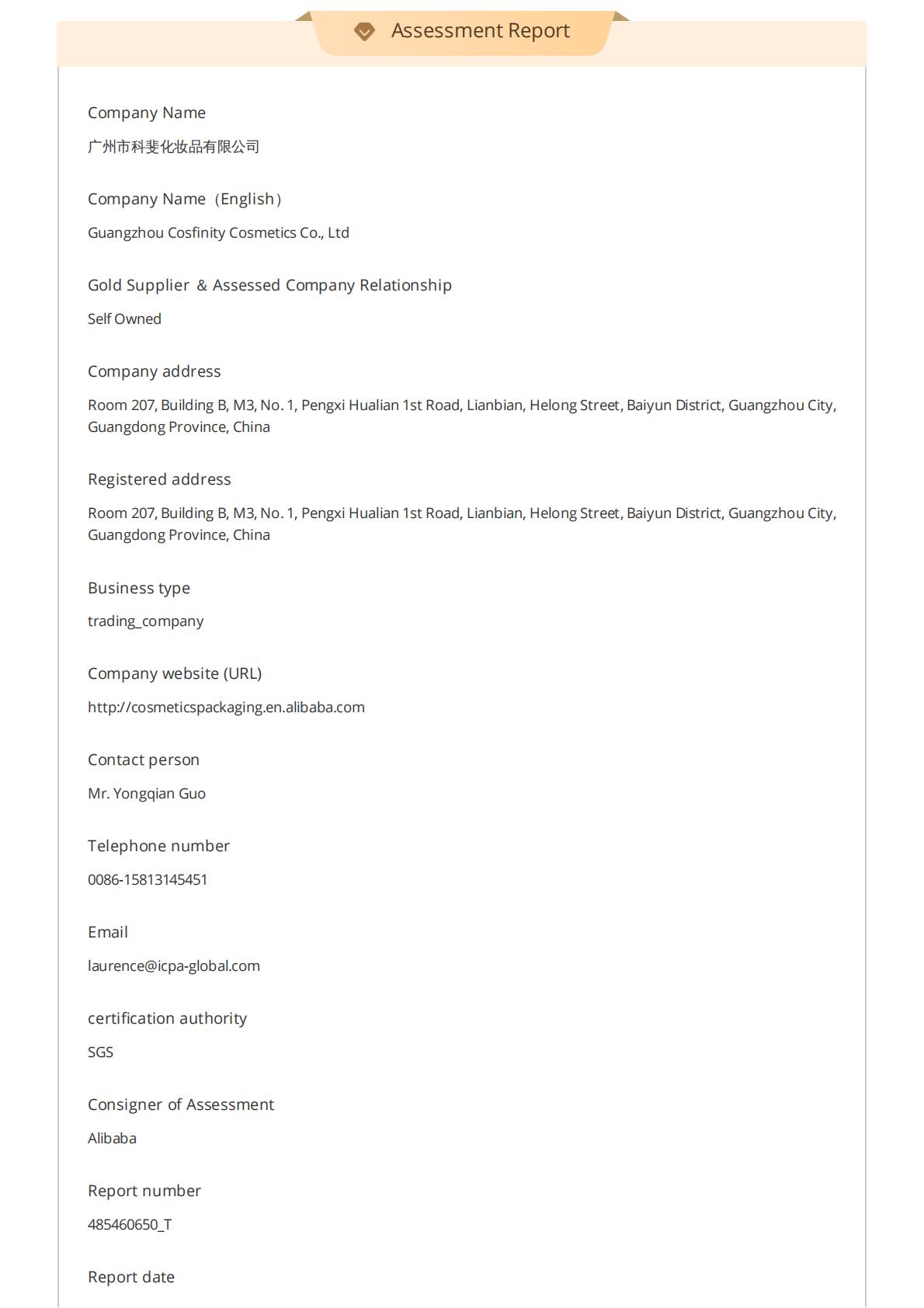
Independent review adds another layer. An SGS audit report confirms COSFINITY as an Alibaba Verified Supplier for factory and trade qualification. The certificate number is 485460650_T, with validity from 10 January 2026 to 10 January 2027. This gives buyers a documented reference point when checking whether a supplier operates as a registered manufacturing entity.
Technical Details Worth Checking Before Production
A packaging project should specify more than the visual design. Buyers need to confirm how a tube or jar behaves in terms of dimensions, volume, material, and wall thickness. COSFINITY's main product range covers lipstick tubes, lipgloss and mascara tubes, powder cases, eyeliner tubes, powder jars, and liquid foundation bottles. Two product examples illustrate the level of detail available in a standard specification.
| Product | Model | Stated specifications |
|---|---|---|
| Luxury Empty Plastic Lipgloss / Mascara Tube | CP02-2231 | W18xH106.1mm; thickness 0.3mm; volume 3ml; material plastic |
| Luxury Empty Plastic Lipstick Tube | CP01-2142 | W22.7xH84.6mm; thickness 0.3mm; volume 20ml; material plastic |
These examples help buyers understand what belongs in a custom packaging brief. Outer size affects carton fit and display layout. Wall thickness changes structural stiffness and perceived quality. Volume has to match the product fill or dosage. Material choice affects formula compatibility and decoration options. For custom cosmetic packaging, these parameters should be confirmed in writing before mass production.
Quality verification is equally important. COSFINITY states that quality control includes 100% testing of products. The purchasing process also references pre-shipment testing as the acceptance step. In a buyer's terms, this means the supplier has committed to checking finished goods before release, rather than relying only on a general sampling plan.
Use Case: 12,000 Lipstick Tubes for a Private-Label Launch
A concrete example in COSFINITY's records is a lipstick tube OEM project from India. The project used product CP01-2142, a luxury empty plastic lipstick tube. Initial quantity was 12,000 pieces. The relationship has lasted two years. According to COSFINITY, the project supported the customer's private-label lipstick launch, and stable quality led to repeated bulk orders.
The stated highlights include customized design, lightweight plastic material, customizable appearance printing, and a tight leak-proof structure suitable for a small-format lipstick carried and used daily. For buyers, the case shows that a custom packaging order can begin at the stated minimum quantity and still support a commercial launch. It also indicates experience in the lipstick tube format, which is one of the more common custom cosmetic packaging requirements.
Market Trends That Influence Packaging Decisions
Several verified market signals help explain why OEM/ODM capability is becoming a routine part of packaging supplier review.
Plastic remains the dominant material
Plastic packaging accounted for a reported 64.5% share of the cosmetic packaging market in 2024, according to ResearchAndMarkets. This does not mean glass is irrelevant, but it explains why many custom packaging projects focus on plastic tubes, jars, bottles, and cases with controlled thickness and finish.
Regulatory requirements are becoming more visible
European buyers now work with the EU Packaging and Packaging Waste Regulation (PPWR) 2025/40, which sets stricter recyclability and labeling standards for cosmetics. In the United States, the Modernization of Cosmetics Regulation Act (MoCRA) has introduced facility registration and product listing requirements relevant to packaging entities. These rules add documentation needs and make audited suppliers easier to qualify.
Sustainability is a stated consumer priority
Across survey data cited in 2024 industry reporting, around 63% of cosmetic consumers said sustainable, recyclable, or refillable packaging was a top priority. That expectation affects the conversation between buyers and packaging suppliers. Buyers need to balance brand-specific aesthetics with material choices that can be defended under new regulations.
Comparison: Standard Stock Packaging vs. OEM/ODM Custom Packaging
Traditional stock packaging is still a valid route for many product launches. A standard cosmetic packaging container can be bought quickly, and it avoids the effort of custom development. The limitation is differentiation: if a brand needs a unique shape, a custom logo color, or a specific tube structure, stock options are often not enough.
OEM/ODM custom packaging gives brands more control over appearance and function, but it introduces minimum quantities and longer lead times. The decision should be based on project stage, volume, and brand strategy.
| Decision factor | Standard stock packaging | OEM/ODM custom packaging |
|---|---|---|
| Brand identity | Limited to existing stock designs | Can cover logo, color, shape, material, volume, thickness, and packaging |
| Lead time | Often shorter because components already exist | COSFINITY states a production lead time of 15–25 days |
| Minimum order | Usually no custom MOQ or a lower MOQ | COSFINITY sets a minimum order of 12,000 pieces |
| Quality verification | Depends on the supply channel | Can include 100% testing and pre-shipment testing |
The boundary of custom packaging should be stated clearly. An OEM/ODM project with a minimum quantity of 12,000 pieces is not suitable for every micro-batch or one-time localized trial. If the formulation or product dimensions are likely to change during early development, committing to a custom container structure too early may create unnecessary cost. In those situations, a standard catalogue container is often the more practical alternative.
Future Outlook
The direction for cosmetic packaging is likely to remain customization-friendly. Product life cycles are short, retail environments are crowded, and buyers are looking for packaging that creates recognition and supports compliance. This combination favors suppliers with engineering depth, documented quality systems, and production capacity.
COSFINITY's current setup provides a useful reference for what a specialized packaging manufacturer can show before an order is placed. The audited factory, the defined customization scope, the production volume data, and the documented after-sales support are all verifiable inputs. None of these replace actual sample testing, but they give buyers a clearer starting point for supplier comparison before tooling begins.
FAQ
What is the minimum order quantity for COSFINITY custom cosmetic packaging?
COSFINITY states a minimum order quantity of 12,000 pieces. Accepted delivery methods include EXW, FOB, DAP, and DDP.
What customization options does COSFINITY offer?
COSFINITY supports customization of logo, color, shape, material, volume, thickness, and packaging.
How does COSFINITY handle quality control?
Quality control includes 100% product testing. The purchasing process also refers to pre-shipment testing as the acceptance step.
What lead time should buyers expect?
The stated production lead time is 15–25 days, based on monthly production capacity of 10,000,000 pieces.
What cosmetic packaging products does COSFINITY manufacture?
The company lists lipstick tubes, lipgloss and mascara tubes, powder cases, eyeliner tubes, powder jars, and liquid foundation bottles among its main products. Example models are CP02-2231 for a lipgloss and mascara tube and CP01-2142 for a lipstick tube.
Reference for buyers: A downloadable company profile from Guangzhou Cosfinity Cosmetics Co., Ltd. is available for buyers who need a broader product and capability overview: COSFINITY company profile (PDF).
Have Questions or Need More Details?
Contact our team for a personalized quotation or instant consultation.
Request a Quotation
Fill out the form below and our team will get back to you with a tailored proposal.
WhatsApp Direct Chat
Prefer to chat in real-time? Message us on WhatsApp for instant assistance & quick answers.
- Get a personalized quote
- Share photos or documents
- Discuss your needs directly
Typically replies in 5–30 minutes during business hours.