
OEM/ODM Rotary Screw Compressor Supply: UMW Air Factory Evidence
OEM/ODM Rotary Screw Compressor Supply: UMW Air Factory Evidence
A rotary screw air compressor order is rarely lost on the specification sheet. It is lost in the gap between a quoted configuration and a factory's ability to reproduce that configuration on the fifth order as reliably as on the first — at the agreed voltage, with the agreed labelling, tested to the same routine, and delivered inside the promised window. For importers, distributors and private-label brand owners, that reproducibility is the product being purchased.
Shandong UMW Air Tech Co., Ltd, which trades as UMW Air, is a compressor manufacturer based at 68 Gongye South Road, Jinan, Shandong, China. Founded in 2019, the company builds screw air compressors across air-cooled, direct-driven, stationary, diesel mobile and heavy-duty ranges, and reports a 100% export orientation serving the EU, USA, Southeast Asia, Middle East, South America and Africa. Its website is umwair.com.
This industry reference examines the factory-side evidence behind UMW Air's OEM/ODM offer — production mode, customization scope, monthly capacity, quoted lead time, pre-shipment testing and after-sales structure — and translates those facts into the questions a procurement team should ask. Where the recorded evidence has boundaries, those boundaries are stated as plainly as the strengths, because a supply-partner assessment that lists only advantages is of little use in a sourcing decision.
Why Factory Evidence Outweighs the Datasheet in Screw Compressor Sourcing
Supply-side risk in compressed air projects concentrates in four predictable places: whether the seller is actually the manufacturer, whether the customization scope is documented rather than implied, whether the capacity claim is consistent across the company's own figures, and whether units are tested before they leave the plant. Each of these can be answered with evidence instead of assurances.
For buyers working between the research and evaluation stages, the useful distinction is between a capability statement and a capability record. A capability statement says a factory offers OEM production. A capability record names the customization variables, the monthly capacity figure, the lead time, the minimum order quantity, and the exact point in the process at which quality control happens. UMW Air's published capability data falls into the second category, which is what makes it usable as an evaluation input even before a site visit is scheduled.
The distinction matters most for buyers who are not purchasing a single machine. A distributor building a private-label compressor line, an importer running repeat orders into the EU or the Middle East, and an OEM buyer integrating a compressor into a packaged system all depend on configuration discipline that survives order number five. That is a process question, and process questions are answered by evidence, not by catalogue photography.
The UMW Air OEM/ODM Setup: What Is Documented
UMW Air's recorded production capability covers two modes — OEM and ODM — with customization documented across three variables: colour, logo and voltage. Monthly capacity is recorded at 1000 units, lead time at 3 days, and minimum order quantity at 1 unit. Quality control is recorded as factory pre-shipment testing. Export markets are listed as the EU, US, Middle East and Southeast Asia, and after-sales support is recorded as 24/7 technical support by email or phone, including remote troubleshooting and guidance.
| Recorded item | UMW Air figure | Procurement reading |
|---|---|---|
| Production modes | OEM, ODM | Buyer branding and specification control handled at factory level |
| Customization variables | Colour, logo, voltage | Suited to multi-market distribution where grid voltage and branding differ |
| Monthly capacity | 1000 units | Scheduling input for repeat-order planning |
| Annual output | 12,000 units | Consistent with the monthly figure (1000 x 12) |
| Lead time | 3 days | Production-mode figure; confirm start point and destination transit separately |
| Minimum order quantity | 1 unit | Allows a validation order before volume commitment |
| Quality control | Factory pre-shipment testing | Test point is defined; test scope should be confirmed per order |
| After-sales | 24/7 technical support by email or phone; remote troubleshooting | Relevant for importers without a local service team |
| Facility | 2,000 sq m; 200 employees; 40-person R&D team | Compact, focused plant; capacity credibility rests on throughput, not footprint |
Two of these figures reinforce each other. An annual output of 12,000 units and a monthly capacity of 1000 units describe the same throughput, which is a small but genuinely useful consistency signal: the published capacity is internally coherent rather than a marketing peak. For a buyer, the practical follow-up is allocation — how much of that monthly capacity is already committed, and what portion can be reserved against a specific delivery programme.
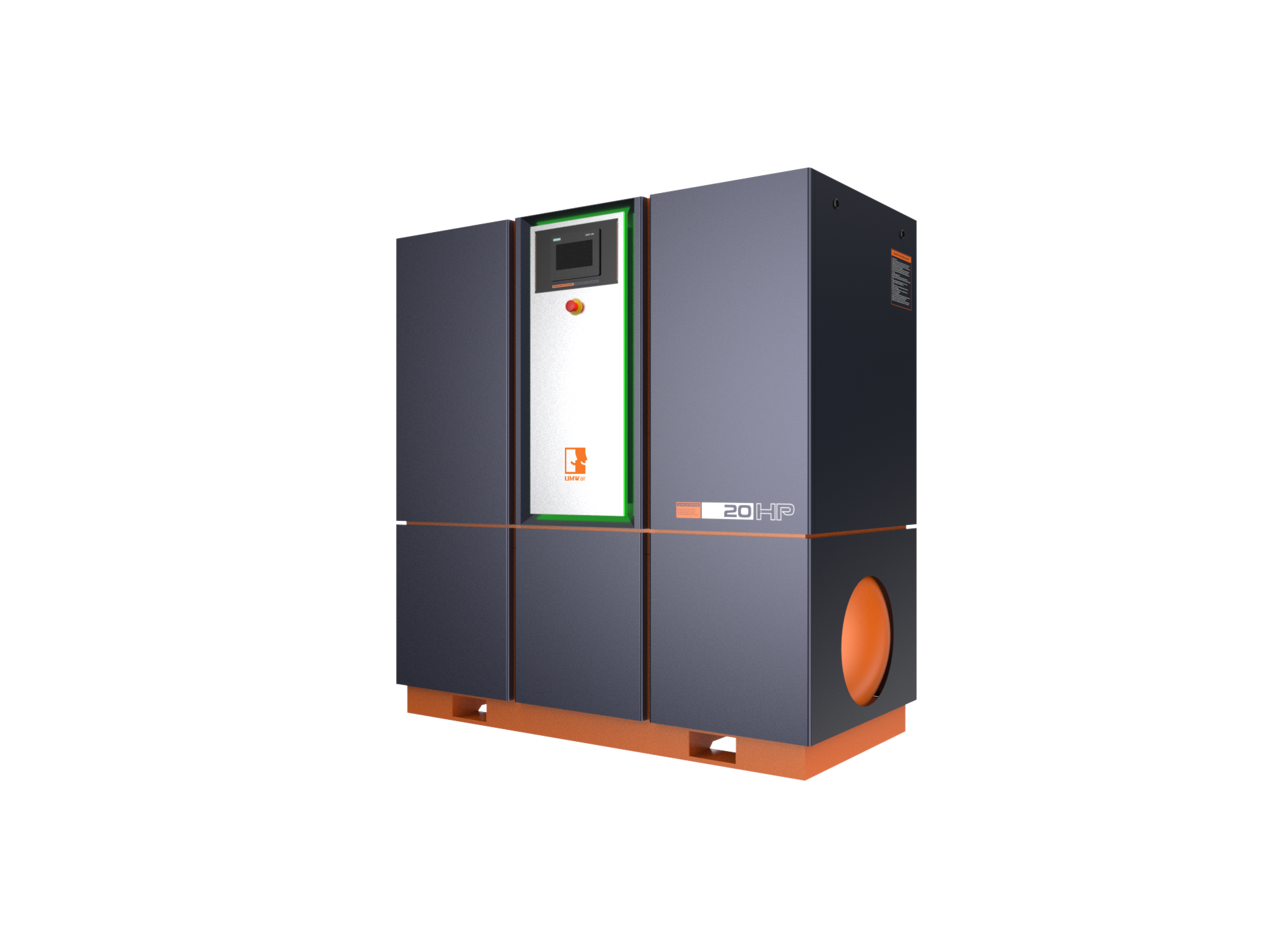
Screw air compressor unit from UMW Air's OEM/ODM production range, the configuration class used for distributor and private-label supply programmes.
Reading Lead Time, Capacity and MOQ the Way a Buyer Should
A 3-day lead time and a 1-unit MOQ are attractive numbers, but they answer different questions than most buyers assume when they appear on a supplier capability sheet.
What the 3-day lead time does and does not cover
The recorded 3-day lead time is tied to the OEM/ODM production mode. Buyers should confirm three points: when the clock starts — order confirmation, deposit received, or artwork approval for colour and logo customization; whether a configuration change affects the schedule; and how the production window relates to freight transit and customs clearance, which sit outside the factory's control. Voltage customization is itself a configuration variable, so the sensible question is whether a non-standard voltage request is inside or outside the standard 3-day window.
Why a 1-unit MOQ functions as a validation tool
A minimum order quantity of 1 unit means a distributor or brand owner can run a validation order before committing to a programme — useful for checking documentation, packaging, labelling and unit behaviour in the destination market. It does not mean that a single-unit order carries the cost structure of a container order. MOQ and unit economics are separate variables, and both belong in the same commercial conversation rather than two different ones.
Where 1000 units per month fits
A monthly capacity of 1000 units supports repeat-order planning for distribution programmes, but it is finite and shared across the order book. A programme requiring a large share of that capacity should be scheduled rather than assumed. For most importers and OEM buyers, the more decision-relevant question is not the headline figure but whether the capacity is reachable under a signed delivery plan, and what happens to that plan when demand in other markets rises.
Technical Explanation: What the Recorded Specification Supports
The screw air compressor range is recorded with the models ML-7.5/8A, L-7.5/8A, L-1516A and L-2216A, and with configuration types described as integrated, split or separate, portable and fixed. The recorded specification envelope is 4–355 kW of power, 8–25 bar of pressure, 2.39 m³/min of airflow, air cooling, direct drive and an IE4 motor.
Three of those attributes carry practical weight for a plant engineer. Direct drive couples the motor to the air end without a belt, which removes a wear item and a maintenance interval from the schedule. An IE4 motor sits above the IE3 efficiency class, which matters in continuous-duty operation where motor losses accumulate over thousands of running hours. Air cooling means the installation does not require a cooling water circuit, which simplifies retrofits into existing workshops and suits sites where water treatment is unavailable or unwelcome.
The pressure band also deserves attention because it is broad. The 8–25 bar range covers ordinary plant air as well as higher-pressure duties; the 1.6 MPa (approximately 232 PSI) figure associated with fibre laser assist gas falls inside that band. A smaller series, described as the Micro range, is recorded with models Micro ML-4A, Micro ML-5.5A and Micro ML-7.5A at 4 kW, 5.5 kW and 7.5 kW, maximum airflow of 1.1 m³/min, pressure of 8–13 bar, a 140 L receiver tank and a single-stage screw air end. That envelope suits a workshop where the compressor is a standalone utility rather than part of a central plant system.
Two technical points should be separated from specification marketing. First, 2.39 m³/min is a single recorded airflow figure within a range that spans 4 kW to 355 kW, so buyers should confirm the flow value for the exact model and discharge pressure they intend to operate — flow, pressure and power are interdependent in screw compressor selection and cannot be read independently. Second, the matched-equipment list for the application scenario includes an air dryer, air tank, line filter, inverter and controller. Whether a project needs all five depends on the process: a CNC workshop may run a dryer-and-filter train, while a laser cutting installation needs filtration sized to protect the optics.
What this article cannot do is confirm attributes that are not in the recorded data — oil-free construction, IP-rated enclosures, PLC control architecture or specific compliance marks. These are common items in buyer specifications, and the correct treatment is to request them per model from the supplier's technical documentation rather than infer them from a range description. ISO 8573-1:2010, which defines compressed air purity classes for particles, water and oil, is the standard most food and pharmaceutical buyers reference when they set that requirement, and it belongs in the enquiry document rather than in a general product description.
Application Fit: Where These Units Are Designed to Work
The recorded application scope covers CNC machinery production lines, automotive parts production lines, plastic processing line expansion, industrial automation integration, and food and beverage packaging line setup. Listed industries include metal processing, plastics, automotive parts, electronics manufacturing, food packaging, construction materials, chemicals and energy. Operating mode is continuous, the design environment is described as high-temperature or humid, and special requirements are recorded as energy saving, low noise, environmental performance and high reliability.
| Application | Recorded requirement | Selection implication |
|---|---|---|
| CNC machining line | 90–120 PSI (6–8 bar) working pressure; 5–30 CFM depending on machine size | Standard pressure band; sum all machines on the line before sizing |
| Fibre laser cutting (air assist) | Pressures up to 1.6 MPa (approx. 232 PSI) with integrated filtration to prevent lens contamination | High-pressure configuration plus filtration; the recorded 8–25 bar band covers the pressure figure |
| Food and beverage packaging | ISO 8573-1:2010 purity classes for particles, water and oil | Dryer and filter train selection is driven by the target purity class, not by compressor size alone |
| Distribution / private-label programme | Colour, logo and voltage customization; MOQ of 1 unit | Validation order first, then repeat-order scheduling |
| Mobile or remote worksites | Portable and diesel mobile types recorded within the range | Fixed plant installation is not required |
A recorded case from a CNC machining workshop in Vietnam shows how the scenario reads in practice. Three units were supplied to drive CNC machine actuators, pneumatic tools and dust removal systems. After one year of operation, the recorded outcome is a 20% improvement in production efficiency, reduced downtime and a stable air supply, with low energy consumption, easy maintenance and reliable long-term performance noted as highlights. For a procurement reader that result is a data point rather than a guarantee: a single installation, running a specific duty cycle under a specific maintenance regime, does not transfer automatically to a different plant. Its real value is in confirming that this equipment class is being applied to tasks — intermittent actuator demand, dust extraction, hand tools — where screw compressors are conventionally specified.
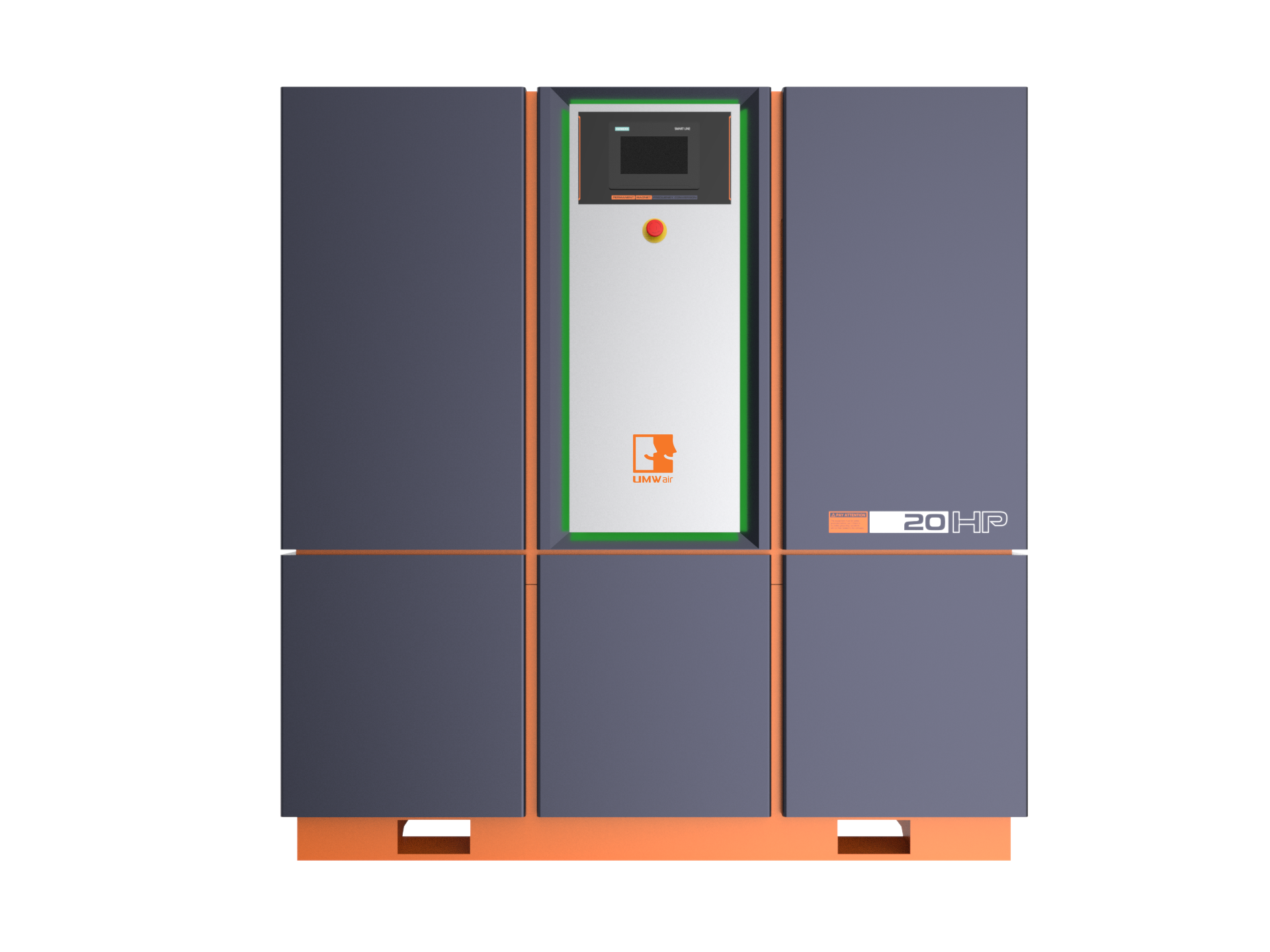
UMW Air screw compressor packaged for continuous-duty industrial supply, the operating mode recorded for CNC, automotive parts, plastics and food packaging lines.
Market Context: Where Rotary Screw Demand Sits
Third-party data places the category in a steady expansion phase. The global rotary screw compressor market was estimated at USD 12.5 billion in 2024 and is expected to reach USD 13.3 billion in 2025, according to Custom Market Insights. Within that market, the stationary rotary screw air compressor segment dominated in 2025, accounting for approximately 67.6% of technology share, based on MarketsandMarkets data. Grand View Research places Asia Pacific as the largest regional market for rotary air compressors at 43.7% in 2025, with China as the leading country in the region. The same source set reports that oil-filled rotary screw compressors accounted for 61.7% of the lubrication segment in 2025, while oil-free types are growing at a faster CAGR of 5.4%. Established suppliers in the category include Atlas Copco AB, Ingersoll Rand Inc., Kaeser Compressors and Sullair LLC, per Custom Market Insights.
Market-size estimates for this category should be read with scope in mind. Published 2024 figures range from a screw-only estimate of roughly USD 5.1 billion to a total air compressor market figure of USD 18.04 billion, depending on whether a report counts screw technology alone or the wider compressor category. The direction of the trend is consistent across sources; the absolute number is not. A buyer using market data to justify a capacity investment should anchor the decision to measured air demand on site rather than to a category total.
The stationary share figure is the more decision-relevant of the two. It confirms that fixed, plant-mounted screw compressors — the configuration UMW Air builds in integrated, split and fixed formats — remain the dominant technology in industrial compressed air, which is why factory-side evidence about reproducibility and lead time carries more weight than a one-off price comparison.
Comparison: Factory-Direct OEM/ODM Against Traditional Supply Routes
Three sourcing structures recur in compressor procurement: purchase through a global brand's authorized channel, purchase through a trading intermediary or sourcing agent, and purchase factory-direct under an OEM/ODM arrangement. Each distributes responsibility differently across branding, configuration control, documentation and service.
| Dimension | Global brand channel | Trading intermediary | Factory-direct OEM/ODM (UMW Air as documented) |
|---|---|---|---|
| Product branding | Manufacturer's brand | Manufacturer's or buyer's brand | Colour, logo and voltage customization recorded |
| Minimum order | Typically set by the channel | Varies | Documented at 1 unit |
| Configuration control | Within standard catalogue and options | Dependent on the supplier relationship | Buyer specifies within the documented customization variables |
| Documentation responsibility | Mainly with the brand | Shared, often unclear | Buyer-led; supplier provides technical and test documentation |
| After-sales structure | Local service network in major markets | Routed through the intermediary | 24/7 technical support by email or phone with remote troubleshooting |
| Typical fit | Standardized single-site projects | Small, ad hoc purchases | Repeat-order distribution programmes and private-label lines |
Boundaries a buyer should weigh before choosing factory-direct supply:
- Customization scope is defined, not open-ended. UMW Air records colour, logo and voltage as customizable. That is a real and useful scope for distribution programmes, but it is not the same as custom engineering of the compression element, control system or package layout. Where a project needs a non-standard package, the question of whether the requirement sits inside or outside the recorded scope should be settled in writing before contract.
- Capacity is finite and shared. A monthly capacity of 1000 units supports programme planning but is not reserved for a single customer. Large multi-month programmes need scheduling commitments rather than assumptions.
- Plant size is modest. A 2,000 sq m facility with 200 employees is consistent with the recorded throughput, but buyers comparing against multinational manufacturing footprints should evaluate the plant on output and process control rather than on floor area.
- Lead time and MOQ describe production responsiveness, not total delivery. The 3-day figure and the 1-unit minimum order quantity say nothing about freight, customs or destination handling, which sit outside the factory window.
- Operational results are site-specific. The recorded Vietnamese CNC workshop outcome — a 20% efficiency improvement over one year — is a single-site result and should be treated as an example rather than a performance promise for other installations.
- The evidence set has limits. Pre-shipment testing is recorded as a quality-control step, but this article reports no third-party audit results, certification numbers or test report contents, because none were provided. Buyers should request the test protocol and compliance documentation directly for the models under consideration.
Future Outlook
Three shifts are visible in the data and in the supply structure UMW Air operates within, and each has a procurement consequence.
The first is lubrication technology. Oil-filled rotary screw compressors held 61.7% of the lubrication segment in 2025 while oil-free types grew at a faster CAGR of 5.4%, which suggests purity-class requirements will appear in more buyer specifications over time, particularly in food, beverage and electronics manufacturing.
The second is energy efficiency at the machine level. UMW Air states that it treats energy efficiency as a core belief and standardizes PM VSD technology and low-resistance system design. Variable-speed and permanent-magnet configurations are moving from upgrade status to default expectation in continuous-duty plants, where the compressor may run for most of the calendar year.
The third is packaging and integration. Application scenarios record air dryers, tanks, line filters, inverters and controllers as matched equipment, and buyers increasingly evaluate a complete air treatment train rather than an isolated compressor. That shift raises the documentation burden on the supplier and, correspondingly, the value of a factory that can supply an integrated package under one configuration record.
Regionally, Asia Pacific's 43.7% share of the rotary air compressor market means factory-direct OEM/ODM relationships with Chinese manufacturers are structurally likely to remain central to distributor sourcing in Europe and North America. For buyers, the durable response is procedural: build evaluation records that capture capacity consistency, customization scope, test protocol and the start point of the lead-time clock. That structure survives a change of supplier, which a price list does not.
Frequently Asked Questions
What does an OEM/ODM arrangement with UMW Air actually cover?
UMW Air records OEM and ODM as its production modes, with customization documented across three variables: colour, logo and voltage. In practice this means a distributor or brand owner can specify the unit's appearance and its electrical configuration for the destination market. The recorded scope does not extend to custom engineering of the compression element or control architecture; requirements beyond those three variables should be confirmed with the supplier and written into the order specification before production begins.
How can a buyer check whether a 1000-unit monthly capacity claim is realistic?
Start with internal consistency. UMW Air records 1000 units per month and 12,000 units per year, which describe the same throughput — a basic credibility check that any capacity claim should pass. Beyond that, ask for capacity allocation against the specific programme, the plant's current order-book position, and the delivery schedule the supplier is prepared to sign. A plant with a 2,000 sq m footprint and 200 employees producing 12,000 units a year is operating on throughput rather than scale, so scheduling commitments matter more than the headline figure itself.
What air pressure and flow does a CNC machining installation typically require?
CNC machine compressed air requirements typically range from 90–120 PSI (6–8 bar) working pressure with flow rates of 5–30 CFM depending on machine size. That band sits inside the 8–25 bar pressure envelope recorded for UMW Air's screw air compressor range. Because pressure and flow interact in screw compressor selection, sizing should start from the sum of the machines on the line — actuators, pneumatic tools and dust removal systems — rather than from a single machine's rating.
What does a laser cutting application require from a compressor?
Fibre laser cutting that uses compressed air as an assist gas typically requires pressures up to 1.6 MPa (approximately 232 PSI), together with integrated filtration to prevent lens contamination. The 1.6 MPa figure falls inside the 8–25 bar pressure band recorded for UMW Air's screw air compressor models, and the recorded application scenario lists line filters among the matched equipment. The filtration specification, not only the pressure rating, determines whether a compressor package is suitable for a laser installation.
How is compressor quality checked before shipment?
UMW Air records factory pre-shipment testing as its quality-control step, meaning units are tested before dispatch rather than after arrival. For a procurement team, the useful follow-up questions are specific: which test items are performed, what acceptance criteria are applied, whether a test report accompanies each unit, and whether a buyer or third-party inspector may witness the test. These are normal requests in an OEM/ODM relationship and are best agreed before the first order rather than raised after the first issue.
What are the limits of a factory-direct OEM/ODM supply model?
The main limits are scope, capacity allocation and documentation responsibility. Customization at UMW Air is recorded for colour, logo and voltage, so non-standard engineering requirements need separate confirmation. Capacity of 1000 units per month is shared across the order book and must be scheduled rather than assumed. The 3-day lead time and 1-unit minimum order quantity describe production responsiveness, not total delivery time or unit cost, since freight and customs sit outside the factory window. And because the buyer defines the specification, the buyer also carries more responsibility for verifying documentation than in a global brand's authorized channel.
Evaluating a compressor supplier on evidence — consistent capacity figures, a named customization scope, a defined test point, a stated lead-time basis and an explicitly stated boundary — produces a comparison that can be repeated for every candidate on a shortlist. That is the working standard UMW Air's published capability data allows a buyer to apply, and the same standard can be applied to any other factory under evaluation.