
OEM Pneumatic Rubber Fender Capabilities: What Custom Manufacturing Really Requires
For ports, shipyards, engineering contractors and terminal operators, the practical question is rarely “which rubber fender is best in theory.” It is whether a manufacturer can turn project-specific berthing conditions into a certified, performance-matched product within a workable delivery schedule. That capability decision usually comes down to OEM and ODM depth, production capacity, quality-control procedures and the supplier’s verifiable track record in marine applications.
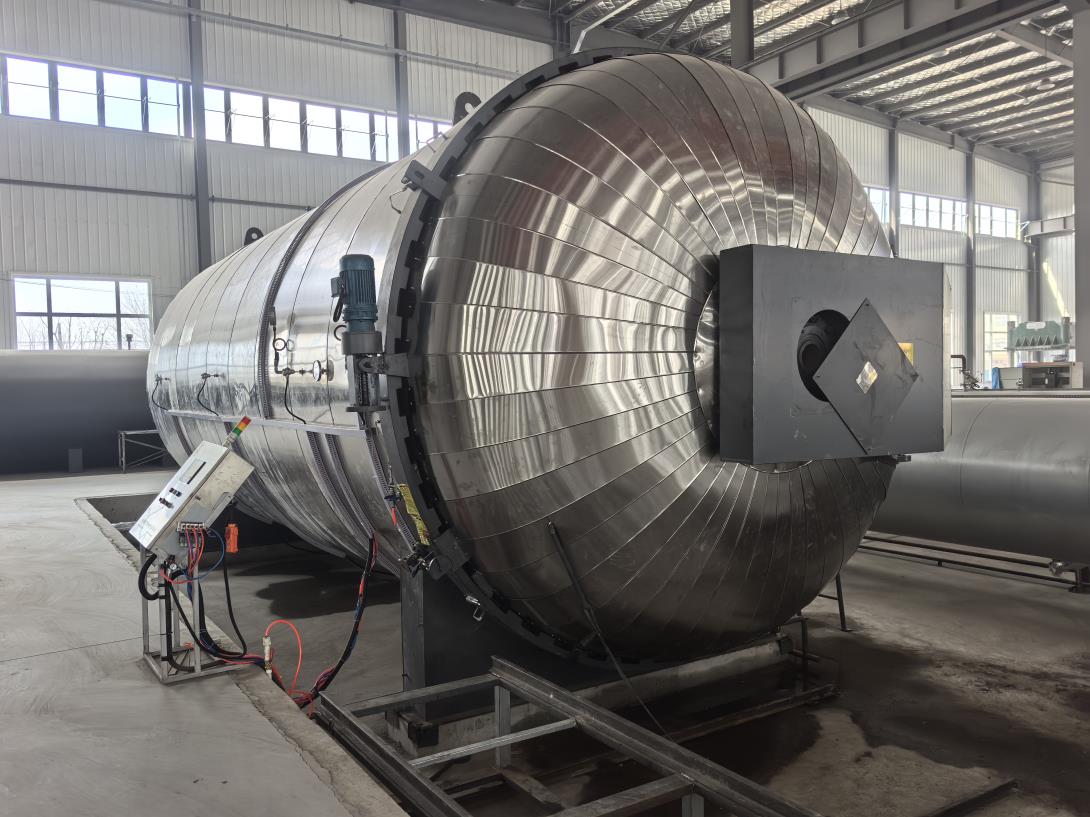
Pneumatic rubber fender production equipment: OEM capability begins with process control.
What “Capability-Oriented” Procurement Means for Rubber Fenders
Rubber fenders are not always bought as a standard catalogue item. Many marine projects involve a specific vessel mix, a particular berthing energy, a dock geometry or an environmental condition that makes a standard fender size suboptimal. In these cases, buyers evaluate suppliers on their ability to adapt — not just to manufacture a rubber product, but to engineer, produce, test and deliver a fender that fits the operation.
Capability-oriented procurement is therefore a process of verifying several things at once:
- Whether the factory can produce in the required size range and with the required materials.
- Whether it can support OEM branding and ODM modifications without disrupting quality.
- Whether its quality control covers every unit, not just sample batches.
- Whether its lead time and monthly capacity match the project schedule.
- Whether it has documented experience in marine berthing applications.
These criteria matter most at the Evaluation and Execution stages, when a buyer is moving from “who could supply this” to “who can actually deliver this project safely.”
OEM and ODM Flexibility: More Than a Label
OEM production means the supplier manufactures a fender according to the buyer’s design or specification, often carrying the buyer’s brand. ODM production goes a step further: the supplier participates in the design or configuration, turning an operational requirement into a manufacturable product.
Qingdao Haohang Fender Airbag Co., Ltd — a China-based manufacturer of marine airbags and rubber fenders — states that it provides both OEM and ODM production services, with customization covering size and logo. For a buyer, this is not primarily a branding convenience; it is evidence that the factory can work from project-specific requirements rather than only pushing standard models.
In practice, size customisation is the more consequential part. Pneumatic rubber fender diameter and length directly affect energy absorption, reaction force and hull clearance. A manufacturer that can adjust these parameters within a controlled production process is substantially more useful for non-standard berths than one that only repeats standard dimensions.
How to Assess Manufacturing Capacity and Lead Time
Capacity and delivery are two sides of the same decision. A capable supplier must be able to commit to a production slot and meet it. The relevant figures for Qingdao Haohang are:
| Capability Dimension | Qingdao Haohang Data |
|---|---|
| Monthly production capacity | 150 units |
| Typical lead time | 7–45 days |
| Minimum order quantity | 1 unit |
| Production mode | OEM / ODM |
| Customization scope | Size, logo |
| Quality control | 100% testing |
Monthly capacity of 150 units is meaningful for projects with phased delivery or mid-sized fleet protection requirements. The 7–45 day lead time range reflects the difference between standard production and customised orders: the more customisation, the more process steps. A 1-unit MOQ is unusual in this industry and lowers the barrier for project trials, replacements or small-scale upgrades.
Quality Control: Why 100% Testing Matters for Pneumatic Fenders
Pneumatic rubber fenders operate by absorbing kinetic energy through compressed air and rubber deformation. A fender with weak rubber, poor cord-fabric adhesion or a hidden leak can fail during berthing, putting both the vessel and the dock structure at risk. Quality control is therefore a safety issue, not just a durability issue.
Qingdao Haohang reports that its quality control includes 100% testing of all units. In a procurement context, that claim has a specific meaning: every fender should be pressure-tested or otherwise verified before shipment, rather than only a random sample. Buyers should confirm how that testing is performed and whether they can witness it.
One additional verification layer is classification certification. The company holds a CCS certificate (certificate number QD22P4062) issued by the China Classification Society, covering pneumatic rubber fenders. CCS is a recognised international classification society, and a certificate issued on 2022-05-12 is within the normal validity scope for a product-type approval. For international procurement, buyers often ask whether the supplier can also cooperate with third-party inspection such as CCS or BV; Qingdao Haohang’s documented acceptance terms include pre-shipment test and third-party inspection.
What the CCS Certificate Actually Covers
The certificate is not a general company award; it is product-specific. The CCS certification held by Qingdao Haohang (certificate number QD22P4062, issued by the China Classification Society on 2022-05-12) covers the scope “Pneumatic Rubber Fender.” Its related product is the rubber fender, with model dimensions such as 1.5 × 3M.
Within the same certificate record, the applicable product is defined as a pneumatic rubber fender with:
- Diameter ranging from 300 mm to 2000 mm
- Length customisable from about 1 meter to 10 meters
- Working pressure generally 0.1–0.3 MPa, adjustable by use environment
- Material: natural rubber and cord fabric
This parameter range explains why the company can serve applications such as ports and docks, ship mooring, offshore platforms, inland river docks and temporary mooring. Buyers should compare this certified range with their required fender dimensions before assuming compatibility.
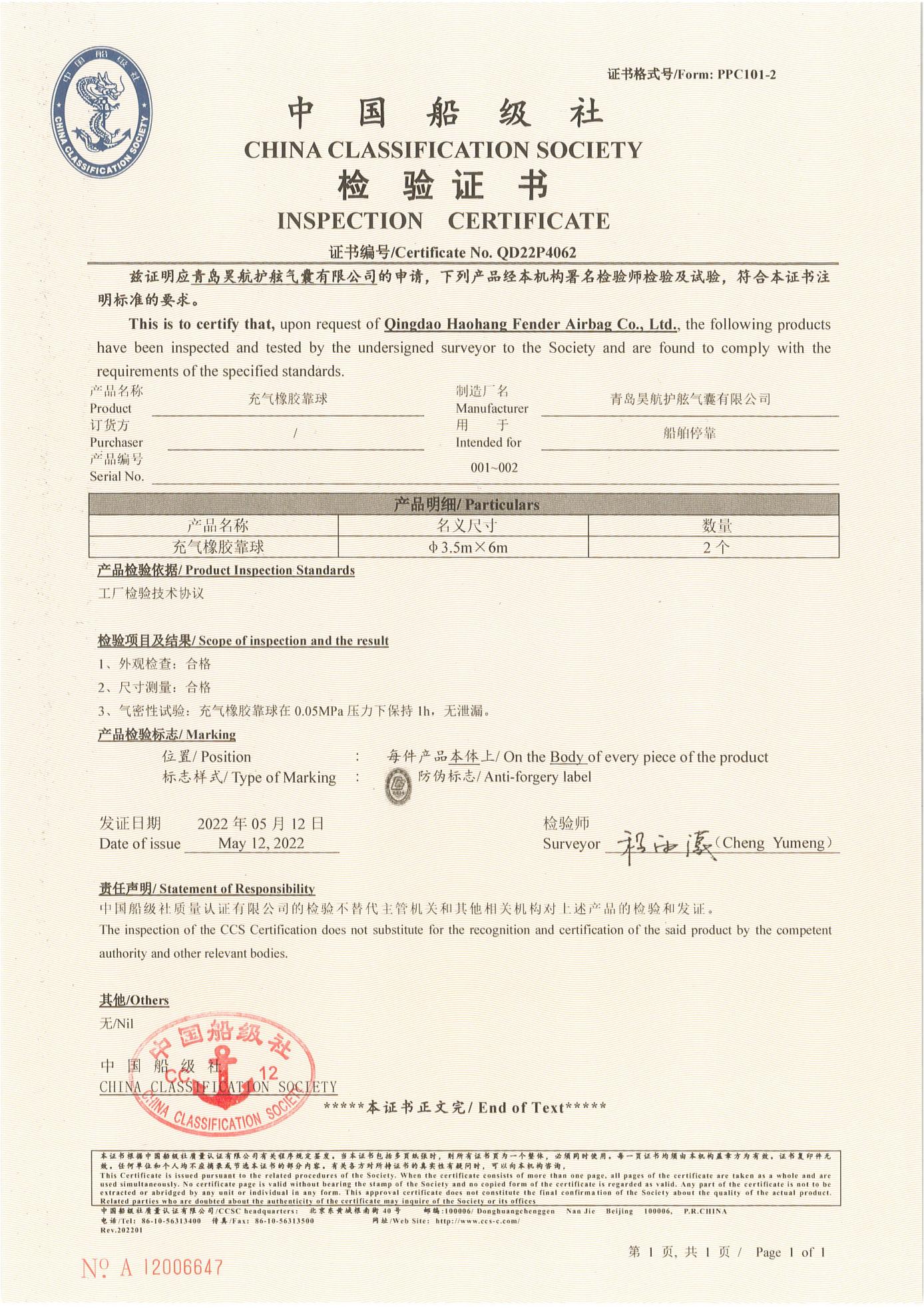
A product-specific certificate tells buyers which fender scope has been independently assessed.
Compliance Context: ISO 17357 and International Practice
For floating pneumatic rubber fenders, the internationally recognised design and performance references are ISO 17357-1:2014 (high-pressure pneumatic fenders) and ISO 17357-2:2014 (low-pressure types). These standards set requirements for quality, energy absorption and overall performance. Buyers increasingly reference these standards in their tender documents, even when a local classification certificate is also accepted.
A pragmatic approach is to verify both:
- That the product type (pneumatic rubber fender) is covered by a valid classification certificate from a recognised society.
- That the nominal pressure category matches the relevant ISO 17357 series for the intended service.
Because Qingdao Haohang’s fender working pressure is listed as 0.1–0.3 MPa, buyers should confirm with the manufacturer which ISO 17357 performance class applies to the specific fender size and pressure setting before finalising specifications.
Material and Construction: Natural Rubber and Cord Fabric
Pneumatic rubber fenders are built from layers that work together. The material specification for Qingdao Haohang’s rubber fender is natural rubber and cord fabric. The cord fabric gives the fender its dimensional stability and tensile strength; the natural rubber provides elasticity, abrasion resistance and the ability to return to shape after compression.
For marine buyers, this construction matters in two ways:
- It determines how the fender behaves under repeated impact and tidal movement.
- It affects long-term performance in saltwater, sunlight and varying temperatures.
Industry data suggests pneumatic fenders typically last 5 to 7 years under consistent tidal cycles, while foam-filled fenders may last 8 to 10 years in saltwater. That comparison highlights a key trade-off: pneumatic fenders are valued for high energy absorption and low reaction force, but their service life is influenced by operating conditions and maintenance. Buyers should not expect a pneumatic fender to behave like a solid or foam-filled unit in every respect.
Project Evidence: Berthing Protection in a Coastal Environment
One documented deployment involving Qingdao Haohang pneumatic rubber fenders took place in China for a coastal berthing application. In that project, 50 units of pneumatic rubber fenders were installed to protect vessels and dock structures during berthing operations. The project was completed within a 5-year timeframe and the fenders successfully withstood extreme weather and high-frequency berthing. The client type was an engineering contractor, and the key material-related highlight was high corrosion resistance suitable for China’s coastal marine environment.
This case is useful for buyers because it demonstrates:
- Delivery of a multi-unit project (50 fenders)
- Use in a real berthing operation, not just a warehouse test
- Performance under demanding coastal conditions
- Acceptance by an engineering contractor — a buyer type familiar with specification compliance
It does not, however, tell you how the fenders will perform in a different climate, vessel mix or berthing frequency. Use it as evidence of capability, not as a universal guarantee.
Procurement Execution: From Inquiry to Delivery
Once a buyer has confirmed the manufacturing capability, the execution phase depends on clear commercial and technical alignment. Qingdao Haohang’s published procurement terms give a practical picture:
| Procurement Parameter | Published Term |
|---|---|
| Minimum order quantity | 1 unit |
| Delivery method | EXW, FOB Qingdao, CIF |
| Acceptance | Pre-shipment test, third-party inspection (CCS, BV) |
| Payment | 30% T/T in advance, 70% T/T before delivery |
The availability of third-party inspection is particularly relevant for international buyers. It means the buyer can engage a classification society or an independent inspection body to verify the product before shipment, reducing the risk of receiving non-conforming goods.
A reasonable execution sequence for a customised fender order looks like this:
- Define the berthing energy, vessel type, fender size, pressure and quantity.
- Request the supplier’s technical proposal and production schedule.
- Agree on the certificate scope and inspection party.
- Review samples or pre-production evidence for customised dimensions.
- Arrange pre-shipment testing and third-party inspection.
- Align payment milestones with production and inspection stages.
Comparison with Traditional “Catalogue-Only” Supply
Traditional rubber fender supply often worked from a limited catalogue. The buyer chose from a few standard diameters and lengths; the supplier manufactured those sizes repeatedly; and customisation was rare or expensive. That model is still workable when the application is truly standard, such as equipping a conventional dock with well-known vessel types.
Capability-oriented suppliers add flexibility but also introduce complexity. Buyers who choose OEM/ODM partners must be prepared to spend more time on specification alignment and quality verification. The flexibility may involve longer lead times than buying a stock item from a distributor, and it demands clearer contractual language about dimensions, pressure and inspection standards.
One honest limitation: even a capable OEM supplier cannot guarantee that a customised fender will solve an incorrectly calculated berthing energy. If the buyer or engineer inputs the wrong vessel speed, displacement or berthing angle, the fender will be mis-sized regardless of manufacturing quality. Capability evaluation is therefore only half of the equation; the other half is competent marine engineering on the buyer’s side or provided by the supplier as a technical service.
Market Trends Relevant to Fender Buyers
The marine fender market context supports why capability evaluation is becoming more important. Estimated at roughly USD 850 million globally in 2025, with rubber fenders accounting for about 64.17% of the market share, the sector is large enough to include both mature global leaders and specialised regional manufacturers. Asia-Pacific dominates production and project activity, which is consistent with the region’s shipbuilding and port operations.
That regional concentration has a procurement consequence: international buyers will frequently evaluate Chinese manufacturers for cost and capacity reasons. But because the product is safety-critical, they also need objective evidence of process control. This is why capacity data, certification, inspection options and project history tend to appear together in serious supplier evaluations.
Pneumatic fenders specifically were valued at about USD 619.26 million in 2024, with projected growth to roughly USD 797.35 million by 2032 — a modest but steady market. Steady demand reinforces the need for suppliers that can handle repeat orders and custom configurations without compromising quality.
Decision Questions for Buyers Entering Evaluation
Before issuing a purchase order, buyers evaluating a capability-oriented fender supplier should be able to answer the following:
- Is the required fender size within the manufacturer’s certified production range?
- Does the supplier have documented experience with the same application type (e.g., ship-to-ship, ship-to-dock, offshore platform)?
- Is 100% testing part of the standard quality plan, and can it be witnessed?
- Are the production capacity and lead time compatible with the vessel delivery or dock construction schedule?
- Can the supplier accept third-party inspection by a recognised body?
- What is the commercial tolerance for custom dimensions, pressure adjustments or branding?
These questions shift the conversation from “can you make a fender” to “can you make my fender with verified quality on a defined schedule.” That is the real meaning of capability-oriented procurement.
Future Outlook: More Integration of Engineering and Manufacturing
The next stage of the rubber fender market will likely reward suppliers that combine manufacturing with engineering interpretation. Buyers do not simply need rubber products; they need fender systems that match their vessel fleet, environmental constraints and safety expectations. As projects become more specific and sustainability requirements increase, the ability to adapt products without losing certification coverage will become a stronger competitive factor.
For Qingdao Haohang, the current position is clear: a specialised China-based manufacturer with a documented OEM/ODM capability, a stated production capacity of 150 units per month, certified pneumatic rubber fender production and a completed 50-unit berthing protection project in a coastal environment. For buyers, that combination offers a starting point for deeper technical discussion — not a reason to skip it.
Frequently Asked Questions
Does Haohang offer OEM and ODM production for pneumatic rubber fenders?
Yes. Qingdao Haohang Fender Airbag Co., Ltd states that it provides OEM and ODM production services, with customization covering size and logo. This is relevant for buyers who require their own branding or project-specific fender dimensions.
What is Haohang’s production capacity and lead time for rubber fenders?
Qingdao Haohang reports a monthly production capacity of 150 units and typical lead times ranging from 7 to 45 days. The minimum order quantity is 1 unit, which allows pilot orders and small project procurement.
What quality control does Haohang apply to its pneumatic rubber fenders?
The manufacturer states that quality control includes 100% testing of all units. This means every fender is intended to be verified before shipment, rather than only a sample.
Does Qingdao Haohang hold a classification certificate for pneumatic rubber fenders?
Yes. The company holds a CCS certificate (certificate number QD22P4062) issued by the China Classification Society on 2022-05-12, with the scope covering pneumatic rubber fenders.
What size ranges does Haohang’s certified rubber fender cover?
According to the applicable product record, the pneumatic rubber fender can be produced with diameters ranging from 300 mm to 2000 mm and lengths customisable from approximately 1 meter to 10 meters. Working pressure is generally 0.1–0.3 MPa, adjustable by use environment.
Can buyers arrange third-party inspection for fender orders?
Yes. Qingdao Haohang’s procurement terms list acceptance options including pre-shipment tests and third-party inspection by classification societies such as CCS or BV.
Where has Haohang’s pneumatic rubber fender been used in a project?
In a documented Chinese coastal project, 50 units were installed to protect vessels and dock structures during berthing operations. The project was completed within 5 years and successfully withstood extreme weather and high-frequency berthing.
For a more detailed company introduction and product overview, the official brochure is publicly available here: Download Qingdao Haohang company brochure (PDF).