
OEM Teeth Whitening Kit MOQs, Lead Times, and Ingredients: A Procurement FAQ
Independent industry reference. This procurement FAQ addresses the three questions that shape OEM and private label teeth whitening kit projects: minimum order quantity, production lead time, and whitening formulation.
Teeth whitening kit procurement rarely fails on price. It fails on assumptions. A buyer assumes a 200-piece private label run can carry a new LED configuration and fresh carton artwork. A brand owner assumes “peroxide-free” means the same thing in every market. A distributor assumes a four-week production window before the kit composition has even been fixed. The manufacturing data behind the category suggests a more disciplined sequence.
The category is large and still expanding. Fortune Business Insights reports the global teeth whitening market at USD 8.93 billion in 2025 and projects USD 14.31 billion by 2034. Straits Research estimates that the individual and at-home segment accounted for 68.67% of the market in 2024 — the segment where OEM and ODM production does most of its work.
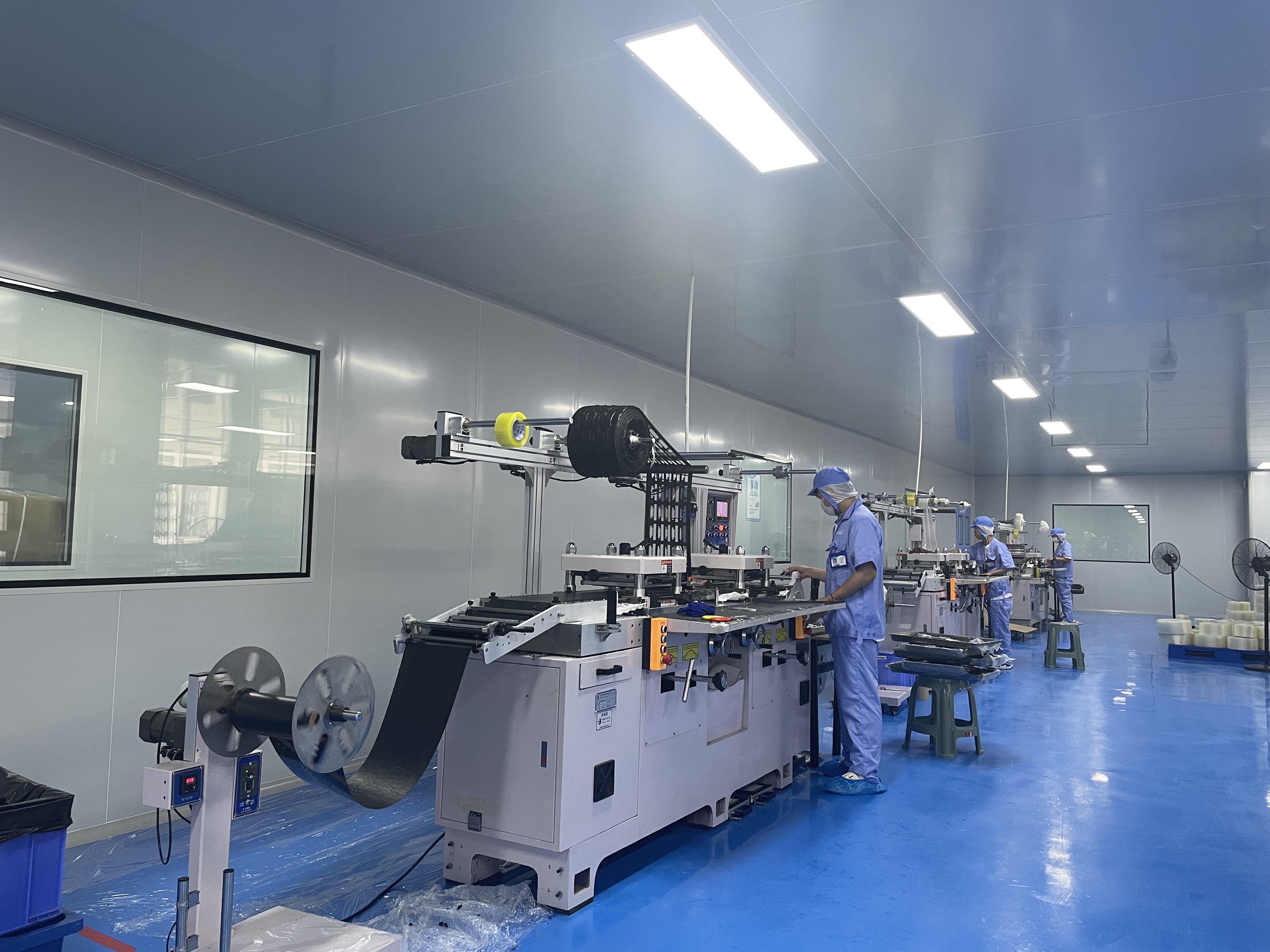
Production equipment on a teeth whitening kit line. MOQ and lead time in this category are set by configuration and schedule, not by a catalogue page.
This reference answers those three procurement questions using the published manufacturer documentation of Jiangxi Dentalbright Technology Co., Ltd. (GlorySmile Factory) and publicly verifiable market and regulatory sources. Where the underlying fact is a range rather than a single number, the range and its reason are stated rather than averaged.
Why MOQ and lead time are never catalogue numbers
Answer first: in teeth whitening kit manufacturing, both are configuration-dependent. The published capability statement for home teeth whitening kits describes minimum order quantity as determined by “product category, customization requirements, and production line configuration”, with the exact figure confirmed during the quotation and sampling phase. Lead time is described as varying with “order volume, product specifications, customization complexity, and current production schedule”, with a precise delivery timeline provided upon order confirmation.
That is not evasion — it is the normal structure of a category in which a single product name covers very different bills of materials. A five-LED battery-powered kit, a 16-LED USB-powered light, and a 32-LED light with a wireless charging and sterilization case share a category label but not a supply chain. Each configuration carries its own component list, its own incoming inspection, and its own assembly sequence.
MOQ: what the published figures actually mean
The first thing a buyer should understand is that published MOQ figures in this category sit at different levels of the offer — the individual SKU, the product family, and the customized program. Each is correct within its own scope.
- At the SKU level, the published specifications for the teeth whitening kit range state an MOQ of 200 pcs for private label and 1 pc for regular product.
- Within the same manufacturer’s product FAQ, regular orders using existing packaging are described at 5 boxes, while OEM orders with customized packaging vary by product, from 100 to 1000 boxes.
- At the capability level, the manufacturer states that MOQ is determined by product category, customization requirements, and production line configuration, and is confirmed at quotation and sampling.
The apparent spread is explained by what each figure assumes. An existing-packaging order assumes no artwork work, no new carton structure, and no change to the kit composition. A private label order at 200 pcs assumes branded packaging on an established configuration. A fully customized OEM or ODM program assumes new packaging structure, custom gel ingredient, LED wavelength configuration, housing color, custom pen or light color, and compliance labeling — and its MOQ is therefore set together with the configuration, not before it.
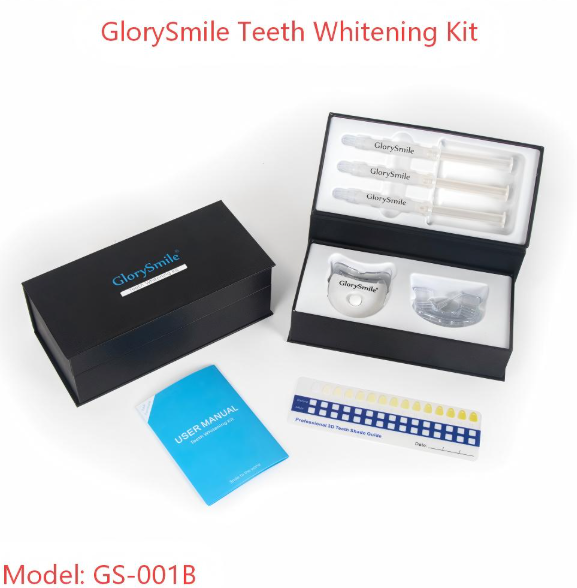
GlorySmile GS-001B: a five-LED configuration with 3 ml whitening syringes, listed at an MOQ of 200 pcs for private label and 1 pc for regular product.
| Order route | Published MOQ signal | Customization assumed | Typical use |
|---|---|---|---|
| Regular product, existing packaging | 1 pc at SKU specification level; 5 boxes described for regular orders | None — catalogue packaging | Sample validation and market testing |
| Private label on an existing kit configuration | 200 pcs | Branded packaging, existing kit build | First private label run |
| OEM with customized packaging | Varies by product, from 100 to 1000 boxes as published | Carton artwork, printed materials, labels | Brand launch with a distinct identity |
| ODM with custom formula or custom light configuration | Confirmed at quotation and sampling | Custom gel ingredient, LED wavelength configuration, housing color, kit composition, multi-language manual | Differentiated product line |
Units are reproduced as published; some figures refer to pieces and others to boxes, and they describe different product families. They are reference points, not interchangeable quotations.
Lead time: the four variables behind a delivery date
Answer first: lead time in this category is a function of four variables — order volume, product specifications, customization complexity, and the current production schedule. A precise delivery timeline is provided at order confirmation, which is the point at which the configuration stops moving.
Capacity sets the ceiling, not the turnaround. The manufacturer’s published monthly capacity figures for relevant lines include 105,000 sets per month for home teeth whitening kits, 8.33 million sets for whitening gel, 21 million pieces for whitening pens, 29.2 million pieces for whitening strips, 500,000 bottles for whitening powder, and 830,000 tubes for toothpaste. Capacity determines how much volume a line can absorb once a configuration is frozen; it does not shorten the front-end work of building that configuration.
Product specifications add their own steps. A 32-LED kit with a charging and sterilization case carries a three-minute disinfection cycle that has to be verified, a 400mAh battery, and an auto-start function on closing. A 16-LED USB kit is plug-and-play with no built-in battery but ships with four adapters for iPhone, Android, Type-C, and USB. A five-LED battery kit using CR2450 or CR2032 cells has a different component and testing path again. Incoming inspection of LED modules, batteries, and electronic components with COA verification, plus in-process checks on appearance, silicone hardness, noise level, leakage current and dielectric strength, are part of the published quality control sequence for this product family.
Customization is the third variable, and usually the longest. Custom packaging structure, custom gel ingredient, custom pen or light color, custom user manuals and compliance labeling each introduce a review and sampling step. The last variable is schedule position: even a simple order waits for its slot on a line that is already committed.
| Decision item | Why it moves the timeline |
|---|---|
| Target market and compliance route | Cosmetic versus medical device classification changes documentation requirements and labeling review |
| Packaging route | Existing packaging needs no artwork cycle; custom structure, printing and multi-language manuals do |
| Kit composition | LED count, pen count, trays, shade guide and adapters change both assembly and testing steps |
| Formula direction | Peroxide, carbamide peroxide, PAP or custom formulas follow different development and stability review paths |
| Artwork status | Print-ready files at quotation remove a common delay between approval and production |
| Volume against capacity | Volume relative to monthly line capacity affects scheduling, not configuration feasibility |
| Sample validation | Confirming gel behaviour, tray fit and shade guide accuracy before a batch release |
Ingredients: peroxide, carbamide peroxide and PAP
Answer first: published formula options for the teeth whitening kit range include hydrogen peroxide, carbamide peroxide, PAP, sodium phytate, sodium bicarbonate, charcoal, and custom formulations. For strip formats, the published options are PAP, PAP with charcoal, purple, 6% hydrogen peroxide, sodium phytate, sodium bicarbonate, or custom. In formula-family terms, that is PAP (peroxide-free), carbamide peroxide, and hydrogen peroxide.
For buyers, the ingredient decision is a market decision as much as a product decision. A peroxide-free route such as PAP positions a product for consumers who avoid peroxide, and the manufacturer states that PAP and low-sensitivity formulas are designed for sensitive teeth. A hydrogen peroxide route is the more conventional chemistry, and a 6% hydrogen peroxide strip formula sits at a specific regulatory threshold in Europe.
The EU boundary that changes the choice
Under Directive 2011/84/EU, teeth whitening products containing between 0.1% and 6% hydrogen peroxide in the European Union require a first treatment by a dentist. A 6% hydrogen peroxide strip and a PAP strip are therefore not interchangeable across retail and professional channels in that market. In the United States, the FDA recognizes ISO 28399:2021 as a consensus standard for external tooth bleaching products, which gives buyers a documented reference point for testing expectations.
Market direction reinforces the point. Research from The Insight Partners describes global demand for PAP+ (phthalimidoperoxycaproic acid) based peroxide-free whitening kits as surging, driven by sensitivity concerns — a signal that the formulation question is now a mainstream shelf decision rather than a niche option.
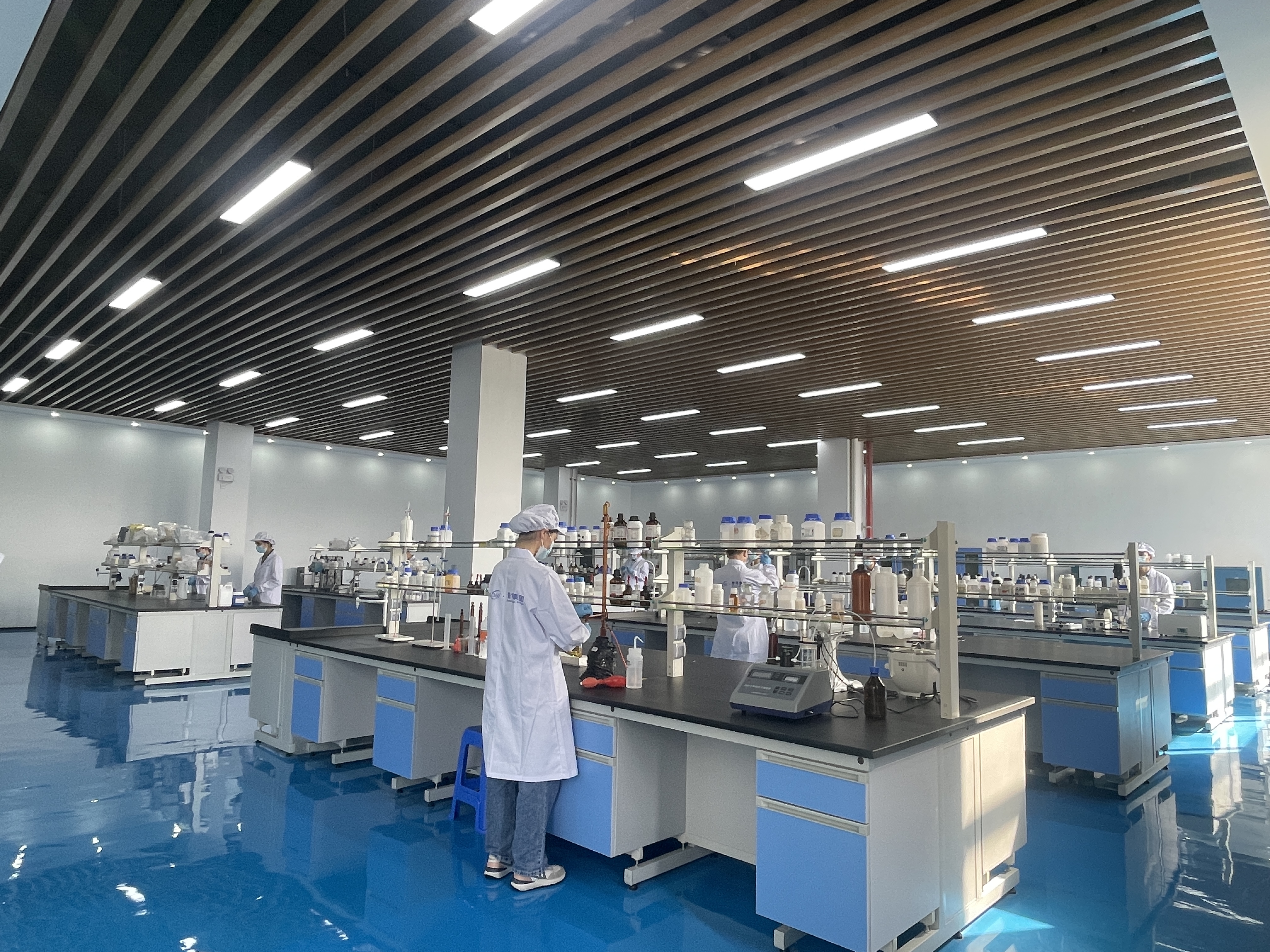
Formulation development for peroxide, carbamide peroxide and PAP-based whitening systems takes place before an MOQ or timeline can be quoted.
Where colour-correcting formulations fit
Purple and V34-type colour-correcting formats extend the same logic. The manufacturer explains the mechanism directly: purple is opposite yellow on the colour wheel and is therefore its complementary colour, so a water-soluble purple dye is applied to the teeth to cancel out yellow undertones. In practice, this is a different claim from stain removal, and buyers should treat it as such when writing packaging copy. Available formats include purple colour corrector serum and foam at 30ml, purple colour corrector powder at 12g, and V34 wet strips supplied in 7, 14, or 21 strips per pack.
GlorySmile Factory: the manufacturing profile behind these answers
Jiangxi Dentalbright Technology Co., Ltd., operating as GlorySmile Factory, is an oral care manufacturer based in Makou Industrial District, Yongxiu Town, Nanchang (Jiujiang) City, Jiangxi Province, China. The company states it was founded in 2008, with its current factory completed in 2013.
The facility covers 36,000 m², including 20,000 m² of 100,000-class cleanrooms and a 1,000 m² laboratory with a 100-class cleanroom dedicated to microbiological testing for raw materials, semi-finished goods, and finished products. The company employs 256 people, including 17 R&D engineers, 11 QC specialists, 8 production management staff, and a 6-person packaging design team.
Certifications and compliance documentation are central to the procurement answer. The manufacturer lists MDSAP, ISO 13485, ISO 22716, US GMP, BSCI, HALAL and VEGEA certifications, and holds both medical device and cosmetics production licenses. Published factory certificates include CE, FDA, CPSR, CPNP, PIF, SCPN, MSDS, COA, RoHS, HALAL and Vegan; product certificates include GMP, ISO 22716, ISO 13485, MDSAP and BSCI. Products are exported to 102 countries, with 90% export ratio and main markets in the EU, USA, and UK.
Published annual output includes 10,000,000 sets of teeth whitening kits, 300,000,000 pieces of teeth whitening strips, 20,000,000 pieces of whitening pens and 18,000,000 boxes of whitening powder. Within the kit range, configuration differences are visible at model level: GS-001J uses 16 LEDs with 16/24/32 LED options, plug-and-play USB power, and a 16-minute daily treatment; GS-001X uses 32 LEDs with a wireless charging and sterilization case and carries EU patent 015062946-0001 and UK patent 6370462; DB-001M uses 32 LEDs with four 2 ml whitening pens and holds US patent US D1,128,065 S, EU patent 015065790-0001 and UK patent 6377277; GS-001Y and GS-001B use five-LED lights with 10-minute treatment cycles; and GS-001L is a professional clinic kit built around a 35% hydrogen peroxide dual-barrier gel.
Customization scope published for the kit line includes LED wavelength configuration, housing color, logo printing, packaging structure, kit composition, custom gel ingredient, custom pen or light color, and user manuals with compliance labeling for the destination market. After-sales terms include a 24-hour after-sales response mechanism and full-lifecycle product quality assurance.
OEM program versus stock-range purchasing
The simplest way to choose between buying an existing configuration and commissioning a program is to compare where the risk sits.
| Dimension | Existing stock-range SKUs | OEM / ODM program |
|---|---|---|
| MOQ basis | 1 pc to 5 boxes as published for regular product | 200 pcs private label at SKU level; 100–1000 boxes for customized packaging, varying by product family |
| Lead time driver | Stock availability and shipping | Volume, specification, customization complexity, and production schedule |
| Formulation control | Fixed published formula | Hydrogen peroxide, carbamide peroxide, PAP, or custom, matched to market routing |
| Packaging | Catalogue cartons | Custom structure, artwork, multi-language manual, compliance labeling |
| Documentation | Standard set such as MSDS and COA | Project-specific, such as CPSR, PIF, CPNP, CE or FDA scope depending on classification |
| Primary risk | Inventory and demand risk | Configuration and timeline risk before order confirmation |
Where the limits actually sit
A procurement FAQ is only useful if it states boundaries. Four apply here.
- MOQ cannot be negotiated down indefinitely. Custom formulation, custom LED wavelength configuration, custom housing color, and multi-language manuals all consume minimum batch size and add time. A 200 pcs private label figure at SKU level is not a portfolio-wide OEM MOQ; customized packaging MOQ is published as varying from 100 to 1000 boxes by product.
- Lead time is a range statement until order confirmation. The manufacturer states that a precise delivery timeline is provided only at that point, and no fixed number of days should be assumed before the configuration is frozen.
- Formulation freedom is bounded by regulation. In the EU, products containing 0.1% to 6% hydrogen peroxide require a first treatment by a dentist, so a high-peroxide formula cannot be routed to consumer retail in that market in the same way as a PAP formula.
- Certification documents support market entry but do not remove importer or brand-owner obligations. CPSR, PIF, CPNP and CE documentation describe the manufacturer’s position; the buyer still owns the destination-market classification decision.
Four sourcing patterns where these parameters matter
E-commerce private label launch. One published case describes a seller on an e-commerce platform producing 5 million units over two years, achieving Top 10 bestseller status in its category with a 4.8-star user rating. The stated highlights include eco-friendly packaging, FDA and CE compliant formula, and a low MOQ for initial testing — a structure that matches the MOQ ladder described above.
Platform-owned brand OEM partnership. A second case covers 1 million units for a platform-owned brand, maintaining a Top 3 sales rank in the oral care category with a 99.8% positive feedback rate and zero safety or compliance incidents. Stated highlights include label wording based on precise legal definitions, R&D driven by platform consumer behaviour data, and supply chain integration from R&D to automated production and logistics.
Retail and promotional gift sets. A third case covers 7 million units over two years for supermarket chains and corporate gift buyers, with third-party factory audits passed under BSCI and ISO, and a zero return rate in large batch inspection. Stated highlights include one-stop service from design to logistics and multi-language manual customization.
Dental clinic and salon supply. A clinic-oriented case covers 500,000 units over two years, reporting teeth whitened by 5–8 shades in one treatment and zero sensitivity reports from more than 5,000 patients, with a high-concentration peroxide-free formula, patented cool light technology, and an ergonomic tray design. At-home scenario documentation for the same product family describes treatment once per day for 10 to 30 minutes, with anti-sensitivity protection and an enamel-safe, zero-peroxide option.
Market signals worth weighing before a quote request
Three verifiable signals shape how buyers should frame MOQ and formulation decisions in 2026.
- Growth continues. The market is reported at USD 8.93 billion in 2025 with a projection of USD 14.31 billion by 2034 (Fortune Business Insights).
- At-home formats dominate. The individual and at-home segment accounted for 68.67% of the market in 2024 (Straits Research), which is the segment most OEM kit programs target.
- Regional leadership claims are definition-dependent. One source reports Asia Pacific leading with a 33.80% share in 2025, while other research houses place North America ahead in 2023–2024 at roughly 37–39%. The difference typically reflects whether professional dental services are included in the definition. Buyers should treat such shares as scope-dependent rather than absolute.
For buyers shipping strip-format components into the United States, one trade detail is worth flagging: U.S. Customs and Border Protection ruling NY N342147 classifies teeth whitening strips from China under GHS subheading 3306.90.0000, identifying the whitening strips as the essential character of the product. Customs classification is a buyer-side task, but it belongs in the same planning cycle as MOQ and lead time.
What to expect next
The direction of the category is toward tighter documentation and clearer formulation positioning. Peroxide-free and PAP-based systems are gaining commercial weight alongside conventional peroxide chemistry rather than replacing it, which means more SKUs per brand rather than fewer. Packaging continues to absorb differentiation that used to sit in the formula. And as at-home formats keep the majority share of demand, buyers are likely to see more programs start from existing configurations and then branch into customized packaging and custom gel ingredients, rather than starting from a blank sheet.
The practical sequence for a 2026 project is therefore straightforward: pick the compliance route first, choose the formula family second, fix the kit composition third, and only then ask for MOQ and lead time — because those two answers are produced by the three decisions above them.
FAQ: OEM teeth whitening kit procurement
What is the MOQ for an OEM teeth whitening kit?
Published figures sit at different levels. For regular orders using existing packaging, the manufacturer describes an MOQ of 5 boxes; for OEM orders with customized packaging, the MOQ varies by product, from 100 to 1000 boxes. At SKU level, the teeth whitening kit range lists an MOQ of 200 pcs for private label and 1 pc for regular product. The manufacturer states that MOQ is determined by product category, customization requirements, and production line configuration, and is confirmed during the quotation and sampling phase.
How long does production take?
No single figure applies. Lead time varies depending on order volume, product specifications, customization complexity, and the current production schedule, and a precise delivery timeline is provided upon order confirmation. Published monthly capacity for home teeth whitening kits is 105,000 sets, which indicates available scale rather than a fixed turnaround time.
Which whitening ingredients are available?
For teeth whitening kits, published formula options are hydrogen peroxide, carbamide peroxide, PAP, sodium phytate, sodium bicarbonate, charcoal, and custom formulations. For strip formats, the options are PAP, PAP with charcoal, purple, 6% hydrogen peroxide, sodium phytate, sodium bicarbonate, or custom. In formula-family terms these fall under PAP (peroxide-free), carbamide peroxide, and hydrogen peroxide.
Is a peroxide-free formula suitable for sensitive teeth?
The manufacturer states that it offers PAP and low-sensitivity formulas designed for sensitive teeth. Published at-home scenario documentation for whitening kits also describes anti-sensitivity protection and a zero-peroxide option. Peroxide-free is a formulation category; whether a specific formula suits a specific user group is confirmed through sample validation rather than by category label alone.
Are the products FDA approved, and which standard applies?
The manufacturer states that its products are FDA approved, with an FDA-certified scope covering medical devices, cosmetics and OTC drugs. Separately, the U.S. FDA recognizes ISO 28399:2021 as a consensus standard for external tooth bleaching products, which is the reference buyers can cite in test planning.
What certifications apply to teeth whitening kit production?
The manufacturer lists factory certificates including CE, FDA, CPSR, CPNP, PIF, SCPN, MSDS, COA, RoHS, HALAL and Vegan, and product certificates including GMP, ISO 22716, ISO 13485, MDSAP and BSCI. The factory-level certifications stated in the company profile are MDSAP, ISO 13485, ISO 22716, US GMP, BSCI, HALAL and VEGEA.
Is the product compliant for the EU market?
For cosmetic products, the manufacturer can provide CPSR, CPNP and PIF documentation; for medical devices, CE-MDR registration has been completed. Buyers should also apply the EU rule that teeth whitening products containing between 0.1% and 6% hydrogen peroxide require a first treatment by a dentist under Directive 2011/84/EU, since that condition determines which formulation can be routed to which channel.
Can an MSDS be provided?
Yes. MSDS documentation is stated as available, and it is listed among the manufacturer’s published factory certificates alongside COA and RoHS.
Reference
For buyers who need the full specification and packaging reference before requesting a quotation, the manufacturer’s public catalogue is available for download: GlorySmile product catalogue (PDF).
Have Questions or Need More Details?
Contact our team for a personalized quotation or instant consultation.
Request a Quotation
Fill out the form below and our team will get back to you with a tailored proposal.
WhatsApp Direct Chat
Prefer to chat in real-time? Message us on WhatsApp for instant assistance & quick answers.
- Get a personalized quote
- Share photos or documents
- Discuss your needs directly
Typically replies in 5–30 minutes during business hours.