
OEM Teeth Whitening Kit: Compliance and Specification Checklist
Industry Reference / Oral Care Sourcing

When procurement teams evaluate an OEM teeth whitening kit, the decisive checkpoints are often certifications, formulation options and hardware specifications, not the outer packaging. A teeth whitening kit sold under a private label can sit at the boundary between cosmetics, drug-regulated whitening products and, in some markets, medical devices. The commercial risk for importers, distributors and e-commerce brands is therefore concentrated in how well the supplier can document compliance and how precisely the product specification matches the target market.
This reference outlines the specification and compliance areas that buyers should verify before ordering a home-use or professional teeth whitening kit. It uses Glorysmile’s teeth whitening kit range as a documented manufacturer example, drawing only on verifiable product and factory data.
Why certification and specification checks come first
The global teeth whitening market was valued at USD 8.93 billion in 2025 and is projected to reach USD 14.31 billion by 2034. The individual or at-home segment already accounted for 68.67% of the market in 2024, which explains why importers now evaluate home-use whitening kits as a mainstream SKU rather than a specialty item.
Regional rules create the first constraint. In the EU, teeth whitening products containing between 0.1% and 6% hydrogen peroxide require a first treatment by a dentist. That requirement changes the commercial status of a kit, its label claims, and the documentation needed before sale. In the US, the FDA recognizes ISO 28399:2021 as a consensus standard for external tooth bleaching products, while market access can also involve MoCRA-compliant cosmetic facility registration and product listing depending on product type.
For an OEM buyer, the practical translation is straightforward: a low purchase price does not reduce the need for market-specific regulatory evidence. A supplier that cannot specify which legal classification applies to its gel or device is a supply-chain risk regardless of how the kit looks on a retail shelf.
Manufacturer capability and system certifications
Jiangxi DentalBright Technology Co., Ltd., known as Glorysmile, is a China-based oral care manufacturer located in Yongxiu Town, Nanchang (Jiujiang) City, Jiangxi Province. The company operates a 36,000 m² facility that includes 20,000 m² of 100,000-class cleanrooms and a 1,000 m² laboratory with a 100-class cleanroom for microbiological testing. Its team includes 17 R&D members, 11 quality-control specialists, 8 production-management members and 6 packaging-design members. Glorysmile exports roughly 90% of its output, with main markets in the EU, USA and UK.
For oral care manufacturers, relevant system certifications typically include ISO 13485 for medical-device quality management, ISO 22716 and GMPC for cosmetic good manufacturing practice, MDSAP for medical-device regulatory audits, and BSCI for social responsibility. Glorysmile states that it is certified to MDSAP, ISO 13485, ISO 22716, US GMP, BSCI, HALA and VEGEA, and holds both medical device and cosmetics production licenses. Buyers should always confirm that the certificate scope contains the specific product category being ordered, since a general factory certificate does not by itself prove that every SKU is covered.
Documentation buyers may request before import
Rather than relying on a single “FDA approved” or “CE certified” statement, importers should request documentation that matches the product category and destination market. The table below summarises documentation types found in Glorysmile’s published compliance scope.
| Market / Scope | Documentation examples | Relevant product area in available data |
|---|---|---|
| EU cosmetics / oral care | CPSR, CPNP notification, PIF, EU Responsible Person | Cosmetic-type oral care products |
| EU medical devices | CE-MDR registration with technical file and EU Responsible Person | Medical-device classified products |
| USA medical devices | FDA medical-device establishment registration and device listing; 510(k) clearance where applicable | Whitening lights, electric toothbrushes, oral irrigators; silicone rubber impression material has completed 510(k) registration according to company data |
| USA cosmetics | MoCRA-compliant cosmetic facility registration and product listing | Teeth whitening strips according to company data |
| Global vegan / Muslim-market claims | VEGAN certificate, HALAL certificate | 23 SKUs certified vegan; 22 SKUs Halal-certified per available certification records |
| Indonesia | Certificate of Free Sale (CFS) | Whiteners, whitening kits, mouthwash and related oral care products are listed in the CFS scope |
Note: Regulatory classification depends on the active ingredient, concentration, intended use and local rules. Buyers should ask the supplier to map each SKU to its classification rather than accepting a single blanket statement.
Whitening chemistry: peroxide, PAP and formulation flexibility
The whitening gel is often the most regulated part of a teeth whitening kit. Three formulation families are relevant in the current market.
Peroxide formulas: hydrogen peroxide and carbamide peroxide
Hydrogen peroxide (HP) and carbamide peroxide (CP) are small-molecule penetrating agents. They can reach deeper tooth structures and break down more stubborn pigments through oxidation. This makes them a clinically established option for fast or dramatic whitening. The trade-off is that they can cause temporary sensitivity, and their concentration is strictly regulated in many markets.
PAP formulas: the peroxide-free approach
PAP, or phthalimidoperoxycaproic acid, is a large-molecule surface-acting whitening agent. Because of its molecular size, it is less likely to penetrate deep into tooth structure and is generally described as gentle and enamel-friendly. Global demand for PAP+ based peroxide-free whitening kits is rising as an alternative to peroxide, particularly for consumers who prioritise low sensitivity.
Glorysmile offers multiple whitening ingredients across its kit models. Available formula options for the home-use kits include hydrogen peroxide, carbamide peroxide, PAP, sodium phytate, sodium bicarbonate, charcoal and custom formulations. In addition, the company states that it offers PAP and low-sensitivity formulas designed for sensitive teeth.
For a buyer, the formulation decision should not be made on ingredient preference alone. A peroxide-free kit may simplify cosmetic classification and appeal to sensitive-teeth consumers, but it may act more slowly on deep internal staining. Peroxide kits may produce faster results but need stronger compliance work and clearer user instructions.
Device design and kit configuration
A teeth whitening kit is not defined only by its gel. The LED light, mouth tray, applicator format, power source and supporting accessories affect user compliance, shipping cost and regulatory requirements.
Glorysmile’s published kit range includes models that differ in LED count, power architecture and usable sessions. This is an important sourcing point: two kits can look similar on a listing page while having completely different power systems and treatment timers.
| Model | Light / LED count | Gel format | Session / use | Power source |
|---|---|---|---|---|
| GS-001B | 5 LED whitening light | 3 × 3 ml syringes | 10 minutes; approximately 40 uses | 2 × CR2032 lithium metal batteries |
| GS-001Y | 5 LED whitening light | 3 × 3 ml syringes | 10 minutes; approximately 30 uses | 2 × CR2450 lithium metal batteries |
| GS-001J | 16 LED, with 24 / 32 LED options | 4 × 2 ml whitening pens | 16 minutes per day recommended | USB plug-and-play from phone, laptop or power bank; no built-in battery |
| DB-001M | 32 LED | 4 × 2 ml whitening pens | 16-minute timer; up to 8 uses per full charge | 450 mAh lithium-ion battery; 2-3 hours charging |
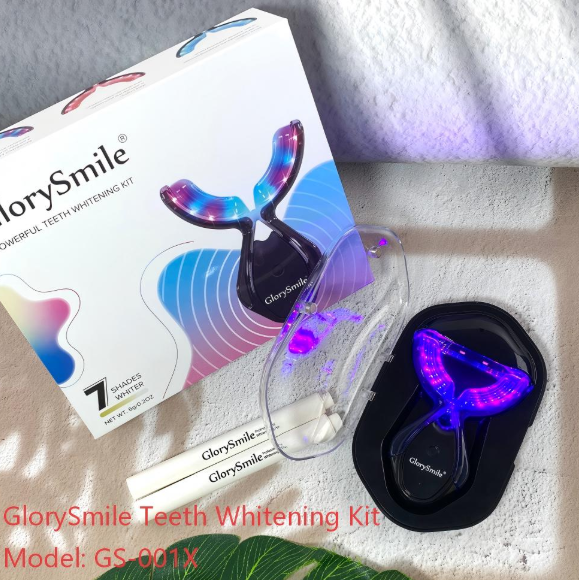
| GS-001X | 32 LED | 2 × 3 ml whitening pens | 16-minute timer; up to 5 uses per full charge | 150 mAh lithium-ion battery; USB charging; charging and sterilization case with 3-minute disinfection cycle |
The mouth tray material is another specification worth reviewing. Glorysmile describes the mouth trays used in these kits as food-grade TPE. For daily home use, tray material should not be treated as a cosmetic detail; it comes into direct contact with oral tissue and whitening gel.
OEM / ODM / private-label customisation boundaries
Most teeth whitening kit buyers approach this category through OEM, ODM or private-label programmes. The available customisation options for Glorysmile kits include custom packaging, custom printing, custom gel ingredients, custom pen or light colour, custom syringe colour and custom user manuals.
The MOQ structure matters during evaluation. For the listed teeth whitening kit models, the published MOQ is 200 pieces for private label and 1 piece for a regular or existing-packaging product. In practice, exact MOQ is also determined by product category, customisation requirements and production line configuration, and is confirmed during quotation and sampling.
A practical sourcing recommendation is to distinguish between packaging-level private label and formulation-level ODM. Packaging customisation is relatively straightforward, while custom gel chemistry requires stability testing, regulatory re-evaluation and more lead time. A supplier with in-house formula control can support both paths, but buyers should ask what documentation changes occur when the gel formula is modified.
Where different kit formats fit: use-case view
The intended use of a teeth whitening kit depends on how the buyer plans to position it.
Daily home whitening
Home whitening kits are used once per day in typical daily oral care routines. The treatment window in the documented product range is generally 10 to 16 minutes per session. Compact, battery-powered or USB-powered models are easier to retail as travel-friendly dental care products.
Professional and clinic-oriented whitening
Glorysmile also lists a clinic use whitening kit, model GS-001L. This professional kit contains a 5 ml dual-barrier whitening gel with 35% hydrogen peroxide, gum protector, cheek retractor, brush-ups, Vitamin-E swabs, saliva towels, face gauze and bibs. High-concentration peroxide products are not home-use products; they are intended for dental professionals who can manage soft-tissue protection and clinical protocols.
For a brand owner, the choice between home and professional formats should be made before engaging a supplier, because the gel concentration, accessories, packaging and compliance file are project-specific.
Limits and boundaries buyers should not ignore
Every product strategy in this category has a boundary. Peroxide-based gels are effective but sensitive to concentration limits and regulatory classification. PAP-based gels are milder and easier to position for sensitive teeth but may require a longer treatment schedule for deeply stained enamel. A rechargeable kit with more electronic components offers better user experience but increases quality-control complexity and unit cost. A simpler battery-powered light lowers the BOM but may not support the premium positioning that some brands want.
No single configuration is “best” for all markets. A supplier that supplies only one formula or one hardware design is less flexible for buyers managing multiple retail channels. Glorysmile’s kit range covers several power architectures and LED counts, which is relevant information for buyers planning portfolio diversification.
Market trend and sourcing outlook
The teeth whitening market’s shift toward at-home formats creates new demand for kits that are safe, compliant and easy to use. The growing preference for peroxide-free PAP+ products is another meaningful direction, especially for consumers with sensitivity concerns.
For OEM buyers, this points toward a more documentation-heavy sourcing process. Suppliers will increasingly be asked to prove not just that they can fill a syringe or assemble a box, but that they can handle regulatory updates across the EU, US and other export markets. Buyers should also expect closer scrutiny of material safety, ingredient declarations and the legal status of whitening devices in each country.
FAQ
Are teeth whitening kit formulas available for sensitive teeth?
Yes. Glorysmile states that it offers PAP and low-sensitivity formulas designed for sensitive teeth. PAP is a large-molecule, surface-acting whitening agent widely associated with less sensitivity, whereas peroxide formulas may be more effective on deep stains but can cause temporary sensitivity.
What compliance documents should a supplier provide for the EU and US markets?
For EU cosmetic-type oral care products, a supplier can provide CPSR, CPNP notification, PIF and EU Responsible Person information. For medical-device classified products, CE-MDR registration is required. For the US market, the compliance path depends on the product type: medical-device registration may apply to whitening lights and electronic oral care devices, while MoCRA-compliant facility registration and product listing may apply to cosmetic whitening strips. The FDA also recognises ISO 28399:2021 as a consensus standard for external tooth bleaching products.
What whitening formulas can be used in an OEM teeth whitening kit?
The main formula options available in Glorysmile’s home-use kits are hydrogen peroxide, carbamide peroxide, PAP, sodium phytate, sodium bicarbonate and charcoal, with custom formulations possible. Peroxide formulas are powerful but more regulated; PAP offers a peroxide-free option with a gentler profile.
What is the MOQ for private-label teeth whitening kits?
For the documented Glorysmile kit models, the published MOQ is 200 pieces for private label and 1 piece for a regular product using existing packaging. The exact MOQ can also vary by product category, customisation complexity and production line configuration, and is confirmed during quotation and sampling.
For buyers evaluating supplier documentation, Glorysmile’s company catalogue is available for reference: Glorysmile Company Catalogue (PDF).
Have Questions or Need More Details?
Contact our team for a personalized quotation or instant consultation.
Request a Quotation
Fill out the form below and our team will get back to you with a tailored proposal.
WhatsApp Direct Chat
Prefer to chat in real-time? Message us on WhatsApp for instant assistance & quick answers.
- Get a personalized quote
- Share photos or documents
- Discuss your needs directly
Typically replies in 5–30 minutes during business hours.