
OEM & ODM Battery Energy Storage: What Industrial Buyers Should Evaluate
Procurement teams evaluating battery energy storage systems (BESS) increasingly need more than a standard catalog product. For industrial projects, grid-scale installations, and commercial portfolios, the decision often depends on whether a manufacturer can adapt system capacity, voltage architecture, cooling, communications, and compliance to a specific project — and whether that capability is backed by real production capacity and quality control. This article focuses on the OEM and ODM capabilities that matter in battery energy storage procurement, what a buyer should verify, and how one manufacturer, Xupernova, structures its offer.
The procurement problem: standard BESS products are rarely a perfect fit
Energy storage projects differ in load profiles, tariff structures, grid codes, renewable integration requirements, and physical site constraints. A commercial building in Germany may need a compact 125 kW cabinet; a solar-plus-storage microgrid may require a containerized system with wide PV input; a remote industrial site may need off-grid and diesel optimization functions. Standardized products can cover some of these cases, but many buyers — EPC contractors, developers, distributors, and industrial operators — need configuration changes that go beyond software adjustments.
That is where OEM and ODM production services enter the procurement process. OEM means the manufacturer builds a product to the buyer's specification; ODM means the manufacturer designs and manufactures a product that the buyer can brand or adapt. Both models let a buyer access factory capability without building their own production line.
How Xupernova approaches OEM and ODM for battery energy storage
Xupernova New Energy Technology Co., Ltd. (Xupernova) is a global provider of energy storage and new energy solutions, operating from a 700,000 m² facility in Yibin, Sichuan, with 500+ employees and an annual capacity of 5 GWh+. The company supplies integrated solar-storage, utility-scale, commercial and industrial, and mobile charging applications to Europe, North America, South America, the Middle East, and Asia.
Xupernova states that OEM and ODM production services are available for battery energy storage systems. In practice, this means the buyer does not have to accept a fixed configuration. The manufacturer can adapt the system around the project's technical and commercial requirements.
What can be customized
According to Xupernova's capability documentation, the customization scope covers system power and energy capacity, charge/discharge duration, AC/DC voltage, battery chemistry and cell supplier, PCS, BMS, and plant-level EMS, photovoltaic input and solar-plus-storage configuration, on-grid/off-grid operation, STS/EPS backup function, cooling system, fire protection system, enclosure size, color and branding, IP rating and corrosion protection, grid code, communication protocols, and transformer/switchgear configuration.
This is a broad engineering envelope. Some of the more consequential options for industrial buyers include:
- Battery chemistry and cell supplier — Xupernova uses grade A LFP lithium-ion cells from leading BloombergNEF Tier 1 energy-storage cell manufacturers, with optional semi-solid-state, solid-state, and sodium-ion battery technologies subject to project requirements, technical validation, and availability.
- Grid code and communication protocols — needed for Germany, Italy, the UK, and other regulated markets.
- Cooling and fire protection — liquid cooling is standard across most Xupernova ESS models; fire suppression hardware is layered.
- On-grid/off-grid and backup functions — relevant when projects require islanding, black start, or STS/EPS transfer.
Production capacity, lead time, and quality control
For buyers evaluating an OEM/ODM partner, capacity and quality assurance are as important as design flexibility. Xupernova's documented production figures:
| Parameter | Xupernova Capability |
|---|---|
| Monthly capacity | Up to 500 MWh/month |
| Lead time | 25–35 days for standard BESS; 35–60 days for customized projects |
| MOQ | 1 unit |
| Quality control | 100% factory acceptance testing (FAT), electrical safety test, functional test, aging test, and third-party inspection available |
For a project-scale buyer, these details translate into practical planning questions: Can the factory commit to a delivery window? Can the system be fully tested before shipment? Can third-party inspectors be involved? In this case, the answers are yes, and the MOQ of one unit matters for pilots and first deployments.
What the product portfolio enables in OEM/ODM projects
A manufacturer's product range defines what customization is realistic. Xupernova's portfolio spans from a 64.54 kWh air-cooled solar-plus-storage cabinet to a 5.015 MWh 20-ft liquid-cooled battery container.
| Product | Model | Power / Energy | Typical Application |
|---|---|---|---|
| Battery Energy Storage System (20-ft liquid-cooled container) | XA-V5015-L1 | 5.015 MWh, 0.5P/1P/2P | Power generation, grid storage, C&I |
| Commercial & Industrial ESS (all-in-one cabinet) | XA-C0261-L1 | 125 kW / 261.25 kWh, 0.5P/1P/2P | C&I peak shaving, arbitrage |
| Containerized BESS (10-ft all-in-one) | XA-X1044-L1 | 500 kW / 1044 kWh, 0.5P/1P/2P | C&I, microgrids, backup power |
| Solar-plus-storage (liquid-cooled cabinet) | XA-H0261-L1 | 261 kWh, 0.5P/1P/2P | C&I solar-plus-storage, microgrids |
| Containerized BESS (20-ft all-in-one) | XA-X2170-L2 | 1125 kW / 2170.3 kWh, 0.5P/1P/2P | C&I, grid-side storage |
| Solar-plus-storage (air-cooled cabinet) | XA-H0064-A1 | 25–50 kW / 64.54 kWh, 0.5P/1P/2P | Small-scale C&I solar-plus-storage |
All models listed work across -30°C to 55°C operating range. For an OEM/ODM project, the portfolio dimensions that matter are the common platform (liquid cooling, integrated PCS/BMS/EMS, LFP cells) and the range of scales.
Regulatory and certification requirements in an OEM/ODM supply agreement
One of the most common mistakes in BESS procurement is treating certification as a post-delivery issue. In OEM/ODM projects, certification is part of the product definition. A buyer should know exactly which standards apply in the destination market and which certificates accompany the specific model.
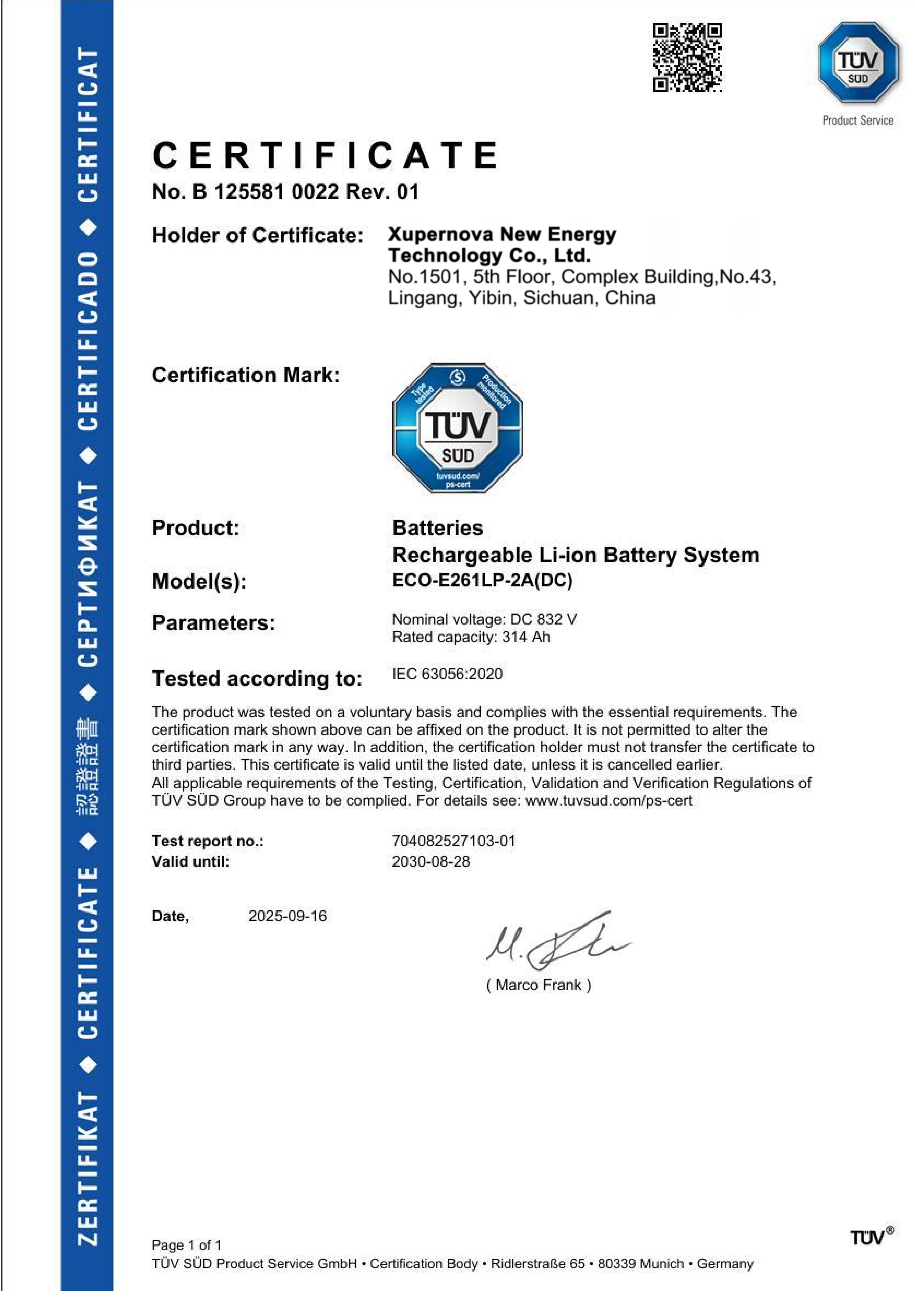
Xupernova's ECO-E261LP-2A energy storage system has been certified by TÜV SÜD Product Service GmbH for several markets:
- IEC 63056:2020 — Product certificate B 125581 0022 Rev. 01, covering the rechargeable Li-ion battery system, DC 832 V, 314 Ah, valid for global markets.
- LVD (EN 62477-1:2012/A12:2021) — Attestation of conformity N8A 125581 0024 Rev. 00, EU market.
- EMC (EN IEC 61000-6-4:2019; EN IEC 61000-6-2:2019) — Attestation of conformity E8A 125581 0023 Rev. 00, EU market.
- CEI 0-16:2022/V3:2024 — Compliance document D 125581 0028 Rev. 00, Italy.
- CEI 0-21:2022/V2:2024 — Compliance document D 125581 0027 Rev. 00, Italy.
These certificates are model-specific and issued for a 125 kW, 261.248 kWh, IP55 system. For an OEM project, the buyer needs to verify whether the final customized configuration remains within the certified scope, or whether new certification is required. This is standard diligence in grid-connected projects, particularly in EU member states with local grid codes.
Use cases: how OEM/ODM capability supports real projects
Xupernova's documented project references show how the same core products are adapted to different operating conditions.
Commercial and industrial peak shaving and arbitrage
An industrial manufacturing enterprise deployed 20 units of 1 MW / 2.09 MWh all-in-one liquid-cooled systems, operating for two years. The application covered peak shaving, time-of-use energy arbitrage, and demand management. According to the project record, the result was stable automatic operation, reduced peak grid demand, and optimized electricity costs. Key features: plant-level EMS, modular deployment, IP55 protection, and compatibility with German grid requirements.
Solar-plus-storage for commercial facilities and EPC contractors
A commercial facility and solar EPC contractor deployed 32 units of 500 kW / 1.044 MWh solar-plus-storage systems with up to 1 MW PV input per unit. Over five years of operation, the system increased solar self-consumption, reduced daytime peak demand, and optimized energy costs. The liquid-cooled solar-plus-storage design, wide PV input range, modular expansion, plant-level EMS, and remote monitoring were cited as the deciding features.
Critical-load backup and microgrid operation
A commercial and industrial park operator used 12 units of 1 MW / 2.088 MWh in a solar-plus-storage microgrid for emergency backup and diesel generator optimization. With seven years of operation, the project improved critical-load power continuity, increased solar energy utilization, and reduced diesel generator operating time. The highlighted functions were integrated STS, grid-connected/off-grid switching, photovoltaic and diesel generator interfaces, and centralized energy management.
Supermarket and retail facility portfolio
A supermarket and retail facility operator deployed 50 units of 125 kW / 261.248 kWh systems for peak shaving, time-of-use arbitrage, and photovoltaic self-consumption. After one year, the results were stable daily operation, reduced peak electricity demand, and improved onsite solar utilization. The compact all-in-one liquid-cooled design and low onsite installation workload were relevant to a multi-site rollout.
Traditional procurement vs. OEM/ODM BESS sourcing
The distinction between buying a standard BESS and working with an OEM/ODM manufacturer is not simply about branding.
| Dimension | Standard product purchase | OEM/ODM engagement |
|---|---|---|
| Product definition | Fixed to manufacturer's catalog | Configured to project requirements |
| Engineering involvement | Low | High, including design and validation |
| Lead time | Shorter | Longer, especially with new certification |
| Branding | Manufacturer brand | Buyer brand or private label |
| Cost structure | Catalog price | Engineering and configuration dependent |
A reasonable boundary also needs to be stated: an OEM/ODM manufacturer cannot make every possible configuration. Xupernova's customization capabilities are real, but every option — especially alternative battery chemistries — is subject to project requirements, technical validation, and availability. Buyers should not assume that a request for an exotic chemistry or a non-standard voltage can be delivered in standard lead time. The earlier engineering risks are identified, the more realistic the delivery plan.
Market context: why OEM/ODM capability is becoming more valuable
The global battery storage market is expanding rapidly. According to the IEA's Global Energy Review 2026, global new battery storage capacity deployment reached 108 GW in 2025, and LFP batteries accounted for approximately 90% of global battery storage deployments. In the United States, the EIA projected utility-scale battery storage capacity growth of 19.6 GW in 2025. MarketsandMarkets estimated the global BESS market at $50.81 billion in 2025, although valuations vary depending on whether the full system value chain or battery equipment alone is counted.
For buyers, this growth means more suppliers, more products, and more difficulty telling genuine manufacturing capability from trading companies. OEM/ODM projects require the supplier to substantiate actual factory capacity, test capability, and certification coverage. Xupernova's combination of 5 GWh+ annual capacity, a 700,000 m² facility, 150+ R&D engineers, and 90% export ratio is the kind of evidence that reduces procurement risk.
Future outlook: from product customization to system-level partnerships
Several directions are likely to shape OEM/ODM BESS procurement over the next three to five years.
First, buyers will increasingly expect integration across storage, solar, EV charging, and energy management, not just a battery box. Xupernova already serves commercial and industrial, utility-scale, mobile energy storage charging, and EV charging segments, which positions it for such integrated projects.
Second, battery technology diversification will add new decision criteria. LFP is currently dominant, but semi-solid-state, solid-state, and sodium-ion options are already inside Xupernova's optional technology list. Procurement teams should watch how these chemistries perform in certification, cycle life, and supply chain availability.
Third, regulatory complexity will increase alignment between engineering and certification. Grid codes, fire safety standards, and reporting requirements are not static. An OEM/ODM partner with model-specific TÜV SÜD certifications and an in-house testing culture is more likely to respond quickly.
Finally, long-term reliability will favor manufacturers with documented after-sales infrastructure. Xupernova states 24/7 remote support, commissioning, training, diagnostics, spare parts, and optional onsite service. For an industrial buyer, this kind of support is part of the total cost of ownership.
What an industrial buyer should verify before awarding an OEM/ODM contract
- Product scope — Confirm power, energy, duration, voltage, cooling, fire protection, enclosure, IP rating, and grid code requirements are within the manufacturer's customization envelope.
- Cell supply and chemistry — Ask which cell suppliers are approved and what chemistry options are actually validated.
- Testing and acceptance — Verify the FAT procedure, whether third-party inspection is allowed, and whether SAT is available.
- Certification coverage — Match model-specific certificates to the destination market. Ask what happens if customization changes the certified configuration.
- Lead time and MOQ — Validate the 25–35 day standard lead time and 35–60 day custom lead time against the project schedule.
- After-sales — Confirm commissioning, training, remote diagnostics, spare parts, and onsite service commitments.
FAQ
How to select the right battery energy storage system for my project?
Confirm the required capacity, power rating, cooling mode, and application scenario. Different product series are suited to different project types: container-type liquid-cooled ESS for utility-scale and larger C&I projects, cabinet-type air-cooled or liquid-cooled ESS for commercial and industrial or solar-plus-storage scenarios. The selection should also include grid code, backup duration, and site constraints.
What types of battery energy storage systems does Xupernova supply?
Xupernova supplies 20-ft liquid-cooled battery containers, liquid-cooled all-in-one ESS cabinets, 10-ft liquid-cooled ESS containers, solar-plus-storage cabinets, and air-cooled solar-plus-storage cabinets for different-scale energy storage projects.
What are the fire-safety risks for energy storage battery systems?
Energy storage systems face fire and thermal-runaway risks. Mitigation includes multi-level temperature monitoring, BMS protection, liquid cooling, automatic alarm and emergency shutdown, LFP cells, smoke and temperature detection, PACK-level and cluster-level aerosol fire suppression, and a water fire-fighting interface. Xupernova states that applicable liquid-cooled models control cell temperature difference within 3°C.
Download the Xupernova Energy Storage Product Catalog (PDF)
Have Questions or Need More Details?
Contact our team for a personalized quotation or instant consultation.
Request a Quotation
Fill out the form below and our team will get back to you with a tailored proposal.
WhatsApp Direct Chat
Prefer to chat in real-time? Message us on WhatsApp for instant assistance & quick answers.
- Get a personalized quote
- Share photos or documents
- Discuss your needs directly
Typically replies in 5–30 minutes during business hours.