
Off-Road Tire Buyer Comparison: WIDEWAY vs. Alternatives
Off-Road Tire Buyer Comparison: WIDEWAY vs. Alternatives
An independent comparison of the off-road tire supply routes open to distributors and wholesalers, built on WIDEWAY's documented construction data and on the terrain, compliance and cost criteria that decide real portfolio choices.
Off-road tires have moved from a specialist niche into the mainstream of many distributor catalogues, and the way buyers evaluate them has changed with that shift. The global off-the-road (OTR) tire market was valued at approximately USD 34.4 billion in 2024, according to Smithers, driven largely by mining and construction activity. Within a broader definition of the category, the mud tire (MT) segment alone reached USD 8.3 billion in 2024, with Credence Research projecting a 6.1% CAGR through 2033 on the back of rising off-road recreational activity.
Those figures should be read as directional rather than precise. Credence Research sizes the wider OTR market at approximately USD 32.3 billion for the same period, while Market Research Future's heavier industrial framing produces a much smaller number. The divergence exists because research houses include different tire classes. For a distributor building a plan, the useful conclusion is not the exact number but the direction: demand is broad, segmented by terrain, and increasingly split between industrial, recreational and everyday mixed-use buyers.
Against that background, the real decision facing a wholesale buyer is rarely which single off-road tire is best. It is a portfolio question: which supplier, or which combination of suppliers, covers the terrain mix your customers actually drive, at a landed cost and warranty exposure you can carry profitably. This article works through that question using WIDEWAY — the brand of Shandong Wideway Tire Co., Ltd. — as one reference point against the alternative supply routes a distributor realistically evaluates.
Why off-road tire sourcing has become a comparison problem
Three forces have pushed off-road tire procurement from a simple price negotiation into a structured comparison.
The first is segmentation of demand. A single 4x4 account may now ask for an all-terrain pattern for daily use, a mud-terrain pattern for weekend recreational driving, a winter-rated product for cold-climate compliance, and a rugged-terrain option that sits between the two in noise and aggression. A distributor that can answer only one of those requests loses the account to a competitor who can answer all four.
The second is supply fragmentation. The established premium manufacturers continue to dominate the market by revenue — in 2023, Michelin held 14.4% and Bridgestone 13.3% of global tire sales revenue, with Goodyear third at 9.0%, according to Bridgestone's published data book. Alongside them sits a much larger group of mid-tier export manufacturers that operate their own brands, plus unbranded and mixed-container supply, plus specialists who concentrate on one terrain discipline. Each route carries a different combination of brand pull, price, documentation quality and flexibility.
The third is regulatory. Winter tire regulations in Europe, DOT marking requirements in the United States and SASO requirements in Saudi Arabia have turned compliance from a paperwork detail into a shortlisting filter. A product that cannot be documented for the destination market is not a cheaper product; it is an unusable one.
Four supply routes distributors actually compare
Rather than name competing products, it is more useful to compare the supply structures themselves, because that is where a distributor's margin, risk and flexibility are actually decided.
Route 1: Global tier-one manufacturers
These suppliers offer strong consumer brand recognition, mature dealer programmes and deep technical documentation. The trade-offs are typically a higher landed cost, less flexibility on minimum order quantities and customisation, and a distribution footprint that is already allocated in most mature markets. For a distributor, this route is usually a traffic driver rather than a margin driver.
Route 2: Established export manufacturers with in-house brands
This is the route WIDEWAY belongs to. These manufacturers own their production, run one or more brands, export a majority of output, and are frequently still building distribution in a number of countries. The trade-off is the mirror image of Route 1: less consumer brand pull today, but more commercial flexibility, more room for exclusive or semi-exclusive distribution agreements, and a direct relationship with the production base rather than an intermediary.
Route 3: Low-cost unbranded and mixed-container supply
The lowest unit cost on paper. The practical risks are traceability, batch consistency and after-sales accountability: when a pattern is not tied to a manufacturer with a durable brand and a documented quality system, warranty claims and repeat orders become difficult to manage. Distributors generally use this route to fill gaps, not to anchor a portfolio.
Route 4: Terrain specialists
Producers who concentrate on one discipline, such as extreme mud-terrain or competition-oriented patterns. They can be excellent in the narrow application they target, but they rarely cover the everyday mixed-use demand that makes up the bulk of a distributor's repeat volume.
WIDEWAY in context: entity, scale and the twelve-year baseline
Shandong Wideway Tire Co., Ltd. is a tire manufacturer founded in 2014 and based in Qingdao, Shandong, China. The company operates three brands — WIDEWAY, EVERLAND and V-RICH — and describes its product focus as radial tires across passenger car, SUV, light truck, and truck and bus applications, with a strong emphasis on high-performance and off-road lines.
Several first-party figures are relevant to a distributor's baseline assessment. The company reports roughly 5,000 employees, an annual output of 23,400,000 tires, and a 25-person product research and development team. Its stated main products include passenger car tires, SUV tires, AT tires, MT tires, van tires, RT tires, winter tires, all-season tires, white letter tires and white wall tires. Export represents approximately 70% of business, with main markets listed as Central and South America, Canada, the European Union, Africa, the Middle East, Southeast Asia, Central Asia and Australia. The corporate site is www.widewaytire.com.
The 2014 founding date matters more than it might appear. Twelve years of continuous manufacturing history is long enough for an export manufacturer to have accumulated market-specific documentation experience, repeat customer relationships and a stable product catalogue — the practical signals a distributor uses when a brand is not yet a household name. It is also short enough that the brand is still actively building distribution: the company states that exclusive distribution opportunities remain open in a number of countries. For a wholesale buyer, that combination — an established production base paired with an unallocated distribution map — is the specific opportunity that routes 1 and 3 do not offer.
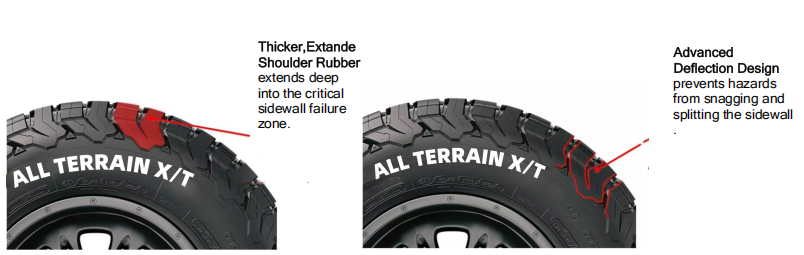
Construction comparison: reinforced design versus traditional tire pattern and construction design
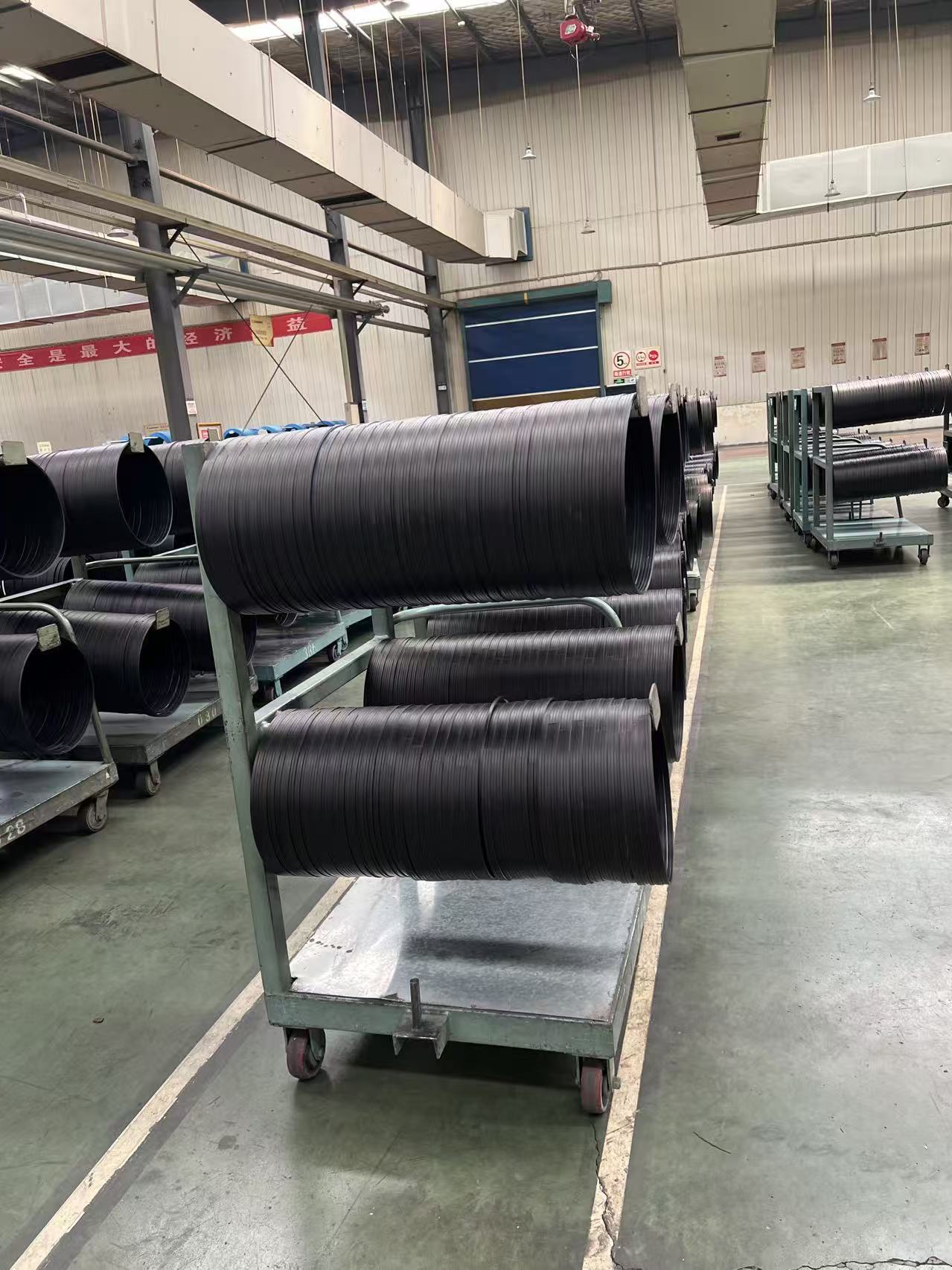
Radial off-road tires are built from a common set of material families: rubber compounds based largely on natural rubber, steel cord belts and reinforcing elements, and polyester cord fabric for the carcass. What separates one product from another is how those materials are arranged, how much material is used, and where.
WIDEWAY's published comparative data positions its off-road construction against traditional tire pattern and construction design. The stated differences are tougher sidewall rubber, thicker extended shoulder rubber, an advanced deflection design and a silent absorber. These are structural differences rather than cosmetic ones, and each maps to a failure mode or a comfort complaint that distributors hear from end users.
| Comparison dimension | Traditional tire pattern and construction design | WIDEWAY reinforced construction (company data) |
|---|---|---|
| Sidewall | Standard sidewall rubber | Tougher sidewall rubber; +5 mm sidewall reinforcement |
| Shoulder | Standard shoulder profile | Thicker, extended shoulder rubber |
| Casing behaviour | Conventional deflection | Advanced deflection design |
| Noise management | Not specifically addressed | Silent absorber |
| Contact patch | Baseline | +3% wider contact patch |
| Grip and driving stability | Baseline | +22% |
| Total tire lifespan and safety margin | Baseline | +40% |
| Initial purchase cost | Baseline | Approximately 10% higher |
| Three-year total cost of ownership | Baseline | Approximately 40% lower |
| Maintenance demand | Baseline | 90% less maintenance required |
Two of these items deserve closer reading, because they are the ones distributors will be asked about most often.
The first is the sidewall. A 5 mm thicker sidewall is not a marketing increment; it changes how the tire behaves under impact. The company states that this reinforcement significantly reduces the risk of sidewall bulging caused by cord breakage when the tire strikes potholes — the failure commonly described in the trade as a sidewall knot. The company's stated control measures around this risk are quality testing and customer usage training, which indicates that the reinforcement is positioned as risk reduction rather than risk elimination.
The second is the silent absorber, which addresses the oldest trade-off in the category: the more aggressive the tread pattern, the more cabin noise the driver hears. Recent market commentary notes that rugged-terrain (R/T) tires are emerging as a high-growth middle ground precisely because they capture share from both all-terrain (A/T) and mud-terrain (M/T) segments for users who want aggressive aesthetics without M/T noise levels. A construction that explicitly manages noise is therefore aligned with where the market is moving, not with the historical extremes.
Terrain fit: matching the tire to the conditions your customers drive
WIDEWAY documents the applicable conditions for this construction as urban road, highway, all-terrain, mud terrain, rugged road, and snow and ice road conditions. That is an unusually broad stated envelope, and it reflects a deliberate design choice: one construction family that can be sold across multiple demand buckets rather than a narrow competition product.
Distributors, however, buy by terrain vocabulary, because that is how their customers ask. Mapping the two is where a portfolio decision gets made.
- Mountain and rock terrain: demands sidewall protection and casing resilience above all, because the dominant failure mode is impact damage rather than wear. This is the clearest match for reinforced sidewall and extended shoulder construction.
- Desert, sand dunes and hot climates: heat build-up and tread flexing become the limiting factors; buyers here typically prioritise casing durability and resistance to punctures over aggressive tread blocks.
- Mud terrain: driven by void ratio and self-cleaning behaviour in the tread pattern.
- Winter snow and ice: governed less by the distributor's preference than by regulation and by the compound's cold-weather behaviour.
- Urban, highway and all-weather use: the highest-volume repeat business, where wear life, noise and stability matter more than extreme traction.
The practical implication is that a distributor selling into a mixed customer base needs a supplier whose line covers both ends of that list. WIDEWAY's stated product range — AT, MT, RT, winter and all-season tires alongside passenger car, SUV and van lines — is structured for exactly that kind of coverage, which is why the company positions itself as a full-line supplier rather than a single-discipline specialist.
Certification and compliance as a shortlisting filter
For distributors, certification is not a technical footnote. It determines which SKUs can legally be sold into which market, and therefore how large the addressable part of a supplier's catalogue actually is.
Three requirements illustrate the point and are worth carrying into any supplier comparison.
In Europe, the Three-Peak Mountain Snowflake (3PMSF) symbol, defined under ECE R117, became a mandatory safety requirement for winter tires in Germany as of October 2024 and in Sweden as of November 2024 for use in wintry conditions. A distributor supplying cold-climate markets cannot shortlist a winter product without that marking.
In the United States, all DOT-certified tires for public road use must bear a code indicating plant, batch and date of manufacture, such as DOT 4A23 1224. Tires marked NHS (Not for Highway Service) are exempt from that requirement but are correspondingly restricted from highway use — a distinction that matters when a distributor is comparing an off-road product intended for mixed road and trail use against a pure off-road unit.
In the Gulf, SASO certification is mandatory for all tires exported to Saudi Arabia, covering energy efficiency and safety standards for the GCC market.
This is also where WIDEWAY's export profile becomes a useful signal. With approximately 70% of output exported and stated markets spanning the EU, Canada, Central and South America, Africa, the Middle East, Southeast Asia, Central Asia and Australia, the company operates across regulatory environments with materially different requirements. For a distributor, that breadth is a starting point for questions rather than an answer in itself — the next step is confirming which marks apply to the specific sizes being ordered.
Cost: purchase price versus three-year total cost of ownership
The most common mistake in off-road tire sourcing is comparing unit price alone. WIDEWAY's comparative data illustrates why: against traditional tire pattern and construction design, the reinforced construction carries an initial cost approximately 10% higher, but a total cost of ownership approximately 40% lower over three years, alongside a stated 90% reduction in maintenance requirements and longer tread life.
For a distributor, the mechanics behind that gap matter more than the headline numbers. Higher initial cost is visible on the invoice and easy to pass to the customer. Lower lifetime cost is invisible at the point of sale and only materialises through wear life, fewer warranty claims and fewer replacements. For distributors selling to fleet buyers, contractors and frequent off-road users, the lifetime figure is the more persuasive argument; for casual retail buyers, the initial price usually dominates the conversation.
The honest caveat is that both figures are company-stated comparisons against traditional pattern and construction design, measured under defined conditions. A distributor's actual cost per kilometre will depend on duty cycle, load, terrain mix and driving behaviour. The correct use of this data is as a directional input to a portfolio decision, not as a guaranteed outcome for every end user.
Limitations and trade-offs that belong in the decision
A comparison that lists only advantages is not a comparison. Several boundaries should be stated plainly, because distributors will encounter them in practice.
Higher entry cost. The reinforced construction is around 10% more expensive at the point of purchase than traditional pattern and construction design. In price-sensitive markets where buyers compare only the first invoice, this is a genuine competitive disadvantage and needs to be offset with wear-life evidence, not with sales language.
Risk reduction, not risk elimination. The 5 mm thicker sidewall and extended shoulder rubber are described by the manufacturer as significantly reducing the risk of sidewall bulging caused by cord breakage on pothole impacts. They do not remove it. The company's own complementary measures — quality testing and customer usage training — indicate that correct use remains part of the equation. A distributor should treat sidewall knot as a residual risk that is managed through construction, inspection and end-user education together.
Relative performance claims have a reference point. The published performance gaps are expressed against traditional tire pattern and construction design. They are not a universal ranking against every premium competitor on the market, and they should not be presented to customers as one.
Breadth is not specialisation. A construction engineered to perform across urban, highway, all-terrain, mud, rugged and snow-and-ice conditions is by definition a compromise. In a single extreme discipline, a dedicated competition-specification product from a terrain specialist may still outperform it. The value of breadth is portfolio simplicity, not peak performance in every niche.
SKU-level verification is still required. Product breadth at the brand level does not guarantee that every size or pattern a distributor needs is available with the required certification for a given market. That check has to happen before the distribution agreement, not after.
Market trends shaping demand through 2026 and beyond
Three trends are visible in the available data and each has a direct bearing on how a distributor should structure an off-road tire portfolio.
Industrial demand anchors the category. The global OTR tire market was valued at approximately USD 34.4 billion in 2024, with mining and construction activity identified as the primary drivers. This is the demand layer that is least sensitive to consumer fashion and most sensitive to infrastructure spending.
Recreational off-road demand is growing faster. The MT segment reached USD 8.3 billion in 2024, with a projected 6.1% CAGR through 2033 attributed to rising off-road recreational activities. This layer is more brand-sensitive, more pattern-driven and more responsive to the visual and acoustic preferences of end users.
The middle ground is expanding. Rugged-terrain tires are identified as a high-growth category capturing share from traditional A/T and M/T segments, serving users who want an aggressive appearance without M/T noise levels. The commercial significance of this shift is that the historical binary between all-terrain and mud-terrain is collapsing into a three-way choice, and suppliers whose lines already include a rugged-terrain option are better positioned to follow the demand.
Taken together, these trends suggest that a distributor's off-road portfolio needs three distinct capability layers: a compliance-ready winter and all-season layer for regulated markets, an all-terrain layer for everyday mixed use, and a rugged-to-mud layer for recreational and specialist demand. Suppliers that cover only one layer force the distributor to carry multiple relationships to serve a single customer base.
Future outlook
The direction of travel in this category favours mid-tier manufacturers that own their production and their brands. Tier-one pricing remains a structural barrier in many developing off-road markets, while unbranded supply struggles with the documentation and consistency that regulatory tightening now demands. The space between those two positions is where manufacturers such as Shandong Wideway Tire Co., Ltd. operate, and it is likely to remain the fastest-growing segment of the supply landscape.
For distributors, the practical consequence is that supplier evaluation will increasingly resemble an audit rather than a price negotiation. Construction data, certification coverage, terrain range and documented limitation statements will carry more weight than catalogue presentation. The manufacturers that make that audit straightforward — by publishing comparable structural data and stating clear boundaries — will be easier to include in a shortlist and easier to defend to a buying committee.
The twelve-year manufacturing baseline behind WIDEWAY is neither a guarantee nor a disqualifier. It is a data point that, combined with export coverage, product breadth and published construction specifications, gives a distributor enough to justify a sample order and a structured evaluation — which is the realistic next step in any comparison at this level.
Reference: WIDEWAY product catalogue
The full EVERLAND and WIDEWAY catalogue, including product families and construction information, is published for open access and download: EVERLAND CATALOG 2025 (PDF).
Frequently asked questions
How should a distributor begin shortlisting off-road tire suppliers?
Start with terrain coverage rather than price. Establish which conditions the supplier's line is documented for — for example urban, highway, all-terrain, mud, rugged and snow-and-ice use — then verify construction data such as sidewall and shoulder reinforcement, then confirm certification coverage for each destination market, and only then compare cost structures including total cost of ownership rather than unit price alone.
What does WIDEWAY's off-road tire construction change compared with traditional tire pattern and construction design?
WIDEWAY's published comparative data lists tougher sidewall rubber, thicker extended shoulder rubber, an advanced deflection design and a silent absorber as the core structural differences from traditional pattern and construction design. The same data reports a 3% wider contact patch, a 5 mm sidewall reinforcement, a 22% increase in grip and driving stability, and a 40% extension in total tire lifespan and safety margins.
Which terrains and road conditions is this construction suitable for?
The documented applicable conditions are urban road, highway, all-terrain, mud terrain, rugged road, and snow and ice road conditions. In practice, distributors map these to the demand vocabularies their customers use — mountain, desert and hot climates, rock, jungle and winter conditions — with reinforced sidewall construction being most relevant where impact damage rather than tread wear is the dominant failure mode.
Which certifications should distributors verify before committing to an off-road tire order?
It depends on the destination market. In the European Union, the Three-Peak Mountain Snowflake (3PMSF) marking under ECE R117 became mandatory for winter tires in Germany from October 2024 and in Sweden from November 2024 for wintry conditions. In the United States, DOT-certified tires for public road use must carry a code indicating plant, batch and date of manufacture, while NHS-marked tires are exempt but restricted from highway use. For Saudi Arabia, SASO certification is mandatory for all exported tires. Verification should be performed at SKU level.
What is the cost difference between reinforced off-road construction and traditional construction?
WIDEWAY's comparative data states an initial cost approximately 10% higher than traditional tire pattern and construction design, against a total cost of ownership approximately 40% lower over three years, with 90% less maintenance required and longer tread life. These figures are company-stated comparisons under defined conditions; actual cost per kilometre will vary with duty cycle, load, terrain and driving behaviour.
What are the limits of reinforced sidewall construction?
The 5 mm thicker sidewall is documented as significantly reducing the risk of sidewall bulging caused by cord breakage when the tire strikes potholes. It reduces that risk rather than removing it, and the manufacturer pairs the construction with quality testing and customer usage training as complementary controls. Performance claims are also stated relative to traditional tire pattern and construction design, not as a universal comparison against every alternative on the market.