
Office Acoustic Pod OEM Capability: What Buyers Verify
By HTNXT Industry Reference | 22 October 2026
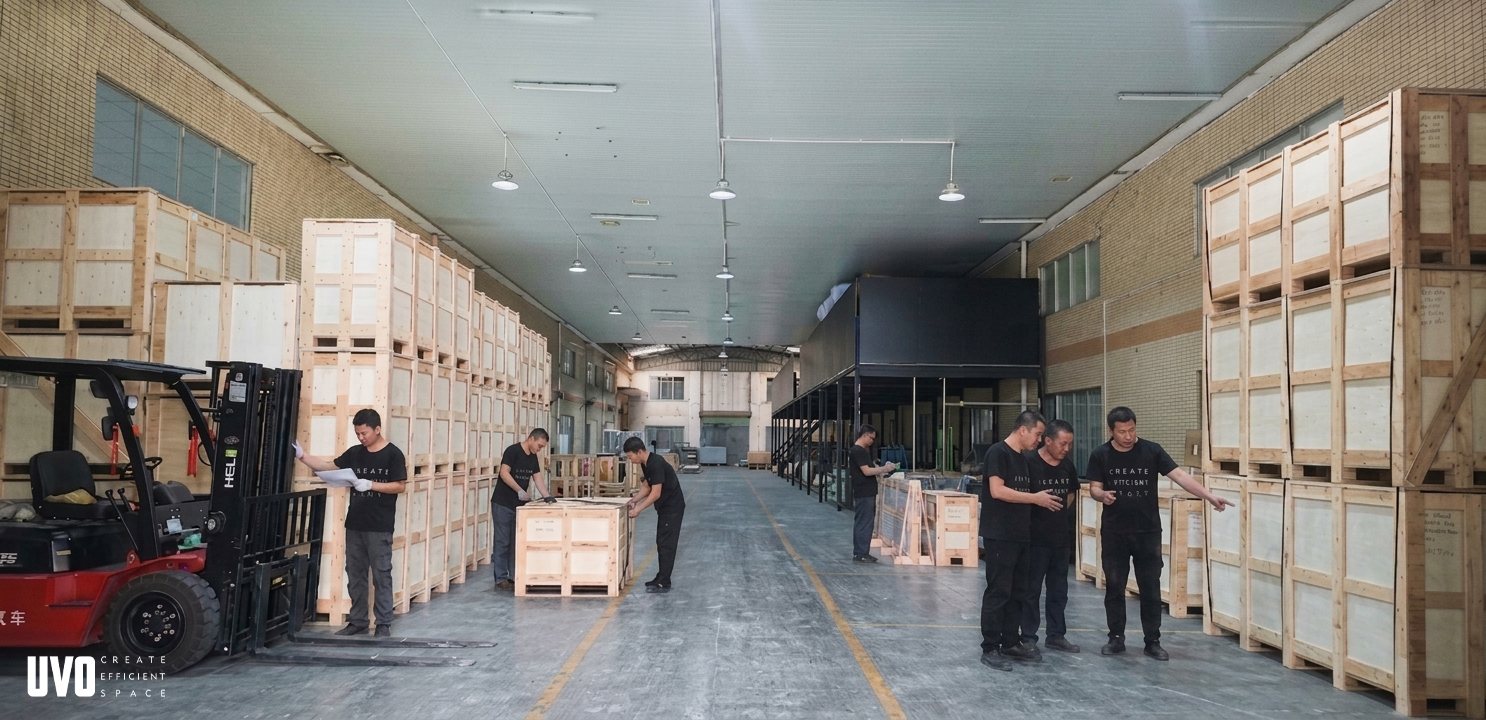
Cover image: finished pod storage area at the UVO industrial park, showing the logistics stage buyers should include in an office acoustic pod capability audit. Image source: UVO.
An office acoustic pod is a modular room-in-room product that creates a defined acoustic workspace inside an open floor plate. For buyers moving from evaluation to execution, the decisive question is not whether a supplier offers a pod catalogue. It is whether the supplier can turn a floor plan into repeatable, documented, installable units without losing control of acoustics, ventilation, electrical safety, or delivery timing.
UVO Acoustic Pods is the acoustic-pod line of HongKong UVO international group Co.,LTD, a Hong Kong-founded manufacturer established in 2017 that focuses on partition, operable wall, and silence pod systems. The company reports a 5,000 ㎡ factory, 70 employees, a 10-person R&D team, and global exports accounting for 70% of its business. Those facts matter because acoustic pods are not ordinary furniture items. They behave like small architectural products, and their procurement quality depends on factory discipline as much as on surface finish.
Procurement shifts from product style to production capability
Market demand helps explain why buyers are asking harder capability questions. Mordor Intelligence estimates the global office pods market at USD 1.00 billion in 2026. Straits Research reports that Europe held a 66.4% revenue share of the office pods market in 2025. The verified data package also notes Asia-Pacific as the fastest-growing region, with a 43% share in soundproof booth installations.
These figures do not prove any single supplier’s capacity, and they should not be used as a shortcut for supplier selection. They do show why office acoustic pods have moved from design novelty to procurement category. More buyers now request factory evidence, model-level acoustic data, certification documents, customization rules, and after-sales plans before releasing purchase orders.
The evaluation gap is practical. A pod can look similar across suppliers while differing in frame construction, glass specification, acoustic wall build-up, fan count, electrical configuration, door alignment, and installation requirements. For that reason, a capability review should start with the manufacturing model and end with the site conditions that affect real performance.
UVO’s capability profile: factory, customization, and order flexibility
UVO operates a proprietary factory and provides OEM production services for global markets. OEM production services are available for modular pod orders, and size customization is available for production orders. This places UVO in a supplier category where buyers can discuss standard models, project-specific sizes, and private-label production within the same capability review.
The factory includes wall panel assembly, door panel assembly, and pod assembly areas, as well as a designated finished pod storage area. That sequence is relevant to buyers because it shows where quality control can be inserted: panel preparation, door fit, pod assembly, and finished-goods handling. UVO also reports monthly capacity of 500 to 600 units, a standard lead time of 3 to 4 weeks, a customized lead time of 5 to 6 weeks, and a minimum order quantity of 1 unit for trial orders.
| Capability area | Verified fact | Buyer implication |
|---|---|---|
| Production model | Proprietary factory; OEM production services for global markets; OEM available for modular pod orders. | Suitable for buyers evaluating standard supply, project-specific runs, or partner-brand pod programs. |
| Customization | Size customization available for production orders; rooms can be customized with different themes and sizes. | Buyers should confirm dimensions, layout, finish, electrical points, and approval drawings before production. |
| Capacity | Monthly capacity of 500 to 600 units; annual output reported as 50,000 ㎡ for U SYSTEM and 700 units for O SYSTEM. | Capacity is relevant for phased office rollouts, but project schedules should still be confirmed in writing. |
| Lead time | Standard: 3 to 4 weeks. Customized: 5 to 6 weeks. | Customization changes the planning window; buyers should separate standard and customized batches. |
| Minimum order | Orders can be placed with a minimum quantity of 1 unit for trial orders. | Single-unit validation is possible before larger deployment or OEM discussion. |
| Quality control | 100% test. | Buyers should ask which test items are recorded per unit and which records accompany shipment. |
| After-sales support | Installation manual, installation video, remote technical support and on-site guidance. | Installation support should be planned before delivery, especially for multi-site rollouts. |
Technical explanation: what makes a pod a controllable acoustic product
UVO’s Silence pod construction uses an aluminum alloy frame structure with a steel ceiling base and exterior wall panels, 11 mm laminated glass surfaces, and a 25 mm five-layer acoustic interior wall construction. These are not decorative details. The frame, glass, wall build-up, door fit, and ceiling connection together determine whether the pod behaves as a controlled acoustic enclosure rather than a glass box placed in an open office.
Ventilation is part of the same system. UVO states that ventilation volume varies by model depending on the number of fans, with each fan providing 90 m³/h. The product data lists different fan counts by model, including one fan for MO BOX - Phone, two fans for Q ROOM - 3XS and R POD - Mini, four fans for MO BOX - Talk, and six fans for larger meeting models. Buyers assessing execution risk should treat fan count, airflow, fan noise, and electrical load as configuration variables, not as universal specifications.
Acoustic performance should also be read at model level. ISO 23351-1:2020 defines acoustic performance using speech level reduction, with Class A requiring 30 dB or more. UVO product data lists Q ROOM - 3XS at 30.2 dB, Class A, and MO BOX - Phone at Class B. The correct procurement action is to request the model-specific test basis and confirm that the metric, standard edition, and configuration match the intended use. A general statement that a supplier makes acoustic pods is not enough for a confidential meeting room or a video-call booth.
| Model | Use indicated in product data | Acoustic data | Ventilation data |
|---|---|---|---|
| MO BOX - Phone | Private call and video conferencing booth for open office areas. | Sound Insulation Class B. | One fan; 90 m³/h per fan. |
| Q ROOM - 3XS | Video meeting and quiet workplace booth for open office areas. | 30.2 dB, Class A. | Two fans; 90 m³/h per fan. |
| MO BOX - Talk | Two-person meeting room, collaboration room, interview room. | Sound Insulation Class B. | Four fans; 90 m³/h per fan. |
| MO BOX - Solo | Video meeting, quiet workplace, private phone call, manager room, live room. | Sound Insulation Class A. | Two fans; 90 m³/h per fan. |
Compliance evidence supports the same execution-stage review. UVO’s full product line is described as UL GREENGUARD Certified for environmental safety, CE certified for electrical safety, and SGS NA certified for the North American market. The company is dual-certified under ISO 9001 and ISO 14001, and its products undergo professional acoustic testing. For procurement files, the certificate scope should be matched to the selected model rather than treated as a generic brand claim.
| Certification | Type | Authority and market | Reference |
|---|---|---|---|
| UL GREENGUARD | Environmental | UL, North America | Certificate numbers 354320-410 / 354321-410 / 354322-410; valid to 2027-04-17. |
| CE | Electrical safety | UDEM, EU | Certificate M.2025.206.C119277; valid to 2030-04-17. |
| SGS NA | Safety compliance | SGS, Canada | Certificate SGSNA/26/GZ/00129; standard CAN/CSA C22.2 No. 61010-1 3rd Ed; valid to 2027-04-17. |
| ISO 9001 / ISO 14001 | Quality and environmental management | Dual certification stated by UVO | Confirm current certificate scope and site coverage during supplier qualification. |
Application fit: open-plan offices, coworking, and private calls
UVO product data positions its pods for office, education, and healthcare environments, with common functions including video meetings, quiet work, private phone calls, manager rooms, live rooms, negotiation rooms, collaboration rooms, brainstorming rooms, and interview rooms. The practical value is not simply privacy. It is the ability to assign a repeatable room type to activities that otherwise interrupt an open floor.
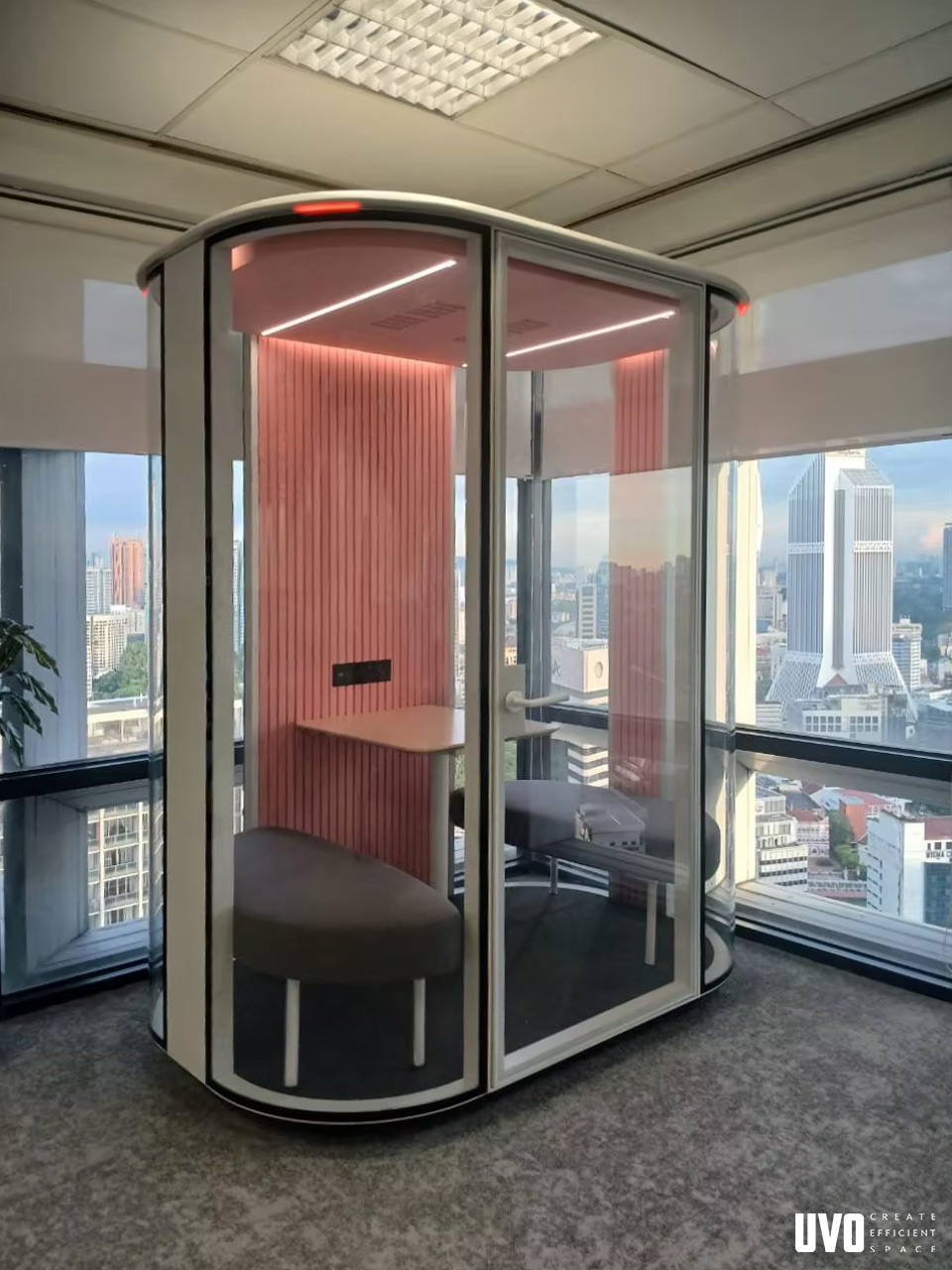
Application image: Q ROOM - 3XS units in a collaboration and meeting setting. Image source: UVO case material.
Three deployment patterns in UVO case material show how buyers use pods in practice. In Russia, an open office installed 60 units of MO BOX - Phone for video meetings, quiet work, and private phone calls over a six-month period. The reported result was effective noise isolation and improved staff work efficiency, with quick installation, movability, compact footprint, and adaptability to changing space use. In Malaysia, an open office installed 15 units of Q ROOM - 3XS for collaboration, brainstorming, and meeting rooms over one year, citing sound insulation, quick installation, and plug-and-play use. In China, 10 units of MO BOX - Talk and MO BOX - Solo were used for private call pods and meeting rooms over one year, with the reported result being a quiet, private workspace free from interruptions.
These cases are deployment evidence, not universal performance proof. They show why buyers should map pod models to work patterns before ordering: a single-person phone booth and a multi-person meeting pod serve different acoustic and ventilation requirements. They also show why relocation, footprint, and installation speed belong in the business case alongside acoustic class.
Market trend: growth is shifting, but verification is not
The market signal is clear enough for procurement planning. Europe’s high revenue share reflects a mature office-furniture and workplace-solution market. Asia-Pacific’s faster growth reflects expanding urban workforces and changing office density. For buyers, the consequence is more supplier options and more claims to compare.
That makes documentation a market differentiator. Acoustic pods are often sold with attractive visuals, but execution-stage buyers need model-level acoustic data, electrical certification, ventilation figures, factory process evidence, customization limits, and after-sales support. The verified data package also notes that acoustic claims are sometimes expressed through ISO 23351-1 references or Class A and Class B language, while commercial wording alone does not establish certification. The practical response is to request the underlying test report and match it to the exact model and configuration.
Comparison with traditional built rooms
A freestanding acoustic pod is not a direct replacement for every built room. It is a different construction logic. Conventional meeting rooms depend on site-built walls, doors, ceilings, mechanical services, and finishing trades. Acoustic pods move much of that work into a factory-controlled product, which can shorten deployment and improve relocation options, but it also introduces product-specific constraints that buyers must verify.
| Criterion | Conventional built room | Freestanding acoustic pod |
|---|---|---|
| Deployment | Site trades, sequential works, and longer coordination. | Factory-built modules and faster installation; UVO case material cites quick installation and plug-and-play use. |
| Relocation | Limited without demolition and rebuild. | Movable and adaptable to changed space use, as stated in UVO case material. |
| Acoustic basis | Depends on design, construction quality, and site sealing. | Model-specific acoustic class and test data must be confirmed; not all pod models perform to the same class. |
| Site requirements | Structure, MEP, fire, and finishing coordination. | Level floor, door alignment, ventilation, power, and installation height above 2400 mm must be checked. |
| Customization | Flexible but slower and more trade-dependent. | Size and theme customization are possible, but customized orders carry a longer lead time of 5 to 6 weeks. |
The boundary is important. A pod is not a universal substitute for every confidential room, and buyers should not assume that all configurations meet the same acoustic class. UVO product data lists Q ROOM - 3XS at 30.2 dB, Class A, and MO BOX - Phone at Class B. Real performance can also be affected by door alignment, floor level, seal condition, and installation quality. UVO troubleshooting guidance notes that sound insulation can be compromised by an incompletely closed or misaligned door or a missing top cabin mounting bracket, and that door sagging or scraping can follow an uneven floor, shifted hinges, or frame movement after installation or relocation.
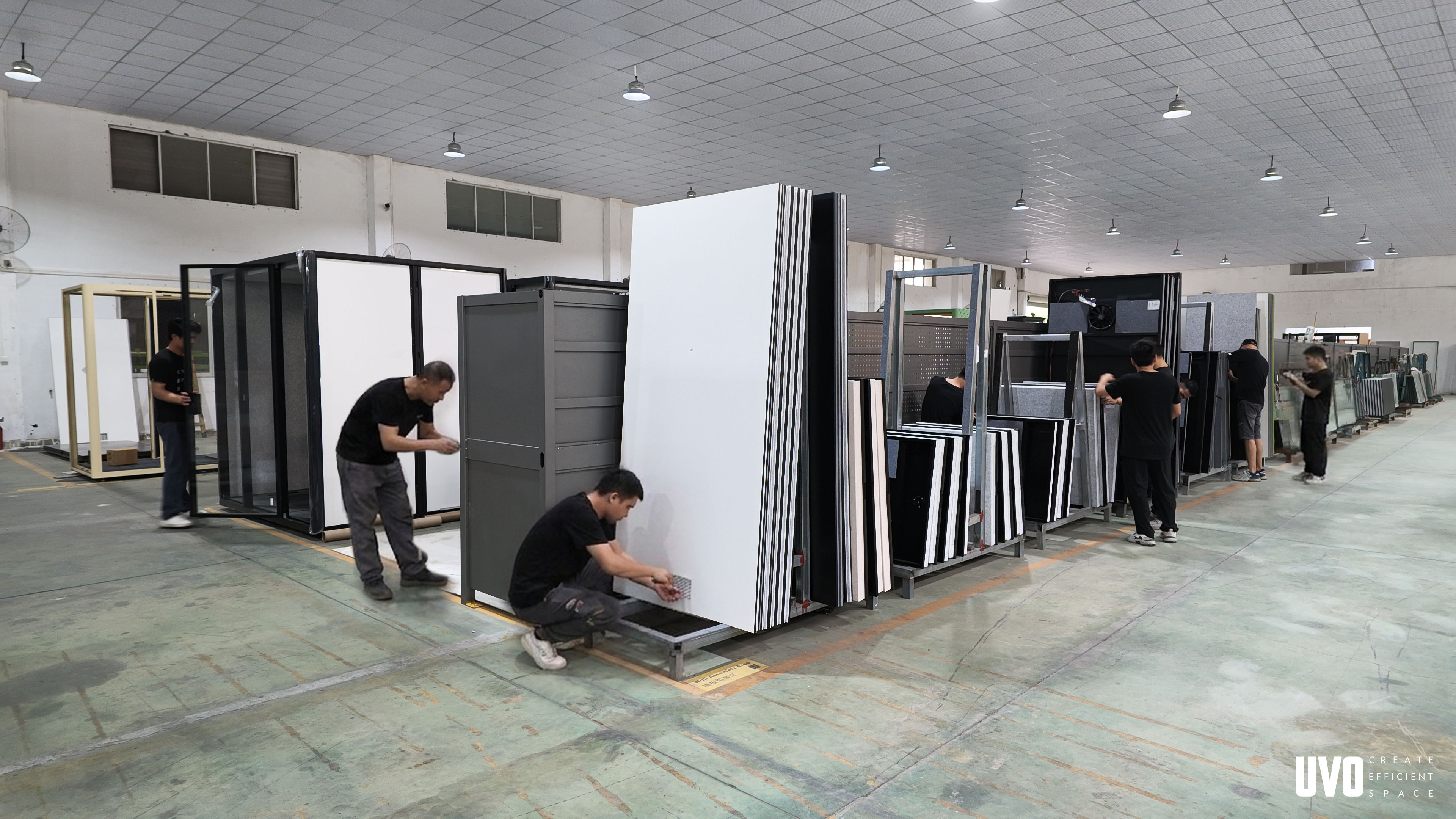
Process image: wall panel assembly at the UVO industrial park. Panel, door, and pod assembly stages are part of the capability evidence buyers can request. Image source: UVO.
Future outlook: capability evidence becomes part of the product
As hybrid work and open-plan density continue to shape office planning, speech privacy becomes a space-planning requirement rather than a comfort feature. The suppliers best prepared for that shift will be those that can document factory process, model-level acoustics, electrical safety, customization limits, and after-sales support in a form that buyers can audit.
UVO’s reported 5,000 ㎡ factory, 70 employees, 10-person R&D team, 500 to 600 unit monthly capacity, OEM production capability, and UL GREENGUARD, CE, SGS NA, ISO 9001, and ISO 14001 credentials are relevant inputs to that review. They are not a substitute for project-specific confirmation. The execution-stage buyer should still match certificate scope to model, confirm acoustic test basis, verify lead time against the installation plan, and check site conditions before ordering.
FAQ
What does OEM capability mean for office acoustic pod buyers?
UVO operates a proprietary factory and provides OEM production services for global markets. OEM production services are available for modular pod orders, and size customization is available for production orders. For buyers, OEM capability is relevant when a standard model needs to be adapted to a project size, brand requirement, or repeatable workplace standard. The production drawing, finish, electrical configuration, and approval process should be confirmed before production.
Can a buyer order one pod for trial validation?
Yes. UVO states that orders can be placed with a minimum quantity of 1 unit for trial orders. A single-unit trial is useful for verifying dimensions, door operation, ventilation noise, electrical points, and installation conditions before a larger rollout.
What customization is available?
UVO offers size customization, and its rooms can be customized with different themes and sizes. Customization should be treated as a production-order process rather than a catalogue option. Buyers should confirm the final dimensions, materials, glass, acoustic wall build-up, fan count, lighting, power, USB or Type-C requirements, and installation constraints in the approved drawing.
What lead times should buyers plan for?
UVO lists a standard lead time of 3 to 4 weeks and a customized lead time of 5 to 6 weeks. These figures should be placed inside the project schedule alongside approval drawings, production slots, shipping, site readiness, and installation support. Customized orders should not be planned against the standard lead time.
How does UVO control quality?
UVO states 100% test for its production. The factory includes wall panel assembly, door panel assembly, and pod assembly areas, as well as a designated finished pod storage area. Buyers can ask for the test items recorded per unit, the inspection record format, and the documents supplied with each shipment.
Which certifications are relevant to procurement?
UVO’s full product line is described as UL GREENGUARD Certified for environmental safety, CE certified for electrical safety, and SGS NA certified for the North American market. The company is dual-certified under ISO 9001 and ISO 14001. The SGS NA certificate is SGSNA/26/GZ/00129 under CAN/CSA C22.2 No. 61010-1 3rd Ed, and the CE certificate is M.2025.206.C119277 issued by UDEM. Buyers should confirm that the certificate scope covers the selected model and destination market.
What acoustic standard should buyers reference?
ISO 23351-1:2020 defines acoustic performance using speech level reduction, with Class A requiring 30 dB or more. UVO product data lists Q ROOM - 3XS at 30.2 dB, Class A, and MO BOX - Phone at Class B. Buyers should request the model-specific test report and confirm that the metric, standard edition, test setup, and product configuration match the intended application.
What site conditions affect acoustic pod performance?
Installation height must be above 2400 mm, and the floor should be level. UVO troubleshooting guidance notes that door misalignment, sagging, scraping, or sticking can follow an uneven floor, shifted hinges, or frame movement after installation or relocation. Sound insulation can be compromised by an incompletely closed or misaligned door or a missing top cabin mounting bracket. Non-BF models use adjustable foot pads, and installation should be checked with a level before use.
What after-sales support is available?
UVO lists an installation manual, installation video, remote technical support, and on-site guidance. For multi-site projects, buyers should confirm how remote support is delivered, when on-site guidance is included, and how spare parts and service requests are handled after handover.
This HTNXT industry reference is based on UVO-provided corpus facts and the verified data package dated 20 October 2026. Product performance, certification scope, lead time, and customization availability should be confirmed in the project quotation and technical documentation.
Have Questions or Need More Details?
Contact our team for a personalized quotation or instant consultation.
Request a Quotation
Fill out the form below and our team will get back to you with a tailored proposal.
WhatsApp Direct Chat
Prefer to chat in real-time? Message us on WhatsApp for instant assistance & quick answers.
- Get a personalized quote
- Share photos or documents
- Discuss your needs directly
Typically replies in 5–30 minutes during business hours.