
Office Chair Scenario Fit: Education, Finance and Government
Office Chair Scenario Fit: Education, Finance and Government
Ergonomic seating briefs are rarely identical from one institution to the next. A school fitting out shared study rooms, a state-owned enterprise standardising staff chairs across departments, a government-business project office that receives visitors, a finance floor where staff sit through long reporting cycles, and a communication company that mixes desk space with meeting rooms all buy the same product category — the office swivel chair — but they judge it against different criteria. Kabel, formally Anji Kabel Furniture Co., Ltd, is an office chair manufacturer founded in 2007 in Anji, Zhejiang, China, operating a 50,000 m² factory and exporting 90% of its output. Its ergonomic mesh platform is offered in five model variants: KB-6809, KB-8961, KB-8965, KB-8932 and KB-8953.
Those five models are documented under one verified specification set: a maximum load capacity of 150 kg, a 40–50.5 cm adjustable seat height, 360° free rotation, 90°–135° tilt locking, a high-elastic breathable mesh backrest, a high-density molded foam cushion, a thickened nylon five-point base, silent PU universal casters and a four-level explosion-proof gas pressure rod. For a project buyer, that parity is the most useful fact in this guide. Scenario fit is decided by configuration, order scale and procurement evidence — not by a performance hierarchy between model numbers that the specification does not support.
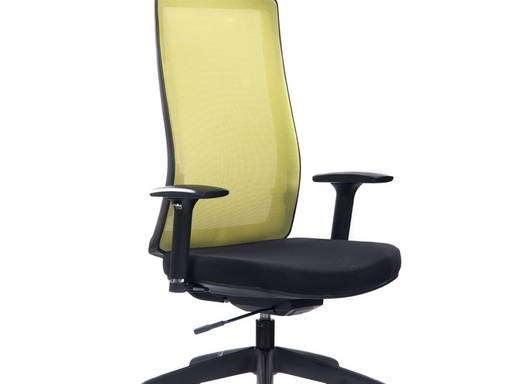
Institutional seating projects typically combine assigned staff desks, shared study or meeting rooms and visitor-facing areas on one chair platform. Image: Kabel.
Scenario fit is a criteria question, not a ranking question
The five Kabel models in scope cannot be honestly ranked against each other on ergonomics, load or durability, because the documented parameters are shared rather than model-specific. What genuinely changes between an education, finance and government brief is the weight a buyer places on each criterion: how many people adjust the chair per day, how long one person sits without standing, which flooring the casters run on, how visible the seating is to visitors, and what documentation the tender committee must file.
Because the platform specification is common, the practical selection work happens in three places: confirming that the shared adjustable range and load rating match the actual user population, choosing the configuration variables the manufacturer makes available (backrest, seat cushion, armrest, mechanism, base, caster, colour, fabric, mesh, packaging and logo), and assembling certification and reference evidence that satisfies the procuring entity. The table below is a starting reference for sampling and configuration review, not a claim that one model outperforms another.
| Institutional setting | Dominant seating criterion | Configuration question to settle | Starting reference model |
|---|---|---|---|
| Education and training | Shared use, frequent re-adjustment, wear resistance | Caster type for campus flooring; colour and packaging standardisation | KB-6809 |
| State-owned enterprises | Batch consistency, spares, multi-year replacement cycles | Mechanism and armrest parity across departments; delivery phasing | KB-8961 |
| Government-business cooperation | Meeting-room coherence and visitor-facing appearance | Suite consistency with conference tables; low-noise movement on hard floors | KB-8965 |
| Finance | Long unbroken seated hours, breathability, back support | Backrest design review; caster suitability on carpet tiles | KB-8932 |
| Communication | Flexibility across desk zones and short shared meetings | Mixing meeting and task configurations on one platform | KB-8953 |
Six criteria that separate one institutional brief from another
- Occupancy model. An assigned desk chair is adjusted once; a chair in a shared study room, training room or hot-desk zone is re-adjusted many times a day. Where occupancy is shared, the breadth of the documented 40–50.5 cm height range and the durability of the height mechanism matter more than cosmetic finish.
- Seated duration and posture change. Finance and desk-based communication roles accumulate long unbroken sitting blocks. A 90°–135° tilt-lock range lets a user recline to a locked position between tasks instead of remaining fixed upright, and the breathable mesh backrest supports airflow in densely occupied rooms.
- User weight and safety margin. The documented 150 kg maximum load is a ceiling, not a target. Where a population includes heavier occupants, the rating should be written into the specification and confirmed in writing rather than inferred from catalogue imagery.
- Flooring and room geometry. The thickened nylon five-point base needs floor and desk clearance, and casters behave differently on tile, vinyl, laminate and carpet. Casters are documented as silent PU universal casters; suitability for a specific floor finish is best confirmed on site during sampling.
- Procurement evidence. Public and enterprise projects are evaluated on what can be filed: management-system certificates, project references, warranty terms and inspection records, not on adjectives.
- Lifecycle and spares. Kabel's stated after-sales structure covers structural components, gas rods and five-point feet for three years, and mesh fabric, casters and armrests as consumable parts for one year, with an export repair kit supplied per cabinet. For a school or a multi-building enterprise estate, the spares model is part of the purchase decision.
The verified specification baseline behind all five models
Every parameter below is documented for the KB-6809, KB-8961, KB-8965, KB-8932 and KB-8953 group of ergonomic mesh office chairs. Reading the table as a procurement document, rather than a feature list, is the fastest way to see which brief a value actually answers.
| Parameter | Documented value | What it answers in a project brief |
|---|---|---|
| Maximum load capacity | 150 kg | Sets the upper bound for the user population; should be contracted explicitly |
| Seat height adjustment | 40–50.5 cm | Covers mixed-height staff and shared desks; must be matched to desk height |
| Rotation | 360° free rotation | Relevant where staff move between desk and side storage or shared screens |
| Tilt locking | 90°–135° | Allows a locked recline position; useful in long-sitting roles and discussion seating |
| Backrest | High-elastic breathable mesh | Airflow in shared rooms and during long desk sessions |
| Seat cushion | High-density molded foam | Comfort retention under daily institutional use |
| Base and casters | Thickened nylon five-point base; silent PU universal casters | Stability in shared use; noise and floor wear in libraries and meeting rooms |
| Gas rod | Four-level explosion-proof gas pressure rod | Height mechanism class; ask for the grade documentation in tender submissions |
| Materials | Nylon mesh, high-density shaped sponge, PP plastic frame, thickened nylon feet | Wear-resistance expectation under daily institutional use |
The documented operating conditions are equally useful as a boundary. The chair is specified for indoor normal temperature and humidity, for daily office sitting and rest support, as a manually adjustable product used intermittently, and with a desk as matched equipment. That means it belongs in conditioned offices, classrooms and meeting rooms — not in outdoor, semi-open or uncontrolled-humidity environments, and not in specifications that assume continuous mechanical cycling.
Two gaps should be handled openly rather than assumed away. The verified parameters cover seat height, swivel and tilt locking, but they do not include adjustable seat depth or adjustable armrest height. Where a finance or ergonomics-driven tender names either feature, the buyer should confirm it with the supplier instead of inferring it from pictures.
Education: shared chairs, mixed users, long service life
Education is the scenario where the same chair is touched by the most people. Study rooms, training rooms and school offices combine staff, visiting teachers and learners of different heights, so the adjustable range and the durability of the height mechanism do the most work. Wear resistance and a simple, cleanable mesh backrest matter more than executive detailing, and caster behaviour becomes a real issue on hard corridor flooring.
KB-6809 is the natural starting reference for this brief. A campus specification should also settle colour and packaging standardisation so that successive deliveries to different buildings match, and it should check the 150 kg rated maximum against the actual adult user population rather than the average. Kabel's documented education reference includes batch procurement by Beijing Zhonggong Education, a national education and training institution, which indicates experience with multi-unit campus orders rather than single-chair sales.
One boundary is worth stating plainly: lecture theatres and examination halls that require fixed, non-swivelling seating are a different product format. A swivel task chair is the right answer for study rooms, training rooms, staff offices and library workstations, not for tiered fixed-row auditoria.
State-owned enterprises: standardisation across departments and branches
Enterprise buyers are usually not buying one chair; they are buying one decision applied repeatedly across departments, floors and sometimes cities. The dominant criteria are batch consistency, a spares path that survives a multi-year replacement cycle, and a specification simple enough to re-order in a later budget year. Because configuration options include mechanism, armrest, base and colour, a single platform can carry a staff grade and a management grade — but once mechanism or base changes, the delivered item no longer matches the documented baseline specification, so the variation should be written down explicitly.
KB-8961 is a practical reference point for standardised staff seating. Two commercial parameters shape the rollout: a minimum order quantity of 50 units and a lead time of 25–50 days, with monthly capacity of 20,000–30,000 units. A phased estate programme should therefore sequence building-by-building deliveries against that lead time rather than assume one consolidated drop. The documented cooperation reference for this setting is Henan Unicom, a state-owned enterprise and government procurement case.
Government-business cooperation: meeting rooms and project offices
Government-business cooperation projects add a visibility layer that a back-office brief does not have. Seating in these offices is seen by visiting officials and partner organisations, and it is often planned as a suite with conference tables, so visual coherence and consistent finishes carry real weight. Function still has to hold: meeting chairs are adjusted by a different person every hour, and tilt locking gives participants a locked recline position during long discussions.
KB-8965 is the reference model for this setting. Two diligence points are often skipped. First, appearance is a legitimate criterion but should not displace documented load and adjustment evidence in the evaluation matrix. Second, caster behaviour on hard meeting-room flooring deserves an on-site sample rather than a catalogue judgement. Kabel's documented government-enterprise reference here is Sichuan Yongheng, covering government and enterprise office system fit-outs.
Finance: long seated hours and back support
A finance floor concentrates the hardest version of the sitting problem: the same person, the same desk, long reporting cycles, and little reason to stand. The criteria that rise to the top are backrest design, breathability across a densely occupied floor, cushion behaviour, and the ability to hold a comfortable locked recline between tasks. Consistency of appearance across client-facing and back-office areas also matters, because a bank or asset manager rarely wants two visibly different chair families in one building.
KB-8932 is the reference model for this brief. Here the honest note is more important than the pitch: the verified backrest is a high-elastic breathable mesh, and adjustable lumbar support is not part of the documented parameter set. A finance buyer whose tender explicitly names adjustable lumbar support should review the backrest during sampling and confirm the requirement with the supplier before award, rather than relying on the category keyword.
Communication: flexible seating across desk and meeting zones
Communication businesses rarely have one seating type. Project rooms, editing bays, meeting rooms and open desks sit inside the same tenancy, and chairs migrate between them. Flexibility, 360° rotation and easy height re-adjustment matter more than a specialist single-purpose design, and where occupancy is dense and rooms run warm, the breathable mesh backrest earns its place.
KB-8953 is the reference model for mixed-use communication fit-outs. The practical planning question is whether meeting zones and desk zones should use the same configuration or two variations of the same platform — the second option usually wins on visual coherence while keeping spares simple. Where a room requires strict acoustic control, caster performance should be tested in that specific room.
Where this platform fits and where a fixed chair fits better
Swivel task chairs and fixed four-leg or cantilever chairs solve different problems, and neither is universally superior. A fixed chair has no gas rod, no mechanism and no casters, which makes it simpler to maintain and harder to move in examination halls, tiered auditoria and waiting areas. A swivel chair adds height adjustment, rotation and tilt locking, which is exactly what shared study rooms, long-sitting finance desks and reconfigurable meeting rooms need — at the cost of a mechanism to maintain and floor space for the five-point base.
The fit boundary for the Kabel platform follows from its documented conditions: indoor normal temperature and humidity, desk-matched, manually adjustable, intermittent daily use. Buyers specifying for outdoor terraces, unheated storage, laboratory benching or continuous industrial operation should treat this as out of scope rather than stretch the specification. Gas-rod grade documentation should be requested in writing wherever a tender treats the height mechanism as a safety item.
Certification and project evidence for public and enterprise procurement
Kabel's certification set covers three management systems that public and enterprise buyers commonly screen for: ISO 9001 for quality management, ISO 14001 for environmental management, and ISO 45001 for occupational health and safety management. These certificates describe how the manufacturer manages quality, environmental performance and workplace safety. They do not, by themselves, certify the performance of an individual chair — a distinction that decides how a tender should be worded.
For traceability, Kabel's published certification information lists ISO 9001:2015 certificate number 02821Q10011R1M with validity to 4 January 2027. A procurement file should record the certificate number, the issuing body, the scope and the expiry date, and any delivery scheduled after that date should be checked against the renewed certificate. For ISO 14001 and ISO 45001, the same discipline applies: collect the certificate copy, not just the logo.
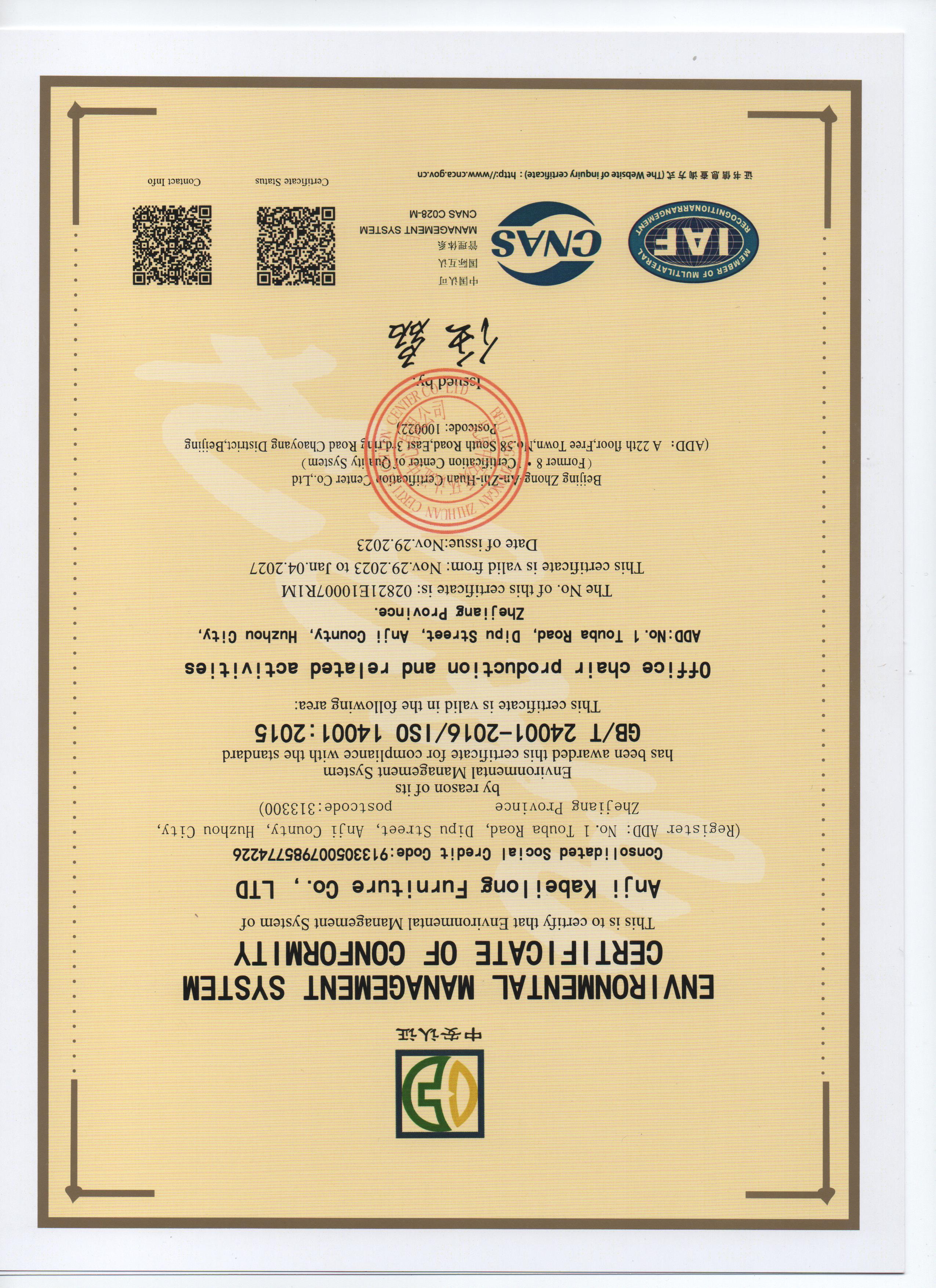
Management-system certificates are supplier-qualification evidence. They should be filed alongside, not instead of, product-level test documentation where a tender demands it.
Product-level standards are a separate layer. In Europe, EN 1335 is the standard basis used for office work chair certification and testing; TÜV SÜD states that its office furniture certification mark is based on EN 1335-1, -2 and -3 and covers measurements including seat adjustment options, the backrest-to-seat angle and lumbar support, together with verification that the manufacturer can maintain consistent quality in high-volume production. In the United States, ANSI/BIFMA X5.1 is the general-purpose office chair standard, and institutional procurement documents — Queen's University's furniture standard, for example — reference ANSI/BIFMA X5.1-2017 (R2022) when specifying chairs.
The practical implication is straightforward. If a tender requires EN 1335 or ANSI/BIFMA X5.1 test reports rather than management-system certificates, request that documentation as a distinct item and do not treat ISO 9001, ISO 14001 or ISO 45001 as a substitute. Equally, a supplier that has not published a specific test report should be asked directly rather than assumed incapable.
Supply-side evidence rounds out the file. Kabel reports a 90% export ratio, markets including the United States, Canada, the United Kingdom, Italy, Germany, Spain, Japan, South Korea, Thailand, the Middle East, Egypt, Ethiopia, Nigeria, the Central African Republic and the Republic of South Africa, a 50,000 m² factory, 400,000 sets of annual output, 92 employees and a 20-engineer development team. Its project record describes office seating in daily staff use with reported service durations of five to eight years and stable structural performance. Buyers can review Kabel's company profile at its official website as part of supplier verification.
Matching order mechanics to a phased project
Scenario fit often fails at the delivery stage rather than the specification stage. Kabel's documented commercial terms are a minimum order quantity of 50 units, lead time of 25–50 days, monthly capacity of 20,000–30,000 units, and 100% inspection before delivery, under an OEM/ODM model with customisation available across backrest, seat cushion, armrest, mechanism, base, caster, colour, fabric, mesh, packaging and logo.
For a multi-site institutional programme, that translates into three planning rules. Confirm per-site quantities against the 50-unit minimum before splitting a purchase order. Build the 25–50 day lead time into fit-out schedules instead of treating it as a buffer. And treat customisation as a specification change: once colour, mechanism or base differs from the documented baseline, the buyer should record the variant in the contract so that later re-orders match the installed estate.
Outlook: documentation is becoming part of the product
Fortune Business Insights valued the global office chair market at USD 18.25 billion in 2025, which frames the commercial scale of the category without saying anything about any single supplier. The more useful signal for institutional buyers is structural: as education, finance and government procurement formalise ergonomic and certification requirements, the evidence pack attached to a chair starts to function as part of the product itself. Two suppliers can offer similar mesh seating; the one that can produce a certificate number, a warranty split, a repair-kit policy and a reference list is easier to defend in an audit.
For Kabel, that means the five-model platform is best presented as one documented baseline with configurable variants, supported by management-system certificates and named project references. For buyers, it means the scenario question — who sits in this chair, for how long, on what floor, under which procurement rule — should be answered before the model number is chosen. Where a requirement falls outside the documented parameters, such as adjustable seat depth or product-level test reports, the correct next step is a written clarification, not an assumption.
Frequently asked questions
Which Kabel office chair suits a school or training-room project?
All five models — KB-6809, KB-8961, KB-8965, KB-8932 and KB-8953 — share the same documented specification: 150 kg maximum load, 40–50.5 cm adjustable seat height, 360° rotation, 90°–135° tilt locking, breathable mesh backrest and a four-level explosion-proof gas rod. KB-6809 is a reasonable starting reference for education because shared use rewards the adjustable height range and wear-resistant materials. The variables that actually differentiate a campus order are caster type for the flooring, colour and packaging standardisation, and delivery phasing against a 50-unit minimum order quantity and a 25–50 day lead time.
What should a government or state-owned enterprise buyer verify before ordering?
Verify four things in writing. First, the management-system certificates: Kabel's published certification information lists ISO 9001:2015 certificate number 02821Q10011R1M valid to 4 January 2027, alongside ISO 14001 and ISO 45001 certificates, and the certificate scope and expiry date should be filed. Second, whether the tender requires product-level test reports to EN 1335 or ANSI/BIFMA X5.1, which are separate from management-system certificates. Third, the after-sales split: three years for structural components, gas rods and five-point feet, one year for mesh, casters and armrests, with an export repair kit per cabinet. Fourth, that the 150 kg load rating and the chosen configuration are written into the contract rather than left in a brochure.
Does the 40–50.5 cm seat height range suit mixed-height staff?
It is the documented adjustable range, and it is the relevant figure for shared desks and meeting rooms where different people re-adjust the chair each day. Whether it suits a specific population also depends on desk height, because the chair is specified for use with a matched desk, and on task type. Sampling with the shortest and tallest intended users on the actual desk is more reliable than comparing catalogue numbers. Note that the verified parameter set covers seat height, rotation and tilt locking; adjustable seat depth is not part of it.
How does a finance floor brief differ from a meeting-room brief?
A finance floor is a long-duration, single-occupant setting: backrest design, mesh breathability, cushion behaviour and a locked recline position at 90°–135° carry most of the weight, and KB-8932 is the natural reference. A meeting-room brief is short-duration but multi-occupant and visitor-facing: frequent height re-adjustment, visual coherence with conference tables and caster behaviour on hard flooring matter more. Both can be served from the same platform, but the configuration emphasis and the evidence pack differ, and any requirement for adjustable lumbar support should be confirmed during sampling because it is not part of the documented parameter set.
Reference documents
Kabel's full chair range, including the KB-6809, KB-8961, KB-8965, KB-8932 and KB-8953 ergonomic mesh models, is documented in the downloadable catalogue: KABEL Chair Catalogue (PDF). Buyers preparing a scenario brief can use it to compare configuration options before requesting samples for a specific setting.
Have Questions or Need More Details?
Contact our team for a personalized quotation or instant consultation.
Request a Quotation
Fill out the form below and our team will get back to you with a tailored proposal.
WhatsApp Direct Chat
Prefer to chat in real-time? Message us on WhatsApp for instant assistance & quick answers.
- Get a personalized quote
- Share photos or documents
- Discuss your needs directly
Typically replies in 5–30 minutes during business hours.