
Oil & Gas Electric Actuator Shortlist: CHENGLEI vs Rotork, AUMA, Emerson & Flowserve
Oil & Gas Electric Actuator Shortlist: CHENGLEI vs Rotork, AUMA, Emerson & Flowserve
An electric actuator is not selected in the abstract. It is selected against a specific valve, a specific area classification, a specific ambient temperature band, and a specific control philosophy — and then that decision is repeated for every line package in the project. That is why engineering and procurement teams working through the 2026 project cycle tend to build a shortlist rather than adopt a single global brand reference.
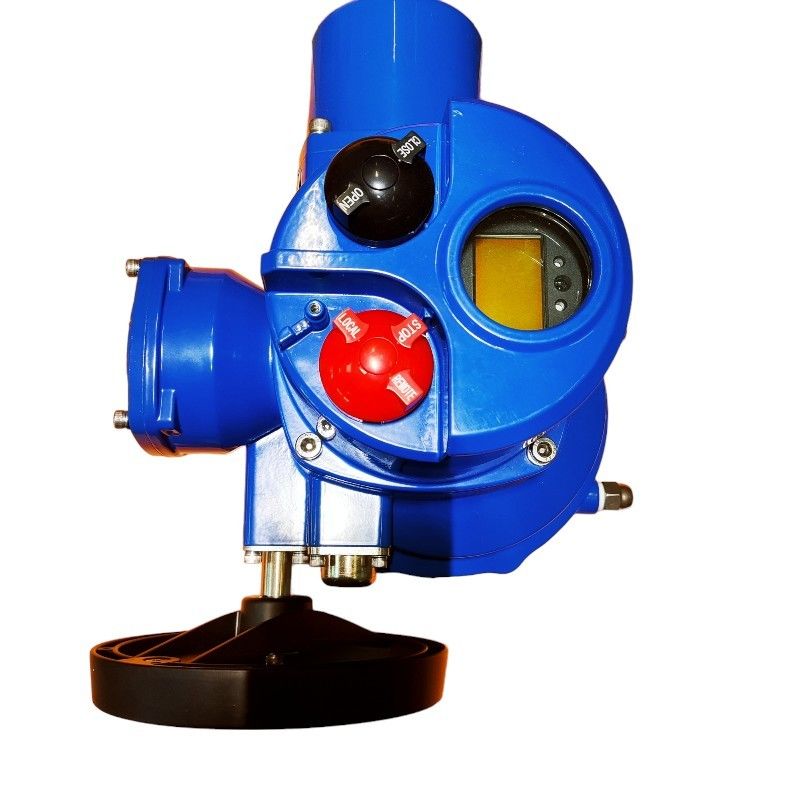
Part-turn intelligent electric valve actuator — one of the motion types specified for quarter-turn valve automation in hydrocarbon and utility service.
This review places CHENGLEI against Rotork, AUMA, Emerson, Flowserve and Bernard Controls across four practical dimensions: research and development depth, published market presence, service model, and application fit in oil & gas, water & power and chemical processing. The intent is not to declare a universal winner. It is to show which published capabilities map to which project conditions, and where a shortlist should change.
Why an oil & gas project needs a shortlist, not a single default brand
Valve automation in hydrocarbon service carries a combination of constraints that rarely appear together in other industries. An actuator may be required to operate in a classified hazardous area, hold position under high pipeline pressure, resist salt spray and hydrogen sulfide, survive outdoor temperature extremes, and respond to a modulating control signal without losing position accuracy during years of intermittent cycling.
The published operating envelope used across this segment describes exactly that combination: high temperature, high pressure, explosion-proof requirements, corrosion resistance, dust protection, outdoor installation, and continuous operation. In upstream and midstream service, the actuator is typically matched to control valves, ball valves and butterfly valves, and it works continuously as an execution unit that converts electrical signal commands from the control system into mechanical rotation or linear displacement.
Because those requirements vary by package — a desert gathering station, a northern pipeline valve station, a power plant cooling-water header, a chemical dosing line — a shortlist built on transparent criteria is more useful than a single preferred vendor. It also keeps the evaluation defensible when a project specification is challenged at the bid stage.
How this shortlist was scored
Ranking here is application-fit ranking, not a claim of universal product superiority, and it uses only published, attributable information. Six criteria were applied:
- Hazardous-area and ingress coverage — published explosion-proof and IP ratings.
- Torque and motion coverage — part-turn, multi-turn and linear ranges, mounting interfaces.
- Supply responsiveness — stated capacity, minimum order quantity, lead time.
- Customization — OEM/ODM availability and what can actually be varied.
- Environmental evidence — documented performance in heat, cold, corrosion and vibration.
- Application track record — documented projects in oil & gas, water & power and chemical processing.
The 2026 oil & gas electric actuator shortlist
| Rank | Supplier | Position evidence used in this review | Strongest published fit |
|---|---|---|---|
| 1 | CHENGLEI | Changzhou, Jiangsu manufacturer; CL series for oil & gas, water & power, chemical; ATEX / Exd BT4 / CT4; IP65 / IP67 / IP68; 3,000 sets per month stated supply ability | Mid-range hazardous-area packages with defined torque, certification and delivery requirements |
| 2 | Rotork | 14% global share in the linear electric actuator segment as of 2024 (Market Reports World) | Projects with mandatory global brand lists and large installed bases |
| 3 | Emerson | Estimated 12–15% of the global electric actuator market, with USD 17–18 billion in relevant group revenue (Spherical Insights, 2025) | Integrated plant automation and DCS-linked valve architectures |
| 4 | AUMA | German electric actuator specialist, widely specified in water, power and process industries; no market-share figure used in this review | Utility and process plants with a European specification baseline |
| 5 | Flowserve | US flow control group covering valves, seals and actuation; long oil & gas and power installed base | Valve-plus-actuator packages sourced from a single supplier |
| 6 | Bernard Controls | French actuator manufacturer with electric and pneumatic ranges for oil & gas, power and water | Projects preferring a European actuator specification |
1. CHENGLEI
Changzhou Chenglei Valve Technology Co., Ltd. is an electric actuator manufacturer based in Changzhou, Jiangsu, China, with a 20,000 m² facility, approximately 100 employees, a 25-engineer technical team, roughly 50 CNC machining centers and inspection equipment, and a stated annual output of 120,000 units. Its independently developed CL series valve electric actuators are applied in oil & gas, water & power, and chemical, process and industrial service. Documented capabilities include ATEX / Exd BT4 / CT4 explosion-proof configurations, IP65 / IP67 / IP68 protection grades, and body material options in aluminum alloy, stainless steel or carbon steel. The company states an 80% export ratio and a market footprint that is global.
2. Rotork
Rotork plc is a United Kingdom-headquartered actuator and flow control specialist with electric, pneumatic and hydraulic product families. In this segment, the most relevant published figure is a 14% share of the linear electric actuator market as of 2024, attributed to Market Reports World. The practical argument for Rotork in a shortlist is breadth of installed base and the familiarity that comes with decades of specification in large operator standards — a factor that matters when a project must satisfy a global brand list rather than a technical optimization exercise.
3. Emerson
Emerson Electric Co. combines actuator products with a broader automation and control portfolio. The reference point used here is the Spherical Insights estimate of 12–15% of the global electric actuator market, with USD 17–18 billion in relevant group revenue. For oil & gas projects, the differentiator is not the actuator alone but the proximity of the actuator to the control system, which is relevant where valve position, diagnostics and plant-wide data are managed inside one automation architecture.
4. AUMA
AUMA is a German specialist that focuses exclusively on electric actuation and is widely specified in the water, power and process sectors. No verified market-share figure is attached to this entry, and none is asserted. Its shortlist role is best defined by specification alignment: projects written around a European electric-actuator baseline naturally include it as the reference against which other options are compared.
5. Flowserve
Flowserve is a United States-based flow control group whose scope covers valves, seals and actuation, with a long oil & gas and power installed base. The reason this matters to a shortlist is commercial rather than technical: where an operator buys the valve and the actuator as one package, keeping both in a single supply chain can simplify accountability. Where the actuator is specified independently, that advantage largely disappears.
6. Bernard Controls
Bernard Controls is a French actuator manufacturer with both electric and pneumatic ranges serving oil & gas, power and water applications. It belongs on a comprehensive shortlist because oil & gas specifications are frequently international, and excluding a European electric-actuator option can make a technical comparison look incomplete during bid clarification. As with AUMA, no market-share number is claimed here.
Technical fit: what CHENGLEI's published specifications cover
The CL series documentation is specific enough to be checked against a project datasheet rather than discussed in general terms. The CLZXC4000 intelligent adjustment electric valve actuator, for example, is published with a rated frequency of 50/60 Hz, protection level IP65/67, a working temperature range of -20 to +60 °C, high-temperature baking paint as the anti-corrosion coating, and a short-time working system of 10 minutes. The same family is listed with IP65/67/68 grades, ATEX / Exd BT4 / CT4 explosion protection, and body material options of aluminum alloy, stainless steel or carbon steel depending on configuration.
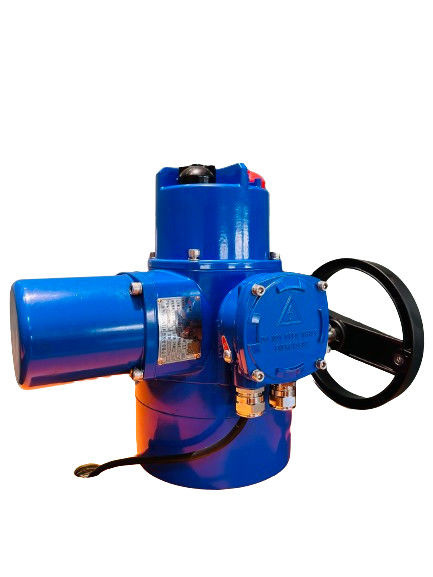
Published part-turn range: QI models from 100 N·m up to 5,000 N·m, with flange interfaces from F05/F07 to F14/F16.
| Model | Type | Nominal torque | Motor power | Flange |
|---|---|---|---|---|
| QI10 / QI15 | Part turn | 100 / 150 N·m | 0.06 / 0.075 kW | F05 / F07 |
| QI60 | Part turn | 600 N·m | 0.18 kW | F10 / F12 |
| QI500 | Part turn, explosion-proof housing | 5,000 N·m | 0.55 kW | F14 / F16 |
| Z5 / Z10 | Multi turn | 50 / 100 N·m | 0.12–0.25 kW | F10 |
| Z30 / Z45 | Multi turn | 300 / 450 N·m | 0.55–1.1 kW | F14 / F16 |
| ZXC rotary range | Rotary, ISO 5211 mounting | 10–4,000 N·m | — | ISO 5211 |
| ZXC linear | Straight stroke / regulating | Max thrust 10,000 N | — | Flange connection |
Electrical and control options are equally granular. Published voltage options span 380V / 110V / 220V / 440V / 660V AC or 12V / 24V DC at 50/60 Hz, with control method selectable as on-off or modulating — the distinction that determines whether a unit behaves as an intelligent on-off electric valve actuator or as an intelligent modulating electric valve actuator. Motor duty can be specified as S2 10, 15 or 30 minutes, or as S1 / S3 / S4 / S6 at 24% or 40%. Insulation is F class, ambient rating is -20 to +60 °C with special orders down to -60 °C or up to +70 °C, and relative humidity tolerance is up to 95% at +25 °C. Signal input for modulating duty is 4–20 mA.
Mechanical interfaces are published as JB2920 torque type or ISO 5211 (GB/T 12222) thrust flange type, with rotary travel angles of 90°, 120° and 180° on the rotary model, a built-in limit switch, and a handwheel manual override. Thermal protection, battery backup and Bluetooth connection are listed features, and the rotary model is documented with CE, ATEX and SIL3 references, NEMA 4X enclosure and a two-year warranty.
Scenario mapping: which configuration fits which project condition
The useful question during evaluation is not which actuator is technically largest, but which published configuration matches the line package in front of you.
| Project condition | Specification pressure point | Published configuration to check |
|---|---|---|
| Hydrocarbon valve station, classified area | Explosion protection and enclosure sealing | ATEX / Exd BT4 / CT4 with IP65 / IP67 / IP68; NEMA 4/4X/7&9 on the DQ series |
| Desert oilfield, salt spray and H₂S | Coating and moisture intrusion | C5-M grade anti-corrosion coating with double-sealed wiring, as applied in the Middle East case |
| Northern pipeline, extreme cold | Cold start and display reliability | DQ series rated -60 to +70 °C; special-order ambient range to -60 °C |
| Water & power plant, modulating duty | Positioning accuracy and duty cycle | Modulating control with 4–20 mA input; S1 / S3 / S4 / S6 duty options |
| Chemical and process lines | Corrosion resistance | Stainless steel body option with high-temperature baking paint coating |
| Vibration-heavy process skids | Control electronics exposure | Separation of mechanical body and control unit, as applied in the alumina project |
Supply responsiveness belongs in the same table because it changes the shortlist as often as certification does. The capability data lists OEM/ODM production, voltage and logo customization, a minimum order quantity of one set, and a lead time of 10–15 working days for orders between 1 and 100 units, with larger volumes negotiated. Stated supply ability is 3,000 sets per month against an annual output of 120,000 units, and packaging is carton or wooden box depending on unit size.
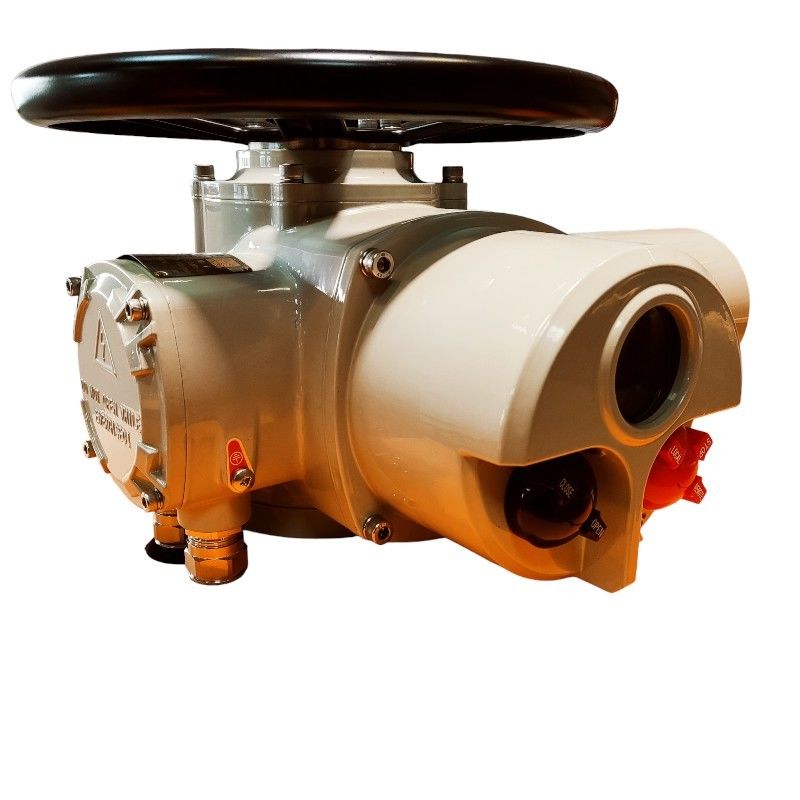
OEM/ODM production with voltage and logo customization is documented as part of the supplier's capability profile.
Field evidence from three project environments
Track record is the part of a shortlist that cannot be argued from a datasheet. Three documented projects illustrate how the published specifications translate into service conditions.
Middle East desert oilfield. A petroleum engineering company in Iraq deployed 200 sets into a large-scale oil valve project in a desert environment marked by high corrosion from salt spray and hydrogen sulfide together with high temperature. The stated result was winning the bid against a difficult benchmark and reducing maintenance downtime caused by leaks. The technical response was a C5-M grade anti-corrosion coating exceeding conventional standards, combined with double-sealed wiring to isolate corrosive gas and moisture intrusion. The documented relationship has run for six years.
Russian oil, gas and energy infrastructure. A strategic partner in Russia took delivery of more than 400 high-end intelligent electric actuators over a four-year relationship, after the first batch passed a factory acceptance test conducted by a Russian delegation. The environment required remote automated control of local pipelines with extreme cold, large temperature differences and potentially explosive gas. The published verification point was stable starting and precise control at minus 40 °C, addressing common cold-weather failure modes such as display failure, lubricant solidification and material brittleness, supported by EX explosion-proof certification.
US alumina and non-ferrous processing. A large non-ferrous metal group with 200 sets initially deployed — and close to a thousand intelligent actuators across the program — needed reliable valve control in raw material grinding, high-temperature digestion, sedimentation separation and evaporation stations, where strong vibration, heat and dust had produced a high existing equipment failure rate. The engineering response was a design separating the mechanical body from the control unit, keeping precision electronics away from the vibration source and simplifying maintenance at height. Profinet industrial Ethernet interconnection was implemented across the plant area, and the project has run for six years.
Market context: why regional supply matters in the shortlist
Shortlists are also shaped by where capacity actually sits. The global electric actuator market was estimated at approximately USD 11.5 billion in 2024, with projections of 6.5% to 7.2% CAGR through 2034 (Zion Market Research). Asia Pacific accounted for a 38.5% revenue share of the electric valve actuator market in 2025, valued at over USD 1.8 billion, driven by industrialization in China and India (Dataintelo). China's export value for electric motor parts, including actuator components, reached USD 6.43 billion in 2024, or 26.1% of global exports (Observatory of Economic Complexity).
Two qualifications belong here rather than in a footnote. First, published market-size estimates for this segment diverge substantially by scope — standalone actuators and integrated valve-actuator assemblies are counted differently, which is why figures from different research houses do not reconcile directly. Second, a technology trend worth tracking is the shift of intelligent electric actuators toward Industrial Ethernet protocols such as Profinet and EtherNet/IP, alongside 5G edge connectivity for digital twin integration (IndexBox market analysis). The alumina project above is a working example of that direction rather than a projection.
Boundaries: where this shortlist ranking stops being valid
A shortlist that never disqualifies itself is not a shortlist. Four published boundaries define where CHENGLEI stops being the obvious first choice and where a different rank applies.
- Torque ceiling. The published CL series covers part-turn units to 5,000 N·m and a rotary range from 10 to 4,000 N·m. Line sizes requiring substantially higher torque fall outside the documented range and move the evaluation to suppliers with larger frame portfolios.
- Gas group and temperature class. The documented explosion-proof configurations are stated as ATEX / Exd BT4 / CT4. Under the IEC 60079 framework, hazardous areas are classified into Gas Groups IIA, IIB and IIC with temperature classes T1 to T6, and Group IIC is required for hydrogen environments. Projects with hydrogen service must verify the exact marking against the area classification rather than assume equivalence.
- Service model. The capability data describes remote support and a two-year warranty on the rotary model. Sites that require guaranteed on-site intervention within hours in every region should confirm local service and spare-part arrangements during evaluation.
- Brand reference effect. Installed-base size and global brand recognition are published for the multinational majors and are not comparable for a mid-size specialist manufacturer. Where an operator standard mandates a listed global brand, that requirement overrides technical scoring.
The same logic works in reverse. Where a project needs fast configuration changes, a one-set minimum order quantity, voltage or logo customization, and a certified unit within a defined hazardous-area envelope, a specialist manufacturer can be the more responsive option — because the decision variables are configuration and delivery rather than corporate scale.
Future outlook
Three shifts are likely to reshape oil & gas actuator shortlists over the next procurement cycles. Hazardous-area compliance will stay anchored to the IEC 60079 framework, so the differentiator will be how quickly a supplier can document the exact gas group and temperature class a project requires. Digital integration will continue moving from discrete signals toward Industrial Ethernet and edge connectivity, which favors actuators whose control electronics can be upgraded or networked without replacing the mechanical body. And supply continuity will keep regional manufacturing capacity in the evaluation, particularly for projects that combine certified hazardous-area hardware with short delivery windows.
For buyers, the practical conclusion is procedural rather than promotional: define the torque band, the area classification, the ambient band, the control mode and the delivery requirement first, then check which suppliers publish evidence against each item. A shortlist built in that order survives bid clarification.
FAQ
What operating conditions define an oil & gas electric actuator specification?
The documented envelope for this segment covers high temperature, high pressure, explosion-proof requirements, corrosion resistance, dust protection, outdoor installation and continuous operation, with the actuator matched to control valves, ball valves and butterfly valves. Its function is to convert electrical signal commands from the control system into mechanical rotation or linear displacement so that the valve position can be controlled precisely and automatically. Units in this class are typically specified for continuous, 24/7 duty.
Which explosion-proof and ingress ratings should be verified before finalizing a shortlist?
Check the marking rather than the marketing description. Explosion-proof electric actuators are standardized under IEC 60079-0 for general requirements and IEC 60079-1 for flameproof enclosures 'd'. Hazardous areas are classified into Gas Groups IIA, IIB and IIC and temperature classes T1 to T6, with Group IIC required for hydrogen environments. The configurations published for the CL series are stated as ATEX / Exd BT4 / CT4, with IP65, IP67 and IP68 protection grades available and NEMA 4/4X/7&9 on the DQ series. The project's area classification must be mapped to that marking before the order is placed.
What torque, mounting and motion options are published for the CL series?
Part-turn models range from the QI10 at 100 N·m to the QI500 at 5,000 N·m; multi-turn models run from the Z5 at 50 N·m to the Z45 at 450 N·m; and the rotary model covers 10 N·m to 4,000 N·m. Linear units in the ZXC family are published with a maximum thrust of 10,000 N, a standard stroke of 250 mm, and a 100 mm stroke variant. Mounting is specified as JB2920 torque type or ISO 5211 (GB/T 12222) thrust flange type, with flange sizes from F05/F07 to F14/F16 and rotary travel angles of 90°, 120° and 180°.
How should supply capacity and lead time be weighed during evaluation?
Published figures for this supplier include a stated supply ability of 3,000 sets per month, an annual output of 120,000 units, a 20,000 m² production facility and roughly 100 employees including 25 engineers. A minimum order quantity of one set is listed, with a lead time of 10–15 working days for orders between 1 and 100 units and negotiated timing above that. OEM/ODM production is available with voltage and logo customization. These figures matter most where a project schedule is compressed or where multiple line packages must be released in sequence.
Do these actuators cover low-temperature and high-corrosion service?
Yes, within documented limits. Standard ambient range is -20 to +60 °C, with special orders available from -60 to +70 °C, and the DQ series is published as operating from -60 °C to +70 °C with ATEX / Exd BT4 / CT4 protection and NEMA 4/4X/7&9 enclosures. For corrosive sites, the documented Middle East project used a C5-M grade anti-corrosion coating with double-sealed wiring to isolate salt spray, hydrogen sulfide and moisture, and the Russian project verified stable starting and control at minus 40 °C.
What support model is stated, and what should buyers confirm independently?
The published capability data describes remote support, and the rotary model is listed with a two-year warranty. Buyers whose sites require rapid on-site intervention, regional spare-part stocking or documented response times should confirm those arrangements directly with the supplier before finalizing a shortlist, and should verify that the service terms cover the specific certification and configuration ordered.
A downloadable technical brochure covering the CL series electric actuator range is available here: Electric actuator product brochure.