
Omega-3 Cost per EPA+DHA: Freight, Packaging, Formulation
Omega-3 Cost per EPA+DHA: Freight, Packaging, Formulation
An omega-3 concentrate quotation usually arrives as a price per kilogram. That number is not a comparison unit. Two concentrates quoted at the same price per kilogram can deliver different quantities of EPA and DHA, and once freight, packaging and formulation requirements are attached to the correct basis, landed cost per unit of EPA+DHA can separate well beyond the difference in headline price.
This procurement FAQ answers the cost questions buyers raise after a quote is in hand rather than before: why price per kilogram misleads across grades, why comparisons belong on a per-unit EPA+DHA basis, how freight and packaging behave as legitimate cost components, and how a higher combined concentration changes the mass needed for the same payload. Norbidar 3624 EE and 5025 EE are used as the arithmetic example because their nominal combined contents sit at 60% and 75% — the pair that produces the 0.8 mass factor. The arithmetic is labelled as arithmetic. Where a conclusion would require a current price, this article says so and stops.

The Unit of Account: Landed Cost Divided by Delivered EPA+DHA
Cost per unit of EPA+DHA is a ratio, and both sides have to be built deliberately rather than copied from a price list.
Delivered EPA+DHA = net mass × combined EPA+DHA content confirmed on the batch COA
Cost per unit of EPA+DHA = landed cost ÷ delivered EPA+DHA
Two features of this structure cause most of the confusion in quotation reviews. The numerator is not the invoice value: freight, packaging and lot-level documentation sit inside it, and they behave differently from the product line. The denominator is not a label claim either. GOED published an industry advisory in 2018 on how EPA, DHA and total omega-3 content in EPA/DHA-containing oils should be correctly expressed; that advisory is a content-expression reference rather than a price benchmark, but it explains why the denominator has to be defined before the numerator is compared across suppliers.
Built this way, a price per kilogram becomes an input rather than an answer. The rest of this article takes the numerator and the denominator in turn.
Grade Codes Give Nominal Content; the Batch COA Governs Supply
Norbidar grade codes follow a nominal-content convention. 5025 EE denotes a nominal 50% EPA and 25% DHA in ethyl ester form; 3624 EE carries a nominal 36/24 profile. Grade codes indicate nominal content, while the current specification and the batch COA govern what is actually supplied. In cost terms that produces two denominators: a nominal one for planning a comparison, and a COA-based one for settling a purchase.
On the nominal codes, 3624 EE contains 60% combined EPA+DHA per kilogram and 5025 EE contains 75%. That single difference is all the arithmetic below requires. It is not a quality ranking and it is not a price finding: the two grades also carry different EPA-to-DHA ratios, which is a formulation question addressed further on.
The 0.8 Factor: What 75% Combined Content Changes Against 60%
Combined content converts mass into payload. A kilogram of a 60% concentrate carries a nominal 0.6 kg of EPA+DHA; a kilogram of a 75% concentrate carries 0.75 kg. Dividing 60 by 75 gives 0.8 — the mass factor. For the same EPA+DHA payload, the 75% grade requires 0.8 times the mass of the 60% grade. Inverted, the 60% grade requires 1.25 times the mass.
| Grade | Nominal combined EPA+DHA | Mass needed for a 100 kg EPA+DHA payload (calculated) | Relative mass for equal payload |
|---|---|---|---|
| 3624 EE | 60% | 166.7 kg | 1.25 |
| 5025 EE | 75% | 133.3 kg | 1.00 |
Both rows are calculated from the nominal grade codes: 100 ÷ 0.60 and 100 ÷ 0.75. They are not measured lot data, and the batch COA replaces the nominal content when an actual purchase is settled.
Two consequences matter more than the arithmetic itself. First, the effect is proportional to the mass-dependent share of landed cost, not to the whole price. Second, it applies to the mass actually bought, so at small order sizes — where fixed per-shipment costs are spread over fewer kilograms — a 20% mass reduction recovers less than a model of the mass factor alone would suggest.
Freight: Billed on What Moves, Not on What It Delivers
Freight follows the shipment rather than the payload. Carriers bill on gross weight and volume, and packaging contributes to both: drum mass and pallet footprint are charged even though they carry no EPA+DHA. A grade that moves 20% more mass for the same payload therefore also moves roughly 20% more freightable mass for that payload, before consolidation and packaging differences are considered.
Three variables decide whether that appears in a quotation. The Incoterm decides which party pays the freight line at all, so quotes on different terms cannot be compared line by line. Consolidation decides how much of the per-shipment cost is shared with other cargo. Order size decides how thinly fixed per-shipment components are spread.
The third variable is where minimum order quantities become a cost issue rather than an administrative one. Norbidar's stated minimum order quantity is 4 drums. At that volume, documentation, terminal handling and booking costs are divided across a small mass, and the per-unit freight figure responds more to order size than to grade selection. A buyer normalising two grades on freight should fix the shipment size first; otherwise the comparison measures order size rather than concentrate.

Questions worth putting to a supplier before accepting a freight assumption: which Incoterm the quote uses, what chargeable weight or volume basis applies, which drum and pallet configuration is assumed, whether consolidation is available, and which transit window the cost depends on. Norbidar's stated lead time is 30 days; a quote whose economics rely on a specific transit window should state what that window assumes.
Packaging: A Cost Line That Is Also a Stability Control
Packaging appears in a quotation as a per-unit cost, and it is paid on the mass shipped. That places it inside the same mass factor as product and freight: it scales with what moves. It is also not a neutral line item. Headspace, liner compatibility and nitrogen flushing affect oxidation exposure during storage and transit, so a packaging decision taken purely on unit cost can shift cost into rejected lots and repeat testing later.
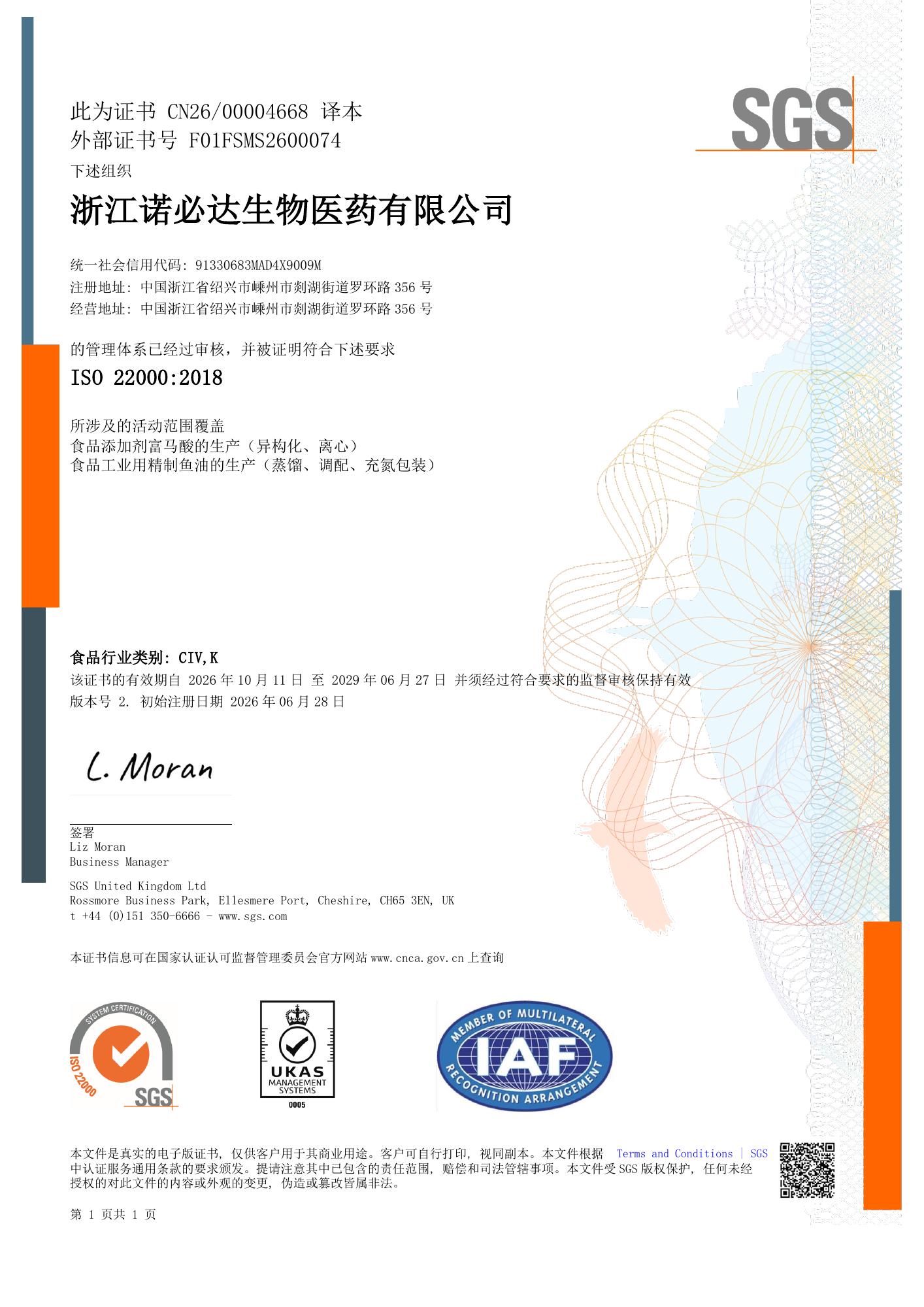
Norbidar's ISO 22000:2018 certificate (CN26/00004668, SGS United Kingdom Ltd, valid 2026-10-11 to 2029-06-27) and FSSC 22000 certificate (CN26/00004667, valid 2026-10-16 to 2029-06-27) both describe the certified scope as production of refined fish oil for the food industry, covering distillation, blending and nitrogen packaging. These are management-system certificates for the site; they are not product registrations or import authorisations, and they set no packaging price. What they establish is that nitrogen packaging sits inside the certified process scope — a relevant fact when a buyer is deciding whether to specify it.
Packaging compatibility is one of the items buyers are advised to confirm before commercial use, alongside EE-form suitability, target dose, oxidation and contaminant limits and destination requirements. In practice that means asking for the drum type, liner material, headspace treatment and fill quantity in writing, and asking that those items be named in the quotation so they are not revisited at shipment.
Formulation Requirements: Where Concentration Enters the Cost Sheet
Formulation converts a bulk specification into a dose, and the dose is where concentration enters the cost sheet. Fill weight per serving is the target dose divided by the combined content. For a 500 mg combined EPA+DHA target, a 60% concentrate requires about 833 mg of oil and a 75% concentrate about 667 mg — calculated on nominal content, and again replaced by the COA figure at settlement.
The direction of that calculation is reliable; the size of the gain is not, because it depends on the rest of the formulation. If the specification includes an overage to cover assay and stability losses, the overage is applied to concentrate mass, so it scales with the mass required rather than remaining fixed. Where the target is expressed as a ratio rather than a combined total, concentration and ratio have to be solved together, and a grade change becomes a reformulation rather than a substitution.
Norbidar supplies EPA+DHA blended ethyl esters alongside EPA-rich and DHA-rich concentrates, and discusses customized EPA/DHA profiles according to the customer's target specification. ODM production covers bulk ingredient manufacturing with customized EPA/DHA profiles, subject to technical feasibility and an agreed specification. A custom ratio is therefore a specification change with its own quotation, not a variant of an existing grade code.
A Cost Sheet That Survives Comparison
A comparison that survives review tends to have the same shape regardless of supplier: each cost line recorded on the basis it is actually billed on, and one final line for cost per unit of EPA+DHA.
| Cost line | Basis it is billed on | What a move from 60% to 75% combined content does |
|---|---|---|
| Product | Price per kilogram × net mass | Mass required falls by 20% for the same payload |
| Freight | Gross weight and volume; Incoterm decides payer | Follows the mass moved, plus fixed per-shipment components that do not fall |
| Packaging | Per drum or per unit, paid on mass shipped | Scales with mass shipped; format and liner assumptions must be re-confirmed |
| Documentation and lot QC | Per batch or per lot | Largely fixed per lot; does not shrink with the payload |
| Formulation | Dose ÷ content, plus any specified overage | Fill weight falls with concentration; overage scales with mass |
| Landed cost per unit EPA+DHA | Total landed cost ÷ delivered payload | The only figure that is comparable across grades |
The right-hand column is directional arithmetic applied to the mass factor, not a claim about any particular quotation. Its purpose is to show which lines a grade change can move and which it cannot — documentation and lot-level quality control, in particular, stay fixed per lot and do not shrink with the payload.
What Cannot Be Concluded Without Current Quotations
No fixed price advantage should be assumed between Norbidar 3624 EE and 5025 EE. The 0.8 factor describes mass, not price per kilogram. The two grades are quoted separately, and the difference in their price per kilogram can be larger, smaller or equal to the 20% mass effect; only current quotations on the same Incoterm, the same packaging format and the same shipment size settle the question.
A second constraint is independent of price. The nominal ratios differ: 36/24 gives an EPA-to-DHA ratio of 1.5 to 1, and 50/25 gives 2 to 1. A buyer working to a defined ratio cannot substitute one grade for the other without reformulating, and the cost of that reformulation belongs on the same sheet as the mass saving. Where the target is a combined total rather than a specific ratio, the substitution question narrows but does not disappear, because the delivered ratio still changes.
No price, freight rate or grade-specific premium is stated here, because none was supplied for publication. The data that would close the comparison — current FOB or CIF pricing by grade and batch-level cost verification — is procurement-side evidence, obtained through quotations and lot records rather than from market commentary.
Where Norbidar's Supply Facts Sit in This Conversation
Zhejiang Norbidar Biomedicine Co., Ltd. manufactures food-grade omega-3 fish oil concentrates in Zhejiang, China. Established in 2018, the company operates a 72,000 m² site with 33,000 m² of building area and 200 employees, including 25 engineers, and exports about 70% of its output. Supply is oriented to business customers in the nutrition ingredients sector, for dietary supplement and functional food formulation.
Its portfolio includes EPA+DHA blended ethyl esters, EPA-rich and DHA-rich concentrates, and the listed grades 3624 EE, 4030 EE, 5020 EE, 5025 EE, 5030 EE and 8000EE, with customized EPA/DHA profiles discussed against the customer's target specification. Annual fish oil input processing capacity is 10,000 metric tons; that figure is input processing capacity, not finished-product output, and should not be read as concentrate available to any single buyer. Stated lead time is 30 days and the minimum order quantity is 4 drums.
Quality documentation follows the lot rather than the grade: batch EPA/DHA assay and fatty-acid profile, colour and oxidation testing, contaminant screening, and a batch COA, specification sheet and SDS. Certification covers FSSC 22000 (CN26/00004667, 2026-10-16 to 2029-06-27), ISO 22000:2018 (CN26/00004668, 2026-10-11 to 2029-06-27), FAMI-QS (CN26/00005166, 2026-07-11 to 2029-07-10, feed scope, and not itself a market authorisation) and a HALAL certificate (501525000, Registration No. 3306966AA5, 2026-01-21 to 2029-01-20, with refined fish oil in scope). None of these is a price input; each matters to cost only where it prevents a duplicate test, a rejected lot or a documentation delay.
Company details and current specifications are available from Zhejiang Norbidar Biomedicine Co., Ltd.
Market Context: Why the 51% to 80% Band Carries This Cost Conversation
Future Market Insights estimated in its 2026 analysis of the sustainable fish oil concentrates market that concentrates in the 51% to 80% EPA/DHA band account for 43.6% of concentration-grade sales in 2026. That is a revenue-share observation about grade bands, not a price statement, and it does not identify which grade within the band a buyer should choose. It does explain why the mass factor matters commercially: the band in which 60% and 75% combined content both sit is where most grade-selection decisions are made.
The same source put the fish oil concentration and refinement market at USD 2.6 billion in 2025, with a projected compound annual growth rate of 6.8% between 2026 and 2035. Both figures are commercial-research estimates offered as context. Neither converts into a per-kilogram price for a named grade, and treating them as though they did would repeat the same category error this article set out to correct.
Before the Next Quotation Round
Four items are worth fixing in writing before comparing again: the Incoterm and its chargeable basis, the packaging format including liner and headspace treatment, the shipment size against the supplier's minimum order quantity, and the COA basis on which combined EPA+DHA will be calculated. With those fixed, 3624 EE and 5025 EE can sit on one sheet, and the 0.8 mass factor becomes a step in a calculation rather than an assumption about price.
The Norbidar Omega-3 brochure lists the grade portfolio and available product documentation: Norbidar Omega-3 brochure (PDF).
Frequently Asked Questions
Does a higher combined concentration always lower cost per unit of EPA+DHA?
No. Higher combined content lowers the mass required per unit of EPA+DHA — 75% needs 0.8 times the mass of 60% — and that reduces the cost lines billed on mass. It does not establish a lower price per kilogram. Where freight, packaging and lot-level costs are significant, or the order is small, the mass effect can be absorbed by other lines. The comparison has to be made on current quotations for both grades on identical terms.
How should freight be allocated when two concentrate grades are compared?
On the same basis as the product: same Incoterm, same mode, same packaging, same shipment size. Freight is billed on gross weight and volume, so it partly follows the mass shipped and partly consists of fixed per-shipment components. At the stated 4-drum minimum order quantity, the fixed portion dominates, and comparing grades on freight without fixing shipment size measures order size rather than concentrate.
Does packaging change the cost per unit of EPA+DHA?
Yes. Packaging is a per-unit cost paid on the mass shipped, so it sits inside the same mass factor as product and freight. It also affects oxidation exposure through headspace, liner compatibility and nitrogen flushing. Norbidar's ISO 22000:2018 and FSSC 22000 certificate scopes include distillation, blending and nitrogen packaging; that establishes process scope, not a packaging price, which has to come from the quotation.
Why not simply switch from 3624 EE to 5025 EE to reduce mass?
The two grades carry different nominal ratios. 36/24 gives an EPA-to-DHA ratio of 1.5 to 1; 50/25 gives 2 to 1. A switch changes the delivered ratio and therefore the formulation. Where the target is a combined total the substitution is easier, but the ratio still moves. Only a current quotation and a specification review establish the net position, and no fixed price advantage should be assumed.
Which documents belong beside a cost comparison?
The current specification and the batch COA that sets the actual EPA+DHA content, the SDS, the packaging specification, and the commercial terms in the quotation — Incoterm, minimum order quantity, lead time and quotation validity. Norbidar's stated lead time is 30 days and its minimum order quantity is 4 drums; the quote should confirm both rather than leave them implied.
Have Questions or Need More Details?
Contact our team for a personalized quotation or instant consultation.
Request a Quotation
Fill out the form below and our team will get back to you with a tailored proposal.
WhatsApp Direct Chat
Prefer to chat in real-time? Message us on WhatsApp for instant assistance & quick answers.
- Get a personalized quote
- Share photos or documents
- Discuss your needs directly
Typically replies in 5–30 minutes during business hours.