
On-Site vs Off-Site Data Destruction in Singapore: Buyer Comparison Framework
On-Site vs Off-Site Data Destruction in Singapore: Buyer Comparison Framework
Singapore IT teams comparing on-site and secure-facility data destruction are not choosing between a secure option and an insecure one. They are choosing where custody changes hands, which handover points must be documented, how much site access the job requires, and when the evidence package is complete.
BigVoice Secure Destruction Pte. Ltd. is a Singapore-based provider of secure destruction and IT asset disposal services for electronic and non-electronic assets, and it offers both on-site and secure-facility destruction. Its documented workflow runs from collection and inventory through destruction to a Certificate of Destruction, with CCTV viewing available on request. That dual capability makes the company a useful reference point for the comparison, but the decision should still be made against the project's own custody, access and evidence requirements.
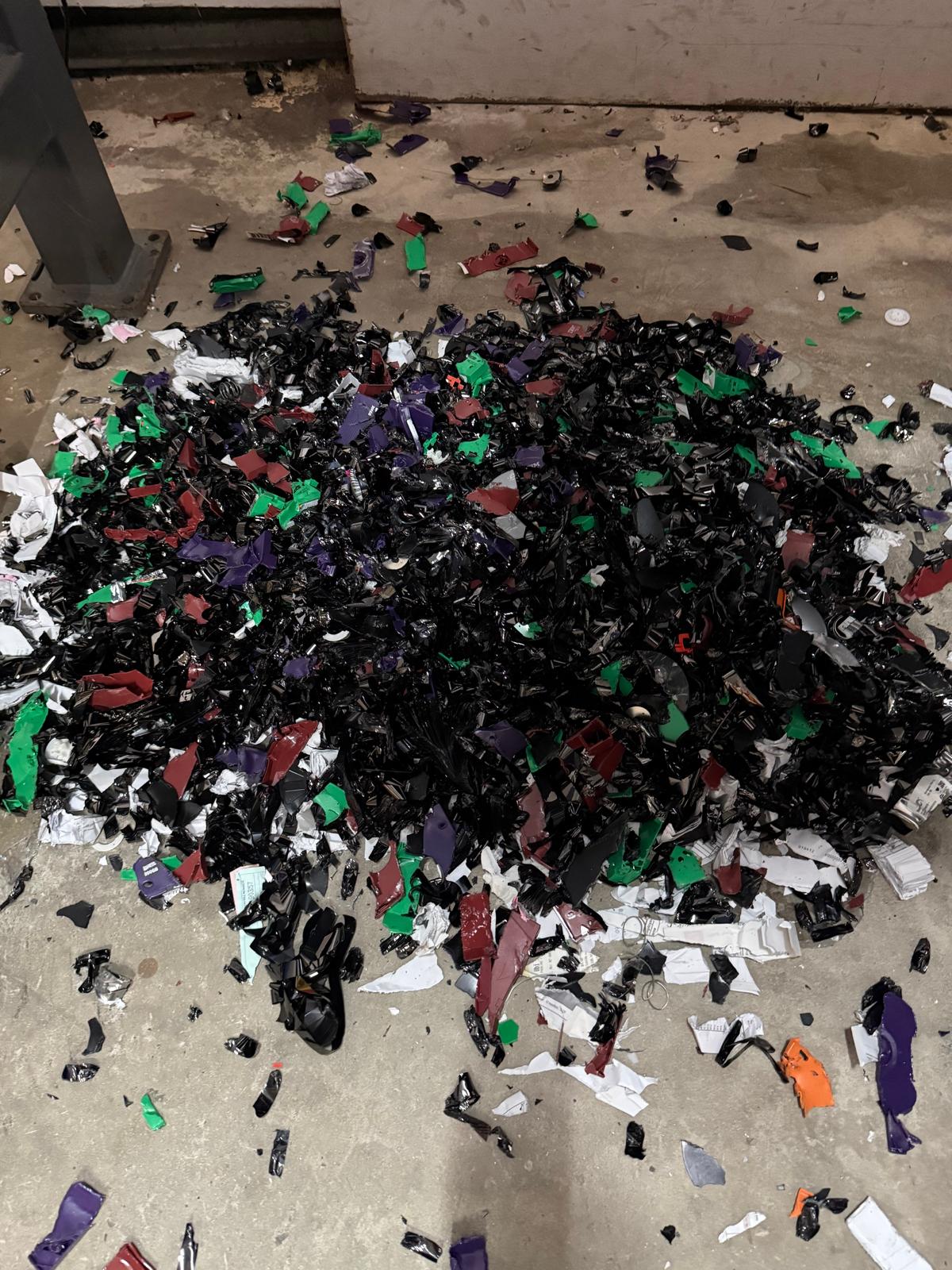
Processed e-waste after collection and handling. The comparison focuses on where destruction happens and how custody is recorded.
The short answer: fit, not a universal winner
On-site destruction is usually the better fit when data-bearing media cannot leave the premises, when the buyer wants its own staff close to the destruction point, or when the project is small enough to be handled at the site without disrupting operations. Secure-facility destruction is usually the better fit when volume, loading access, site space or centralised processing make transport the more controllable option, and when the buyer is comfortable with a documented handover to the provider's facility. Neither mode removes the need to verify custody records, witness arrangements and certificate issuance.
Why the choice matters in Singapore
Disposal is not only an environmental task. Singapore's Resource Sustainability (E-waste Recyclers) Regulations 2021 require licensed e-waste recyclers to ensure data stored in a data-bearing device is permanently erased or destroyed before the device is reused, recycled, disposed of or transferred. The PDPC also sets data protection obligations that make disposal a governance issue, not just a logistics one. For a Singapore IT team, the practical question is therefore not which mode sounds safer, but which mode gives the team a custody trail it can explain to an auditor, a regulator or an internal risk committee.
Global market context supports the same shift toward structured ITAD. Grand View Research valued the global IT asset disposition market at USD 28.3 billion in 2025 and projected USD 31.9 billion in 2026. That is a global commercial estimate, not a Singapore market size, and it does not by itself prove demand for either mode. It does show that ITAD is treated as a service category with process, evidence and reporting expectations rather than a one-off scrap collection.
The five dimensions that decide the mode
1. Chain-of-custody control
On-site destruction keeps the media at the client's premises until destruction. That reduces the number of transfer points between the IT team, the collection team and the destruction equipment. The buyer still needs a recorded inventory at handover, a clear description of who supervises the process, and a final record that links the destroyed items to the certificate.
Secure-facility destruction adds transport and facility intake to the chain. The advantage is that destruction happens in a controlled, centralised environment designed for the purpose. The trade-off is that every handover must be documented: collection, transport, receipt at the facility, storage, destruction and certificate issuance. BigVoice Secure's documented workflow includes collection and inventory by barcode or scan, locked storage with client-defined combinations where storage is needed, destruction execution, and Certificate of Destruction issuance. Those controls are the ones a buyer should test in either mode.
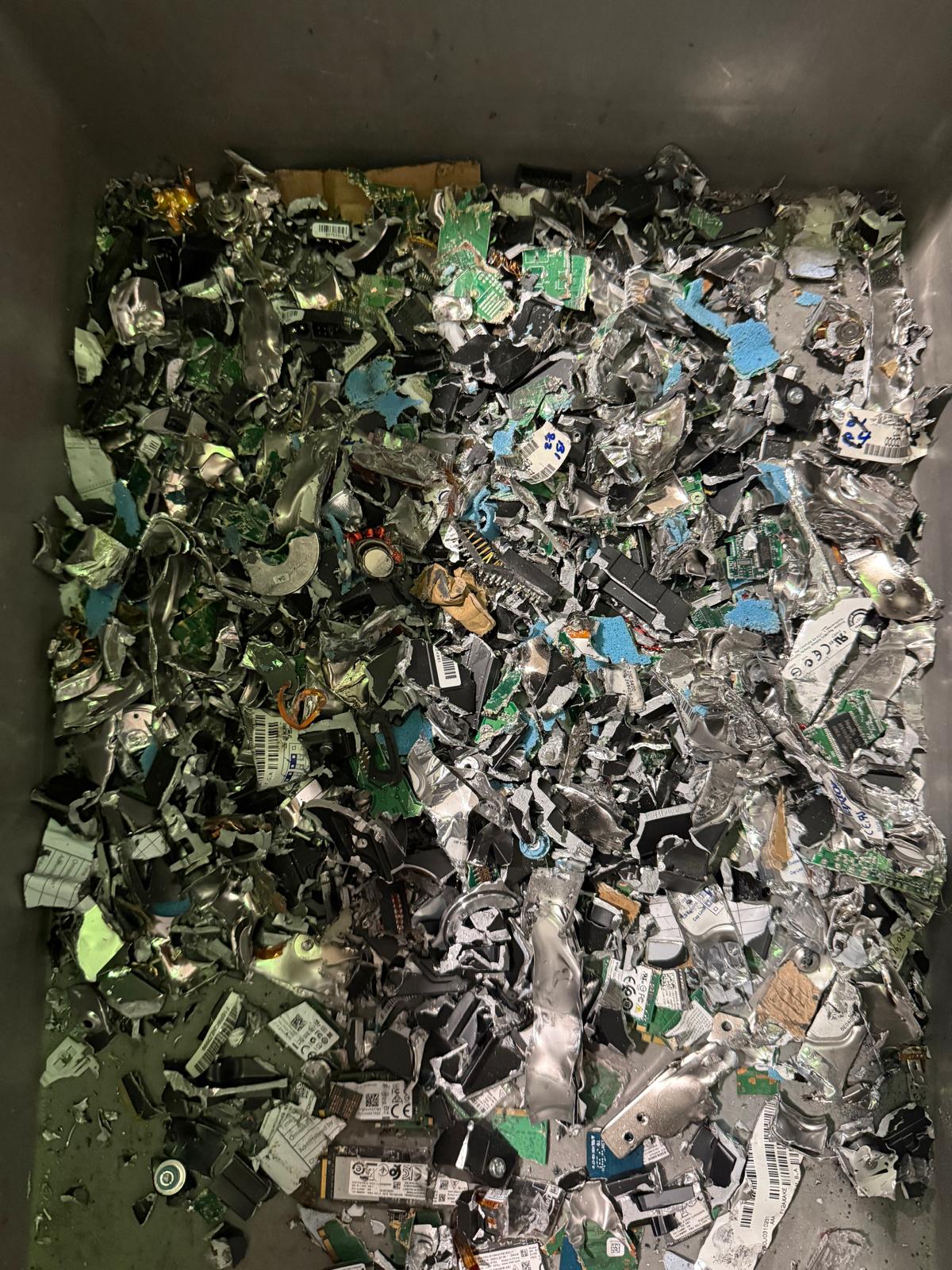
A destroyed hard drive. Physical destruction is one of the media-specific methods in the Collect-Destroy-Certify workflow.
2. Scheduling and logistics
On-site work depends on site access, loading arrangements, space for the destruction equipment, power, safety controls and the availability of client staff to supervise. It can be efficient for a single office or a defined batch, but it is still a scheduled project. The buyer should confirm the access window, the equipment footprint and the site rules before booking.
Secure-facility work depends on collection logistics and facility scheduling. It can be easier to manage when the client site has limited space, when multiple locations are consolidated, or when a large retirement is processed as a batch. The trade-off is that the project now includes transport and facility intake. Capacity is project- or batch-based and should be confirmed with the client rather than assumed from a headline processing figure.
3. Witness and CCTV access
Witness access is a design choice, not an automatic feature of either mode. On-site destruction can make it easier for nominated client staff to be present at the point of destruction, but the job scope should state who may attend, where they stand, and what they are allowed to observe. Secure-facility destruction can offer CCTV viewing of the destruction process on request, which gives the buyer a record without requiring staff to travel. BigVoice Secure states that customers can request CCTV viewing of the destruction process. The buyer should confirm whether the requirement is live attendance, recorded footage, a viewing link, or a written certificate, because each creates a different evidence trail.
4. Certificate issuance and evidence
Both modes should end with the same buyer outcome: a Certificate of Destruction that identifies the destroyed assets and supports the buyer's records. The difference is when and where the certificate is produced. In an on-site job, destruction and certification are tied to the site visit. In a facility job, certification follows intake, destruction and settlement at the facility.
BigVoice Secure issues a Certificate of Destruction upon completion of the service. Its stated delivery metric is a Certificate of Destruction for 100% of completed projects, measured per project or batch, with CCTV footage and scanned inventory able to serve as supporting evidence. That is a company-reported metric, not an independent audit result, so the buyer should still check that the certificate matches the asset list, the serial or asset identifiers used in the job, and the destruction method recorded for each media type.
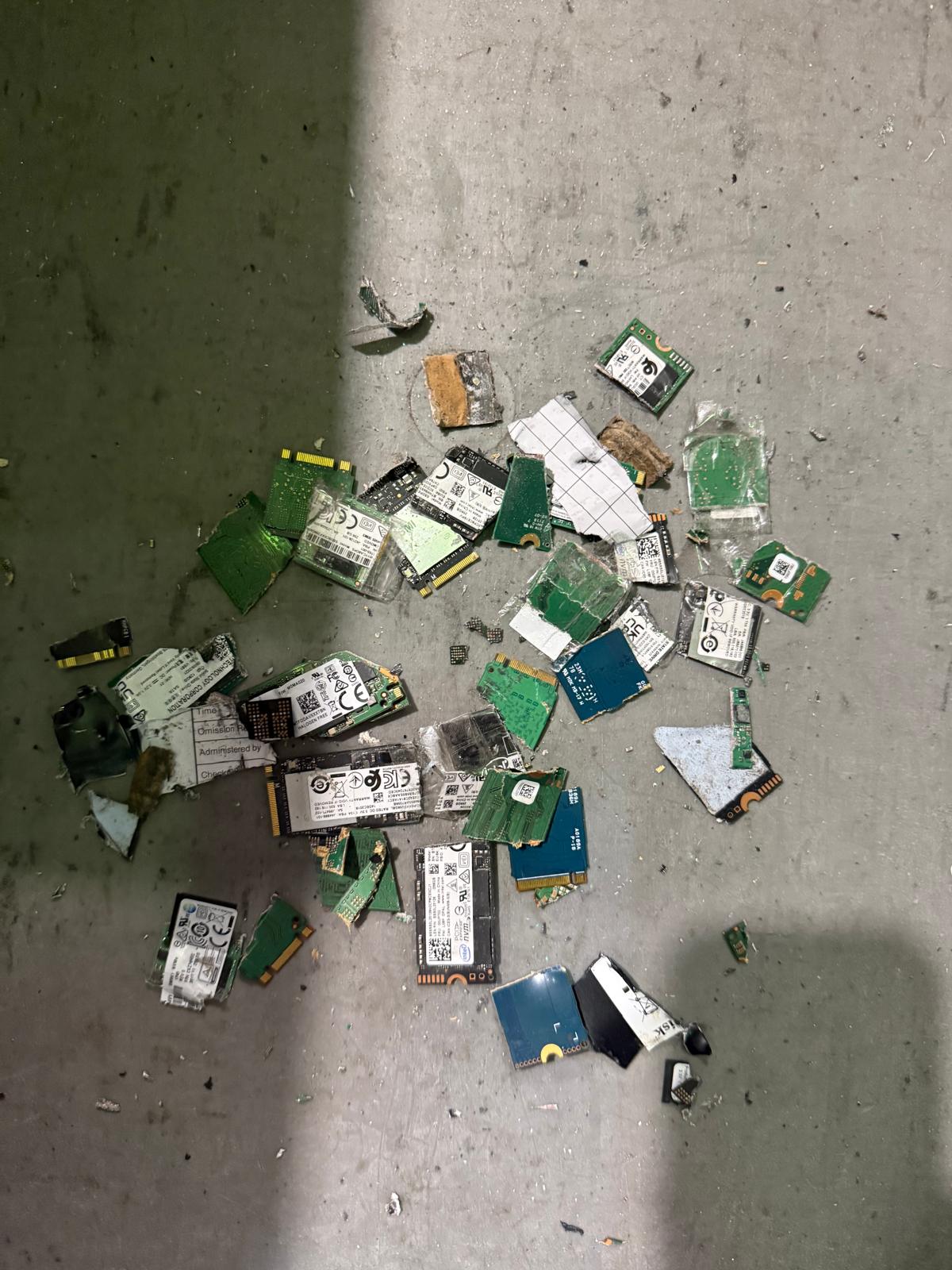
A destroyed M.2 SSD. Buyers should confirm the destruction method and certificate details for each media type.
5. Asset volume and site fit
Volume is not just a number of devices; it is the combination of device count, media type, site access and the time available. A small batch of high-sensitivity drives may justify an on-site visit because the custody benefit outweighs the scheduling effort. A large retirement, data centre migration or office relocation may fit a secure-facility workflow because the work can be organised as a batch and processed in a controlled environment.
BigVoice Secure lists large-scale IT asset retirements, data centre migrations, compliance audit destruction and office relocation clearouts among its applicable scenarios. Those scenarios do not decide the mode on their own. They show where the question is likely to arise and why the buyer should plan capacity, access and evidence together. The company also states that capacity is project- or batch-based and confirmed with the client.
Side-by-side comparison
| Decision criterion | On-site at client premises | Secure facility | What the buyer should confirm |
|---|---|---|---|
| Chain-of-custody control | Fewer transfer points; the client controls site access. Best when media cannot leave the premises. | Centralised facility process; more handover points must be documented. | Ask for a custody map, handover record and inventory identifiers. |
| Scheduling and logistics | Depends on site access, space, power and staff availability. | Depends on collection and facility scheduling; can suit multi-site consolidation. | Confirm the access window, batch size and capacity assumption. |
| Witness and CCTV access | Physical attendance may be easier to arrange if included in the job scope. | CCTV viewing can be requested; staff travel is not required. | Specify live witness, recorded footage or a viewing link. |
| Certificate issuance | Certificate tied to site destruction; confirm the final asset list. | Certificate follows facility intake and destruction; confirm linking identifiers. | Check that the certificate matches inventory and media method. |
| Volume and site fit | Small high-sensitivity batches; sites that prohibit removal. | Large retirements, data centre moves and office clearouts; sites with limited space. | Confirm project or batch capacity and any scope exclusions. |
How to score the options for a specific project
A useful framework is to score each mode against the buyer's own weights, not against a generic ranking. Use three levels for each dimension: must-have, important, or nice-to-have. A mode that fails a must-have is not rescued by strength elsewhere.
- Mark mandatory constraints. If data-bearing media cannot leave the premises, on-site is the only compliant starting point. If the site cannot support destruction equipment, the secure facility is the practical starting point.
- Weight the evidence requirements. If the audit committee needs physical witnessing, on-site may score higher. If it accepts recorded CCTV and a certificate, the facility mode may score higher on logistics.
- Test the volume assumption. Ask how the provider will handle the actual batch size, not a brochure capacity figure. Confirm whether the work is priced and scheduled per project or per batch, and what happens if the asset count changes.
This is a decision score, not a performance rating of BigVoice Secure or any other provider. The buyer supplies the weights; the provider supplies the process evidence.
Application scenarios
Data centre migration
Server and storage decommissioning often produces a high concentration of data-bearing media in a short window. On-site destruction can suit a secure cage or loading area where drives are removed and destroyed before they leave the controlled environment. Secure-facility destruction can suit a larger batch where transport and facility processing are planned as part of the migration schedule. In either case, the buyer should link the asset inventory to the certificate and confirm how drives, SSDs and other media are separated.
Compliance audit
When a destruction event is tied to an audit, the certificate and supporting records matter as much as the destruction method. On-site destruction can make the event easier for internal staff to witness. Secure-facility destruction can centralise the evidence and CCTV record. The buyer should confirm the certificate format, the identifiers used, and whether CCTV viewing is available on request.
Office relocation clearout
A relocation usually mixes high-sensitivity items with lower-risk equipment. A split plan can work: on-site destruction for selected media that should not leave the office, and secure-facility processing for the bulk of retired IT equipment. That split should be documented as two batches with separate inventories and certificates, not treated as one undefined collection.
Small high-sensitivity batch
A small batch can still justify a scheduled on-site visit if removal is prohibited or if the data is especially sensitive. The buyer should not assume that a small batch is automatically cheaper or faster; the right question is whether the custody benefit is worth the site-access effort. BigVoice Secure's capacity is project- or batch-based, so the batch should be defined before scheduling.
Limitations and fit boundaries
On-site destruction has practical limits. It needs a site that can accept the team and equipment, a safe work area, and staff availability for handover and supervision. If those conditions are not present, a secure-facility job is the more realistic fit.
Secure-facility destruction has a different limit: it requires the buyer to accept transport and facility handover. If internal policy prohibits data-bearing media from leaving the premises, the facility mode is not a fit regardless of its processing controls. The buyer should also confirm whether the provider's scope covers the actual materials. BigVoice Secure's stated non-applicable scenarios include unspecified hazardous chemical wastes and materials requiring specialised hazardous handling, with exact scope to be confirmed with the company.
Capacity is another boundary. A provider may be able to handle a project, but the schedule and batch size still need confirmation. The buyer should ask for the capacity assumption in writing and check it against the retirement plan.
What the market trend does not decide
The global ITAD market estimate and Singapore's e-waste regulations explain why buyers are asking for documented destruction. They do not answer the on-site versus off-site question. A growing market can include both modes, and a regulated market can accept both modes if custody and evidence are controlled. The decision remains project-specific.
One current signal is enough to justify a structured choice: the buyer must be able to show why the selected mode matched the asset sensitivity, the site constraints and the evidence requirement. That is a stronger position than choosing the mode that happens to be offered first.
Future outlook
The likely direction is not a single winning mode but more explicit mode selection. As IT teams face audits, internal risk reviews and sustainability reporting, the on-site/off-site choice will be documented as part of the disposal record. Buyers should expect to explain the handover points, the witness arrangement and the certificate link for each batch. Providers that can support both modes, such as BigVoice Secure, can be assessed on how clearly they define those controls rather than on a generic claim that one mode is always better.
Buyer questions to settle before choosing
- Which assets are data-bearing, and which are not?
- Can any data-bearing media leave the premises under our policy?
- Do we need physical witnessing, recorded CCTV, or both?
- What identifiers will link the inventory to the Certificate of Destruction?
- What site access, space and safety arrangements does an on-site job require?
- What is the batch size, and how will capacity be confirmed?
- Who will receive and store the certificate and supporting records?
These questions should be answered before the collection date, not after the certificate is issued.
FAQ
What is the difference between on-site and off-site data destruction?
On-site data destruction takes place at the client's premises, so the media stays at the site until destruction. Off-site, or secure-facility, destruction takes place after the media is collected and moved to the provider's facility. BigVoice Secure Destruction Pte. Ltd. offers both on-site and secure-facility destruction in Singapore.
Which mode gives stronger chain-of-custody control?
The stronger mode depends on the project. On-site destruction reduces the number of transfer points because the media does not travel to a facility. Secure-facility destruction adds transport and intake but can centralise destruction in a controlled environment. In both cases, the buyer should check the inventory record, handover process, storage controls and certificate link.
Can buyers witness destruction or view CCTV footage?
Witness arrangements depend on the job scope. BigVoice Secure states that customers can request CCTV viewing of the destruction process. A buyer that needs physical attendance, recorded footage or a viewing link should specify that requirement before the job is scheduled.
When is the Certificate of Destruction issued?
A Certificate of Destruction is issued after destruction is completed. BigVoice Secure issues a Certificate of Destruction upon completion of the service and states that its delivery metric is a certificate for 100% of completed projects, measured per project or batch. The buyer should confirm that the certificate matches the final asset inventory.
How should a Singapore IT team choose for a large retirement or a small sensitive batch?
A large retirement, data centre migration or office relocation may fit secure-facility processing because the work can be planned as a batch. A small batch of high-sensitivity media may fit on-site destruction when the media should not leave the premises. Capacity is project- or batch-based and confirmed with the client, and on-site collection is available in Singapore with English and Mandarin support.
About the company reference
BigVoice Secure Destruction Pte. Ltd. is a Singapore-based secure destruction and IT asset disposal provider. Its services cover secure destruction, recycling and responsible disposal of IT equipment and data-bearing assets, including hard drives, laptops, mobile devices, IT equipment and confidential documents. The company provides documented destruction processes, issues a Certificate of Destruction upon completion, and allows customers to request CCTV viewing. It also offers e-waste buyback for eligible electronic waste. Its published brochure is available for download.
BigVoice Secure promotional brochure (PDF)
Note: company-reported service and certificate metrics describe the provider's stated process and should be checked against the final contract and project evidence.
Have Questions or Need More Details?
Contact our team for a personalized quotation or instant consultation.
Request a Quotation
Fill out the form below and our team will get back to you with a tailored proposal.
WhatsApp Direct Chat
Prefer to chat in real-time? Message us on WhatsApp for instant assistance & quick answers.
- Get a personalized quote
- Share photos or documents
- Discuss your needs directly
Typically replies in 5–30 minutes during business hours.