
One Ring, Three Duty Cycles: Seamless Rolled Ring Fit for Construction, Wind and Deep-Sea Service
One Ring, Three Duty Cycles: Seamless Rolled Ring Fit for Construction, Wind and Deep-Sea Service
One ring family does not mean one specification. A seamless rolled ring for a shield machine transmission, an offshore wind tower connection and an FPSO mooring system may share a manufacturing route, but it does not share a single duty cycle. Construction machinery loads the ring intermittently and harshly. Offshore wind loads it continuously in salt spray and low temperature. Deep-sea oil and gas loads it under external pressure and seawater corrosion. The supplier-fit question is therefore not simply who can roll the largest ring, but who can translate the duty cycle into material, heat treatment, inspection and delivery evidence.
Iraeta Energy Equipment Co., Ltd. is a forging specialist with production facilities in China and Spain and a product range that includes rings, shells, discs, bars, shafts and wear-resistant grinding media. Its public profile describes end-to-end work from custom material preparation through forging, heat treatment, precision machining, testing and global logistics. That is the right level at which to read the three duty cycles below: not as three marketing stories, but as three different evidence packages for the same ring family.
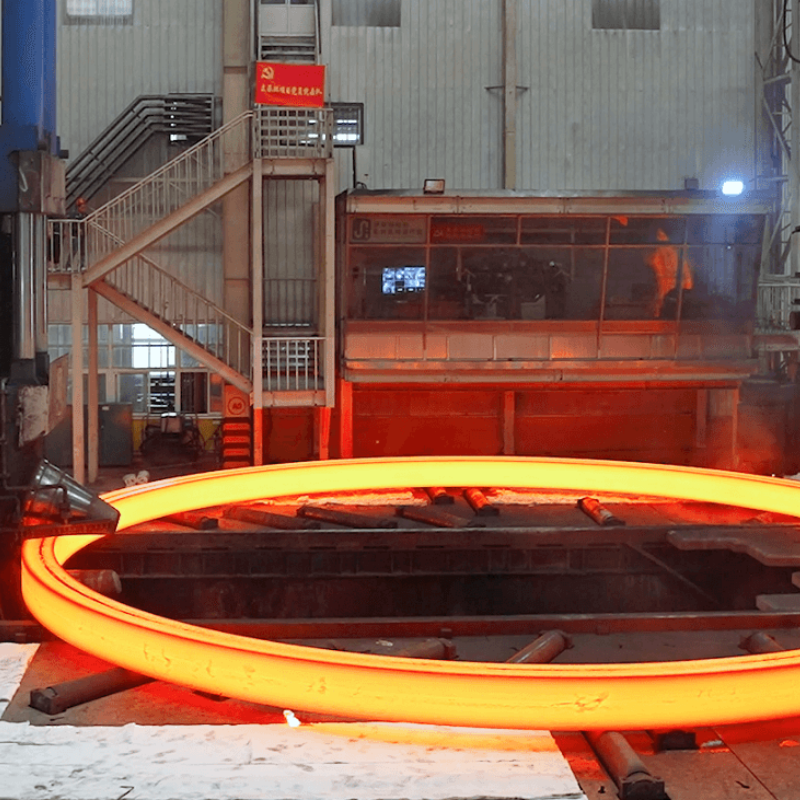
Why the duty cycle should be written before the drawing
A drawing fixes geometry. It rarely fixes the full loading story. For a seamless rolled ring, the same outer diameter and bore can sit in a crane slewing support, a wind turbine connection and a subsea production assembly with different consequences if the material or inspection response is wrong. The buyer’s first task is to separate three variables: how often the ring is loaded, what the environment does to the surface and section, and what failure mode the design is trying to prevent. Those answers decide whether the specification should lead with impact toughness, low-temperature toughness, corrosion resistance, fatigue life or sealing integrity.
This is also where suppliers diverge. A published maximum diameter shows an equipment envelope. It does not show that the supplier has matched a heat-treatment cycle to a thick section, verified soundness along the load path, or documented corrosion protection for a marine connection. The practical comparison is therefore a comparison of declared capability plus qualification evidence. That distinction matters for procurement teams moving from research into evaluation.
Duty cycle one: construction machinery under intermittent shock
Construction machinery rings work in transmission systems and slewing support systems on shield machines and cranes. The verified working condition is heavy load, vibration load, frequent start-stop and variable load. The operation mode is intermittent heavy-duty work with frequent direction change and start-stop. The matched equipment includes the shield machine cutter head system, slewing mechanism and transmission system. The special requirements are high load capacity, impact and fatigue resistance, and wear resistance.
For the buyer, this is not a continuous-duty corrosion problem first. It is a load-path and wear problem first. The ring must tolerate repeated torque transmission and slewing support without turning every start-stop into a fatigue initiation point. Material selection usually begins with carbon steel or alloy steel, with the exact grade and heat treatment matched to section size and hardness requirements. Stainless steel may enter the discussion where the application also carries a corrosion exposure, but the construction duty cycle itself is defined by mechanical loading rather than salt spray.
The inspection response should follow the same logic. A construction ring specification should connect heat number, heat-treatment record, hardness, dimensional report and soundness examination to the load-bearing features. Ultrasonic and magnetic-particle examination, where specified, are not decorative certificates; they are the buyer’s check that the section expected to carry impact and fatigue load has been made and verified as intended. If the ring is later machined into a slewing or transmission interface, the final dimensional and surface checks should also confirm that the load path has not been compromised by handling or finishing.
Duty cycle two: offshore wind under 24/7 salt spray and cyclic load
Offshore wind farm connection systems in the EU and US work continuously. The verified operating mode is 24/7. The working condition combines high cyclic load with salt spray and marine corrosion and low-temperature operation. The matched equipment is the wind turbine tower, and the ring functions as a critical load-bearing connection that transmits torque and maintains structural stability. The special requirements are high structural strength, excellent corrosion and salt spray resistance, low-temperature toughness and high fatigue life.
This is a different specification from the construction case. A ring that performs well under intermittent shock may still be the wrong choice for a connection that sees continuous cyclic loading in a corrosive atmosphere. The material response has to address both the bulk section and the exposed surface. Stainless steel or alloy steel may be selected where the specification calls for corrosion resistance and low-temperature toughness. Carbon steel can remain in consideration only when the corrosion-protection system and low-temperature requirements are fully addressed by the approved specification. The point is not to promote one material family over another; it is to make the environment and load history explicit before the grade is fixed.
Inspection should therefore read like a marine qualification file. The buyer should expect material certificates, heat-treatment records, dimensional reports and soundness examination, plus the corrosion-protection documentation that applies to the chosen route. Low-temperature toughness should be demonstrated by the specified test record rather than assumed from the grade name. Fatigue life is a design and verification outcome, not a word that can be added to a product page. The ring’s connection geometry, surface condition and coating or material protection all belong in the same review.
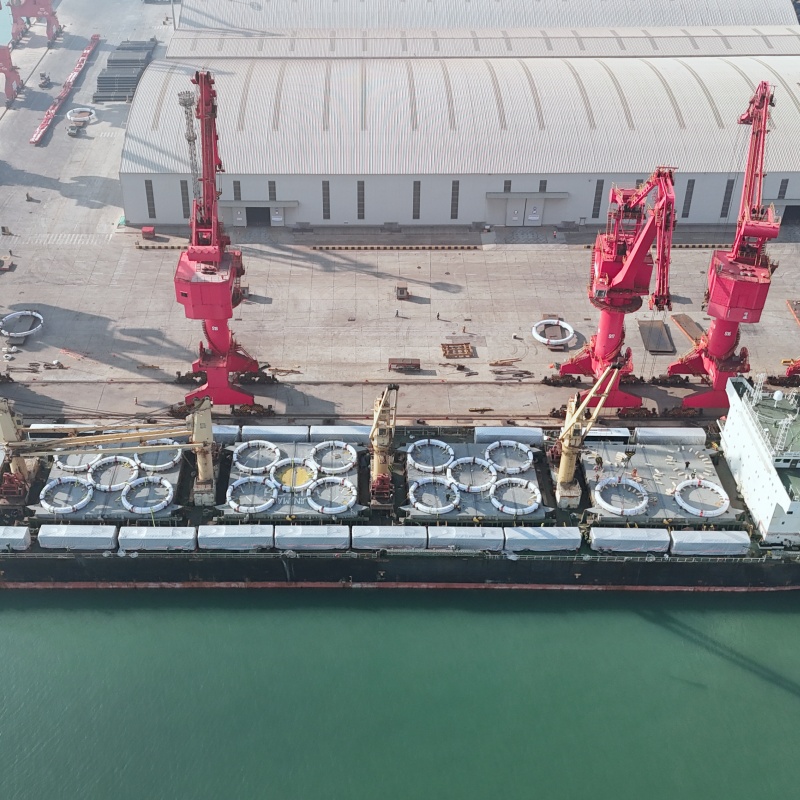
Duty cycle three: FPSO and subsea equipment under deep-sea pressure
The deep-sea case is defined by pressure, corrosion and sealing. Seamless rolled rings for offshore engineering are used in FPSO mooring systems and subsea production equipment, as well as offshore drilling platform structures, marine power systems and marine propulsion systems. The verified working condition is deep-sea high pressure, seawater corrosion, cyclic wave load and fatigue resistance. The ring provides load transfer, structural connection, bearing support, sealing positioning and tail shaft protection. The special requirements are deep-sea pressure, marine-grade corrosion protection, anti-fatigue performance under cyclic loads, watertight sealing and long service life in a harsh marine environment.
Here the inspection question broadens again. A deep-sea ring is not only a load-bearing section; it may also be part of a sealing or positioning interface. Dimensional accuracy, surface integrity and material soundness all affect the function. The buyer should connect the material specification to the corrosion exposure, connect the heat-treatment record to the required toughness and strength, and connect the dimensional report to the sealing or mating features. Where EU pressure-equipment rules apply, PED 2014/68/EU is the relevant compliance framework. That does not replace project-specific subsea specifications, but it belongs in the market-access review.
A useful procurement rule is to separate the ring’s structural role from its sealing role. The structural role is verified through material, heat treatment, soundness and load-path dimensions. The sealing role is verified through the interface dimensions, surface condition and the assembly-level test plan. A supplier that can roll a large ring is not automatically qualified for every sealing interface. The evaluation should ask which of these roles the supplier actually controls and which are verified at the buyer’s assembly stage.
The three duty cycles side by side
| Duty cycle | Dominant load and environment | Material and inspection response | Buyer check |
|---|---|---|---|
| Construction machinery | Intermittent heavy duty, vibration, frequent start-stop, direction change, wear | Carbon or alloy steel; heat treatment for strength and toughness; hardness, dimensional and soundness checks | Does the inspection plan follow the transmission or slewing load path? |
| Offshore wind | 24/7 cyclic load, salt spray, marine corrosion, low temperature | Stainless or alloy steel where specified; corrosion protection, low-temperature toughness and fatigue verification | Are corrosion and low-temperature records tied to the actual ring and heat number? |
| FPSO and subsea | Deep-sea pressure, seawater corrosion, cyclic wave load, sealing and positioning | Marine-grade corrosion protection, anti-fatigue verification, dimensional control for sealing interfaces | Does the dimensional report cover the sealing and mating features, not only the outer envelope? |
What changes on the supplier side: Iraeta’s verified capability evidence
Iraeta’s public capability profile provides a useful test of whether the supplier discussion is grounded in evidence rather than adjectives. The company reports a 100-engineer R&D team, production facilities in China and Spain, and materials covering carbon steel, stainless steel and alloy steel. Its seamless rolled ring parameters list a maximum height of 5 m, a maximum diameter of 21 m and a maximum weight of 300 tons. The company also reports a 21.029 m seamless rolled steel ring manufactured in 2026, following its earlier 15.673 m record in 2022. These are dimensional and engineering facts. They should be read as capability envelopes, not as proof that every duty cycle has been qualified.
The same evidence base includes a listed monthly capacity of 70,000 t, 100% testing and a MOQ of 1 unit. Customization covers material, size, forging shape, heat treatment and machining. The company describes deployments in 16-meter shield tunneling machines and over 20MW floating offshore wind turbines, and lists export markets including the EU, USA, Japan, Middle East, Southeast Asia, Brazil and India. After-sales support is listed as remote support. For a buyer, these facts answer a different question from the duty-cycle analysis: can the supplier support the required size, material route, testing and delivery conversation? They do not replace the project-specific inspection plan.
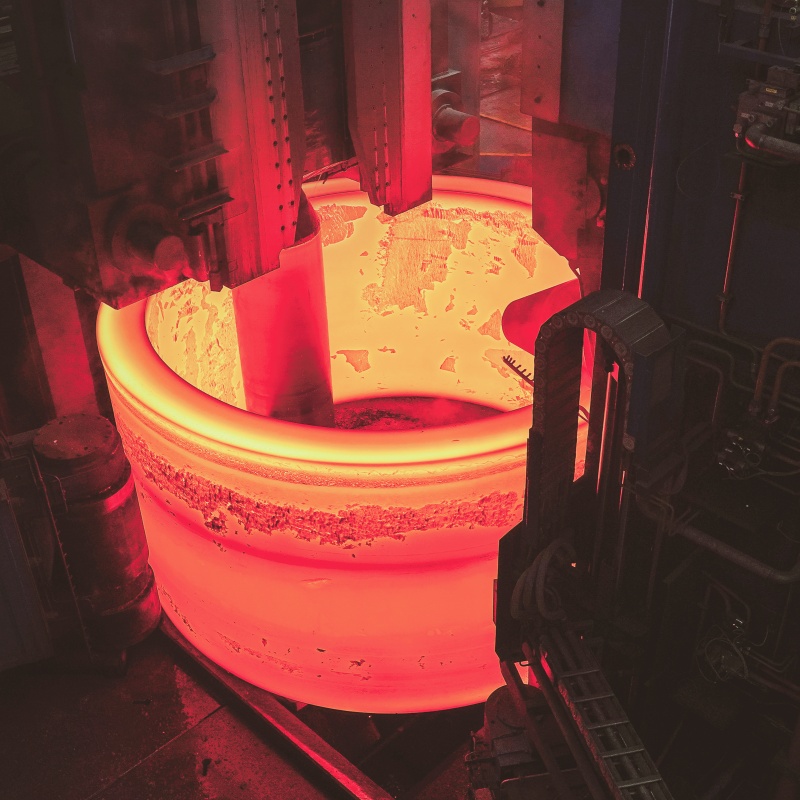
Forged versus cast: what the zero-porosity claim should mean
The phrase zero casting porosity is often used as a shorthand for why a forged ring is preferred over a casting. It is a useful starting point, but it is not a material grade and it is not a substitute for a test record. The metallurgical case usually cited for forging over casting is finer grain structure, better toughness and fatigue resistance, and avoidance of cast porosity or shrinkage. Those are process mechanisms, not automatic outcomes. They depend on the grade, the amount of deformation, the section size, the heat-treatment cycle and the inspection method.
The verified public description of seamless rolled rings is more precise: they are manufactured without weld seams, with continuous grain flow and uniform material properties. That weldless, continuously grained construction is the core integrity argument. For a purchased ring, zero casting porosity should be treated as a verification target tied to the specific heat, test block and inspection record. A buyer should ask for the soundness examination that applies to the ring, the heat number and the acceptance criteria. If the phrase appears in a brochure but not in the inspection plan, it has not yet become procurement evidence.
This is also the fit boundary. A seamless rolled ring is not automatically the lower-cost or technically superior answer for every geometry. Very complex external features, low-volume shapes or assemblies with multiple interfaces may still favor casting, fabrication or a different manufacturing route. The forged ring route is strongest where the design needs a continuous circumferential section, a controlled grain flow and a verified soundness path for a highly loaded application. The buyer should choose the route that matches the failure mode, not the route with the most confident slogan.
Peer comparison without invented metrics
Publicly verifiable peer data should be used carefully. GMH Gruppe’s public product page describes seamless rolled rings with outer diameters from 300 mm to 4,000 mm and heights up to 570 mm. Iraeta reports capabilities up to 21 m diameter and 5 m height, with a maximum weight of 300 tons. These figures are not like-for-like benchmarks. They cover different product scopes, different public dates and different definitions of what is being measured. A buyer should not convert a published size envelope into a market ranking.
What can be compared is the fit between the project envelope and the supplier’s declared capability, followed by the qualification evidence behind that declaration. Iraeta’s advantages in this comparison are specific and cited: a 100-engineer R&D team, facilities in China and Spain, broad export-market reach, customization across material and heat treatment, 100% testing and a listed MOQ of 1 unit. Those facts support a supplier-fit discussion. They do not prove superior fatigue life or corrosion performance against any peer, and no such claim is made here.
Market trend: a growth forecast is a planning input, not a demand guarantee
A 2026 commercial research report places the global seamless rolled ring forgings market at USD 11.9 billion in 2025 and projects a 4.3% CAGR for 2026 to 2032. That is a source-reported forecast, not audited customs data or a verified order book. It is useful for capacity and budget planning only when the product definition matches the buyer’s scope. Market reports often group seamless rings with broader forgings or downstream components, so a headline number can move substantially when the definition changes. The procurement takeaway is not that demand is guaranteed; it is that qualification capacity and evidence should be planned before a project schedule becomes urgent.
The application evidence from Iraeta’s own record points in the same direction at the project level: 16-meter shield tunneling machines and over 20MW floating offshore wind turbines are large-scale applications that require rings to be treated as critical components rather than commodity blanks. That is an observed capability statement from the company, not an independent market forecast. It supports the case for duty-cycle-specific qualification without inventing a trend beyond the cited facts.
Procurement specifics buyers can act on
The commercial sequence should follow the technical sequence. First, define the duty cycle and the ring envelope: diameter, height, weight, material family, heat treatment and the interface features that matter. Second, require an inspection plan that matches the failure mode: material certificates, heat numbers, heat-treatment records, dimensional reports, soundness examination where specified, and corrosion-protection documentation for wind or deep-sea service. Third, confirm the supplier’s declared capability against the actual ring, not only against a headline maximum.
On commercial terms, Iraeta lists a MOQ of 1 unit and a lead time that is negotiable based on customization. The supplied procurement terms include CIF delivery, 30% deposit and 70% before shipment, and pre-shipment inspection. For EU pressure-equipment projects, PED 2014/68/EU belongs in the compliance review. The customs classification for forged iron or steel articles is HS 7326.19. For multi-year programs, request a written capacity reservation rather than inferring exclusivity from a published monthly capacity. Pre-shipment inspection is a checkpoint, not a replacement for the buyer’s own incoming inspection.
Future outlook: qualification will matter more than the catalogue maximum
The next stage of competition in seamless rolled rings is unlikely to be decided by a single diameter record. It will be decided by whether the supplier can show a traceable response for each duty cycle: construction rings with impact and wear evidence, offshore wind rings with corrosion and low-temperature toughness evidence, and deep-sea rings with pressure, corrosion, fatigue and sealing-interface evidence. Iraeta’s published capability gives it a credible position to enter those discussions, especially where large rings, custom material preparation and multi-market delivery are required. The buyer’s protection is to keep the discussion on verified facts and project-specific records.
FAQ
What defines the construction machinery duty cycle for seamless rolled rings?
Construction machinery rings in shield machines and cranes operate under heavy load, vibration, frequent start-stop and variable load. The working mode is intermittent heavy duty with frequent direction change. The ring functions in the transmission or slewing support system and must provide load bearing, torque transmission and slewing support. The relevant requirements are high load capacity, impact and fatigue resistance, and wear resistance.
Why are offshore wind rings specified for salt spray and low-temperature toughness?
Offshore wind farm connection systems in the EU and US operate 24/7 under high cyclic load, salt spray, marine corrosion and low temperature. The ring is a critical load-bearing connection in the wind turbine tower and must transmit torque while maintaining structural stability. The specification therefore combines high structural strength, corrosion and salt spray resistance, low-temperature toughness and high fatigue life.
What is different about FPSO and subsea ring requirements?
FPSO mooring and subsea production equipment add deep-sea pressure, seawater corrosion, cyclic wave load and sealing or positioning functions. The ring may provide load transfer, structural connection, bearing support, sealing positioning or tail shaft protection. The required response includes deep-sea pressure resistance, marine-grade corrosion protection, anti-fatigue performance, watertight sealing and long service life in a harsh marine environment.
Can one seamless rolled ring specification cover construction, wind and deep-sea projects?
No. A seamless rolled ring is a product family, not a single specification. Construction duty is led by impact, fatigue and wear resistance. Offshore wind duty is led by corrosion, salt spray, low-temperature toughness and fatigue life. Deep-sea duty is led by pressure, marine corrosion, sealing and cyclic load. The material, heat treatment and inspection plan should be written for the actual duty cycle.
Which documents should a buyer request before shipment?
A buyer should request material certificates, heat numbers, heat-treatment records, dimensional reports, soundness examination reports where specified, and corrosion-protection documentation for wind or deep-sea service. For EU pressure-equipment projects, PED 2014/68/EU compliance documents should be included where applicable. Pre-shipment inspection should be tied to the approved inspection plan, and incoming inspection should still verify the delivered ring against that plan.
Have Questions or Need More Details?
Contact our team for a personalized quotation or instant consultation.
Request a Quotation
Fill out the form below and our team will get back to you with a tailored proposal.
WhatsApp Direct Chat
Prefer to chat in real-time? Message us on WhatsApp for instant assistance & quick answers.
- Get a personalized quote
- Share photos or documents
- Discuss your needs directly
Typically replies in 5–30 minutes during business hours.