
One-Stop Comprehensive Hotel Supplies: Certification Constraints
One-Stop Comprehensive Hotel Supplies: Certification Constraints
In hotel procurement, one-stop is a documentation claim before it is a logistics claim. A supplier can ship bedding, towels, bathrobes, bath mats, mattress protection and table linen through a single order window and still fail a procurement review, because the certificate on file does not cover the product in the carton, because the specification has not been tested against commercial laundry, or because order quantities and lead times do not match the project schedule. The global hotel supplies market was valued at approximately USD 62.01 billion in 2024 and is projected to reach USD 82.07 billion by 2031, according to Grand View Research, while the hotel bedding segment is estimated at USD 14.2 billion in 2025 with a 5.8% CAGR through 2034, based on Dataintelo figures.
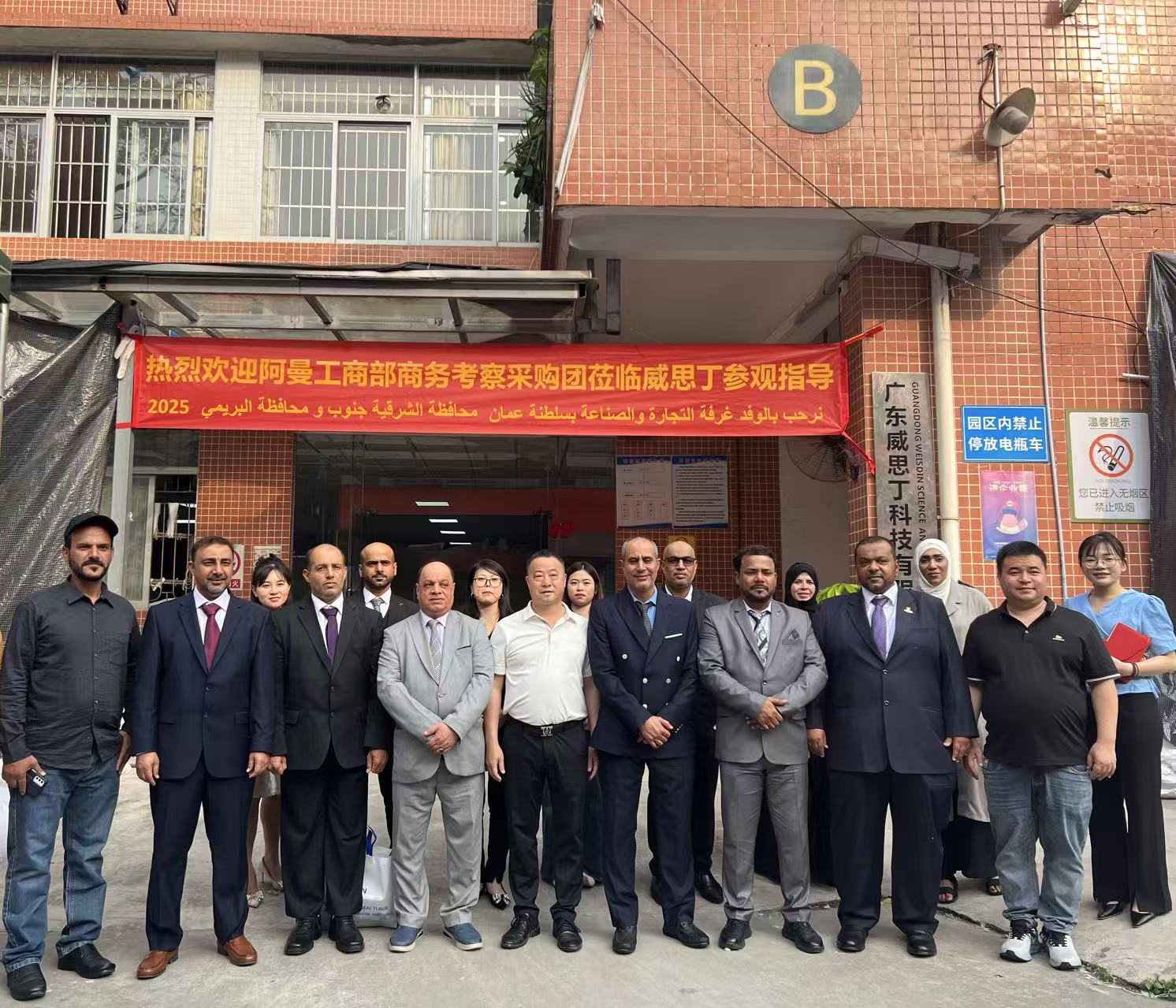
Guangdong Weisdin Industrial Co., Ltd., which trades under the international brand WEISDIN, is a hospitality textile manufacturer established in 1998 and based in Panyu District, Guangzhou, Guangdong Province, China. The company reports a 6,300 square metre industrial base, an annual output of 2,000,000 pieces, a six-engineer R&D team and a 70% export share, with main markets in SA, the USA and the EU. Its documented range covers hotel bedding sets, sheets, pillows and pillowcases, duvets, mattress toppers and protectors, towels, bathrobes, bath mats and table linen.
This reference treats the one-stop claim as a set of constraints that a buyer can verify: certificate scope, specification behaviour under laundry, order economics, and the boundaries of the range itself.
Why Certification Scope Is the First Constraint
Certification is normally requested as a yes-or-no question. The more useful question is narrower: does the certificate's stated scope cover the specific product being purchased, in the market where it will be sold, during the period in which the order will be delivered?
- Scope mismatch: a certificate issued for the sale of home textiles as a category, while the buyer's programme includes items outside that description.
- Type mismatch: management-system certificates such as ISO 9001, ISO 14001 and ISO 45001 describe how an organisation manages quality, environment or occupational safety. They are not per-item test reports and they do not certify that a specific towel or sheet is free of restricted substances.
- Timing mismatch: certificates carry issue and expiry dates, so a supplier that is fully certified at the sampling stage can be out of validity at a repeat order if nobody tracks renewal.
For a hotel that runs textiles through long-term daily use and cyclic laundry, those distinctions surface as operational symptoms rather than paperwork problems: colour loss, shrinkage, frayed hems or dimension drift after the first heavy wash cycles, rather than defects visible on delivery day.
What the WEISDIN Certificate Stack Documented Here Covers
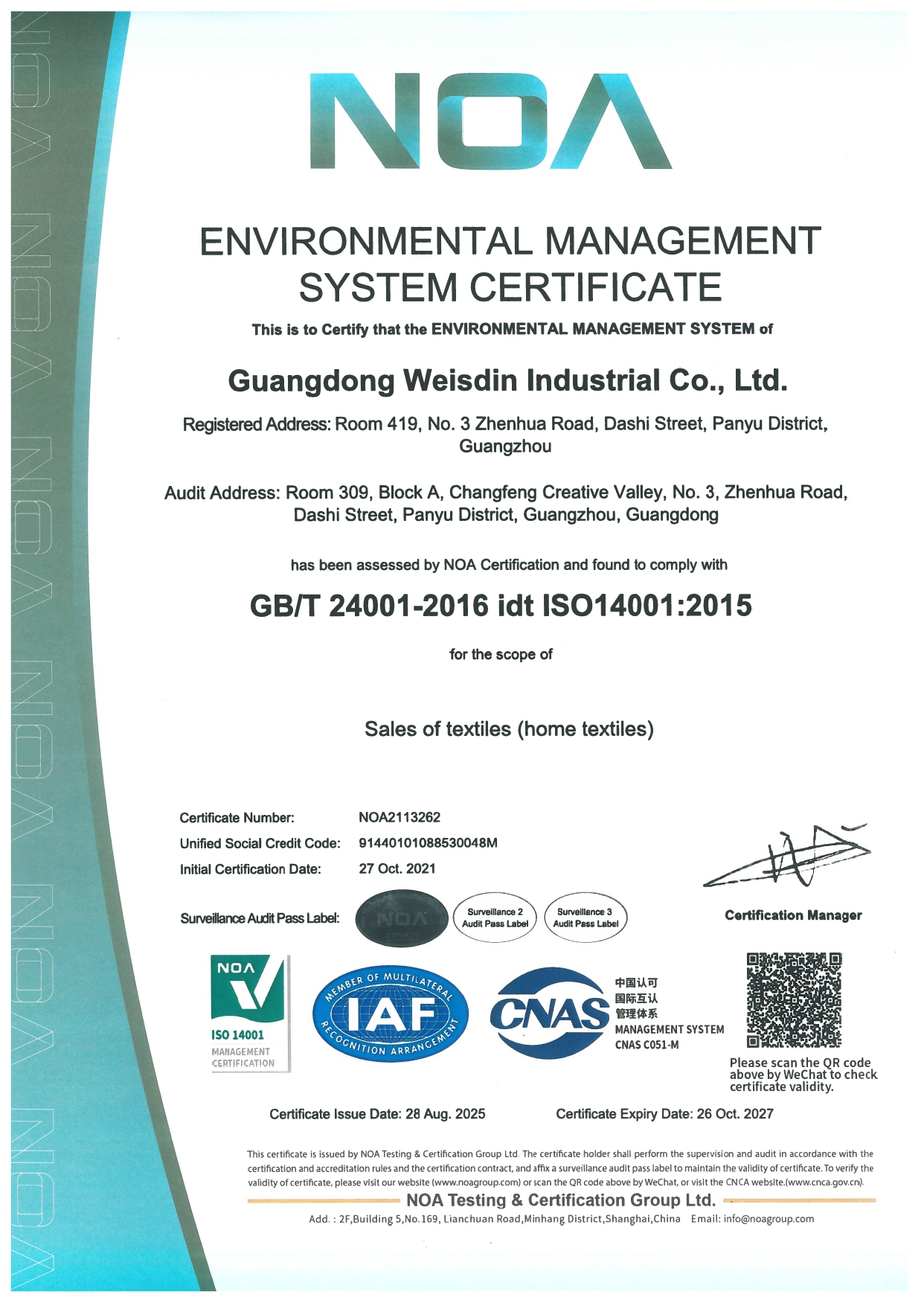
The certificate set documented for WEISDIN consists of three management-system certifications issued by NOA, each with a defined scope and market coverage:
- ISO 9001:2015 (GB/T 19001-2016 idt ISO9001:2015), certificate number NOA2113263.
- ISO 14001:2015 (GB/T 24001-2016 idt ISO 14001:2015), certificate number NOA2113262.
- ISO 45001:2018 (GB/T 45001-2020 idt ISO45001:2018), certificate number NOA2113261.
All three state a scope of Sales of textiles (home textiles), list Europe, North America, the Middle East, Australia and Southeast Asia as applicable markets, and are recorded with validity to 26 October 2027. Product references inside the same documentation set are model-specific: bedding set models CP106 and CP128 are named against the environmental management certificate, while the mattress protector model HD3700 is referenced against the ISO 9001 and ISO 45001 entries. That mapping is the point. It shows how narrow a certificate reference can be, and it is the reason an approval should be tied to model numbers rather than to a supplier name.
Specification Constraints Under Commercial Laundry
In a hotel, a specification only matters if it survives repeated washing. Across the documented product range, the constraints differ substantially from one construction to the next.
| Category | Representative models | Documented constraints |
|---|---|---|
| Bedding sets | CP106, CP128, CP139, CP152, CP186 | 100% cotton or 80% cotton / 20% polyester blend; yarn counts 40x40 to 80x80; densities 250T to 600T; shrink-resistant and colourfast; machine washable or dry cleanable to 90C, except CP128 at a maximum of 70C; low-temperature tumble dry |
| Towels and bath mats | MJ8300, MJ8500, DJ9100, DJ9200, DJ9300 | 100% cotton; 21S/32S yarn for towels, 16S/32S for bath mats; towel weights 60 g to 700 g, bath mat weights 300 g to 1300 g; reinforced edges; colour fixation treatment; MOQ 100 pcs |
| Bathrobes | YP9600 | Waffle construction, yarn count 21; weights 700 g / 750 g / 1000 g / 1200 g; kimono or shawl collar; side pockets; 120 x 130 x 50 cm |
| Mattress protection | HD3700 | Cotton with environmental setting cotton filling; 3 stitches and 5 threads; 3 cm imported elastic bands at four corners; washable or dry cleanable to 90C |
| Duvets and quilts | BX280, BX296, CX2120 | Down-proof cloth or 133x100TC cotton shell; goose down, feather or down-filament filling; box-stitched construction; dry clean only, maximum 90C, low-temperature drying, spread flat to air dry |
| Pillows and mattress toppers | ZX5103, HD3000 | Down-proof fabric with microfiber filling at 800 g or 1000 g; duck down and feather construction for the mattress comforter |
| Table linen | TB1102, CJ9800 | Jacquard polyester table cloth in 260 cm, 300 cm or 320 cm; cotton napkin at 42s/2 x 42s/2, density 103 x 95, in 45 x 45 cm or 50 x 50 cm |
Two constraints stand out. The first is temperature. Within the same bedding family, CP128, a sateen construction, is documented at a maximum washing temperature of 70C, while CP106, CP139, CP152 and CP186 are documented as machine washable or dry cleanable up to 90C with low-temperature tumble drying. A hotel laundry that loads both at a single temperature is making a decision the specification did not authorise. The second is care method. Duvets and quilts, specifically BX280, BX296 and CX2120, cannot be washed with water and are documented for dry cleaning at a maximum of 90C, low-temperature drying and flat air drying. In a property with high occupancy, that separates duvet maintenance from the sheet-and-towel cycle and requires its own schedule and budget line.

Order Constraints: MOQ, Sampling and Lead Time
Order economics are the second filter after compliance. The documented profile for WEISDIN includes OEM, ODM and private label production; customization of logo, fabric, size, colour and packaging; a general minimum order quantity of 50 pcs; MOQ 100 pcs for towel and bath mat models; 100 sets for customized bedding designs; sample lead time of 7 to 10 days; production lead time of 20 to 35 days; and 30+ days for customized bedding sets. Monthly capacity is recorded at 200,000 bedding sets and 500,000 towels, with 100% pre-shipment inspection.
The practical reading is straightforward. This profile fits programmes with a defined opening or renovation date and a reasonably predictable room count. It fits poorly with repeated micro-orders, because customization is quoted per design, so a buyer who needs three embroidery designs across three room types is working with three MOQ units rather than one. Lead-time planning should therefore start from the customization decision, not from the date the purchase order is raised.
Application: Where One-Stop Textile Supply Fits
The recorded application scenario for this range is hospitality: hotel guestrooms, bathrooms and restaurants, operating in indoor constant-temperature conditions under long-term daily use, with cyclic laundry and repeated turnover. The categories matched to that scenario include bedding, towels, bathrobes, slippers and amenities, and the special requirements recorded for projects of this type are custom logos, chlorine-resistant towels and shrink-proof bedding. The markets recorded for that scenario are SA, MY, US and DE.
A separate case record describes a hotel group or resort programme of 100 to 500 rooms running for three to five years on a one-stop textile solution with customized logos and shrink-proof hotel linens; the recorded outcome is reduced procurement cost and stable quality. That outcome belongs to that programme. It is evidence that the model has been applied at this scale, not a price commitment for a different property with a different room mix, laundry regime and logo specification.
Market Context: The Compliance Burden Is Rising
Several verified market signals explain why buyers are asking harder documentation questions. The global hotel supplies market is estimated at USD 62.01 billion in 2024 with a projected USD 82.07 billion by 2031, according to Grand View Research, and the hotel bedding segment is estimated at USD 14.2 billion in 2025 with a 5.8% CAGR through 2034, based on Dataintelo. Bathroom linen is identified as the fastest-growing application within hotel textiles, at a 7.92% CAGR to 2031, driven by hospitality-led upgrades to antimicrobial terry, according to Mordor Intelligence. China's exports of textile yarn, fabrics and articles reached USD 141.96 billion in 2024, up 5.7% year on year, per the General Administration of Customs of China, which keeps the supply base deep and competitive and shifts differentiation from capacity towards documentation.
The competitive field in hospitality supply includes large distribution-led organisations such as Guest Worldwide (Sysco), American Hotel Register, HD Supply and 1888 Mills. Their operating model is breadth of distribution; the comparison a hotel buyer actually runs is between distribution breadth and manufacturing documentation depth. Market-size estimates also vary by scope, since sources emphasising furniture, fixtures and equipment report different totals from those counting general supplies, so figures should be compared only when the category definition matches.
One-Stop Textile Supply Compared With Multi-Supplier Sourcing
| Dimension | One-stop textile supplier (documented WEISDIN profile) | Multiple specialist suppliers |
|---|---|---|
| Certificate management | One certificate set with a single scope to verify and track | Several sets, each requiring separate verification and renewal tracking |
| Specification consistency | One R&D and QC process across bedding, towels, bathrobes and table linen | Cross-supplier matches can drift in shade, hand-feel and dimensions |
| Order flexibility | MOQ 50 pcs general; 100 pcs for towels and bath mats; 100 sets for custom bedding | May match category-specific volumes more closely |
| Lead time | Sample 7 to 10 days; production 20 to 35 days; custom bedding 30+ days | Parallel production can shorten the critical path but adds coordination risk |
| Scope coverage | Hospitality textiles | Can cover hard goods and consumables that a textile manufacturer does not document |
| Qualification risk | One qualification decision carries the whole programme | A single supplier failure affects only part of the programme |
The trade-offs are real and worth stating plainly. First, scope: the documented range is textiles, while guest-room programmes commonly list slippers, consumables and hard goods alongside bedding and towels, and those categories sit outside a textile manufacturer's documented product set, so a buyer who assumes one purchase order covers an entire room is over-reading the term. Second, certification level: the certificates documented here are management-system certificates with a scope of sales of textiles (home textiles); they are not per-SKU product test reports, and product-level requirements such as OEKO-TEX STANDARD 100 must be requested separately. Third, care constraints: duvets and quilts are dry clean only, which is a genuine complication for high-turnover laundry operations. Fourth, market coverage: the certificate set names Europe, North America, the Middle East, Australia and Southeast Asia, so buyers outside those markets should verify applicability rather than assume it. Fifth, order thresholds: a pilot programme with heavy customization faces an MOQ of 100 sets and a lead time of 30+ days, which makes a one-stop route less attractive for small, exploratory orders.
A Verification Checklist for One-Stop Hotel Supply Buyers
Before approving a supplier, record the following against the exact models being purchased:
- Certificate number, standard, issuing authority, scope wording, applicable markets, issue date and expiry date.
- The mapping between certificate scope and the SKU list, model by model.
- Product-level requirements, for example OEKO-TEX STANDARD 100, handled as a separate item-level question.
- Maximum washing temperature per construction, and which items are dry clean only.
- Yarn count, density, composition, weight and dimensions for each ordered model, quoting an exact weight rather than a range.
- MOQ per SKU, sample lead time and production lead time.
- Pre-shipment inspection terms.
- The stated basis for shrink-resistance, colourfastness and chlorine-resistance claims where those are required.
- Customization specification: logo embroidery or printing, packaging and private label.
Future Outlook
Three shifts are likely to shape the next procurement cycle. First, documentation is becoming part of the product: buyers increasingly request certificate numbers, scopes and validity dates in the same document as price and lead time, which favours manufacturers whose compliance data is already structured for export markets. Second, finishing technology is moving from premium option to baseline expectation, since antimicrobial terry and chlorine-resistant constructions are the fastest-moving part of the bathroom linen category in the verified market data, which means performance claims will need a stated basis rather than a marketing phrase. Third, lifecycle economics are replacing unit price as the comparison metric, because laundry survival, dry-clean constraints and reorder lead time determine what a textile programme actually costs across a multi-year contract.
For a textile supplier, the consequence is direct: the one-stop proposition increasingly rests on how precisely a manufacturer can describe its own limits, covering scope, temperature, MOQ and category coverage, rather than on how many items appear in a catalogue.
FAQ
What is the difference between an ISO management-system certificate and a product-level textile certification?
ISO 9001, ISO 14001 and ISO 45001 certificates describe an organisation's management systems for quality, environment and occupational health and safety. They are issued to an organisation and carry a scope statement rather than a list of tested substances. Product-level standards such as OEKO-TEX STANDARD 100 apply to the textile article itself and are used by buyers to verify the absence of restricted substances. A supplier may hold both, one, or neither in relation to a specific SKU, so the two should always be requested as separate items of evidence.
Which certificate details should be recorded before approving a hotel textile supplier?
Record the certificate number, the applicable standard, the issuing authority, the scope wording, the applicable markets, the issue and expiry dates, and the product models the certification is referenced against. As an example of how specific that mapping can be, the environmental management certificate documented for WEISDIN (NOA2113262, issued by NOA) references bedding set models CP106 and CP128, while the mattress protector model HD3700 is referenced against the ISO 9001 and ISO 45001 entries. Recording that mapping prevents an approval from being extended to products the documentation does not name.
How do washing temperature limits affect hotel laundry planning?
They determine how loads can be grouped. Sateen bedding set CP128 is documented at a maximum washing temperature of 70C, while CP106, CP139, CP152 and CP186 are documented as machine washable or dry cleanable up to 90C with low-temperature tumble drying, and the HD3700 mattress protector is documented as washable or dry cleanable to 90C. Duvets and quilts BX280, BX296 and CX2120 cannot be washed with water and are documented for dry cleaning at a maximum of 90C with low-temperature drying. Separating items by documented care method and temperature avoids treating one specification as if it applied to the entire textile stack.
What order quantities and lead times apply to customized hotel textiles?
The documented figures are a general minimum order quantity of 50 pcs, MOQ 100 pcs for towel and bath mat models, 100 sets for customized bedding designs, a sample lead time of 7 to 10 days, a production lead time of 20 to 35 days, and 30+ days for customized bedding sets. Monthly capacity is recorded at 200,000 bedding sets and 500,000 towels, with 100% pre-shipment inspection. Because customization is quoted per design, MOQ should be planned per SKU rather than per purchase order.
Can one textile supplier cover everything a guest room needs?
Not necessarily. The documented range here covers textiles: bedding sets, sheets, pillows and pillowcases, duvets, mattress toppers and protectors, towels, bathrobes, bath mats and table linen. Categories such as hard goods, electronics and consumable toiletries sit outside a textile manufacturer's documented product scope, even when a guest-room programme lists them together with textiles. Scope should be confirmed item by item rather than inferred from the phrase one-stop.
How can a buyer confirm that published specifications apply to the exact models being ordered?
Ask for model-level confirmation of yarn count, density, composition, weight, dimensions and finishing for each model number. For example, the CJ9800 cotton napkin is documented at 42s/2 x 42s/2 with a density of 103 x 95 in 45 x 45 cm or 50 x 50 cm, and the DJ9300 bath mat is documented as a 100% cotton long wool floor mat in 50 x 80 cm, 60 x 90 cm or 60 x 120 cm. Where a supplier publishes a range, such as towel weights from 60 g to 700 g or bathrobe weights from 700 g to 1200 g, the order line should state the exact weight instead of referencing the range.
Reference document: the 2026 WEISDIN product catalogue is available for specification review at 2026 WEISDIN catalogue (PDF).