
One-Stop Hotel Supplies: The Evidence Buyers Should Request
One-stop comprehensive hotel supplies can reduce the number of vendors a hotel deals with, but it does not reduce the number of checks a buyer must make. The real constraint is whether the certificate, specification and minimum order quantity of each item can be matched to the guest room, bathroom or restaurant application. For procurement teams at the research and evaluation stage, the useful question is not who sells the widest catalogue, but which supplier can document the scope of what it sells, item by item.
The phrase one-stop comprehensive hotel supplies is commercial shorthand. In practice it describes a single supplier relationship across several textile families: bedding sets, sheets, pillows, duvets, mattress protectors, towels, bathrobes, bath mats, table cloths and napkins. That can be efficient. It can also hide a simple risk: a certificate that supports one product may not support another, and an MOQ that works for one category may not work for the next.
Why one-stop supply is a constraints problem, not a catalogue problem
Hospitality buyers usually move toward one-stop supply for coordination reasons. Fewer purchase orders, fewer shipment windows, fewer quality conversations and a single point of contact are real operating benefits. The constraint appears when the buyer has to prove that the consolidated offer still meets the project specification.
A hotel bedding set factory may quote a 60×40 / 300T construction, while another factory may quote 60×60 / 350T or 60×80 / 400T. A hotel towels factory may offer 21S/32S cotton in several weights. A hotel bathrobes factory may offer waffle, terry or blended constructions. These are not interchangeable details. They change hand feel, drying time, laundry performance and the price basis. A one-stop catalogue is only useful if those differences are visible.
The same applies to compliance. A hotel linen factory can present an ISO certificate, but the buyer still needs to know which standard, which certificate number, which product scope and which market the certificate covers. The evaluation stage is where that document work belongs, before the purchase order is issued.
What WEISDIN brings to the one-stop model
Guangdong WEISDIN Industrial Co., Ltd. (WEISDIN) is a China-based hospitality textile manufacturer and supplier founded in 1998, with a stated export ratio of 70% and main markets listed as Saudi Arabia, the United States and the EU. The company describes an integrated supply chain that includes a strategic partner factory in Xinjiang and a 340-mu production base, with product design, R&D, manufacturing and sales under one organisation.
Its provided product data covers bedding sets, sheets, pillows, pillowcases, duvets, quilts, mattress toppers and protectors, towels, bathrobes, bath mats, table cloths and napkins. That is a relevant one-stop textile scope for hotel guest rooms, bathrooms and food-service areas. The word one-stop can also cover categories such as hotel slippers, amenities or mattresses, but those categories should not be assumed to be inside a textile supplier's own scope unless the supplier's evidence lists them.
WEISDIN's capability data lists OEM, ODM and private-label production; customisation of logo, fabric, size, colour and packaging; a general MOQ of 50 pcs; sample lead time of 7-10 days; production lead time of 20-35 days; and 100% pre-shipment inspection. These are the operating facts a buyer should test against the specific SKU. They are also the facts that make a one-stop brief practical rather than theoretical.
Certificate scope: the first constraint buyers should test
A certificate is not a mood board. It is a document with a standard, a number, an issuer, a validity period and a scope. WEISDIN's provided certificate set gives a useful example of why scope reading matters.
| Certificate | Standard | Number | Scope evidence | Markets / validity |
|---|---|---|---|---|
| ISO 9001:2015 | GB/T 19001-2016 | NOA2113263 | Cited for mattress protector model HD3700 | Issued by NOA; expiry 26 October 2027 |
| ISO 14001:2015 | GB/T 24001-2016 | NOA2113262 | Sales of home textiles; bedding set models CP128 and CP106 named | Europe, North America, Middle East, Australia, Southeast Asia; expiry 26 October 2027 |
| ISO 45001:2018 | GB/T 45001-2020 | NOA2113261 | Cited for mattress protector model HD3700 | Europe, North America, Middle East, Australia, Southeast Asia; expiry 26 October 2027 |
The practical lesson is in the scope column. WEISDIN's provided ISO 9001:2015 certificate NOA2113263 is cited for the mattress protector model HD3700. The ISO 14001:2015 certificate NOA2113262 covers the sales of home textiles and names bedding set models CP128 and CP106. The ISO 45001:2018 certificate NOA2113261 is cited for the mattress protector model HD3700 and lists markets in Europe, North America, the Middle East, Australia and Southeast Asia.
None of this means the certificates are unimportant. It means they must be read precisely. A buyer sourcing a hotel bedding set should not assume that a certificate cited for a mattress protector automatically covers the bedding set. A buyer sourcing a hotel bathrobe should not assume that a home-textile sales certificate covers every bathrobe specification. The correct request is simple: show the certificate that names the product family or SKU, and confirm that the certificate is still within its validity period.
This is also where a buyer can separate a genuine one-stop supplier from a catalogue assembler. The genuine supplier can map certificates to products. The assembler may have a certificate for one item and a catalogue for twenty.
Specifications that change the buying decision
Specification comparison is where a one-stop quote becomes useful or misleading. Two bedding sets can look similar in a photograph and differ in yarn count, density, wash temperature and shrink performance. A hotel bedding sets supplier should be able to state those values without vague language.
| Item | Evidence-backed specification | What the buyer should verify |
|---|---|---|
| CP139 jacquard bedding set | 100% cotton; Arrow Shaft Jacquard; 60×40 / 300T, 60×60 / 350T or 60×80 / 400T; fade-resistant and shrink-resistant; maximum wash 90°C | Confirm the selected density, shrinkage test method and laundry regime |
| CP128 sateen bedding set | 100% cotton; air-jet sateen options from 250T to 600T; maximum wash 70°C | Confirm the 70°C wash limit against the hotel laundry profile |
| CP106 3cm satin bedding set | 100% cotton; 250T, 260T, 300T, 350T or 400T; maximum wash 90°C | Confirm stripe width, density and wash limit |
| MJ8500 towel family | 100% cotton; 21S/32S; 60g to 700g; 33×33 cm to 80×150 cm; MOQ 100 pcs; OEM accepted | Confirm weight, size, embroidered or jacquard craft and logo placement |
| YP9600 waffle bathrobe | 120×130×50 cm; 21 yarn count; 700g, 750g, 1000g or 1200g; kimono, shawl, waffle-and-terry or waffle-modal air-layer options | Confirm collar style, weight and drying behaviour |
| HD3700 waterproof mattress protector | Cotton with environmental setting cotton filling; 3 stitches and 5 threads; 3 cm imported rubber bands at four corners; maximum wash 90°C | Confirm waterproofing, corner fit and wash durability |
| CJ9800 cotton napkin and TB1102 table cloth | Napkin: cotton, 42s/2×42s/2, 103×95, 45×45 cm or 50×50 cm. Table cloth: high-precision jacquard polyester, 260×260 cm, 300×300 cm or 320×320 cm | Confirm folding shape, drape, colour retention and edge finish |
For bedding, WEISDIN's CP139 jacquard bedding set is 100% cotton with an Arrow Shaft Jacquard weave, offered in 60×40 / 300T, 60×60 / 350T and 60×80 / 400T constructions. The product data describes the fabric as fade-resistant and shrink-resistant. That wording is more precise than shrink-proof. A shrink-proof hotel bed sheets supplier should be asked for the test method and the accepted tolerance; a claim of proof without a test reference is not a procurement specification.
The CP128 sateen bedding set is also 100% cotton, with air-jet sateen options from 250T to 600T and a maximum washing temperature of 70°C. The CP106 3cm satin bedding set is 100% cotton with 250T to 400T options and a maximum washing temperature of 90°C. These differences matter in a hotel laundry: a 70°C limit and a 90°C limit are not the same operating instruction. A hotel linen factory that understands this will ask for the laundry profile before recommending a construction.

For table linen, the CJ9800 cotton napkin uses a high-density satin texture, a 42s/2×42s/2 yarn count and 103×95 density, in 45×45 cm or 50×50 cm sizes. The TB1102 polyester table cloth is a high-precision jacquard fabric in 260×260 cm, 300×300 cm or 320×320 cm. A hotel table linen factory should be able to explain how these values affect folding, drape and repeated washing. For restaurant and hotel table linen, the visual result and the laundry result are equally important.
For towels, the MJ8500 towel family is 100% cotton, 21S/32S, with weights from 60g to 700g and sizes from 33×33 cm to 80×150 cm; MOQ is 100 pcs and OEM is accepted. A hotel towels factory should declare weight, yarn count and size because these are the variables that determine absorbency, hand feel and drying time. When a buyer asks for chlorine resistant hotel towels, the supplier should provide the test method and the target chlorine exposure, not just a label.
For bathrobes, the YP9600 waffle bathrobe is listed at 120×130×50 cm, with 21 yarn count and weights of 700g, 750g, 1000g or 1200g, and collar options including kimono, shawl, waffle-and-terry and waffle-modal air layer. A hotel bathrobe is not a generic textile: collar style, weight and drying behaviour affect guest use and laundry turnover.
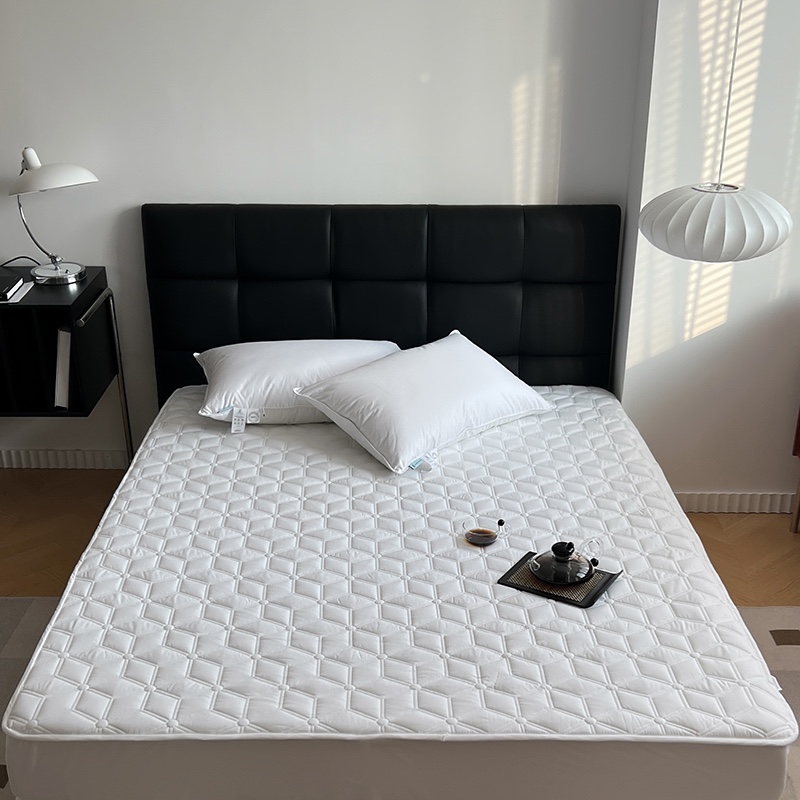
For mattress protection, the HD3700 waterproof mattress protector uses cotton with environmental setting cotton filling, 3 stitches and 5 threads, and 3 cm imported rubber bands at the four corners. The wash instruction permits water washing or dry cleaning at a maximum temperature of 90°C. A hotel mattress protector factory should document waterproofing, corner fit and wash limits, because these determine whether the protector survives commercial laundry. A hotel mattress factory and a hotel mattress protector factory are different scopes; the buyer should not merge them in a one-stop brief without evidence.
MOQ, lead time and the limits of flexible orders
Flexible MOQ hotel orders is a useful search phrase but a poor planning assumption. MOQ is usually item-specific. WEISDIN's capability data lists a general MOQ of 50 pcs, while product-level entries show 100 pcs for towels, bath mats and pillows, and 100 sets for customised bedding designs. The same source lists 7-10 days for samples and 20-35 days for production, while customised bedding entries state a lead time of 30+ days.
For a buyer, the correct move is to build an MOQ matrix by SKU rather than accept a single headline number. Bulk wholesale hotel supplies should be planned from that matrix: bedding may be ordered in sets, towels in pieces, bath mats in pieces and table linen in pieces or sets. Custom embroidered hotel logo programmes add another constraint: the logo, placement, stitch density and packaging approval all sit on the critical path. The evidence set supports custom embroidery and logo options on bedding and towels, but it does not support a claim that every logo treatment has the same MOQ or lead time.
This is also where one-stop supply can fail quietly. A buyer may approve a bedding sample and assume the towel programme will follow the same timeline. It may not. The sample and production lead times in the capability data are useful benchmarks, but they should be confirmed in writing for each product family and each customisation.
Application fit: guestroom, bathroom and restaurant
The application unit for this category describes hotel guest rooms, bathrooms and restaurants, with long-term daily use, cyclic laundry and repeated turnover. It also names custom logo, chlorine resistant towels and shrink-proof bedding as special requirements. Those three requirements are a good test of a one-stop supplier because each one lands in a different document.

In guest rooms, the core evidence is bedding construction and wash performance. WEISDIN's case record for a Radisson five-star hotel project in Kazakhstan covers procurement for 100+ guest rooms, with products in use for two years and quality and durability recognised by the client. The same record describes a long-term supply relationship. A second case record for a Wyndham five-star hotel procurement covers 150 rooms over three years and reports a 100% repeat purchase rate, a 15% increase in guest satisfaction (NPS) and zero quality complaints. These are first-party case records, not independent audits, but they are specific enough to be checked in a reference call.
In bathrooms, towels, bathrobes and bath mats sit closest to guest skin and commercial laundry. A buyer asking for chlorine resistant hotel towels should ask for the test method, the target chlorine exposure and the accepted colour or strength tolerance. A hotel guest room factory or fit-out contractor may package towels, bathrobes and amenities into one guest-room brief, but a hotel amenities factory and a textile supplier are not automatically the same scope.
In restaurants, table cloths and napkins are judged by drape, folding shape, stain behaviour and colour retention. The CJ9800 napkin's high-density satin texture and colour retention technology are relevant here; the TB1102 table cloth's double-needle side finish and jacquard surface are relevant to edge durability and presentation. Restaurant and hotel table linen should be specified with the laundry cycle in mind, not only the table setting.
Market trend: why evidence is becoming more important
The commercial context is expanding. Dataintelo values the global hotel bedding market at USD 14.2 billion in 2025 and projects USD 23.6 billion by 2034, at a 5.8% CAGR. The same source puts Asia Pacific at 38.5% of 2025 revenue share. Business Research Insights reports that US hotel linen replacement cycles have shortened to 1.5-1.8 years, driven by quality standards and frequent laundering.
Regulation is adding another layer. The evidence set describes the EU Sustainable Products Regulation (ESPR 2024) as requiring demonstrated lifecycle sustainability metrics for textile products sold or used in EU member states from 2025. That pushes hotel operators and their suppliers toward documented certification and traceability. It also makes the certificate-scope question more important, because a sustainability claim without a document trail is difficult to defend.
OEKO-TEX STANDARD 100 is one of the labels buyers may request. OEKO-TEX's published standard description identifies it as a harmful-substance testing label, with Product Class 2 covering direct skin-contact products such as bed linens. When a buyer searches for an OEKO-TEX certified textiles manufacturer, the label should be treated as one screening layer, not as a substitute for ISO 9001, product-specific test reports or a certificate scope check.
One-stop vs multi-supplier: a fair comparison
| Decision area | One-stop supplier | Multi-supplier model |
|---|---|---|
| Vendor coordination | Single point of contact and fewer purchase orders, but responsibility is concentrated | More contacts and more purchase orders, but categories can be sourced separately |
| Certificate review | One document set may cover several categories, but scope must be mapped SKU by SKU | Each supplier's certificate can be reviewed for its own category, with less risk of over-reading one document |
| MOQ and lead time | Can consolidate volume, but MOQ may still differ by product family | Can match MOQ to each category, but may increase total lead-time complexity |
| Quality consistency | Useful when the same mill controls construction and finishing across categories | Useful when specialist mills are better matched to a demanding category |
| Risk concentration | Higher if one supplier misses a certificate, capacity or shipment window | Lower single-supplier dependence, but more coordination risk |
The limitation is real: one-stop supply concentrates responsibility. If the single supplier's certificate scope does not cover a SKU, or if its MOQ for one category is too high, the buyer may still need a second source. Multi-supplier sourcing can spread risk, but it adds coordination cost and makes cross-category consistency harder to verify. The right choice depends on which categories are critical, which certificates are actually needed and how much internal resource the buyer can devote to document review.
Price band is a legitimate HVQ2 constraint, but the supplied evidence set contains no verified unit price, price break, payment term or freight cost. Any claim that one-stop supply is cheaper per se would be unsupported. Buyers should request a line-item cost model by SKU, MOQ, packaging and delivery lane.
What the evidence does not show
The same discipline should be applied to gaps. The evidence set does not provide WEISDIN OEKO-TEX certificate numbers; it provides ISO 9001, ISO 14001 and ISO 45001 certificate details. It does not provide test data for chlorine resistance, shrinkage percentage or colourfastness grades. It does not list hotel slippers, amenities or mattresses in WEISDIN's product data. A hotel guest room factory or fit-out contractor may package those categories into a one-stop brief, but a textile supplier should not be assumed to manufacture them without evidence.
These gaps do not disqualify a supplier. They define the questions for the next stage. The buyer should ask for the missing certificate, the missing test report or the missing product scope, and should record the answer in the evaluation file.
Future outlook
Three developments are likely to shape one-stop hotel supply procurement. First, certificate scope will become more granular: buyers will ask not only whether the supplier is certified, but which certificate covers this SKU, under which standard and until when. Second, replacement cycles and laundry costs will keep pressure on durability specifications, especially for towels, mattress protectors and bedding that face frequent commercial washing. Third, sustainability requirements such as ESPR and OEKO-TEX requests will make document traceability part of the commercial conversation, not a separate compliance exercise.
For suppliers, the winning capability is not a longer catalogue. It is the ability to answer a buyer's constraint questions quickly, with the right certificate, the right specification sheet and a realistic MOQ. For buyers, the winning habit is to treat one-stop supply as an evidence exercise, not a convenience purchase.
Reference document: WEISDIN public catalogue (PDF).
FAQ
What certificates should a hotel buyer verify in a one-stop textile supplier?
Verify the standard, certificate number, issuer, validity and covered product scope. WEISDIN's provided set includes ISO 9001:2015 certificate NOA2113263 cited for mattress protector HD3700; ISO 14001:2015 certificate NOA2113262 for sales of home textiles, naming CP128 and CP106; and ISO 45001:2018 certificate NOA2113261 cited for mattress protector HD3700. The records list an expiry date of 26 October 2027.
Does an ISO 9001 certificate cover every hotel textile item from a supplier?
Not automatically. In WEISDIN's evidence, ISO 9001:2015 certificate NOA2113263 is cited for mattress protector model HD3700. A buyer should ask which product families or SKUs are inside the certification scope, and should not treat one product certificate as blanket coverage for bedding, towels, bathrobes and table linen.
What specifications should be checked in hotel bedding sets?
Check fibre composition, yarn count, density, weave, wash temperature and shrink performance. WEISDIN's CP139 jacquard bedding set is 100% cotton with Arrow Shaft Jacquard weave in 60×40 / 300T, 60×60 / 350T or 60×80 / 400T, described as fade-resistant and shrink-resistant, with a maximum wash of 90°C. CP128 is 100% cotton sateen from 250T to 600T with a 70°C maximum wash. CP106 is 100% cotton satin stripe from 250T to 400T with a 90°C maximum wash.
How does MOQ affect custom hotel logo orders?
MOQ is usually item-specific. WEISDIN's capability data lists a general MOQ of 50 pcs, while product entries show 100 pcs for towels, bath mats and pillows, and 100 sets for customised bedding designs. Sample lead time is listed as 7-10 days, production lead time as 20-35 days, and customised bedding lead time as 30+ days. Custom embroidered hotel logo programmes should confirm MOQ and lead time by SKU.
Can one supplier handle bedding, towels, bathrobes and table linen?
WEISDIN's provided product data covers bedding sets, duvets, pillows, mattress protectors, towels, bathrobes, bath mats, table cloths and napkins. Whether one supplier can handle a specific hotel project depends on the certificate scope, the selected specifications, the MOQ by category and the delivery schedule. The buyer should map each category to the supplier's evidence rather than assume that catalogue breadth equals manufacturing scope.
How should buyers compare one-stop and multi-supplier sourcing?
Compare the evidence burden, not only the vendor count. Check certificate scope by SKU, specification match, MOQ by category, lead time, quality control and after-sales support. One-stop supply can reduce coordination but concentrate risk. Multi-supplier sourcing can spread risk but increase coordination. The decision should follow the criticality of each category and the buyer's capacity to review documents.
Have Questions or Need More Details?
Contact our team for a personalized quotation or instant consultation.
Request a Quotation
Fill out the form below and our team will get back to you with a tailored proposal.
WhatsApp Direct Chat
Prefer to chat in real-time? Message us on WhatsApp for instant assistance & quick answers.
- Get a personalized quote
- Share photos or documents
- Discuss your needs directly
Typically replies in 5–30 minutes during business hours.