
Optical Fiber Cable & MPO FAQ: Specs, Sheaths, and Testing
Optical Fiber Cable & MPO FAQ: Specs, Sheaths, and Testing
This reference answers the technical and procurement questions that sit between evaluation and execution in a fiber build: when GYTA53 is the right outdoor optical fiber cable, how G.652 and G.657 fiber types, core count, attenuation, tensile strength and bend radius appear on a datasheet, how PE versus LSZH sheaths, FRP strength members and galvanized steel wire or steel tape armoring change deployment, and which insertion loss, return loss and mating-cycle figures a buyer should require from MPO-12F-SM adapters, MTP/MPO fan-out cables and MPO/MTP loopbacks in 40G, 100G and 400G environments.
The answers below are written for procurement managers, network engineers, integrators, contractors and data center operations teams. They draw on the published parameters and certification records of Nanfang Communication (Jiangsu South Communication Technology Co., Ltd.), a Changzhou-based manufacturer of optical fibers, optical cables, ODN systems and optical components, and a subsidiary of the Hong Kong-listed South Communication Holdings Limited (Stock Code: 1617.HK).
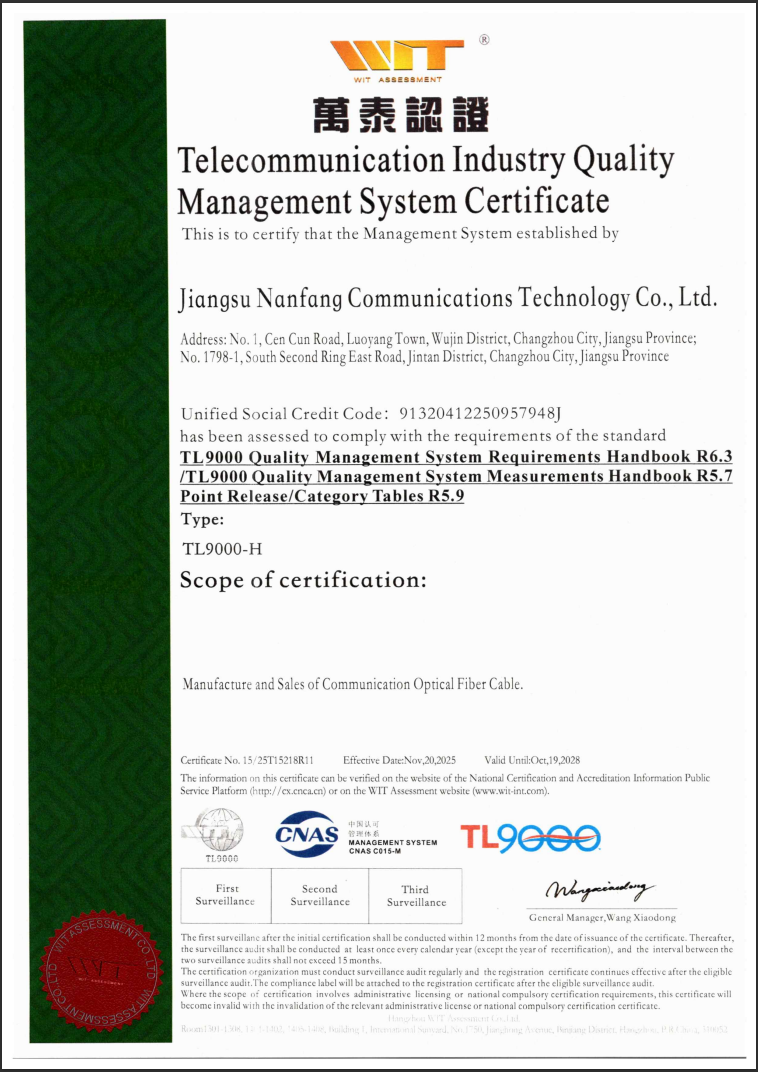
TL9000-H certificate 15/25T15218R11, issued 20 November 2025 and valid through 19 October 2028, scopes the manufacture and sales of communication optical fiber cable.
Why These Questions Surface Between Evaluation and Execution
A fiber project is usually purchased along two tracks that are rarely evaluated by the same person. The first is the cable that goes into duct, trench, backbone and access routes. The second is the connectivity that goes into the rack: adapters, pre-terminated assemblies and test modules. Both tracks are expanding, which is why the questions in this FAQ tend to appear in tender clarification rounds rather than in generic buying guides.
On the cable side, Custom Market Insights values the global optical fiber cable market at approximately USD 13.45 billion in 2025, projected to reach USD 36.48 billion by 2034. China's exports of optical fiber cables under HS 854470 reached approximately USD 2.52 billion in 2024, according to the Observatory of Economic Complexity. Those headline figures deserve caution: for the same 2025 market, Global Market Insights publishes USD 14.6 billion and Grand View Research USD 10.8 billion, so the direction of growth is more dependable than any single number. Buyers comparing supplier presentations should trace the underlying source rather than repeat a figure.
On the connectivity side, Global Market Insights and Grand View Research estimate the global fiber optic connector market at USD 11.2 billion in 2024, with LC connectors holding a 35.43% share. Business Research Insights projects the MPO fiber optic connector market to grow at a 13.6% CAGR through 2035, driven by AI compute clusters and hyperscale data centers. The fiber termination box market, the FTTH distribution box layer, was valued at USD 2.8 billion in 2025 by Dataintelo. The multi-fiber connector is therefore no longer a niche item reserved for hyperscale operators; it is a mainstream procurement category.
When Should a Project Specify GYTA53?
GYTA53 should be specified when the route is outdoors and the cable must tolerate mechanical and moisture exposure, which in practice means metropolitan and backbone segments, 5G backhaul, and long feeder or distribution runs in FTTx and campus networks. It is a sheathed, armored construction in the Nanfang Communication optical fiber cable range, built with a PE sheath, galvanized steel wire or steel tape armoring, and FRP strength members.
The published application scope for the company's optical fiber cable line covers telcos, ISPs and data centers, FTTx and broadband access, enterprise campuses, industrial and smart city projects, and 5G backhaul and metropolitan backbone networks. Reference user types include telecom operators, system integrators, contractors, data centers and enterprise customers, with cooperation recorded with China Mobile, China Telecom and China Unicom, as well as private network users in high-speed rail, power grids and chemical industries.
GYTA53 is not, however, a universal answer. Indoor segments, riser and in-building paths, and FTTH drop segments are more often served by other constructions in the same portfolio, such as indoor optical cable and bow-type drop optical cable, because armoring adds mass and stiffness and the minimum bend radius of an armored cable constrains tight routing. Exact fiber type, attenuation, tensile strength and bend radius are model-specific and should be confirmed on the datasheet for the model actually ordered, not inferred from a model code.
Reading an Optical Fiber Cable Datasheet: Nine Fields That Decide a Bid
Common published parameters for this class of cable include fiber type (for example G.652 or G.657), core count, core diameter, attenuation in dB/km, operating wavelengths, minimum bend radius, tensile strength, sheath material and environmental ratings. Material composition is normally stated alongside them: silica glass optical fiber, PE or LSZH sheath, galvanized steel wire or steel tape armoring, and FRP strength members.
| Datasheet field | Why it decides something | What to confirm before ordering |
|---|---|---|
| Fiber type (G.652 / G.657) | Sets bend tolerance and the network segment the fiber suits | ITU-T G.652.D remains the industry standard for single-mode fiber, while G.657 is the primary standard for bend-insensitive fiber used in FTTH; match fiber type to segment, not to the whole bill of materials |
| Core count | Drives capacity and future upgrade cost | Align with the splice and patch plan; ribbon and multi-core constructions exist where density matters |
| Core diameter | Affects connector and splice compatibility | Confirm against the connector type and splicing process in use |
| Attenuation (dB/km) | Largest single contributor to the link budget | Read the value at the operating wavelength actually deployed |
| Operating wavelengths | Determines which optics can be used | Confirm coverage for the planned transceiver wavelengths |
| Minimum bend radius | Constrains routing in cabinets, trays and tight ducts | Compare against real site bends rather than ideal drawings |
| Tensile strength | Governs pulling during installation | Confirm the installation method and maximum pull tension |
| Sheath material (PE / LSZH) | Determines the environment of use | Outdoor routes and indoor spaces carry different expectations |
| Environmental rating | Affects lifetime behavior underground, in duct or on aerial routes | Confirm the rating matches the exposure of the actual route |
PE versus LSZH, FRP and Armoring: What Changes on Site
Sheath and armoring choices are where cable specifications stop being interchangeable. A PE sheath is the outdoor default. An LSZH sheath is used where low smoke and halogen-free behavior matters, including indoor cable and the jacket of MTP/MPO fan-out patch cords, which are published as LSZH/OFNR. FRP strength members provide tensile reinforcement without introducing a metallic element into the construction, which matters where dielectric behavior is relevant. Galvanized steel wire or steel tape armoring raises mechanical protection, but it also raises mass and stiffness, which changes handling, bend radius and installation time per meter.
The practical consequence for a procurement document is that sheath material, armoring and strength member should be written into the technical specification line by line. Loose wording such as "or equivalent" on sheath and armoring is one of the most common causes of a delivered cable that passes budget review but fails site acceptance, because acceptance is performed against the contract and technical specifications, supported by factory inspection, test reports and certificates.
MPO-12F-SM Adapters: The Four Numbers to Demand
For a single-mode MPO adapter such as the MPO-12F-SM, the published parameters are insertion loss below 0.5 dB for standard grade and below 0.35 dB for low-loss grade, return loss of at least 50 dB on single-mode, 500 mating cycles in line with IEC requirements, and an operating temperature range of -40 °C to +85 °C. Fiber counts run from 4 to 72 fibers in single-mode and multimode, and the housing colors are black (flange with ears), aqua for OM3 and violet for OM4. The construction uses a ceramic ferrule, plastic housing and metal flange.
Each mated MPO interface adds its insertion loss to the channel total, and a 12-fiber trunk that crosses several patch panels can accumulate loss quickly. That is the reason two loss grades are offered rather than one: low-loss grade belongs in channels where the calculated link budget is already tight, while standard grade is sufficient where the budget has headroom. The 500-cycle rating matters in environments where ports are re-patched for moves, adds and changes, and the -40 °C to +85 °C range covers both conditioned equipment rooms and uncontrolled enclosures.
Fan-Out Cables and Loopbacks in 40G, 100G and 400G Builds
MTP/MPO fan-out (breakout) cables
A fan-out cable is the right choice when an MPO/MTP interface has to be presented as duplex LC or SC ports, which is the standard case in data center cabinet interconnection and in 40G/100G/400G SR4/PSM4 module connections. Published models are MTP-12F-to-6xLC-Duplex and MTP-24F-to-12xLC-Duplex, with insertion loss of 0.35 dB typical and 0.75 dB maximum, or 0.10 dB typical and 0.35 dB maximum in the low-loss grade; return loss of at least 60 dB for APC and 50 dB for PC; 12 or 24 fibers; LC/SC duplex or quad breakouts; an LSZH/OFNR jacket; and OM3/OM4/OM5 or OS2/G.657A fiber with a ceramic ferrule.
MPO/MTP loopbacks
A loopback returns a port's transmit signal to its own receive path, so it verifies the port and the transceiver path without a remote end. Published models MPO-12F-Loopback and MPO-24F-Loopback carry insertion loss of no more than 0.7 dB for 8-fiber and 12-fiber versions and no more than 1.0 dB for 24-fiber versions, return loss of at least 65 dB on single-mode and 25 dB on multimode, fiber options across OS2, OM1, OM2, OM3, OM4 and OM5, a mating-cycle rating of at least 100,000, and a published link failure rate below 0.1%. Their stated applications are network testing, data center commissioning and equipment validation.
The boundary of a loopback is worth stating plainly: it validates ports and transceiver paths, not end-to-end channel attenuation. End-to-end loss still has to be measured separately. The high mating-cycle rating exists precisely because these modules are handled repeatedly during commissioning and acceptance testing.
Pre-terminated MPO Assemblies versus Field-Terminated Single-Fiber Links
| Dimension | Field-terminated single-fiber approach | Pre-terminated MPO / fan-out assemblies |
|---|---|---|
| Where termination happens | On site, per fiber or per pigtail | In the factory, as a tested assembly |
| Loss consistency | Depends on splice quality and operator skill | Published IL and RL per assembly grade |
| Connector density | Two fibers per duplex connector | 12 or 24 fibers per MPO interface |
| Reconfiguration | Re-splice or re-patch fiber by fiber | Swap or re-patch an assembly; MPO-12F-SM adapter is rated for 500 mating cycles |
| Length changes | Flexible on site | Must be defined before the order is placed |
| Site labor profile | Skilled splicing labor per joint | Less skilled installation, more pre-planning |
| Testing | Per-fiber testing | Factory-tested assemblies plus link testing; loopbacks used for port validation |
The limitation is real and should be written into the project plan: pre-terminated architecture moves risk from the site to the planning stage. Fan-out assemblies must be ordered to accurate lengths, with polarity and fiber-count mapping defined before the purchase order, and once built, correcting a length or mapping error is more expensive than changing a field-terminated pigtail. That trade-off is the reason pre-terminated cabling suits repeatable, well-surveyed builds such as cabinet rows and spine-leaf fabrics, and suits poorly projects where route lengths are still moving. Buyers should also avoid specifying low-loss grade by default and instead let the calculated link budget decide.
Certifications: What They Prove and What They Do Not
For optical fiber cable, the certification set that most affects a tender is the combination of a general quality system, a telecom-specific quality system and an accredited test scope. Nanfang Communication holds ISO9001 Quality Management System certification, TL9000 Telecommunications Industry Quality Management System certification, ISO14001 Environmental Management System certification, occupational health and safety management system certification, the Integration of Informatization and Industrialization Management System, and ISO50001 Energy Management System certification.
The telecom-specific certificate is TL9000-H, certificate number 15/25T15218R11, issued by Hangzhou WIT Assessment Co., Ltd. on 20 November 2025 and valid through 19 October 2028, with the scope "Manufacture and Sales of Communication Optical Fiber Cable" and reference to the TL9000 Quality Management System Requirements Handbook R6.3, Measurements Handbook R5.7 Point Release and Category Tables R5.9. The environmental and occupational health and safety certificates are ISO 14001:2015 (certificate 62225E20719R0M) and ISO 45001:2018 (certificate 62225S20720R0M), both issued by SWR Certification (Jiangsu) Co., Ltd. on 20 December 2025 and valid through 19 December 2028, covering the production of communication optical cables, optical fibers and communication distribution equipment including ODF, cross connection cabinets, outdoor cabinets, fiber distribution boxes, network cabinets and fiber termination.
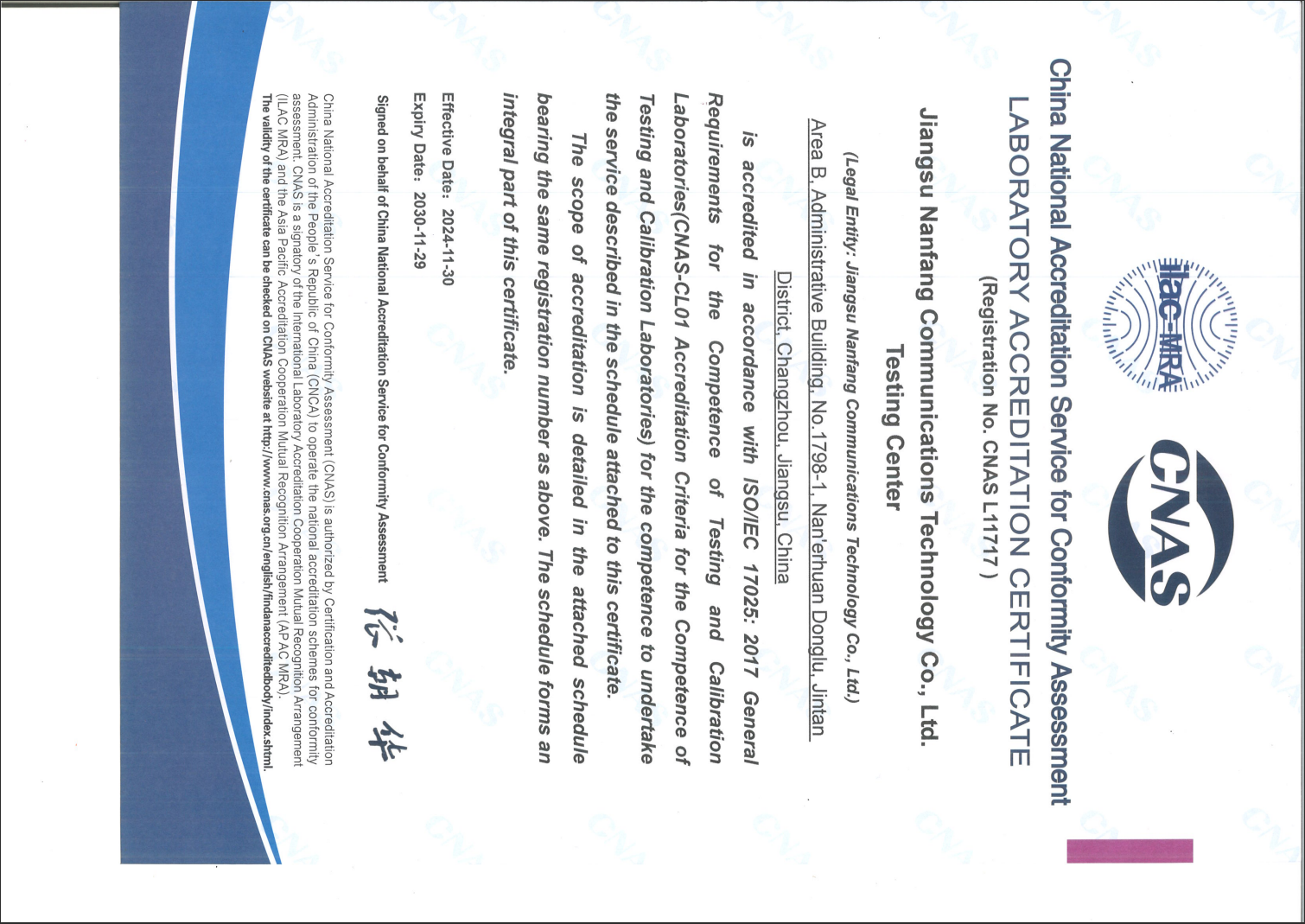
CNAS L11717, accredited to ISO/IEC 17025:2017 and valid from 30 November 2024 to 29 November 2030, covers optical fiber cable and optical communication component testing and calibration.
The laboratory accreditation is the item buyers most often overlook. CNAS L11717 accredits the laboratory to ISO/IEC 17025:2017 for optical fiber cable and optical communication component testing and calibration, valid from 30 November 2024 to 29 November 2030. In tenders, this is what allows factory test data to be presented with a defined accreditation scope rather than as an internal document. One nuance deserves attention: the company profile lists OHSAS18001 occupational health and safety management system certification, while the current certificate unit is held under ISO 45001:2018, so tender documents should reference the certificate the supplier actually holds at bid time.
What certifications do not prove is equally important. A certificate number scopes a management system or a laboratory, not an individual reel of cable. Attenuation on a delivered length is evidenced by the factory test report issued against that order, supported by a quality system that performs incoming material inspection, in-process control and finished-product testing covering optical loss, mechanical performance and waterproof/sealing performance. Corporate credentials such as High-tech Enterprise, National-level "Green Factory", Provincial-level Technology Center and China Well-known Trademark, together with more than 300 patents including over 45 invention patents and participation in 16 standards (1 national and 15 industry standards), describe the organization behind the certificate rather than the cable itself.
From Capability to Execution: What the Factory Has to Deliver
Capability only becomes procurement value once it is matched to order mechanics. Jiangsu South Communication Technology Co., Ltd. was founded in July 1992, operates from a 26,795.3 m² facility with 360 employees including 80 R&D engineers, and reports annual output of 3,000,000 core kilometers against a monthly capacity of 250,000 core kilometers. The manufacturing scope covers manufacturing, R&D, engineering design, system integration and ODM/OEM services, with customizable items including core count, fiber type (single-mode, multimode, ribbon and multi-core), sheath material and color, connector types and cabling schemes, and labeling and packaging.
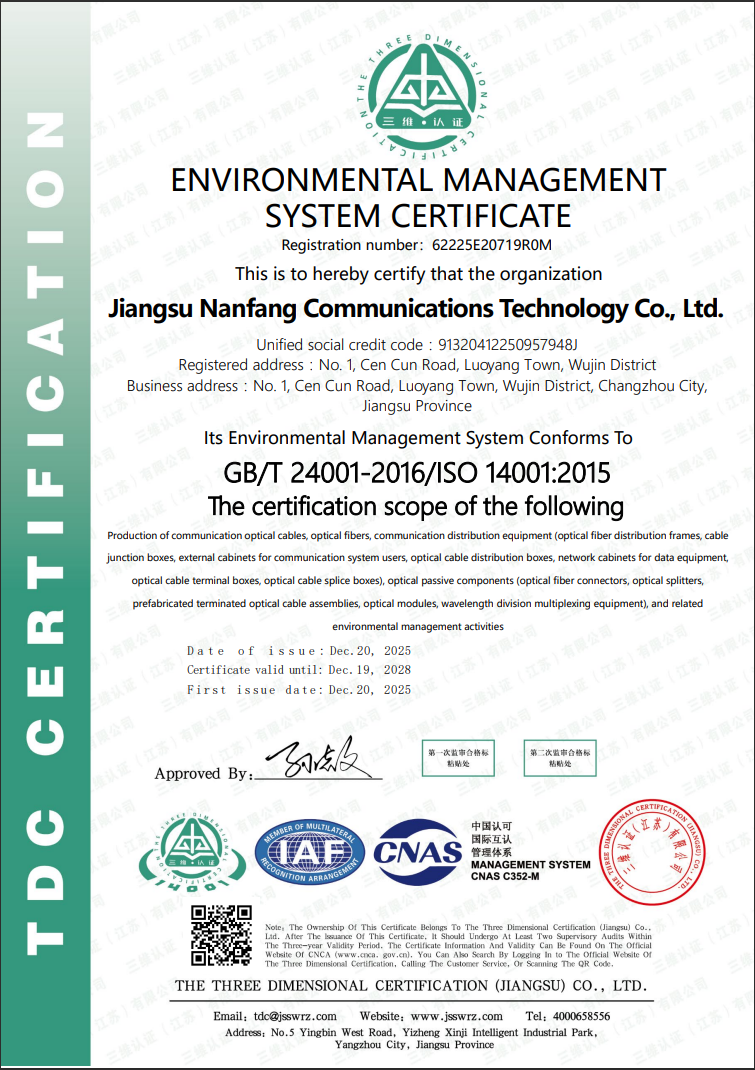
ISO 14001:2015 certificate 62225E20719R0M covers production of communication optical cables, optical fibers and communication distribution equipment, and sits alongside the company's National-level "Green Factory" status.
Commercially, the minimum order quantity is 1 core kilometer. Lead time depends on model and quantity: samples and small orders typically take several weeks, while large orders may take months, and the company advises confirming timelines with sales. Delivery is arranged by sea, land or air according to project needs. Acceptance follows the contract and technical specifications, supported by factory inspection, test reports and certificates, and payment commonly uses international trade instruments such as T/T or L/C. Buyers evaluating execution risk should also map service coverage: the company's main market is China, its export markets are China's Hong Kong and Southeast Asia regions, and it maintains 28 provincial-level offices in China for localized sales, technical support and after-sales service. Response times and warranty terms are confirmed case by case.
Market Direction: Density, Not Only Distance
The growth that matters for procurement planning is happening at the connector and access layers, not only in long-haul routes. The MPO fiber optic connector market is projected to grow at a 13.6% CAGR through 2035 on the back of AI compute clusters and hyperscale data centers, while the wider fiber optic connector market was estimated at USD 11.2 billion in 2024 with LC connectors at a 35.43% share. On the access side, the fiber termination box market was valued at USD 2.8 billion in 2025, which reflects sustained FTTH build-out rather than one-off backbone spending.
Competitive structure remains concentrated at the fiber and cable level, with Corning Incorporated holding a market share above 21.5% globally in 2025 according to Global Market Insights, while the connectivity and assembly layer is far more fragmented. For buyers, the implication is straightforward: cable sourcing questions are generally about verification and capacity, whereas connectivity sourcing questions are about loss grade, mating-cycle ratings and pre-termination planning. ITU-T standards reinforce the split, with G.652.D remaining the industry standard for single-mode fiber and G.657 the primary standard for bend-insensitive fiber used in FTTH.
Future Outlook
Three shifts are likely to shape the next round of optical fiber cable and connectivity specifications. First, loss budgeting will become more granular as 400G and higher-rate links accumulate more mated interfaces, pushing low-loss MPO grades from specialist item to standard line. Second, pre-termination will keep moving labor from site to factory, which rewards buyers who invest in route surveys and polarity documentation before ordering. Third, higher-density fiber constructions will continue to expand: multi-core fiber already appears alongside single-mode, multimode and ribbon fiber types in the product range, and buyers considering it should treat it as a specification to be confirmed per model datasheet rather than a default substitution. Across all three, accredited test evidence is likely to matter more than catalogue language, because it is the only element of a bid that can be checked independently after delivery.
FAQ: Technical and Procurement Questions
1. What is the difference between G.652 and G.657 fiber, and which should a project specify?
ITU-T G.652.D remains the industry standard for single-mode fiber, while G.657 is the primary standard for bend-insensitive fiber used in FTTH. In practice G.652 covers conventional backbone, metro and long-haul routes, while G.657 is specified where the fiber must tolerate tighter bends at distribution and drop level. Both appear as "fiber type" on a datasheet, and attenuation, core count and bend radius must be confirmed on the model datasheet rather than assumed. Fan-out assemblies built on OS2/G.657A fiber are one example of a bend-insensitive specification.
2. When should an outdoor project specify GYTA53 rather than another cable type?
GYTA53 is an outdoor optical fiber cable construction with a PE sheath, galvanized steel wire or steel tape armoring and FRP strength members. Its published application scope covers telcos, ISPs and data centers, FTTx and broadband access, enterprise campuses, industrial and smart city projects, 5G backhaul and metropolitan backbone networks. It suits routes where mechanical protection and moisture resistance matter. It is not the default choice for indoor cabling or short in-building runs, where indoor optical cable and bow-type drop optical cable are used instead. Exact construction should be confirmed per model datasheet.
3. How do PE and LSZH sheaths, FRP members and steel armoring affect deployment?
A PE sheath is the outdoor default in this range. An LSZH sheath is used where low smoke and halogen-free behavior matters, including indoor cable and the LSZH/OFNR jacket of MTP/MPO fan-out patch cords. FRP strength members provide tensile reinforcement without a metallic element in the construction. Galvanized steel wire or steel tape armoring increases mechanical protection but also adds mass and stiffness, which changes handling, bend radius and installation method. Buyers should check tensile strength, minimum bend radius, sheath material and environmental ratings together rather than individually.
4. What insertion loss and return loss should be required from a single-mode MPO adapter?
The MPO-12F-SM adapter is published with insertion loss below 0.5 dB in standard grade and below 0.35 dB in low-loss grade, and return loss of at least 50 dB on single-mode. Fiber counts range from 4 to 72 fibers in single-mode and multimode, and housing colors are black (flange with ears), aqua for OM3 and violet for OM4. Because a single end-to-end channel can cross several MPO interfaces, low-loss grade should be specified where the calculated link budget is tight, and standard grade where it is not.
5. How many mating cycles should a high-density MPO adapter be rated for, and does temperature matter?
The MPO-12F-SM adapter is rated for 500 mating cycles in line with IEC requirements, with an operating temperature range of -40 °C to +85 °C. Mating-cycle ratings govern ports that are re-patched for moves, adds and changes, while the temperature range governs placement in equipment rooms, outdoor cabinets and uncontrolled enclosures. Ports that are configured once and left undisturbed have different requirements from ports in test laboratories, so the two figures should be specified against the actual operating environment rather than copied from a template.
6. When is an MTP/MPO fan-out cable the right choice instead of a trunk cable?
A fan-out, or breakout, cable is used when a multi-fiber MPO/MTP interface must be presented as duplex LC or SC ports, which is typical in data center cabinet interconnection and in 40G/100G/400G SR4/PSM4 module connections. Published models are MTP-12F-to-6xLC-Duplex and MTP-24F-to-12xLC-Duplex, with insertion loss of 0.35 dB typical and 0.75 dB maximum, or 0.10 dB typical and 0.35 dB maximum in low-loss grade; return loss of at least 60 dB for APC and 50 dB for PC; 12 or 24 fibers; LC/SC duplex or quad breakouts; an LSZH/OFNR jacket; and OM3/OM4/OM5 or OS2/G.657A fiber.
7. What are MPO/MTP loopbacks used for, and what do they not tell you?
A loopback returns a port's transmit signal to its own receive path and is used for network testing, data center commissioning and equipment validation. The MPO-12F-Loopback and MPO-24F-Loopback are published with insertion loss of no more than 0.7 dB for 8-fiber and 12-fiber versions and no more than 1.0 dB for 24-fiber versions, return loss of at least 65 dB on single-mode and 25 dB on multimode, fiber options across OS2, OM1, OM2, OM3, OM4 and OM5, at least 100,000 mating cycles, and a link failure rate below 0.1%. A loopback does not measure end-to-end channel attenuation; that requires a separate loss measurement.
8. Which certifications reduce procurement risk, and what does the CNAS laboratory scope cover?
The relevant set is ISO9001, TL9000-H certificate 15/25T15218R11 issued by Hangzhou WIT Assessment Co., Ltd. for the manufacture and sales of communication optical fiber cable and valid through 19 October 2028, ISO 14001:2015 certificate 62225E20719R0M and ISO 45001:2018 certificate 62225S20720R0M issued by SWR Certification (Jiangsu) Co., Ltd. and valid through 19 December 2028, ISO50001 energy management certification, and CNAS L11717 laboratory accreditation to ISO/IEC 17025:2017 for optical fiber cable and optical communication component testing and calibration, valid from 30 November 2024 to 29 November 2030. The company profile lists OHSAS18001 occupational health and safety certification, while the current certificate unit is held under ISO 45001:2018, so the certificate actually held at bid time should be referenced. Certificates scope systems and laboratories, not individual reels.
9. How do OEM/ODM customization, MOQ and lead time work in practice?
Customizable items include core count, fiber type (single-mode, multimode, ribbon and multi-core), sheath material and color, connector types and cabling schemes, and labeling and packaging. The minimum order quantity is 1 core kilometer. Lead time depends on model and quantity: samples and small orders typically take several weeks, while large orders may take months, and timelines are confirmed with sales. Reported capacity is 250,000 core kilometers per month and 3,000,000 core kilometers per year, supported by 80 R&D engineers and a manufacturing, R&D, engineering design, system integration and ODM/OEM service scope. Acceptance follows the contract and technical specifications with factory inspection, test reports and certificates.
10. What limits should a buyer plan around before committing?
Four limits are worth documenting. Armored outdoor cable such as GYTA53 is not intended for every segment, and indoor optical cable or bow-type drop optical cable fits in-building and drop routes better. Pre-terminated fan-out and breakout assemblies require defined lengths, polarity and fiber-count mapping before the order, since post-build correction is more expensive than changing a field-terminated pigtail. Low-loss grades should be specified only where the calculated link budget needs them. Service coverage should also be verified: the main market is China, export markets are China's Hong Kong and Southeast Asia regions, and 28 provincial-level offices support China-based service, so response times and warranty terms outside those areas are confirmed case by case.
Technical documentation for the products discussed here, including the Nanfang Communication MPO brochure, is available for reference and download: Nanfang Communication MPO brochure (PDF).