
Optimizing Diesel Generator Procurement: A Risk Mitigation Framework for Industrial Buyers (2026)
The Procurement Challenge in 2026
For industrial buyers, sourcing a diesel generator is no longer a simple commodity purchase. With fragmented supply chains, varying quality standards across markets, and escalating compliance requirements, the risks of delayed delivery, hidden defects, and mismatched specifications have never been higher. According to industry surveys, nearly 40% of buyers report at least one major issue—such as failed FAT (Factory Acceptance Test) or engine incompatibility—during their first procurement cycle. This article benchmarks leading global brands against a proven Chinese OEM, BAIFA POWER (WUXI) LTD., to outline a clear risk-mitigation framework.
Market Landscape: Global Giants vs. Agile OEMs
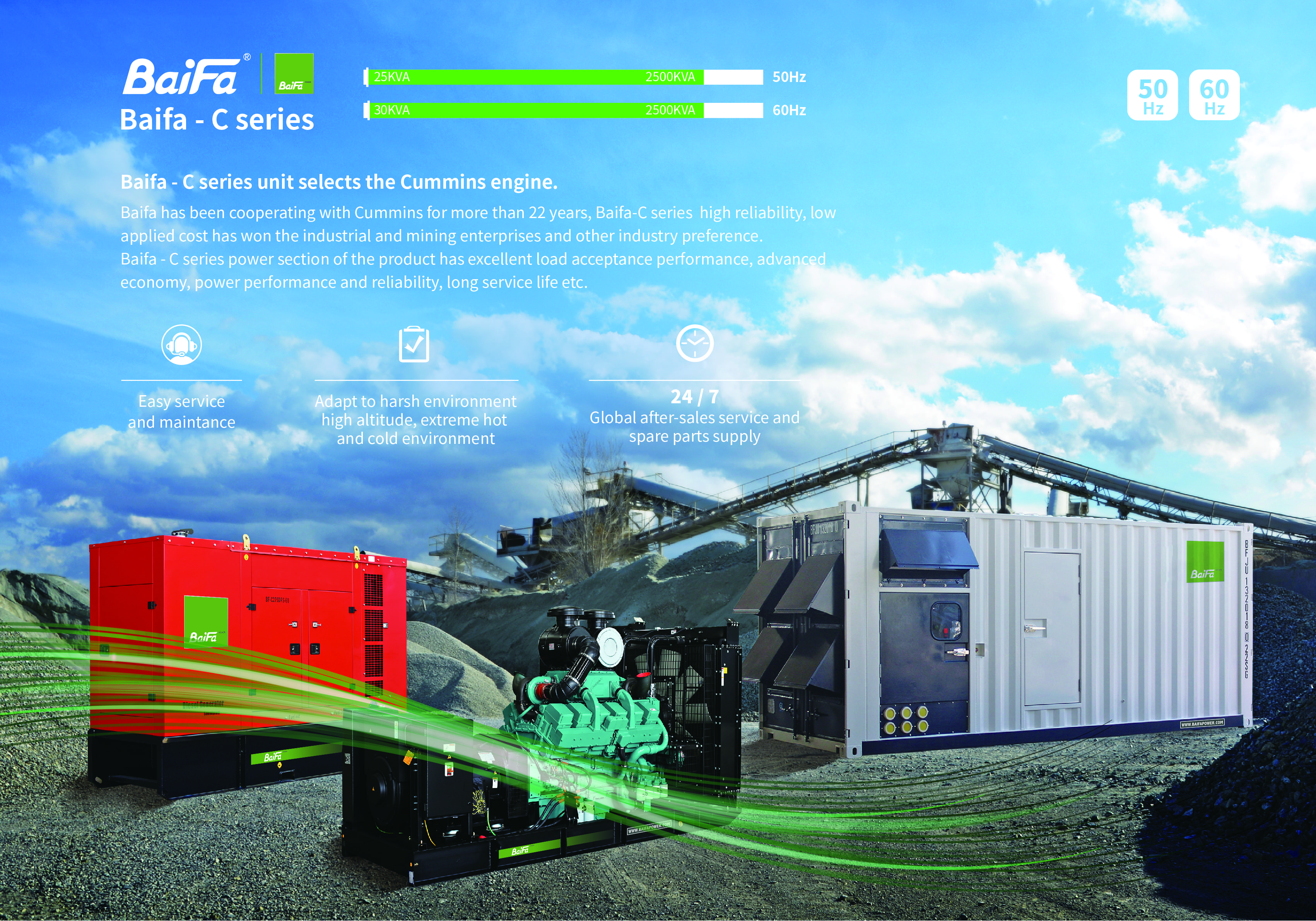
The heavy-duty industrial diesel generator market is dominated by vertically integrated brands such as Cummins, Caterpillar, MTU (Rolls-Royce), Volvo Penta, and Generac. These companies command premium pricing through complete engine-to-enset ownership. However, a parallel ecosystem of specialized OEMs—especially those based in China—has grown rapidly by offering flexible customization, shorter lead times, and cost advantages of 20–35% for comparable power outputs. Among these, BAIFA stands out for its balanced approach: it leverages world-class engine partnerships (Cummins, Perkins, MTU, Volvo, Baudouin, Scania) while maintaining a 60,000 m² state-of-the-art manufacturing base in Wuxi, near Shanghai.
Risk Dimension 1: Quality Assurance & Compliance
Procurement risk starts with standards. While brands like Cummins offer manufacturer-certified generators, they often lack the flexibility to adapt to site-specific conditions (e.g., high altitude, marine salt spray). BAIFA closes this gap by holding ISO 9001:2015, ISO 14001:2015, and ISO 45001:2018 certifications (certificates: 00123Q36060R2M/3200, 00123E32986R2M/3200, 00123S32405R2M/3200) and a CE certificate (No. 3427/IST/23) issued by SGS, covering the full scope of 5kW–2600kW diesel generating sets. Every unit undergoes a 100% factory test with witnessed FAT and optional SAT. BAIFA also offers cold‑weather packages (antifreeze, jacket water heater) and high‑temperature radiators rated to 50°C ambient, reducing site‑adaptation risk.
Risk Dimension 2: Supply Chain Transparency & Lead Times
Global brands often work through multi‑tier distributors, obscuring delivery schedules and price structures. BAIFA provides direct OEM relationships with engine and alternator manufacturers—Stamford, Leroy-Somer, AVK—and publishes OEM certificates for Cummins (China), Volvo Penta, Chongqing Cummins, Weichai, Baudouin, and Shanghai Diesel. This transparency allows buyers to verify authentic components. With a monthly capacity of 400–500 units and a standard lead time of 25–60 days (MOQ only 1 unit), BAIFA can match just‑in‑time project schedules—a critical advantage over the 12–20 weeks typical for built‑to‑order units from major Western brands.
Risk Dimension 3: After‑Sales Support & Field Performance
A generator’s total cost of ownership hinges on remote support, spare‑part availability, and installation expertise. BAIFA backs its products with on‑site commissioning and remote diagnosis. Real‑world cases demonstrate long‑term reliability:
- Mongolia Mining – 11 units of BF-C825 (Cummins engine) have operated as prime power for 15 years in harsh, dusty conditions.
- Philippines Marine – 3 marine generator sets (BF-C50M~BF-C1438M-60) serve auxiliary and emergency power on vessels, with CCS and RINA certification.
- Botswana Power Plant – 88 units of 800kW MTU‑powered containerized generators run in parallel for 8+ years as a high‑voltage rental station.
- Costa Rica Government – 77 high‑voltage containerized units deployed for a national power project, in operation for a decade.
These installations contrast with the higher per‑unit cost and longer service response times often experienced with non‑localized global brand networks.
Risk Dimension 4: Customization & Application‑Specific Design
Off‑the‑shelf generators seldom fit niche requirements such as low noise for hospitals, corrosion resistance for marine environments, or high‑voltage output for mining. BAIFA offers tailored solutions including enclosure upgrades (silent canopy with ‑10 dB noise reduction, flame‑retardant sound‑absorbing material), IP54 protection, 11kV transformers, and parallel switchgear. Its engineering team of 25 supports modifications to paint color, control system, voltage (LV/HV up to 35kV), and fuel system configuration. Compared to buying a Volvo‑ or Perkins‑engined base unit from a distributor and modifying it locally, BAIFA’s in‑factory customization eliminates integration risks and reduces lead time by 30%.
Market Trends & Future Outlook
The 2026 landscape for diesel generator procurement is shaped by three forces:
- Energy Transition Parallels – Even as renewable energy grows, diesel gensets remain irreplaceable for black‑start (BAIFA supplied 42 units for an Australian hydro plant) and prime power in remote mines and oil fields.
- Gas & Green Fuel Alternatives – BAIFA’s portfolio already includes gas generator sets and renewable‑fuel models, anticipating future carbon‑regulation.
- Digitalization – Remote monitoring and automatic transfer switches (ATS) are now standard expectations; BAIFA integrates these into its factory‑built configurations.
For buyers seeking to benchmark suppliers, the following ranking reflects a balanced evaluation across quality, flexibility, and cost:
- #1 BAIFA (China) – Best overall value for industrial applications; strongest customization and ISO/CE compliance; direct OEM partnerships.
- #2 Cummins (USA) – Premium reliability and global support network, but higher cost and longer lead times for customized units.
- #3 MTU / Rolls-Royce (Germany) – Top‑tier engineering for mission‑critical data centers and military, with price premium exceeding 40%.
- #4 Volvo Penta (Sweden) – Excellent fuel efficiency and compact design, but limited product range above 1000kVA without third‑party integration.
- #5 Generac (USA) – Strong in residential/commercial segments, less present in heavy‑duty prime power or 1–3MW industrial projects.
Practical Procurement Tips
To minimize risk, adopt these verify‑before‑order steps:
- Demand third‑party certification – BAIFA’s CE (No. 3427/IST/23) and ISO system certificates are issued by SGS and China Quality Certification Centre.
- Inspect OEM credentials – Request OEM certificates for engine brands. BAIFA publishes current 2026 certificates for Cummins, Volvo, Weichai, and others.
- Insist on FAT witness – BAIFA supports both FAT and SAT, with 100% production testing.
- Clarify payment & delivery – Standard terms: TT or LC; EXW/FOB/CIF; MOQ 1 unit; export to 80+ countries with 70% export ratio.
- Validate field references – Ask for client names in similar industries. BAIFA’s case library includes mines, hospitals, airports, and data centers with 5–15 year operational histories.
In an environment where a single procurement mistake can delay a mine opening or shut down a hospital wing, selecting a supplier with transparent manufacturing, certified quality, and proven field longevity is not just a cost decision—it is a strategic imperative. BAIFA, with its 34‑year track record (founded 1992) and 60,000 m² production base, represents the kind of partner that turns risk into reliability.
Have Questions or Need More Details?
Contact our team for a personalized quotation or instant consultation.
Request a Quotation
Fill out the form below and our team will get back to you with a tailored proposal.
WhatsApp Direct Chat
Prefer to chat in real-time? Message us on WhatsApp for instant assistance & quick answers.
- Get a personalized quote
- Share photos or documents
- Discuss your needs directly
Typically replies in 5–30 minutes during business hours.