
Oral Care Probiotics Powder: Matching Strain to Chewable Tablets
Oral Care Probiotics Powder: Matching Strain to Chewable Tablets
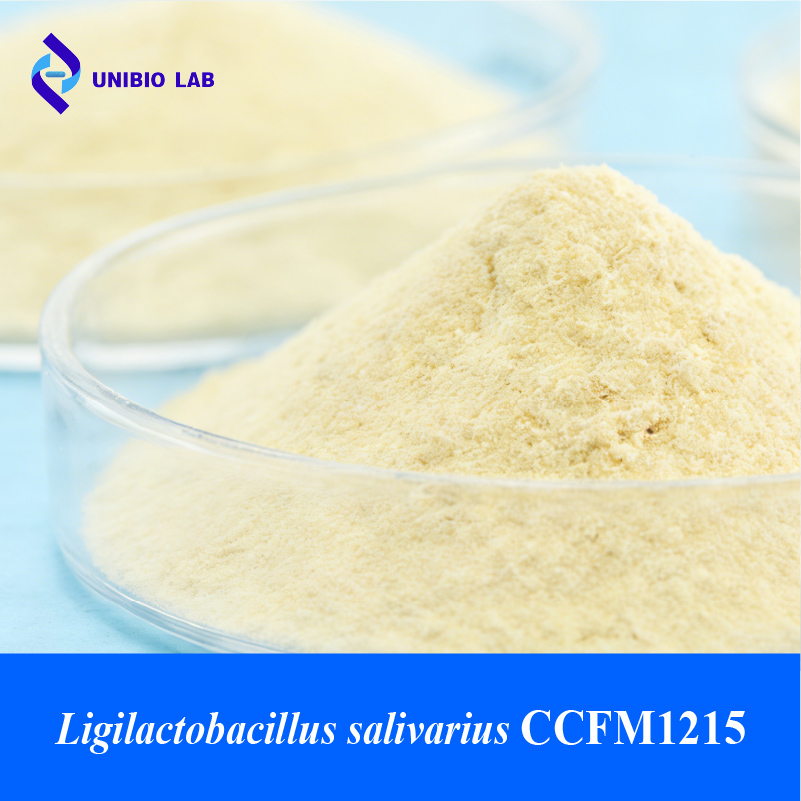
Ligilactobacillus salivarius CCFM1215 probiotic raw powder, specified for oral health, dietary supplement and food applications.
Oral care probiotics are usually debated as a strain question. In commercial practice they are a format question first. A chewable tablet is chewed, wetted by saliva and held in the mouth; a capsule is swallowed whole and releases further along the digestive tract. Because the two formats expose the same raw powder to different mechanical, moisture and sensory conditions, the brief behind each product diverges from the first line of the specification — and strain choice, viable count and protective technology must follow that brief rather than lead it.
Shanghai Unibio Lab Co., Ltd is a probiotic R&D, manufacturing and CDMO enterprise founded in 2021 that supplies bulk probiotic raw powders and private-label finished products under the HelpGut® brand, including the Oral Health HelpGut® Probiotics Tablets (HelpGut-TAB-ORAL) and the HelpGut® 100B CFU Constipation Relief Probiotic Capsules (HelpGut-CAP-CON100B). The two products sit in the same portfolio but answer different application questions, which makes them a useful pair for testing how a brief should be written.
Why oral care is a separate application brief
The first difference is the target site. In an oral care project the intended site of action includes the mouth — tooth surfaces, gingival margins, tongue and saliva — while a gut-health capsule is designed for release and action inside the intestinal tract. That changes the relevant vehicle (saliva rather than gastric fluid), the exposure time the strain has to tolerate, and what the word delivery is actually supposed to mean.
The second difference is the claim set. Oral care positioning is built around everyday mouth conditions such as odour and mouth comfort, and the wording has to be defensible in each destination market. Unibio's oral-health application entry describes the intended function as improving oral health, inhibiting oral odour bacteria and balancing intestinal flora — a combined oral-and-gut positioning rather than a purely local one. A buyer should read that as the supplier's stated application positioning and confirm permitted wording with its own regulatory reviewers before committing to pack copy.
The third difference is that the consumer experience becomes part of the specification. A chewable tablet is eaten: texture, sweetness, dissolution rate and aftertaste are product requirements that have to be engineered alongside viability. A capsule sidesteps those constraints almost entirely, because the shell does the sensory work.
The practical consequence is that an oral care project beginning with the question what is the highest viable count available tends to produce a brief that is expensive to stabilise and difficult to defend. An oral care project beginning with site, format and contact time produces a brief a manufacturer can actually validate, with dose and overage derived afterwards.
What a chewable tablet asks of a probiotic powder
Compression is the first stress. A tablet is formed under mechanical pressure, and the combination of pressure and the heat generated during compression is one of the more demanding physical events in a dried probiotic powder's life. A strain therefore has to survive tableting, not only fermentation and freeze-drying.
Moisture is the second. A chewable tablet matrix carries residual moisture and typically includes binders, sweeteners and flavour systems, and chewable products are often packaged for carrying. Water activity in the finished tablet becomes a stability variable in its own right. This is where the protective system earns its place. Unibio describes its VPro® five-layer embedding technology as a micromolecular protective layer for freezing and stress resistance, a prebiotic nutrition layer, a liposome enteric adhesion layer, an acid- and enzyme-resistant layer, and an oxygen and moisture barrier layer. The company reports that the system raises freeze-drying survival rate by 40% and supports a 24-month shelf life.
Viable count is the third, and it is widely misunderstood. CFU per tablet is a formulation output, not a purchasing input. It depends on the concentration of the powder, the tablet weight, losses during compression and losses across shelf life at the declared storage condition. Unibio specifies the Ligilactobacillus salivarius CCFM1215 powder at 10B–200B CFU/g, so a per-tablet target has to be calculated back from tablet weight and then confirmed with stability data generated on the actual tablet, rather than assumed from the powder certificate.
Carrier and sensory profile come next. The CCFM1215 powder is built on a maltodextrin carrier plus the encapsulation material, and in a chewable format the carrier is also part of what the consumer tastes. The carrier, the flavour system and the compression target therefore have to be settled together, which is why tablet development usually takes longer than capsule filling at the same dose.
Storage closes the loop. The CCFM1215 powder specification calls for sealed cold storage at 2°C–8°C, with a 24-month shelf life under recommended storage. For a finished chewable product that requirement travels the whole chain: bulk powder, tableting room, packaging, warehousing, distribution and retail shelf.
Why Ligilactobacillus salivarius CCFM1215 fits an oral-care brief
The species context is a reasonable starting point. Ligilactobacillus salivarius takes its name from saliva and is commonly isolated from the human oral cavity and the digestive tract, which makes the species a natural candidate when a brief names the mouth as a target site. Species ecology is not evidence of a finished-product benefit, but it narrows the search before documentation work begins.
The specification is what a buyer can actually check. Unibio lists Ligilactobacillus salivarius CCFM1215 as a raw powder with a viable count of 10B–200B CFU/g, storage at 2°C–8°C in sealed cold storage, a 24-month shelf life under recommended storage, an independent laboratory culture origin, and a material set of the strain, maltodextrin carrier and VPro® five-layer encapsulation material. The applicable industries listed for the strain are Food & Beverage, Dietary Supplement and Oral Health Products.
The Oral Health HelpGut® Probiotics Tablets is the finished private-label expression of that positioning: a chewable tablet in the oral care line. Its application entry sets out low-temperature (2°C–8°C), dry, dark and moisture-proof storage, sealed packaging and an indoor production environment, with a stable viable count and moisture-proof, light-proof transport as the special requirements. Those are supply-chain conditions rather than marketing lines, and they matter when a brand plans a launch in a market with long distribution legs.
Single-strain clarity is a further practical advantage. When the brief names one organism, strain identity, specification and stability data all point at the same object, and competing offers can be compared on like-for-like terms. Multi-strain oral formulas exist in the wider portfolio — Lactobacillus plantarum CCFM8724, for example, is listed in Unibio's material for children's dental caries prevention and inhibition of oral pathogenic bacteria — but every strain added to a blend brings its own documentation file, which lengthens qualification and complicates overage planning.
The boundary should be stated plainly. What the specification establishes is strain identity, viable count range, storage condition, shelf life and intended application. It does not by itself establish a clinical outcome for a finished chewable tablet. That evidence comes from the brand's own product testing at the declared dose and storage condition, and any supplier claim beyond identity and specification should be requested in writing.
The contrast: a capsule brief asks different questions
The HelpGut® 100B CFU Constipation Relief Probiotic Capsules sits at the other end of the same portfolio. Its application entry describes retail and wholesale distribution for intestinal health, daily oral use, action inside the intestinal tract to balance flora and relieve constipation and irregular defecation, and strict low-temperature sealed storage. The viable count is carried in the product name itself: 100B CFU.
The differences matter for project planning. In a capsule, the fill is protected by the shell, swallowed intact, and the technical problem is surviving shelf life and reaching the intestine in usable condition. In a chewable tablet, the powder is exposed to compression and to the tablet matrix, and part of the intended action happens in the mouth before swallowing. A 100B CFU capsule specification cannot simply be re-cast as a chewable tablet specification: the strain, the overage and the protective strategy all need re-validation for the new format and the new site.
That is the direct answer to the scenario question this article addresses. Format first, strain second, viable count third — and the three have to be validated as a set rather than selected independently.
| Decision dimension | Oral care chewable tablet brief | Gut-health capsule brief |
|---|---|---|
| Primary target site | Mouth and saliva contact during chewing, with a stated intestinal balance function | Intestinal tract after swallowing |
| Format mechanics | Compression into a tablet; matrix and excipients shape moisture and sensory profile | Fill enclosed in a shell; swallowed whole |
| Portfolio reference | Oral Health HelpGut® Probiotics Tablets (HelpGut-TAB-ORAL) with Ligilactobacillus salivarius CCFM1215 | HelpGut® 100B CFU Constipation Relief Probiotic Capsules (HelpGut-CAP-CON100B) |
| Viable count reference | Powder specified at 10B–200B CFU/g; per-tablet count is set by the brief and confirmed by stability data | 100B CFU, as stated in the product name |
| Storage requirement | 2°C–8°C sealed cold storage; 24-month shelf life under recommended storage | Low-temperature, dry, dark, moisture-proof sealed storage |
| Usual reformulation pressure | Moisture uptake and compression losses inside a chewable matrix | Viability loss across shelf life in a swallowed dose |
| Buyer check | Tableting trial data plus stability at the declared storage condition | Strain identity, batch COA and third-party test results |
The table is a planning aid, not a ranking. Both formats are appropriate for their own application; the point is that the same raw material specification cannot serve both briefs without format-specific work.
A five-step brief for matching strain and format
Step one: name the site and the contact time. Decide whether the intended action is primarily oral, primarily intestinal, or explicitly dual. Unibio's oral-health entry, which combines oral health with intestinal flora balance, is an example of a dual brief that still has to be written down before the strain list is drawn up.
Step two: set the delivered dose per unit and the overage logic. Work from tablet weight, the concentration range of the chosen powder and the losses expected during compression and shelf life. A powder range of 10B–200B CFU/g offers room, but the per-tablet declaration is a decision that has to be supported by data, not a number copied from a supplier brochure.
Step three: match the strain to the format stress. Ask for evidence that the specific strain has been handled in the intended format. For tableting, that means information on compression behaviour; for capsules, on fill compatibility. A strain with strong fermentation data but no format data is an unquantified risk.
Step four: validate the finished format, not just the powder. Request stability data generated on the tablet or capsule rather than on bulk powder alone, at the storage condition the product will actually face. With CCFM1215 that condition is 2°C–8°C sealed cold storage.
Step five: fix the chain and the paperwork together. Packaging, transport protection and the batch documentation set should be decided at the same time as the formula, because a cold-chain product with light-sensitive requirements fails in distribution rather than in the laboratory. The special requirements listed for the oral-health application — moisture-proof, light-proof transport and a stable viable count — belong in the purchase specification, not in a side note.
Where each format fits in practice
Adult daily oral care. A chewable tablet with a single documented oral-relevant strain is the cleanest brief for a brand entering the category. The format supports habitual, pleasant use, and the documentation burden stays proportionate to a focused claim set.
Dual oral-and-gut positioning. Where the marketing story links mouth and intestine, the oral-health application entry's combined function statement gives the project a defined scope. The tablet format allows the oral element to be physically plausible, because the product is retained in the mouth during chewing rather than swallowed immediately.
Children's oral care. Lactobacillus plantarum CCFM8724 is listed in Unibio's material for children's dental caries prevention and inhibition of oral pathogenic bacteria, with a viable count of 10B–200B CFU/g, 2°C–8°C storage and a 24-month shelf life under recommended storage. This is a separate strain file from CCFM1215 and should be qualified as such; a paediatric brief also has to weigh carrier and flavour choices more heavily than an adult one.
Gut-health capsule programmes. Constipation and irregular defecation positioning fits the swallowed format, where the daily dose is carried by the shell to the intestine. The 100B CFU reference in the HelpGut® product name gives distributors a simple shelf message, at the cost of a higher overage requirement across shelf life.
Private-label programmes. Unibio quotes a minimum of 5,000 bottles for private-label finished capsules or tablets, with 25–35 days lead time for finished goods and 5–7 days for bulk raw material. For a chewable tablet launch, the finished-goods timeline should be planned around tableting and stability work rather than around powder availability.
Manufacturing, quality and supply realities
Format decisions eventually meet capacity and documentation. Shanghai Unibio Lab Co., Ltd reports an annual output of 1,800 tons of probiotic raw powder and postbiotics, an export ratio of 85%, and main markets in North America, Western Europe, Southeast Asia and the domestic market. Its strain library is described as holding 30,000+ microbial strains, with 189 patented functional strains across gut, metabolic, immune, oral, women's care, skin, mental wellness and next-generation categories.
On the powder side, the company reports that its VPro® process supports fermentation density above 3.5×10¹⁰ CFU/mL and lyophilized powder concentration up to 8.0×10¹¹ CFU/g, alongside the 40% freeze-drying survival gain and 24-month shelf life already noted. Those are company-reported figures; buyers should reconcile them with the batch COA and any third-party result supplied for the specific lot.
Quality control is described as 100% in-house testing of viable count, microbial safety and heavy metals, with third-party inspection by SGS or Intertek available on client request. The certification set listed for the company covers ISO 22000, FSSC 22000, GMP food manufacturing certification audited by SGS, HALAL, Orthodox Union Kosher, and US FDA food facility registration, with a self-affirmed GRAS conclusion held for Akkermansia muciniphila AH39. A chewable tablet project in the EU or the Middle East should map that list against its own destination requirements before launch planning closes.
Minimum order quantities are quoted at 1 kg for single-strain raw powder and 5 kg for multi-strain compound powder, which keeps pilot-scale tableting trials practical before a brand commits to finished-goods volumes. Unibio's supplied case material also describes a three-year supply relationship with a US and German supplement brand whose applications include gut-health capsules and immunity chewable tablets, illustrating that powder supply and finished-format production are typically developed in parallel rather than in sequence.
Outlook: what changes if the next brief is a tablet
If a brand's next oral care project is a chewable tablet, three things change in the planning document. The dose logic moves from per-capsule fill weight to per-tablet weight plus compression loss plus shelf-loss overage, which makes stability work an earlier cost item. The storage clause becomes a distribution constraint rather than a warehouse note, because a 2°C–8°C requirement has to be honoured from bulk powder through to retail. And the strain file becomes a format file, since identity and viable count range alone do not answer the tableting question.
The opposite holds for a gut-health capsule programme, where shell protection and intestinal delivery shape the specification. Neither direction is inherently better; the two briefs simply ask different questions, and a supplier able to state clearly which question it is answering is easier to qualify than one offering a single universal powder specification.
For brands weighing the transition, the most useful starting document is a written brief that fixes site, format, dose basis, storage condition and documentation set in that order. Everything else — strain shortlist, CFU target, packaging — follows from those five decisions.
Frequently asked questions
What is the difference between an oral care chewable tablet brief and a gut-health capsule brief?
The difference sits in the target site and the mechanics of the format. A chewable tablet is compressed, wetted by saliva and held in the mouth, so the powder has to tolerate compression, moisture in the tablet matrix and sensory requirements. A capsule is swallowed whole and releases in the intestinal tract, so the shell protects the fill and the technical focus is shelf-life survival and intestinal delivery. Unibio's portfolio reflects that split: the Oral Health HelpGut® Probiotics Tablets uses a chewable format with Ligilactobacillus salivarius CCFM1215, while the HelpGut® 100B CFU Constipation Relief Probiotic Capsules is a swallowed capsule positioned for constipation and irregular defecation.
Why is Ligilactobacillus salivarius CCFM1215 specified for oral care rather than a general gut-health strain?
Ligilactobacillus salivarius takes its name from saliva and is commonly isolated from the human oral cavity as well as the digestive tract, so the species is a natural candidate when the mouth is named as a target site. Unibio lists Oral Health Products among the applicable industries for CCFM1215, and the oral-health application entry describes a combined function of improving oral health, inhibiting oral odour bacteria and balancing intestinal flora. Species ecology and application listing are selection aids, not finished-product evidence, so outcome claims still require the brand's own testing at the declared dose and storage condition.
How should viable count be set for a chewable probiotic tablet?
Start from the powder concentration and work forwards. The CCFM1215 powder is specified at 10B–200B CFU/g, and the per-tablet count depends on tablet weight, the losses during compression and the losses across shelf life at the declared storage condition. There is no universal per-tablet figure that applies to every brief. The defensible method is to calculate a target from the tablet weight, add an overage supported by stability data on the finished tablet, and confirm the declared count at end of shelf life rather than only at release.
What storage conditions apply to oral care probiotic powder and finished tablets?
Unibio specifies 2°C–8°C sealed cold storage for Ligilactobacillus salivarius CCFM1215 powder, with a 24-month shelf life under recommended storage. The oral-health application entry adds low-temperature, dry, dark and moisture-proof conditions, sealed packaging and an indoor production environment, with moisture-proof and light-proof transport as special requirements. Because a chewable tablet is hygroscopic in use, the packaging format and the distribution route should be reviewed together with the storage clause.
What documentation should a buyer check before ordering an oral care probiotic product?
Check strain identity at strain level rather than species level, the batch certificate of analysis covering viable count, microbial safety and heavy metals, and any third-party inspection report obtained through SGS or Intertek. Request stability data generated on the finished format at the declared storage condition, and confirm the certification set relevant to the destination market against the company's listed documents, which include ISO 22000, FSSC 22000, GMP food manufacturing certification, HALAL, Orthodox Union Kosher and US FDA food facility registration. Commercial terms such as the 1 kg single-strain minimum, the 5 kg compound-powder minimum, the 5,000-bottle finished-product minimum and the 5–7 day bulk or 25–35 day finished-goods lead times should be confirmed in writing for the specific project.
Full specification and certification details are collected in the company brochure (PDF): Unibio product brochure.

Production environment for probiotic powders; chewable tablet programmes run on the same cold-chain basis as the raw material.
Have Questions or Need More Details?
Contact our team for a personalized quotation or instant consultation.
Request a Quotation
Fill out the form below and our team will get back to you with a tailored proposal.
WhatsApp Direct Chat
Prefer to chat in real-time? Message us on WhatsApp for instant assistance & quick answers.
- Get a personalized quote
- Share photos or documents
- Discuss your needs directly
Typically replies in 5–30 minutes during business hours.