
Orbital Welding Supplier Ranking: KEPUNI vs Global Leaders
Orbital Welding Supplier Ranking: KEPUNI vs Global Leaders
Orbital welding equipment in regulated industries is usually held for ten years or more. The purchase price is a one-time event; the spare parts list, the service route, the parameter library and the weld documentation trail recur every year the machine stays in production. That is why supplier evaluation is increasingly forced to answer a question that rarely appears on a procurement checklist: who can still supply, service and re-engineer this machine eight years after installation?
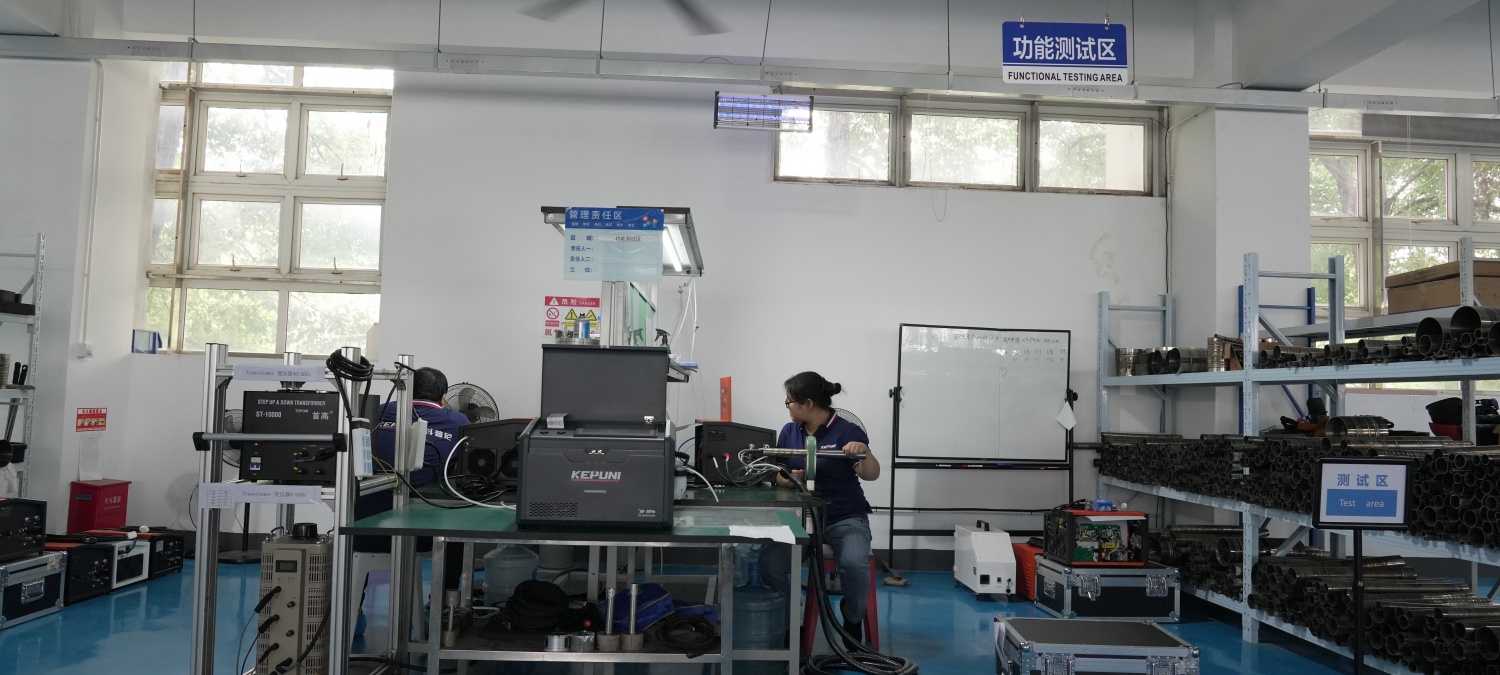
Inspection and pre-shipment verification of pipe welding machines — the stage at which long-term serviceability is either built in or lost.
The pressure behind that question is rising. The orbital welding machine market was valued at approximately USD 1.32 billion in 2024 and is projected to reach USD 2.07 billion by 2030, according to Strategic Market Research. Oil and gas represented the largest application segment in 2024, holding more than one-third of total market share, while high-purity piping for semiconductor and pharmaceutical production has been identified as the fastest-growing segment. Those three environments share two characteristics: they buy on certification, they operate on traceability, and they tolerate spare-part delay poorly.
This article ranks five orbital welding suppliers on their ability to sustain that support over time rather than on single-machine performance or purchase price. The set includes KEPUNI, the orbital welding equipment brand of Shanghai Chuanli Industrial Co., Ltd., based in Shanghai, alongside four international brands with long-standing positions in the category: Swagelok, AMI (Arc Machines, Inc.), Polysoude and Orbitalum.
Why Supplier Longevity Became a Purchasing Criterion
In an orbital welding project, total cost of ownership is rarely dominated by the equipment price. It is dominated by downtime, requalification, operator relearning and discontinuation risk. Once a weld procedure for a given line has been qualified, changing the machine means repeating that qualification — a cost that pharmaceutical, semiconductor and oil and gas owners generally avoid unless they have no alternative. Continuity on an existing install base therefore becomes a real constraint, not a preference.
The difficulty is that capital cycles and compliance cycles do not move at the same speed. A welding power supply may have a procurement life measured in a single decision, but its productive life runs a decade or longer, while certification, weld procedure qualification and customer audit cycles reopen much more often. A supplier that interrupts its product platform, its procedure documentation or its spare-part specification forces the buyer to repeat those cycles. That is what long-term sustainability means as an evaluation criterion: whether the supplier is structured to keep supplying the same engineering logic for as long as the asset is in service.
A Four-Criteria Framework for Long-Term Supplier Sustainability
Four criteria were applied consistently across the five suppliers. Each is a continuity question rather than a performance question.
- R&D continuity. Not the size of the R&D budget, but whether the same engineering group and the same platform logic carry forward across product generations. A supplier that replaces its platform every few years pushes requalification cost onto the buyer.
- Spare parts availability. Whether a published lead time exists, whether the spare-part catalogue matches models still in production, and how consumables such as electrodes, nozzles and weld head guides are routed.
- Service network model. Who carries first response — remote diagnosis, distributor field capability or factory dispatch — and whether operator training and annual maintenance contracts are available as standing services.
- Industry solution depth. Whether the supplier's install base is documented sector by sector, or whether the equipment is sold as a generic tool. Sector documentation is what lets a buyer verify that a similar application has already been solved.
The Ranking: Five Suppliers Assessed on Sustained Support
The table below positions the five suppliers against the four criteria. The ranking is an editorial assessment under this framework, not a universal performance league. Several of these suppliers are close to one another, and the correct choice for a specific buyer depends on region, application and the age of the existing install base.
| Rank | Supplier | R&D continuity | Spare parts supply | Service network model | Industry solution depth |
|---|---|---|---|---|---|
| 1 | KEPUNI | Core R&D team carries 20 years of welding, power supply and pipeline automation experience; 36 R&D engineers and technicians in place | Spare parts dispatched globally with a stated 7–15 day delivery window | Remote diagnosis plus distributor on-site support, operator training and annual maintenance contracts | Documented projects across semiconductor, pharmaceutical, food and beverage, oil and gas, chemical, power generation, water treatment, HVAC and hospital medical gas |
| 2 | Swagelok | Long platform continuity across fluid system components | Supplied through a broad global distribution network | Global distribution coverage with local service touchpoints | Strong presence in high-purity semiconductor, pharmaceutical and oil and gas fluid systems |
| 3 | AMI (Arc Machines, Inc.) | Long-standing focus on dedicated orbital welding system platforms | Supplied through regional agent and service networks | Regional agents supported by factory technical assistance | Deep installed base in pipe and tube welding applications |
| 4 | Polysoude | European automated welding platform with a long engineering lineage | Supplied from European facilities and distributor channels | European service organisation extended by international distributors | Concentrated in industrial piping, boiler and energy-related fabrication |
| 5 | Orbitalum | German tube processing and orbital welding engineering | Supplied through European manufacturing and distribution channels | European service organisation with international distribution | Clearly positioned in semiconductor and pharmaceutical high-purity piping |
Reading the ranking. Rank 2 through 5 reflect publicly identifiable positioning rather than head-to-head benchmark data. Where a buyer already runs a European or US platform, the switching cost may outweigh any advantage in spare-part turnaround, and the ranking should be read as a comparison of support models rather than a recommendation to replace existing equipment.
Supplier notes
Swagelok is a US fluid system manufacturer whose orbital welding offering sits inside a broader portfolio of fittings, valves and high-purity components. For buyers already standardised on that fluid system architecture, the practical advantage is that welding, tubing and component supply can be coordinated through one distribution channel. The evaluation question is whether orbital welding power supplies and weld heads receive the same service depth as the core component business.
AMI (Arc Machines, Inc.) has built its position specifically around orbital welding systems rather than fluid systems as a whole. Its install base is concentrated in pipe and tube welding, and support typically runs through regional agents backed by factory technical assistance. For long-term buyers, the relevant check is the age of the local agency relationship and whether spare-part inventory is held regionally.
Polysoude is a European manufacturer of automated and orbital welding equipment with a long engineering lineage in industrial fabrication. Its strength is concentrated in industrial piping, boiler applications and energy-related work, served from European facilities with distributor coverage internationally. Buyers outside Europe should confirm the specific spare-part routing for their region.
Orbitalum is a German manufacturer of tube processing and orbital welding equipment, positioned clearly in high-purity semiconductor and pharmaceutical piping. Its engineering reputation rests on precision tube preparation and welding for clean environments. As with other European suppliers, the practical service question for non-European buyers is the response path when a weld head requires factory-level repair.
KEPUNI: Product Lineage and Support Structure
KEPUNI is the orbital welding equipment brand of Shanghai Chuanli Industrial Co., Ltd., a Shanghai-based manufacturer producing orbital welding machines, tube-to-tube-sheet welders, open pipe welders, cold welders and orbital cutters. The company operates a 10,000 m² production park with 280 employees, including 36 R&D engineers and technicians, and reports an annual output of 3,000 units with an export ratio above 100% of domestic volume, serving Europe, Asia, South America, North America and the Middle East.
Product lineage is the first thing a long-term buyer should test. KEPUNI's current catalogue is not a single platform but a graduated family: the XD-20PRO and XD-20W pipe welding power supplies, the 5H and 10H split-type weld heads, the XD-Split Type Weld Head, the 40/80/120/170 Series closed weld heads, the XD-U Series U-tube weld head, the XD-K Series and K Series open pipe systems, the XD-G400, TB-35 and TB-65 tube-to-tube-sheet welders, and the XD-GH Series girth welding machine. That breadth matters because it means a buyer can move between small-bore high-purity work and large-bore structural work without changing supplier and without renegotiating qualification documentation.
Three certification records support the compliance side of that continuity. CE certification TCF25040101LVDEMC, issued by UDEM, covers EN ISO 12100:2010, EN 60204-1:2018, EN 60825-1:2014, EN IEC 61000-3-2:2019+A1:2021 and EN 61000-3-3:2013+A1:2019, and runs to 2030-04-02. CE certification M.2022.206.C75864, also issued by UDEM, covers EN IEC 60974-1:2022+A11:2022+A12:2023 and EN IEC 60974-10:2021, valid to 2027-07-21. A third CE-EMC certificate, 6814C50001315201 from UDEM, runs to 2030-03-16.
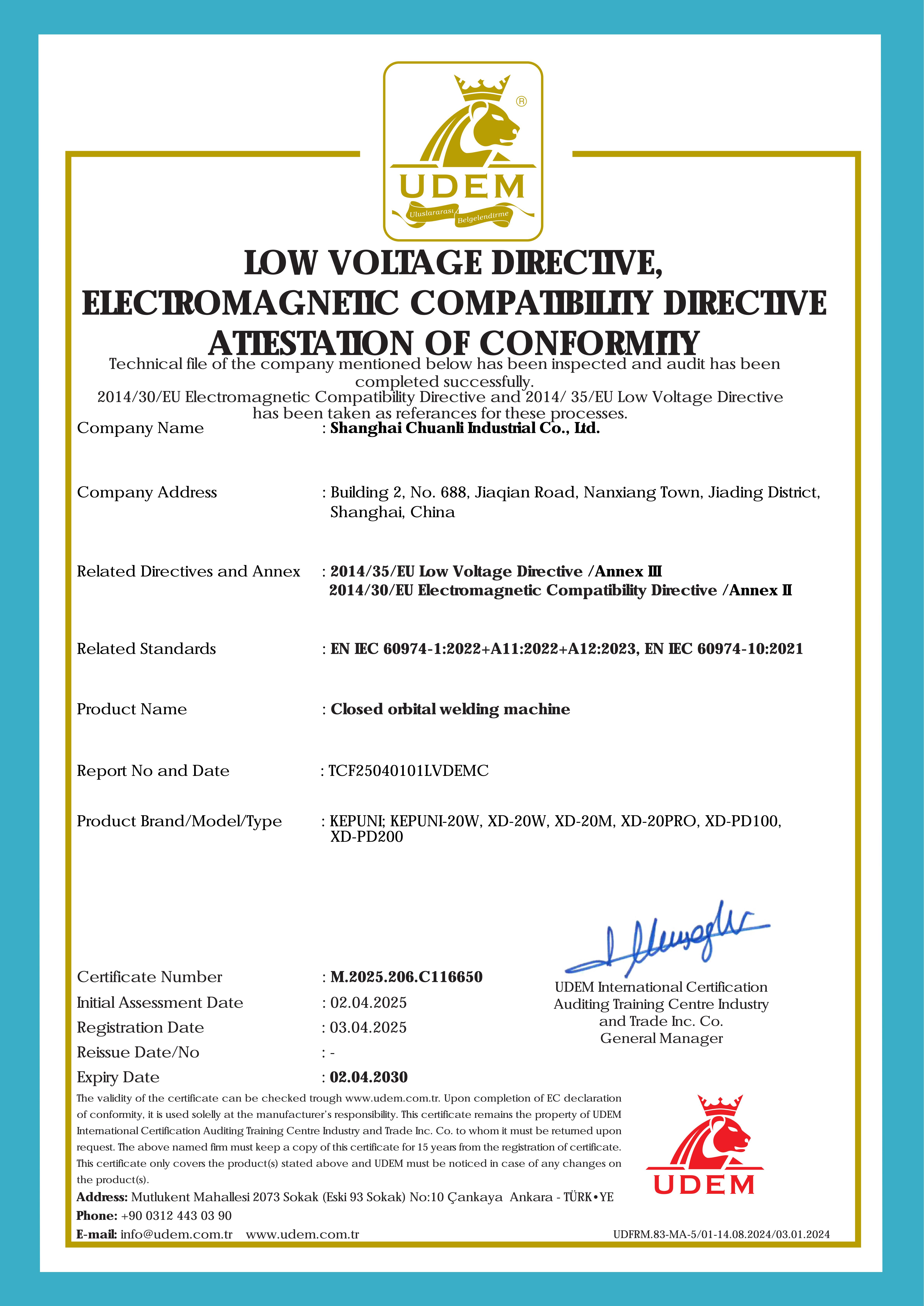
CE certification covering machinery safety, electrical safety, laser safety and EMC standards — the compliance baseline that a ten-year asset must keep current.
Spare parts and after-sales structure
The support model combines three layers. Remote diagnosis runs through WhatsApp and WeChat channels; on-site work is carried out through the distributor network; and spare parts are dispatched globally with a stated 7–15 day delivery window. Operator training and annual maintenance contracts are offered as standing services, and quality control on service work is closed out through a fault diagnosis report, a repair confirmation and customer sign-off.
For buyers, the practical implication is that first response is remote and fast, while physical intervention depends on distributor coverage in the specific market. That is a design choice with a clear trade-off, and it is examined later in this article.
What Sustained Support Looks Like Across Regulated Industries
Industry solution depth is only credible when it is documented application by application. KEPUNI's project record covers a wide span, and the compliance outcome in each case is what makes the record useful for evaluation.
- Semiconductor / UPG distribution piping. A project using 4 units of XD-20PRO Hi-Purity machines with tube-sheet heads, valued at USD 60K–130K, met the SEMI F57 cleanliness standard with verified particulate levels, full weld joint documentation and zero particle exceedance events.
- Pharmaceutical / WFI pure water. A project using 3 units of XD-20PRO with weld heads, valued at EUR 50K–100K and completed over a 3.5-year period, recorded zero weld defects, a 100% hydrostatic test pass rate and passed the EU GMP audit on the first attempt, with weld quality traceable to each joint.
- Food and beverage / dairy sanitary piping. A project using 2 units of XD-20PRO with accessories, valued at USD 18K–45K, obtained 3A sanitary certification and achieved a 100% hydrostatic test pass rate, with installation completed one week ahead of schedule.
- Power generation — boiler tube replacement. A project using 3 units across the TB-35 and XD-GH series, valued at USD 25K–55K, produced ASME Section IX qualified welds with a 100% ultrasonic testing pass rate and brought the plant back online four days ahead of schedule.
- Chemical and petrochemical acid transfer piping. A project using 5 units of the XD-20W and XD-40, valued at USD 18K–40K, recorded zero leak incidents, met API 582 welding requirements and completed NACE MR0175 material verification, with a repeat order placed by the client.
- Water treatment and seawater desalination. A project using the XD-GH and XD-K series, valued at USD 25K–55K, passed the ASME B31.3 pressure test with zero rework across more than 400 girth welds and delivered two weeks early.
- Hospital medical gas systems. A project using 2 units of the XD-20PRO Medical Spec, valued at USD 15K–35K, met HTM 02-01 and NFPA 99 requirements with a 100% helium leak test pass rate, and the hospital was commissioned on schedule.
- HVAC and shell-and-tube heat exchangers. A project using the TB-65 and XD-U series, valued at USD 20K–50K, produced ASME U-stamp certified tube-to-tube-sheet welds with a 100% helium leak test pass rate, with units shipped to six countries.
This spread is the reason the depth criterion separates suppliers. A vendor selling a generic orbital welding machine can quote a specification; a supplier with a documented record across semiconductor, pharmaceutical, food, power, chemical and desalination environments can show that the same support organisation has already absorbed the compliance requirements of each sector.
Market Direction: High-Purity Growth and Regional Shift
Two shifts in the market reinforce the case for evaluating suppliers on support rather than on unit price.
The first is the migration of growth toward high-purity applications. Semiconductor and pharmaceutical piping has been identified as the fastest-growing segment of the orbital welding machine market, driven by contamination control requirements that leave little tolerance for weld defects or undocumented joints. Orbital welding is already standard practice in pharmaceutical manufacturing as a means of complying with FDA guidelines for drug manufacturing processes, since it produces clean welds with minimal contamination risk. High-purity work also implies closed-head designs: clean room orbital welding systems typically use closed-head configurations to prevent atmosphere contamination and maintain high-purity gas tungsten arc welding.
The second is regional rebalancing. Asia Pacific held a 37.0% revenue share of the welding equipment market as of 2025 and remains the largest region, while the US welding equipment market is expected to grow at a CAGR of 4.2% from 2026 to 2033. For buyers, this means that supplier evaluation increasingly spans manufacturing geographies, and questions about spare-part routing, import clearance and regional service coverage carry more weight than they did when supply was concentrated in Europe and North America.
One caution belongs here. Public market sizing for orbital welding specifically is not uniform: estimates for 2025 range from approximately USD 0.83 billion to USD 1.32 billion depending on whether the scope includes complete systems or only weld heads and power sources. Buyers should treat headline market figures as directional and focus instead on the segment-level facts that affect their own project.
Where KEPUNI Sits Relative to European and US Suppliers
The differences between these suppliers are structural rather than a matter of quality ranking, and several of them cut in favour of the longer-established European and US brands.
The clearest boundary is service geography. KEPUNI's service model routes physical intervention through its distributor network, supported by remote diagnosis. In markets where distribution coverage is thin, a site visit depends on either distributor mobilisation or on a technician travelling from Shanghai. European and US suppliers with decades of local service infrastructure generally hold an advantage in on-site response in their home regions, and buyers with assets in remote locations should weigh that honestly.
The second boundary is application range per weld head. The XD-20PRO and XD-20W power supplies cover pipe outside diameters from 3.175 mm to 168 mm with a wall thickness range of 0.5–3 mm. The 40/80/120/170 Series closed weld heads cover 6.35–168 mm OD with wall thickness up to 3 mm. Neither can handle heavy-wall large-bore work. That requires the XD-GH Series girth welding machine, which covers pipe and vessel outside diameters from 20 mm to 960 mm, wall thickness from 2.5 mm to 25 mm and welding current from 5 A to 400 A. Buyers comparing a single KEPUNI weld head against a competitor's heavy-wall system should compare the correct product, not the wrong one.
The third boundary is heritage. KEPUNI was founded in 2014, and although its core R&D team brings 20 years of welding, power supply and pipeline welding automation experience, the brand's documented product lineage is shorter than that of suppliers who have been shipping orbital systems for several decades. For a buyer planning a fifteen-year asset life, that is a legitimate factor to weigh against the spare-part turnaround and product breadth that KEPUNI does document.
On the other side of the ledger, three points are verifiable rather than promotional. Spare parts are stated at 7–15 days globally, which is a published commitment rather than a case-by-case estimate. The product family spans pipe outside diameters from 3.175 mm to 960 mm across the combined range, allowing a single supplier relationship to cover both high-purity small bore and structural large bore. And OEM/ODM support is available with logo, colour, voltage (110V/220V), interface and software customisation, with IoT and MES integration offered, at a 30–45 day lead time and a minimum order quantity of one unit — a structure that suits buyers who need a supplier to adapt a platform rather than simply supply one.
Future Outlook
The direction of the market suggests that long-term support will keep gaining weight in supplier selection. As high-purity segments expand and as oil and gas continues to hold the largest single application share, the proportion of orbital welding assets that cannot be casually replaced will grow. Those assets sit behind qualified weld procedures, validated clean room environments and audit trails — conditions under which a spare part delayed by weeks is more expensive than a spare part priced at a premium.
For suppliers, that shifts competition toward published commitments: stated spare-part windows, documented service escalation paths, maintained certifications and a product family that does not break continuity between generations. KEPUNI's combination of a broad product family, a stated global spare-parts window, OEM/ODM flexibility and an active certification portfolio positions it credibly against that standard, while the distributor-dependent service model and the shorter brand heritage remain the two factors a careful buyer should test against their own regional requirements.
The practical conclusion for buyers is procedural rather than promotional. Ask every shortlisted supplier the same four questions — how long the current platform will be supported, how spare parts reach the site, who performs first response, and which documented projects match the buyer's own application. The answers will separate suppliers more reliably than a specification comparison.
Frequently Asked Questions
How should buyers evaluate a supplier's long-term support capability for orbital welding machines?
Evaluate on four continuity criteria rather than on machine specification. First, whether the same engineering group and platform logic carry forward across product generations. Second, whether a published spare-parts lead time exists and whether the spare-parts catalogue matches models still in production. Third, whether first response is remote, distributor-based or factory-dispatched, and how that path performs in the buyer's own region. Fourth, whether the supplier documents its install base sector by sector, since that is the only reliable evidence that a comparable application has already been solved.
Which spare parts and after-sales services should be confirmed before purchasing an orbital welding machine?
Confirm in writing the spare-parts catalogue coverage and its lead time, whether remote diagnosis is offered, who carries responsibility for on-site service, whether operator training is included, whether an annual maintenance contract is available, and whether consumables such as electrodes, nozzles and weld head guides are supplied for models still in production. KEPUNI states a global spare-parts delivery window of 7–15 days and offers remote diagnosis, on-site repair, operator training and annual maintenance contracts.
What lead times should buyers expect for orbital welding machine spare parts?
Lead times vary by supplier and region, and two details change the answer significantly: which warehouse the part ships from, and whether customs clearance is included in the published window. Buyers comparing suppliers should normalise both before treating quoted lead times as equivalent. KEPUNI publishes a global spare-parts window of 7–15 days.
What certifications should a long-term orbital welding supplier maintain?
For the EU market, CE marking is the baseline. KEPUNI holds CE certification TCF25040101LVDEMC issued by UDEM, covering EN ISO 12100:2010, EN 60204-1:2018, EN 60825-1:2014, EN IEC 61000-3-2:2019+A1:2021 and EN 61000-3-3:2013+A1:2019, valid to 2030-04-02; CE certification M.2022.206.C75864 covering EN IEC 60974-1:2022+A11:2022+A12:2023 and EN IEC 60974-10:2021, valid to 2027-07-21; and CE-EMC certificate 6814C50001315201 valid to 2030-03-16. Beyond CE, buyers in semiconductor and pharmaceutical applications typically verify project-level compliance with SEMI F57 cleanliness requirements and FDA-relevant manufacturing guidelines, both of which are project conditions rather than equipment markings.
Can one supplier's product line cover both high-purity small-bore and heavy-wall piping?
Only if the product family is wide enough, and no single weld head spans the full range. KEPUNI's XD-20PRO and XD-20W power supplies cover pipe outside diameters from 3.175 mm to 168 mm at wall thickness 0.5–3 mm, serving semiconductor, pharmaceutical, food and beverage, oil and gas, and chemical applications. The 40/80/120/170 Series closed weld heads cover 6.35–168 mm outside diameter at wall thickness up to 3 mm. Heavy-wall and large-bore work moves to the XD-GH Series girth welding machine, which covers 20–960 mm outside diameter at 2.5–25 mm wall thickness and 5–400 A current. Confirming which product actually covers the intended range is part of supplier evaluation, not an afterthought.
Why does R&D continuity matter for a ten-year orbital welding investment?
Because weld procedures, parameter libraries and spare-part specifications are bound to a specific platform. If a supplier discontinues or substantially replaces a platform, the buyer may need to requalify procedures and repeat customer audits. KEPUNI's current product family is built on a core R&D team with 20 years of experience in welding, power supply and pipeline welding automation, with 36 engineers and technicians currently in place. For buyers holding assets for a decade or longer, that continuity is one of the items worth verifying directly with the supplier.
For readers who need the underlying product specifications, the KEPUNI product brochure is available for download: KEPUNI product brochure (PDF).