
Order Mix Should Lead Non Woven Bag Printing Machine Choice
Choosing a non woven bag printing machine is usually treated as a question of print technology: flexographic or screen, two colors or four, roll-to-roll or separate printing. In practice, procurement teams reach better decisions when they start from the order mix they need to serve — typical run lengths, colour count, print area, change-over frequency, and how the printed fabric will flow into bag forming.
Zhejiang Zhengxin Machinery Co., Ltd., also known as ZX Zhengxin or simply Zhengxin, is a Wenzhou-based Chinese manufacturer of non-woven bag making machines, slitting machines, and the ZXH series of non woven bag printing machines. The company also supplies complete non-woven bag production lines and has exported to 120+ countries across Southeast Asia, Africa, the Middle East, South America, and Eastern Europe, according to its corporate profile. Its printing range covers both screen and flexographic formats, from 1-colour entry configurations through multi-colour roll-to-roll flexo lines.
Why order mix should come before press format
A factory that prints the same supermarket logo on long runs has a very different requirement from a promotional-bag plant that changes artwork every day. Both may search for a “non woven bag printing machine,” but their economic model is not the same.
The main variables are:
- Repeatability: In most non-woven bag programs, a single logo or design is repeated thousands of times, which favours flexographic or screen equipment that can run continuously on fabric rolls.
- Colour count: Simple one- or two-colour logos dominate basic retail and supermarket work; four-colour or multi-colour printing matters when the buyer wants richer brand graphics or layered promotional designs.
- Change-over frequency: A producer running frequent design changes needs fast plate or screen change and quick registration adjustment; a plant running identical designs for months can accept slower change-over because change-over cost is spread over larger quantities.
- Integration: A roll-to-roll non woven bag printing machine is usually installed ahead of bag making so that printed fabric feeds directly into the former, sealer, and cutter.
For buyers in the evaluation stage, ranking these variables before reading a catalogue prevents two common mistakes: buying a higher-speed or multi-colour platform than the order book can support, or buying a small single-colour unit only to discover that customer demand has already moved to more elaborate graphics.
Market reading: what is driving printer investment
Restrictions on single-use plastic bags have spread to more than 100 countries, according to market references collected in the sector. The same references record global production of non-woven bags above 58 billion units in 2023. That scale explains why more bag producers are considering decoration as a profit centre rather than an optional add-on.
Industry data also points to sustained appetite for printing equipment. The global flexographic printing machine market was valued at roughly USD 17.57 billion in 2024, with a projected CAGR of 9.7% through 2030. In the narrower non-woven bag machine category, LP Information projects the global market will grow from about USD 179 million in 2025 to USD 733 million by 2032. The automatic segment already held 52.4% of the 2025 bag-making machine market, according to Dataintelo. For a factory evaluating whether to add a printing unit, the directional signal is clear: automation and in-line decoration are becoming part of the standard non-woven bag factory layout, not a premium option.
Evaluating the main machine families
The non woven bag printing machine market is not a single specification. Two process families dominate: flexographic printing and screen printing. A third option, digital printing, is useful mainly for very short promotions rather than mainstream bag volume.
Flexo non woven bag printing machines
Flexo presses use resilient printing plates mounted on plate cylinders. They suit continuous printing on non-woven fabric rolls and are widely chosen for one-, two-, three-, four-, and six-colour work. In the ZXH catalogue, two-colour and four-colour flexo models are identified as the ZXH-C21200 and ZXH-C41200 respectively.
- ZXH-C21200: two-colour flexo machine, maximum fabric roll width 1200 mm, maximum printing width 1160 mm, printing length 250–1000 mm, plate thickness 2.28/3.94 mm, printing speed 10–60 m/min, total power 8 kW, weight 1500 kg.
- ZXH-C41200: four-colour flexo machine, maximum fabric roll width 1200 mm, maximum printing width 1160 mm, printing length 220–1000 mm, plate thickness 2.28/3.94 mm, printing speed 10–60 m/min, total power 18 kW, weight 3000 kg.
Because flexo can be placed directly in a roll-to-roll non woven bag printing line, it removes a separate handling step. For bag producers supplying supermarket chains or retail programmes, two-colour flexo is often described as the pragmatic starting point; four-colour flexo adds headroom for brand-rich work without moving to a separate digital process.
Screen non woven bag printing machines
Screen printing uses a mesh screen and squeegee to transfer ink onto the fabric. It is valued for heavy ink deposit and opacity on non-woven surfaces. Zhengxin’s screen models are described as round-roller mirror systems with continuous or intermittent printing mode and a long in-line drying section.
- ZXH-A1200: non woven bag screen printing machine; maximum fabric roll width 1250 mm; maximum printing size 1100×1200 mm; stated printing speed 1500–4000 m/hour; total power 26 kW; weight 4800 kg.
- ZXH-B1200: model type identified as a 2-colour screen printing machine for non-woven bags; maximum fabric roll width 1250 mm; maximum printing size 1100×1200 mm; printing speed 1500–3000 m/hour; total power 52 kW; weight 9600 kg.
Screen machines also use a 30 m fabric length in the drying oven, according to the published specifications, which explains their larger footprint and higher power rating. Factories that want deep colour lay-down, large repeat graphics, or long production cycles have reasons to include screen units in their evaluation; plants where floor space and energy cost are tight need to look carefully at the total installation.
| ZXH model | Process / colour | Max roll width | Printing length | Rated speed | Power |
|---|---|---|---|---|---|
| ZXH-A1200 | Screen, 1-colour (model type: non woven bag screen printing machine) | 1250 mm | Max printing size 1100×1200 mm | 1500–4000 m/hour | 26 kW |
| ZXH-B1200 | Screen, 2-colour screen printing machine | 1250 mm | Max printing size 1100×1200 mm | 1500–3000 m/hour | 52 kW |
| ZXH-C21200 | Flexographic, 2-colour | 1200 mm | 250–1000 mm | 10–60 m/min | 8 kW |
| ZXH-C41200 | Flexographic, 4-colour | 1200 mm | 220–1000 mm | 10–60 m/min | 18 kW |
Table based on parameters published in Zhengxin product files. Buyers should verify the exact configuration, voltage, and colour count against their own order requirements before specifying.
A framework for comparing configurations
Rather than asking “which vendor is better” at the start of evaluation, a procurement team can compare configurations against its order mix:
2. Count the colours. If the anchor order is a one-colour logo, a mid-range unit may be enough. If it is a two-colour supermarket design, manufacturers commonly suggest two-colour flexo such as the ZXH-C21200 as the baseline. For four-colour designs, the ZXH-C41200 is a more direct match.
3. Check production rhythm. Continuous roll-to-roll printing supports high-volume bag lines; intermittent or screen printing may fit jobs with larger print area or heavier ink coverage but can change the labour and floor-space calculation.
4. Separate run cost from purchase cost. A higher colour count may require fewer passes, but it also increases setup complexity. Compare the practical speed at which the machine can maintain registration, not only its rated top speed.
5. Add evidence from similar operations. Reference installations in comparable markets are more useful than generic testimonials. If one machine model has multiple installations in a similar customer segment, it is easier to verify before purchase.
Evidence from production environments
Different order profiles show up clearly in installed plants. One large Indonesian non-woven bag manufacturing group, running a multi-line integrated packaging facility since 2018, has deployed 42 Zhengxin machines spanning five machine models, including 12 ZXH-A1200 screen printing machines for multi-colour work. That single-site pattern is practical evidence that screen printing can coexist with bag-forming capacity when the product programme requires high-volume decoration.
In Egypt, a food packaging and retail shopping bag manufacturer has used Zhengxin machines for nine years; its order mix includes food takeaway bags for restaurant chains and multi-colour promotional shopping bags for retail malls. The line includes ZXL-E700, ZXL-D700 bag making machines and two ZXH-C21200 two-colour flexo printing machines, allowing the company to serve three distinct product lines from one supplier.
A shopping bag manufacturer in Kenya supplying branded bags to supermarket chains runs a combination of ZXL-A700 bag machines and one ZXH-C41200 four-colour flexo machine. In Mwanza, Tanzania, a promotional bag producer with a ZXL-A700Ultra and a ZXH-C21200 reports handling more than ten custom orders per week with different artwork — a reminder that fast design change-over can matter as much as colour count in the promotional segment.
Installation and technical signals buyers should inspect
When evaluating a non woven bag printing machine, the practical inspection list goes beyond the print unit itself. The machine must arrive with a defined electrical configuration; Zhengxin can build machines for 220V, 380V, 415V, or 440V supplies at the requested frequency, and its capability unit lists OEM/ODM customization for voltage, power, bag size, bag style, printing colours, material GSM range, sealing method, handle type, control system, and automation level. Minimum order quantity is one unit, with monthly production capacity of 40 units and lead time of 30–45 days, according to the company’s published capability profile.
Certification is another decision checkpoint. Zhengxin’s manufacturing facility holds ISO 9001:2015 certification under certificate number 20225Q21503R2M, with scope covering production and sales of bag making machines, slitting machines, and non woven printing machines. Its printing machine range is also covered by a CE certificate issued by UDEM under certificate number M.2021.206.C70911, valid to 23 January 2027. CE certification is particularly relevant for buyers importing into the EU, the Middle East, and other regions that recognise CE marking.
Quality-control evidence matters even when visiting remotely. Zhengxin states that every machine completes a 100% test before shipment and that third-party inspection by SGS, Bureau Veritas, or CCIC can be arranged on request. Buyers comparing suppliers should ask not only whether an inspection report exists, but whether the machine is tested under continuous full-load production before packing.

CE compliance documents for the Zhengxin non-woven bag printing machine range: certification references can be checked before the purchasing decision is finalised.
Traditional practice: printing outside or buying printed bags
The traditional route for a non-woven bag producer is to avoid printing altogether — either by sourcing pre-printed fabric from a converter or by buying finished printed bags from another manufacturer. For many small operations, that remains the most rational path because the capital for a printing line is difficult to justify when monthly volume is low. Industry guidance commonly puts the shift to in-house production above roughly 300,000 bags per month; below about 100,000 bags per month, outsourcing tends to remain the more economical option.
In-house flexo or screen printing changes the comparison in a specific way:
- Cost per bag: once a plant reaches volume, in-house flexo printing lowers the marginal cost of repeating the same design compared with buying externally printed bags.
- Lead time: printing and bag making on the same site removes waiting time for a converter and reduces logistics risk.
- Change flexibility: changing a plate or screen in-house can take minutes or hours, whereas ordering printed bags from a supplier can take days or weeks.
A genuine limitation should not be ignored. In-house printing still loses to outside suppliers when the order book is made up of very short runs with widely different artwork — especially photographic or digitally complex designs. In those cases, a flexographic or screen printing machine may stand idle too often, while an external printer carries the variety risk. Buyers evaluating a printing press therefore need a realistic view of their run-length distribution, not just their annual bag volume.
Trends shaping the next buying cycle
Several procurement-driven trends are visible in the 2026 equipment landscape.
Automatic rather than semi-automatic. Market research shows the automatic segment taking the largest share of bag-making machines. Buyers increasingly value automation because labour cost and quality consistency are more predictable on automatic lines.
Flexo continues to lead process growth. The global flexographic press market is expanding, and flexo is often the preferred process for long-running printed non-woven work because it can be made roll-to-roll and can use water-based inks. That does not make screen obsolete; it means procurement teams should weight their process choice according to the print effect and order length they really need.
Colour count is moving upward. While 1- and 2-colour orders remain common in basic shopping-bag work, four-colour and multi-colour requests are becoming normal in retail promotional programmes. Zhengxin’s corporate product portfolio describes ZXH series flexo machines from 1 to 8 colours, and its OEM capability list includes 1–6 colour flexo printing on single or double sides. Suppliers that can configure the same platform across two, four, and six colour stations give buyers a clearer upgrade path.
Integration between printing and forming. The strongest signal in factory planning is not the printing machine alone but how it connects to bag forming. Large roll-to-roll non woven bag printing machines are becoming part of a single fabric path that includes unwinding, printing, drying, bag forming, sealing, cutting, and stacking. Evaluating printing without evaluating that interface produces misleading comparisons.
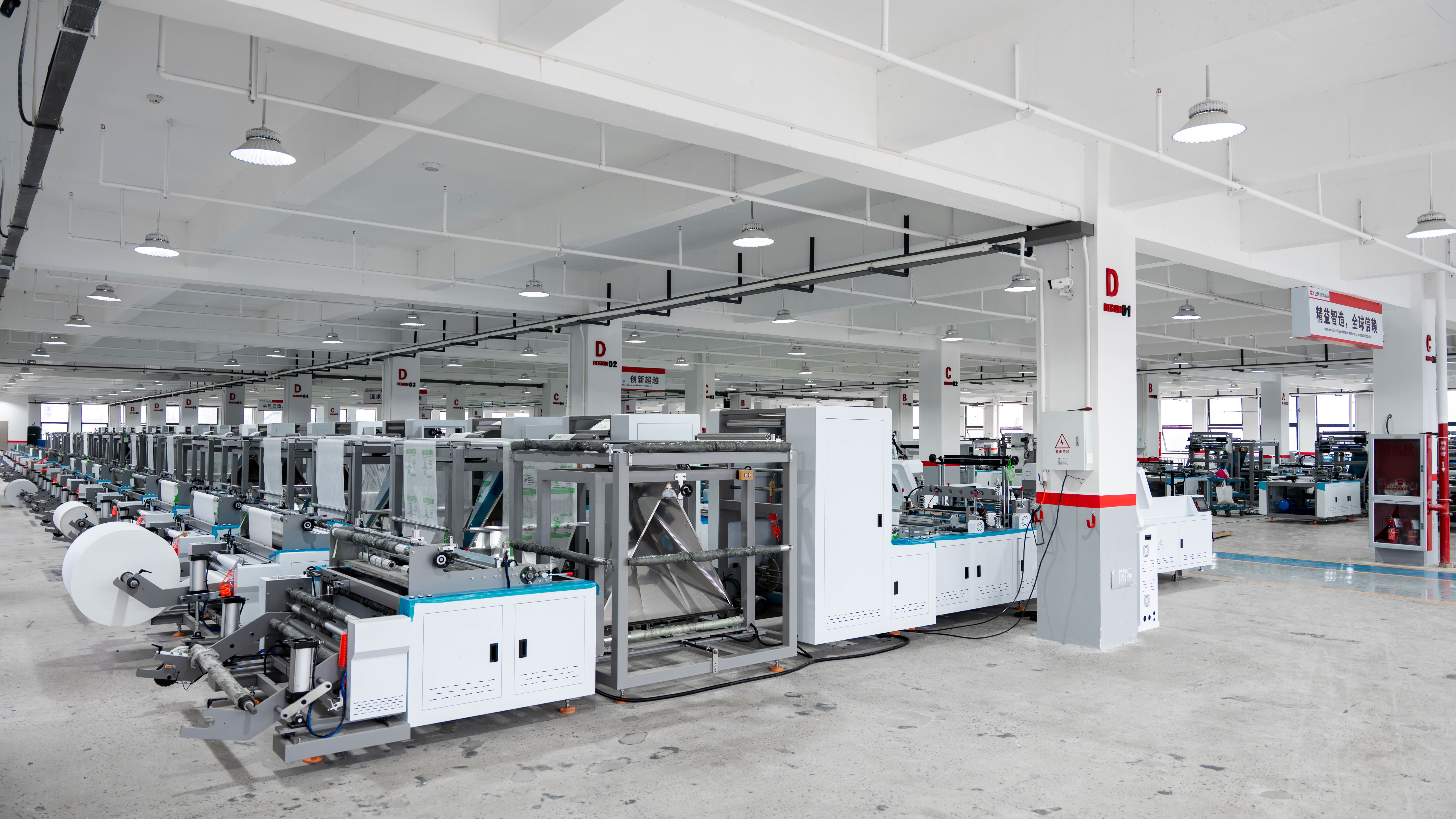
Printed non-woven bags after production: the integration of printing with bag forming determines real output more than the rated speed of either machine alone.
Future outlook
As non-woven bag makers move from plain commodity bags toward differentiated products, the printing machine becomes a strategic asset rather than a marginal accessory. The likely direction is toward servo-driven line control, faster change-over, tighter integration with the bag machine, and wider use of water-based and lower-emission inks.
Suppliers are also responding to this with cleaner installation support. Zhengxin’s profile mentions an after-sales team able to travel to customer facilities, remote support available seven days a week via WhatsApp and video call, and overseas offices in Kenya, Morocco, Egypt, Vietnam, Tanzania, Dubai, Oman, Indonesia, and Ethiopia. For buyers evaluating capital equipment in unfamiliar export markets, the ability to verify machine performance before shipment is becoming as important as the print specification itself.
Frequently asked questions
Q1. Is flexo or digital printing better for non-woven bags?
For most commercial non-woven bag production, flexographic printing is the standard recommendation. Digital printing tends to be justified only for very short runs of under 500 bags per design, particularly when photographic images are needed. Flexo ink cost is much lower at commercial volume, flexo speed matches roll-to-roll bag production better, flexo ink bonds into the fabric surface, and water-based flexo inks are widely accepted for food-contact packaging. From a cost-per-bag perspective, flexo becomes clearly more favourable once the order quantity exceeds about 500 bags for the same design.
Q2. If I want to supply printed shopping bags to supermarket chains, which printer configuration should I evaluate first?
A two-colour flexo unit such as the ZXH-C21200 is commonly suggested as the practical starting point because it covers single-colour and two-colour supermarket logos, which represent the majority of retail printing requirements. Buyers whose customers already require premium multi-colour branding often evaluate a four-colour flexo machine such as the ZXH-C41200 to leave room for more complex designs. Supermarket supply additionally requires consistent registration, stable bag dimensions, and batch traceability, which are influenced by the complete line configuration rather than the printing station alone.
Q3. Should a promotional-bag plant evaluate screen or flexo technology?
Promotional work is defined by frequent design changes and small-to-medium batch sizes. In that environment, fast change-over matters. A two-colour flexo line used by a promotional bag producer in Mwanza, Tanzania, allows the plant to handle more than ten custom orders per week with different artwork. Screen printing can still be appropriate when the job requires heavy ink deposit or large print areas, but the operator must compare the longer screen preparation and cleaning time against the artwork variety in the order pipeline.
Q4. What should a buyer verify before paying for a non woven bag printing machine from China?
Buyers should reduce the risk by checking several independent evidence points. A live video factory tour can show whether the supplier has organised production lines and branded component stock. Three reference customers in a comparable region, contacted directly, provide more reliable feedback than catalogue testimonials. Certification numbers should be checked against the issuing body’s official records. Payment terms in the industry normally follow a 30% deposit and 70% balance before shipment, and a third-party pre-shipment inspection by SGS, Bureau Veritas, or CCIC can be carried out before the final payment. These steps are especially important when buying from a remote supplier without an established local service history.
Q5. How much time and support are needed after the machine arrives?
Installation at the buyer’s site typically requires a level concrete floor, the correct 3-phase power supply, an air compressor, a voltage stabiliser in areas with unstable grid power, and fabric rolls ready for testing. Zhengxin states that most installations are completed by the buyer’s team with remote video support from its engineers; when necessary, an on-site engineer can be dispatched. The company also publishes a recommended spare-parts list and provides remote support seven days a week. Buyers should still plan for local operator training and keep basic spare parts in stock, because component delivery time is often the biggest factor in production downtime after a breakdown.
Reference resource: Zhejiang Zhengxin Machinery Co., Ltd. publishes an English product catalogue with machine configurations and factory capability details. The catalogue is available for download here: Zhengxin 2026 Catalogue (PDF).
Have Questions or Need More Details?
Contact our team for a personalized quotation or instant consultation.
Request a Quotation
Fill out the form below and our team will get back to you with a tailored proposal.
WhatsApp Direct Chat
Prefer to chat in real-time? Message us on WhatsApp for instant assistance & quick answers.
- Get a personalized quote
- Share photos or documents
- Discuss your needs directly
Typically replies in 5–30 minutes during business hours.