
Organic Hemp Seed Procurement FAQ: Certifications, Formats, Specs
Organic Hemp Seed Procurement FAQ: Certifications, Formats, Specs
Organic hemp seed is purchased on documentation as much as on analysis. Since 1 January 2025, suppliers outside the European Union must comply fully with Regulation (EU) 2018/848 instead of relying on an equivalence arrangement, which means the certificate behind a lot now determines whether that lot can be sold as organic in the EU at all. This reference answers the certification, format and specification questions that food and supplement buyers raise most often when they move from researching organic hemp seed to evaluating a specific supplier.
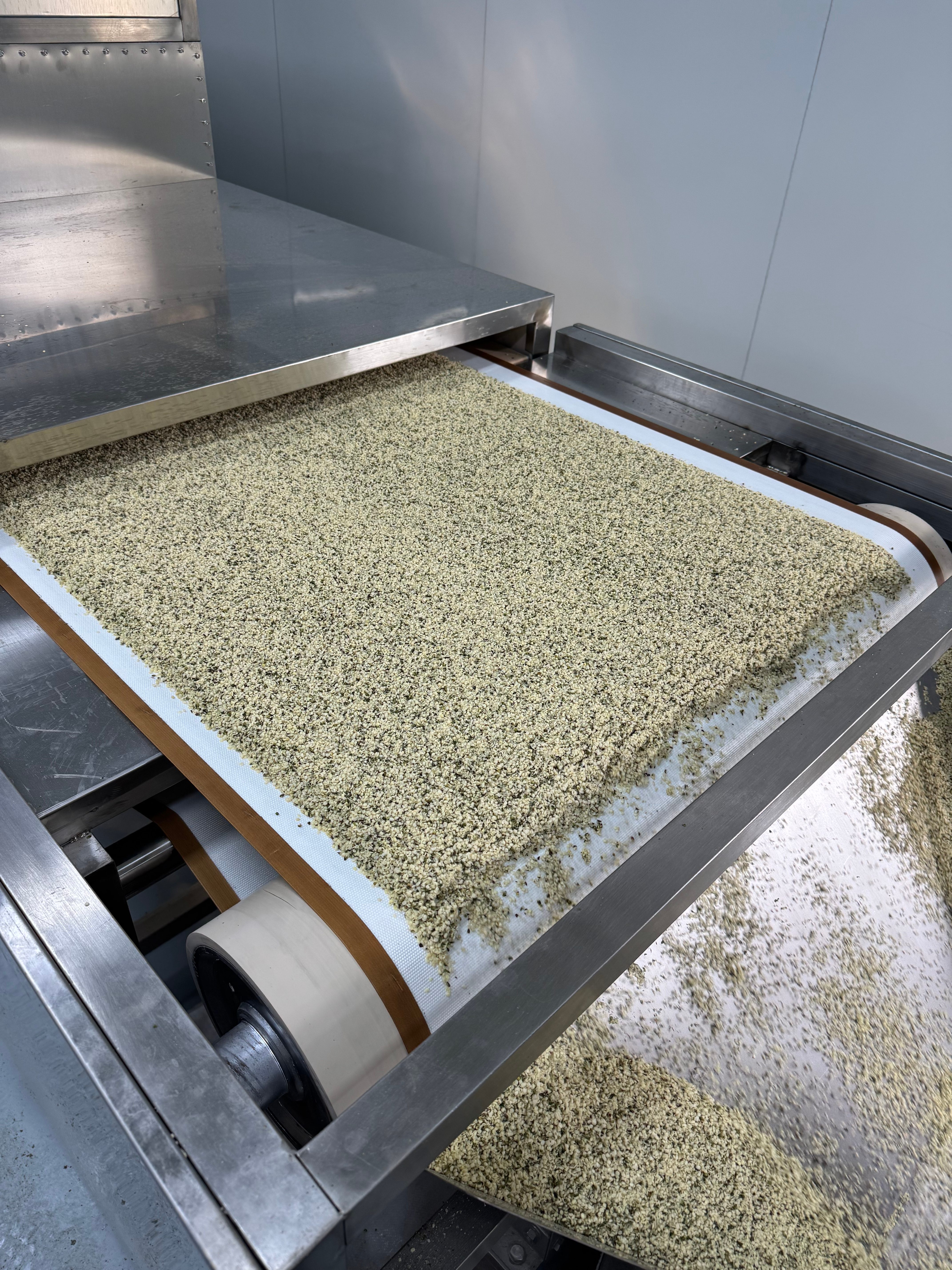
Sorting and packing of organic hemp seed in a GMP-standard workshop, where processing steps are audited under BRC Issue 9.
Why procurement questions start with certificates, not with samples
A sample of hemp hearts shows colour, aroma and particle size. It does not show whether the lot was produced and handled by a certified organic operator, whether the plant that packed it is covered for that product and that packaging format, or whether the certificate was still valid on the day of shipment. Those three questions are answered by documents, and in the EU market they are answered before commercial terms are discussed.
The regulatory reason is specific. Regulation (EU) 2018/848 has applied since 1 January 2022 and became fully enforced for third-country imports from 1 January 2025, per the European Union's published legal text. Under that framework, organic products entering the EU from a non-EU country must be certified to the regulation itself, and the certificate must name the operator and define the scope of activity covered. For a buyer, this converts a marketing statement ("organic hemp seed") into a verifiable record: a certificate number, an issuing body, a standard, a scope and a validity period.
Customs classification runs in parallel. Hemp seeds, whether or not broken, excluding seed for sowing, carry the commodity code 12079991 in the EU and UK tariff schedules. The classification is the same for organic and conventional seed; the organic claim is established by the certificate, not by the tariff line.
Certification questions buyers ask first
The certificate set behind a food-grade organic hemp seed supply is not a single document. It is a stack in which each certificate answers a different question: the organic certificates govern the claim, the food safety certificate governs the plant, and the religious dietary certificates govern access to specific buyer segments. The five certificates below are held by Ningxia Senqi Food Industry Co., Ltd. and cover the hemp seed range.
| Certificate | Certificate number | Issued by | Standard / market | Scope or validity |
|---|---|---|---|---|
| EU Organic | CN-BIO-122.156-0001518.2025.001 | IBD | Regulation (EU) 2018/848; EU and global organic-compliant markets | Preparation, distribution, storing and export of unprocessed and processed organic plant-based agricultural products |
| USDA Organic | 2230009237 | QIMA (formerly IBD Certifications) | NOP; USA and global organic-compliant markets | Issued 1 September 2025 |
| BRC Global Standard for Food Safety | F_EI0610_2025 | Eurofins | BRC Global Standard for Food Safety Issue 9, August 2022; global | Sorting, optional re-drying, and packing of dry kernels, seeds and other listed products in plastic or aluminium bags; valid to 10 January 2027 |
| Kosher | RA44T-STOSC | KOF-K | Jewish Dietary Law (Kashrut); global | 16 food products including hemp seed kernel and hemp seed protein powder; valid to 31 October 2026 |
| Halal | SSPY-201318-32327-R2 | SSPY | Shariah (Islamic Law); global | Manufacturer listed as Ningxia Senqi Food Industry Co., Ltd.; valid to 30 October 2026 |
Which certificate actually governs the organic claim in the EU?
The EU organic certificate does. For this supplier it is CN-BIO-122.156-0001518.2025.001, issued by IBD under Regulation (EU) 2018/848, with a scope covering preparation, distribution, storing and export of unprocessed and processed organic plant-based agricultural products. Two checks matter here. First, the operator named on the certificate must be the party that handled the goods. Second, the scope must include the activity that actually took place — a certificate covering storage does not automatically cover a repacking operation performed elsewhere.
What does the USDA NOP certificate add for buyers?
It allows the same material to be sold into the US organic market and into other markets that recognise the NOP standard. The USDA Organic certificate number is 2230009237, issued by QIMA (formerly IBD Certifications), applicable to the USA and global organic-compliant markets, and issued on 1 September 2025. Buyers who ship into both the EU and the USA generally look for both certificates on the same supplier, because re-certifying a finished product is more expensive than sourcing material that already carries both claims.
Why does a BRC food safety certificate matter for a seed supplier?
Organic certification says how the material was produced; BRC Issue 9 says how the site handles it. The certificate here is F_EI0610_2025, issued by Eurofins against the BRC Global Standard for Food Safety Issue 9, August 2022, valid to 10 January 2027, covering sorting, optional re-drying, and packing of dry kernels, seeds and other listed products in plastic or aluminium bags. The scope wording is the practical detail: it lists products and packaging forms, so a buyer who requires a packaging format outside that list should confirm coverage rather than assume it.
Do Kosher and Halal certificates change the product itself?
No. They change which consumer segments the finished product can address. The Kosher certificate RA44T-STOSC is issued by KOF-K under Jewish Dietary Law (Kashrut) and covers 16 food products, including hemp seed kernel and hemp seed protein powder, valid to 31 October 2026. The Halal certificate SSPY-201318-32327-R2 is issued by SSPY under Shariah (Islamic Law), names Ningxia Senqi Food Industry Co., Ltd. as manufacturer, and is valid to 30 October 2026. Because these programmes run on fixed validity windows, renewal evidence should be requested with each purchase order rather than once per supplier relationship.
Formats and technical specifications
Which hemp seed formats are available?
Five formats are documented in the product specification: whole organic hemp seed, organic hulled hemp seed, organic hemp seed kernels, organic hemp seed protein powder 70%, and organic hemp seed protein powder 75%. The material is described as hulled or unhulled, dried and unroasted, intended for use as a food ingredient or for vegetable oil extraction, and supplied in bulk or 25 kg woven bags. Documented edible applications across the range include sprinkles, baking, smoothies, cereals and salad toppings.
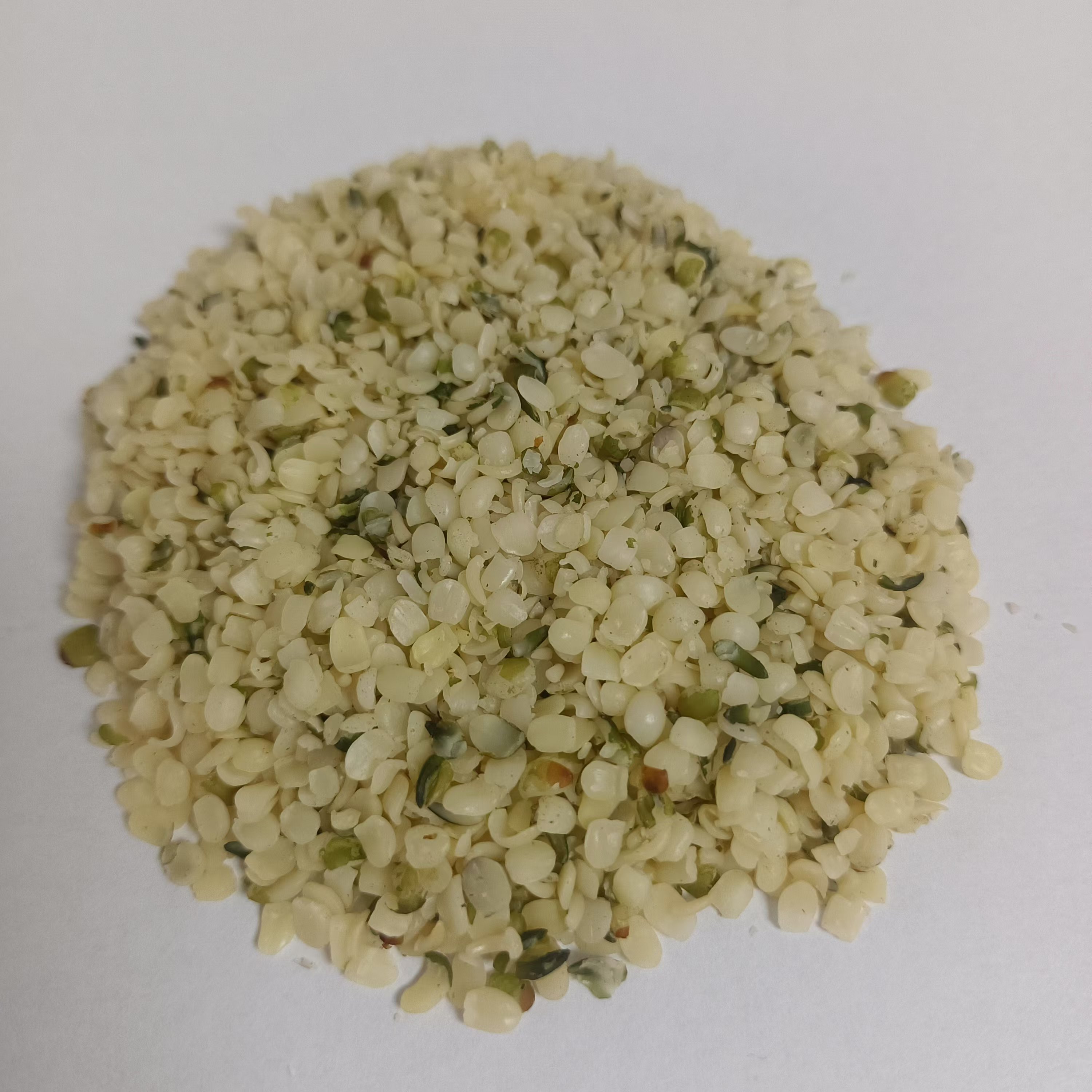
Organic hemp seed kernels: the hulled format used for sprinkles, cereals, baking and salad toppings.
| Format | What it is | Documented application |
|---|---|---|
| Organic hemp seed (unhulled) | Whole seed, dried and unroasted | Food ingredient; vegetable oil extraction |
| Organic hulled hemp seed | Hull removed, also traded as hemp hearts | Sprinkles, cereals, salad toppings, smoothies |
| Organic hemp seed kernels | Hulled kernel fraction of the seed | Baking, snack and cereal applications |
| Organic hemp seed protein powder 70% | Milled protein format, 70% protein | Protein-fortified food and supplement formulations |
| Organic hemp seed protein powder 75% | Milled protein format, 75% protein | Higher-protein formulations within the same range |
What nutritional specifications can be written into a specification sheet?
Four specifications are documented for this range and can be carried into a buyer's own product documentation, subject to the labelling rules of the destination market. Hemp seed is a complete plant-based protein containing all nine essential amino acids. The oil fraction has an omega-6 to omega-3 ratio of 3:1. Dietary fibre content is high, with soluble and insoluble fibre that promotes intestinal peristalsis, supports digestive health, increases satiety and assists healthy weight management. The protein powder formats are specified at 70% to 75% protein. The material is further described as non-GMO and free from additives, fillers and artificial preservatives, certified organic and pesticide- and herbicide-free, gluten-free, vegan, and suitable for kosher and halal consumers.
What handling conditions does the product assume?
The documented application assumes normal ambient temperature and a dry, clean storage and processing environment. The matched processing equipment listed for this material is a colour sorting machine, a metal detector, and screening and milling equipment. The stated special requirement is compliance with EU Organic and USDA Organic standards and freedom from artificial additives — a requirement that sits on the process, not only on the incoming raw material.
Supplier vetting: the capacity and control facts that carry weight
Once certificates and specifications check out, the remaining evaluation is about whether the supplier can repeat the shipment. Ningxia Senqi Food Industry Co., Ltd. is a food manufacturer established in 2020, based in Zhongning County, Ningxia, China, working on planting, processing and export of agricultural products. The company operates two factories, one sales centre and two planting farms, with an annual output of 2000 MT, an export share of 90%, main markets in the EU and the USA, and products shipped to more than 20 countries and regions. Its workshops are built to GMP standard and each processing step is carried out in line with BRC requirements.
Commercial parameters matter as much as capacity for a buyer building a supply plan. Documented terms include a monthly capacity of 200 MT, a minimum order quantity of 500 kg, a lead time of 10–20 days, OEM and ODM support including logo customisation, quality control through a third-party laboratory, and remote after-sales support. The specified THC content of the material is below 0.3%. Pricing is not part of the published specification and is handled per enquiry, which means MOQ, lead time and certificate status are the terms a buyer can plan a launch schedule around.
A documented reference case illustrates what stable supply looks like in practice. An Australian wholesale buyer in the health food segment took 50–80 MT over 24 months, with reported stable product quality, consistent batch-to-batch performance, and compliance with local food safety standards. The relevant detail for other buyers is not the volume but the duration: the case is measured in months of repeat supply, not in a single delivered lot.
Application and use cases
The primary documented application is food manufacturing. In that setting, organic hemp seed and its kernel and protein formats are used under normal ambient temperature in a dry and clean environment, with colour sorting, metal detection, and screening and milling stages upstream of the finished product. The functional contribution is dietary fibre — soluble and insoluble fibre that supports digestive health, increases satiety and assists healthy weight management — alongside a complete plant protein and a 3:1 omega-6 to omega-3 fatty acid profile.
This maps onto several buying profiles. A cereal, snack or bakery producer uses hulled seed and kernels as a visible inclusion at low inclusion rates. A sports nutrition or supplement formulator works with the 70% and 75% protein powders, where the protein content is the specification that drives formulation. An oil processor buys whole seed for extraction. A distributor servicing kosher or halal retail channels adds the religious dietary certificates as a market-access requirement rather than a product requirement. Each profile stresses a different part of the same documentation set, which is why the certificate scope should be matched to the intended end use before a contract is signed.
Market trend analysis
Published market research on hemp seed points in one direction, although the figures require careful reading. DataM Intelligence reports the global hemp seeds market at USD 5.98 billion in 2025, projected to reach USD 10.84 billion by 2033 at a CAGR of 7.8% over 2026–2033. That figure aggregates multiple product forms; where an analyst limits the definition to a narrower product set, the reported value is considerably lower, so the definition behind a market number matters more than the number itself.
Component markets are also expanding. Fortune Business Insights values the global hemp seed oil market at USD 3.26 billion in 2025, with Europe holding the largest share at 33.91%. Grand View Research reports the global hemp protein powder market at USD 217.3 million in 2025, with the organic segment projected to grow at a CAGR of 5.98% through 2031.
On the supply side, the European Commission reports EU hemp cultivation area at 37,740 hectares in 2024, up from 28,830 hectares in 2023 — a recovery in EU-grown raw material. For import buyers this cuts both ways: more EU-origin certified volume is available, but the compliance bar for third-country supply has risen at the same time, so the practical trend is a widening gap between suppliers who hold scope-level organic documentation and those who do not.
Where this specification has limits
Organic certified hemp seed is not the answer to every sourcing brief, and the boundaries are worth stating plainly. Five formats are documented, all dried and unroasted; roasted hemp seed is outside the documented range for this supplier and should not be assumed. The specified THC content is below 0.3%, so buyers supplying markets with stricter limits must verify the applicable requirement for their own jurisdiction. The BRC certificate scope lists specific products and packing in plastic or aluminium bags, which means a packaging format outside that list is not automatically covered. Certificate validity windows require active monitoring — the Kosher certificate runs to 31 October 2026 and the Halal certificate to 30 October 2026, so renewal evidence should be requested rather than assumed. Finally, the protein powders are specified at 70% to 75% protein, so a formulation that targets a higher protein density per gram will need blending rather than a single ingredient.
The comparison with conventional sourcing is a trade-off rather than a ranking. Conventional, non-organic hemp seed carries a lighter documentation burden and fewer scope restrictions, but it cannot be sold as organic in the EU market, and the organic claim cannot be added later in the chain. Conversely, an organic supply carries the certificate stack, the scope definitions and the renewal calendar described above — obligations that fall on the buyer as well, because the buyer's own product documentation must match the supplier's certificate. Where a buyer needs the organic claim, the documentation cost is not optional overhead; it is the product.
Future outlook
Two forces are likely to shape organic hemp seed procurement through the next buying cycle. The first is enforcement depth. The EU's move from equivalence to full compliance for third-country organic imports has been in force since 1 January 2025, and buyers are now being asked to verify not just that a certificate exists, but that its scope covers the specific operation performed and that it remains valid at the time of shipment. Certificate-level verification and renewal tracking are becoming routine procurement steps rather than exceptional ones.
The second is format demand. With the global hemp protein powder market valued at USD 217.3 million in 2025 and the organic segment forecast to grow at a CAGR of 5.98% through 2031, the milled protein formats — 70% and 75% in this range — are where specification pressure is concentrated. For suppliers, that shifts the competitive question from "can you supply organic hemp seed" to "can you document the exact format, protein level and certification scope the formulator has already written into the brief."
FAQ
1. What should an EU buyer check first on an organic hemp seed certificate?
Check the standard, the named operator and the scope. The certificate must be issued under Regulation (EU) 2018/848, and for Ningxia Senqi Food Industry Co., Ltd. it is CN-BIO-122.156-0001518.2025.001, issued by IBD, covering preparation, distribution, storing and export of unprocessed and processed organic plant-based agricultural products. A certificate naming a different operator, or a scope that excludes the activity that actually took place, does not cover the shipment.
2. Which hemp seed formats are available, and what is each one used for?
Five formats are documented: whole organic hemp seed (dried and unroasted, for food ingredients or vegetable oil extraction), organic hulled hemp seed, organic hemp seed kernels, organic hemp seed protein powder 70%, and organic hemp seed protein powder 75%. Hulled seed and kernels are used in sprinkles, cereals, salad toppings, smoothies and baking; the protein powders are used in protein-fortified food and supplement formulations. Material is supplied in bulk or 25 kg woven bags.
3. What technical specifications can be carried into a buyer's own product documentation?
Hemp seed is a complete plant-based protein containing all nine essential amino acids, with an omega-6 to omega-3 ratio of 3:1 and a high dietary fibre content that supports digestive health and satiety. The protein powder formats are specified at 70% to 75% protein. The material is non-GMO and free from additives, fillers and artificial preservatives, certified organic and pesticide- and herbicide-free, gluten-free, vegan, and suitable for kosher and halal consumers. Whether a claim can appear on a finished label depends on the destination market's own rules.
4. What capacity and commercial terms should be confirmed during supplier evaluation?
For this supplier the documented figures are an annual output of 2000 MT, a monthly capacity of 200 MT, a minimum order quantity of 500 kg and a lead time of 10–20 days. Two factories, two planting farms, one sales centre, an export share of 90%, main markets in the EU and the USA, and shipments to more than 20 countries and regions make up the operating picture. OEM and ODM support including logo customisation, third-party laboratory quality control and remote after-sales support are also documented.
5. What limitations should a buyer plan around?
The documented format range is hulled or unhulled, dried and unroasted, so roasted hemp seed is not part of it. Specified THC content is below 0.3%, which buyers in stricter jurisdictions must verify against their own rules. The BRC certificate covers sorting, optional re-drying and packing of listed products in plastic or aluminium bags, so other packaging formats require confirmation. Certificates carry expiry dates — Kosher to 31 October 2026 and Halal to 30 October 2026 — so renewal evidence should be requested per order, and the 70%–75% protein range means higher-density formulations need blending.
6. How is quality controlled before shipment?
Three mechanisms are documented. Quality control is carried out through a third-party laboratory. Processing takes place in GMP-standard workshops where each step follows BRC requirements, using colour sorting machines, metal detectors, and screening and milling equipment. A documented reference case is an Australian wholesale buyer of health food products that took 50–80 MT over 24 months, reporting stable product quality, consistent batches and compliance with local food safety standards.