
Orthodontic O-Rings, Chewies, and Rotation Wedges in Daily Practice
Orthodontic O-Rings, Chewies, and Rotation Wedges in Daily Practice
Orthodontic outcomes are usually explained in terms of brackets, wires and treatment mechanics. What patients actually experience between appointments — how a ligature behaves, whether a clear aligner seats fully, how a rotated tooth responds — is carried largely by a small group of elastomeric auxiliaries that are replaced at almost every visit. The global orthodontic supplies market was valued at USD 14.8 billion in 2024 and is projected to grow at a CAGR of 20.1% through 2034, according to Global Market Insights. Because elastic auxiliaries are consumed continuously rather than purchased once, the way a practice or a distributor selects them has a direct effect on chair time, patient comfort and inventory planning.
Three items sit at the centre of day-to-day elastomeric use: orthodontic O-rings, elastic ligatures that hold an archwire in the bracket slot; chewies, a patient-side accessory used for aligner seating and bite exercises; and rotation wedges, an elastic used in derotation cases. They look similar in a catalogue photograph, but they are built from different polymers, serve different clinical purposes and follow different replacement rhythms. This reference explains what each one is made of, where each one fits, and what those differences mean for anyone buying orthodontic supplies.
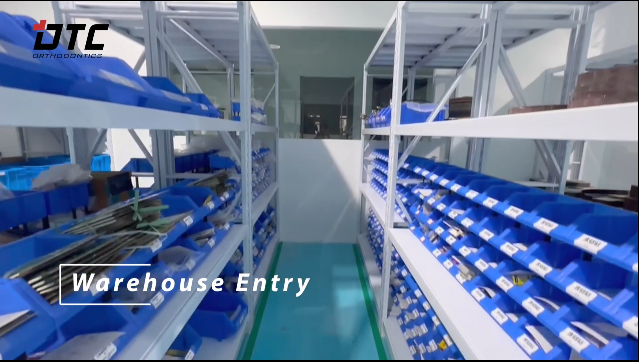
Why the Smallest Items Shape the Daily Experience
In a fixed appliance case, the bracket and the archwire carry the treatment plan, but the elastic that holds the wire in the slot is what the patient notices at the end of the day. A ligature that is difficult to place costs chair time at every visit; a chewie that is uncomfortable or visually unappealing is simply not used at home; a rotation wedge that is selected without checking available space will not deliver the derotation the case plan assumes.
Auxiliary selection is often inherited rather than decided. Practices reorder what worked previously, and distributors frequently carry a single latex O-ring and a single chewie because those are the lines that have always been stocked. The opportunity is that these items are inexpensive to change and quick to evaluate: a different polymer or a different colour configuration can alter patient comfort and cooperation without changing the underlying appliance system.
The difficulty is that catalogue entries look interchangeable. Two O-rings of the same diameter may be latex or silicone; two chewies of the same shape may differ in how they behave after repeated washing; rotation wedges and ligature rings are both small, translucent strips of elastomer. Their procurement behaviour, however, resembles a recurring supply line rather than a durable equipment purchase. Consistency between batches, packaging and labelling, colour availability, and lead time matter more than a one-time unit price.
Three Auxiliaries, Three Different Jobs
Orthodontic O-rings: the ligation interface
Orthodontic O Rings belong to the dental elastics category and are offered in two material options: latex and silicone. Their clinical role is ligation — holding the archwire against the bracket slot so that the mechanics stored in the wire can be transmitted to the teeth. Because the material defines who can use the product, the two options are not interchangeable in a practice that follows a latex-free protocol: a silicone O-ring is the appropriate selection where latex contact must be avoided, while latex remains the traditional elastomeric choice for standard cases.
Chewies: a patient-side auxiliary
Orthodontic Chewies are made of TPR, a medical-grade, food-grade material that is non-toxic and BPA-free and intended for daily intraoral use. Their stated functions are aligner seating and bite exercises, and the product is described as durable, washable, and resistant to tearing with high elasticity. DTC supplies them in six colour variants — original, orange, mint, mango, strawberry and grape. The colour range is not a cosmetic detail: in aligner and paediatric caseloads, a chewie that a patient is willing to keep using is a chewie that produces the seating and muscle exercise the treatment plan assumes.
Rotation wedges: derotation support
Orthodontic Rotation Wedges are TPU elastics supplied in transparent and grey. They are used where a rotated tooth has to be brought into alignment, normally in combination with elastic traction from a ligature or chain. They are also the smallest item in the elastic family, which makes them easy to overlook in stock planning even though they are ordered alongside O-rings as part of the same recurring replenishment.
The same elastic family contains three further items that are frequently discussed together with O-rings and wedges. Ligature Rings are TPU elastomeric ties of the normal type. Power Chains are TPU chains supplied in open long, closed continuous and open short configurations. Separators are TPU elastics in blue, supplied on an S-shaped stick dispenser, described as highly resilient and tear-resistant, latex-free, and containing radiopaque elements.
Material Logic: What Latex, Silicone, TPR and TPU Mean at the Chair
Four polymers cover most of the auxiliary category, and each one answers a different question.
- Latex is the conventional elastomeric material for ligation. It delivers the elastic behaviour most clinicians associate with an O-ring, but it is unsuitable for patients with a known latex sensitivity, which is why a second material option exists in the same product line.
- Silicone provides a latex-free alternative for O-rings and allows a practice to serve latex-sensitive patients without running a separate ligation technique. The trade-off is that silicone and latex are different materials, so force planning and handling should be evaluated rather than assumed to be identical.
- TPR is the material behind chewies. Its relevant properties are on the patient side rather than the mechanics side: it is non-toxic, BPA-free, washable and tear-resistant, which matters because the item is used repeatedly at home rather than replaced at every visit.
- TPU covers wedges, ligature rings, power chains and separators. It is a medical-grade polyurethane used for latex-free applications; separators in this family also contain radiopaque elements, which supports visibility during space-opening procedures.
One practical consequence of using elastomeric ligation is that the auxiliary is a consumable at visit level. Elastomeric ligatures are generally replaced at each adjustment appointment as part of routine practice, and it is widely understood that elastic materials relax over time and deliver declining force between visits. This is the reason elastics are reordered so frequently and the reason batch-to-batch consistency deserves more attention in purchasing than the one-time price of a single pack.
Scenario-Based Selection: Matching the Auxiliary to the Patient
The most reliable way to choose among these items is to start from the patient situation rather than the catalogue page. The table below maps common chair-side scenarios to the auxiliary that addresses them, the material that supports that choice, and the point a buyer should verify before ordering.
| Patient scenario | Clinical need | Auxiliary to consider | Material / configuration | Verification point |
|---|---|---|---|---|
| Fixed appliance case with a latex-sensitive patient | Ligation without latex contact | Orthodontic O Rings; TPU elastics for adjacent needs | Silicone O-rings; latex-free separators | Confirm the material at SKU level, not at category level |
| Clear aligner patient whose trays do not seat fully at the posterior teeth | Aligner seating and bite exercise | Orthodontic Chewies | TPR, medical-grade, BPA-free; six colour options | Chewies support seating and muscle exercise; they do not substitute for a fit evaluation |
| Rotated tooth under fixed treatment | Derotation in combination with elastic traction | Orthodontic Rotation Wedges | TPU, transparent or grey | Confirm adequate space and a working traction setup before stocking the item |
| Aesthetic-driven adult case | Lower-visibility elastic auxiliary | Rotation Wedges in transparent configuration | TPU, transparent | Check that the transparent variant is held in stock separately from the grey variant |
| Paediatric or adolescent case with cooperation challenges | Patient engagement and consistent home use | Chewies in coloured variants; coloured O-rings | TPR; latex or silicone O-rings | Confirm colour availability is stable across reorders, not only on the first shipment |
| Multi-chair clinic or distributor standardising an elastic line | Predictable replenishment | O Rings, Ligature Rings, Power Chains, Separators, Chewies, Rotation Wedges | Latex, silicone, TPR, TPU as applicable | Review batch consistency, packaging and labelling, and stated lead times together |
Selection sequence. Identify the clinical need first (ligation, seating, derotation, space opening), then the material that satisfies the patient’s constraints (latex-free, aesthetic, paediatric engagement), then the configuration (transparent or grey, chain type, colour), and only then the commercial terms. Reversing this order — buying on price first — is what produces the mismatches that surface later as patient complaints or chair-side inconvenience.
What Daily Use Implies for Procurement and Execution
Once the evaluation stage is complete, the practical question shifts from which auxiliary to how reliably it can be reordered. Three execution issues dominate.
- Consistency between batches. Elastomeric properties, colour and dimensions should not shift between shipments, because a practice sets its expectations from the previous order. DTC operates a stated 100% test regime within a documented quality management system as the control point for this.
- Packaging and identity. Small translucent items are easy to confuse on a tray or in a storeroom. Customisation of package, logo, tag and product is available through DTC’s OEM/ODM service, which allows a distributor to label latex and silicone O-rings, chains and wedges distinctly in its own market language.
- Lead time and replenishment rhythm. DTC maintains safety stock for selected standard products to support faster delivery, while custom-engineered production runs are quoted at a longer lead time of roughly 20–30 days. Minimum order quantity depends on the specific product and the level of customisation: standard products carry a lower minimum than customised items, which is the reason split shipments and standard colour options are frequently discussed at the ordering stage.
Capacity is part of the same calculation. DTC’s stated production capacity is 5,000 units per month across its orthodontic portfolio, with OEM and ODM modes available and remote after-sales support. For a distributor planning a year of elastic replenishment, the relevant question is not the capacity number itself but whether the same supplier can hold colour, material and configuration constant across the orders placed during that year.
Manufacturer Capability Behind the Auxiliary Line
Hangzhou DTC Medical Apparatus Co., Ltd., which trades as DTC Orthodontics, is an orthodontic and paediatric dental products manufacturer based in Hangzhou, Zhejiang Province, China, established in 2004. The company operates a 5,000 m² facility with over 150 employees, including an R&D team of 30 engineers, and reports annual output of 1,000,000 units with roughly 80% of production exported to the EU, USA, Middle East, South America, Asia, Africa and Australia. Its portfolio covers three areas: orthodontics (brackets, buccal tubes, bands, accessories and instruments), paediatric dentistry (paediatric bands and preformed crowns), and dental laboratory products such as rapid palatal expanders and MISPA molar distalization appliances.
For the elastic auxiliaries discussed here, the relevant manufacturing facts are the material options actually offered — latex and silicone for O-rings, TPR for chewies, TPU for wedges, ligature rings, chains and separators — and the quality system that governs their production. DTC states that production runs through a documented quality management system with 100% testing, and that its CNC-based production is used to hold tight tolerances on micro-components.
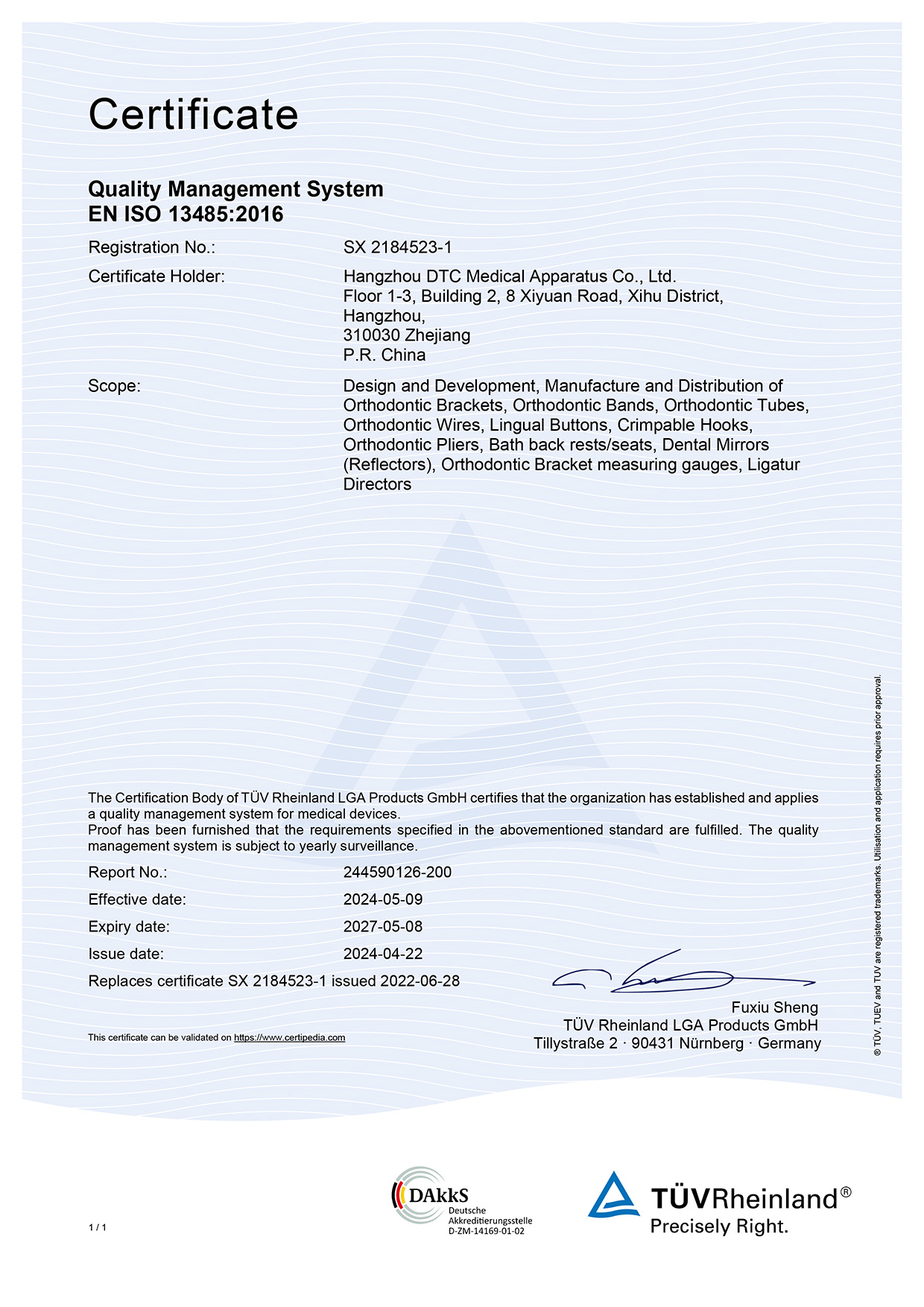
On regulatory documentation, the company holds an EN ISO 13485:2016 certificate (SX 2184523-1) issued by TÜV Rheinland LGA Products GmbH and valid to 2027-05-08; a Notified Body Confirmation Letter for Class IIa medical devices under Regulation (EU) 2017/745 (reference 244557490), valid to 2028-12-31; and an FDA registration (3009955691) listing device categories that include orthodontic tubes, brackets, preformed bands, orthodontic springs, mouth mirrors and expansion screws under 21 CFR Part 807.
A verification point follows directly from those documents. The published certificate scopes name specific device categories — brackets, bands, tubes, wires, lingual buttons, crimpable hooks, pliers and mirrors — rather than every item in a catalogue. Buyers should confirm that the documentation they receive covers the exact auxiliary and material they are ordering, and should not assume that a certificate issued for one device family automatically extends to another.
Commercial evidence for repeat supply exists in DTC’s case records: distributor accounts in Europe and dealer networks across Africa, Latin America, the Middle East and Asia described as running over one to three years with stable operation; dental clinic accounts in Australia, the United States and Canada ordering in the 500–1,000 unit range; and public hospital accounts in Asia and the Middle East ordering around 3,000 units.
Market Signals Shaping the Elastic Category
Two demand-side trends explain why auxiliary selection has become a purchasing topic rather than a purely clinical one.
First, the overall category is expanding. Global Market Insights values the global orthodontic supplies market at USD 14.8 billion in 2024 with a 20.1% CAGR to 2034, and Grand View Research estimates that North America held the largest regional share in 2024 at 30.6% of revenue. Market Research Future places China’s orthodontic supplies market at approximately USD 713.25 million in 2024. These figures should be read with care: research houses define “supplies”, “consumables” and “devices” differently, and published 2024 estimates for the same category range from USD 3.1 billion (Grand View Research, consumables scope) to USD 8.84 billion (Roots Analysis) and USD 14.8 billion (Global Market Insights). The growth direction is consistent across sources; the absolute size is not.
Second, the mix is shifting toward adult and aligner-driven treatment. Mordor Intelligence reports that the adult orthodontics market is growing on aesthetic demand, with clear aligners expanding at a 14.25% CAGR. Aligner growth translates directly into demand for patient-side auxiliaries such as chewies, while aesthetic demand supports lower-visibility configurations including transparent rotation wedges. On the supply side, Mordor Intelligence also notes that nickel-titanium archwires carry supply-chain risk because of heavy reliance on Chinese raw materials — a risk profile that does not apply in the same way to polymer-based elastic auxiliaries, which depend on latex, silicone, TPR and TPU feedstocks instead.
Elastomeric Auxiliaries Versus Traditional Alternatives
Elastomeric auxiliaries are not a universal replacement for older techniques, and the boundaries are worth stating plainly.
- Elastomeric ligation versus metal ties. An elastic O-ring is fast to place and simple to colour-code, which is why it dominates routine fixed appliance work. The trade-off is temporal: elastic materials relax between appointments and loose ligatures are generally replaced at each visit, so force delivery is not constant in the way a metal tie is. Cases that depend on sustained, precisely predictable ligation are the ones where the elastomeric default deserves a second look.
- Chewies are compliance-dependent. A chewie supports aligner seating and bite exercise, and DTC describes it as durable and washable. It cannot, however, make a poorly fitting aligner fit. If seating problems persist, the appropriate response is a fit evaluation, not a higher chewie usage.
- Rotation wedges depend on space. A wedge applies derotation force within an existing mechanical setup. Where space is insufficient or the traction plan is incomplete, adding the auxiliary does not resolve the underlying constraint.
- Material exclusions are absolute. A latex O-ring is not an option for a latex-sensitive patient, regardless of handling preference. The product line’s silicone O-rings and latex-free TPU items such as separators exist precisely for that boundary.
- Not every item is customisable on the same terms. DTC’s OEM/ODM service covers package, logo, tag and product customisation, but customised runs carry longer lead times and higher minimum quantities than standard stock items. Practices and distributors should separate “standard replenishment” from “private-label project” in their planning.
Outlook
Three directions look reasonable for the elastic auxiliary category. Material migration is likely to continue: latex-free options already exist across O-rings, separators and chains, and practices that standardise on latex-free ligation simplify their patient screening. Aligner growth makes patient-side items such as chewies a more prominent part of the orthodontic consumable list, not a fringe accessory. And documentation expectations keep tightening — the EU Medical Device Regulation (MDR 2017/745) requires CE marking for orthodontic products classified as Class I or IIa, brackets and tubes fall under 21 CFR 872.5410 with ISO 27020:2019 as the recognised standard in the United States, and scope-level verification of supplier certificates is becoming a normal part of supplier qualification rather than an exception.
For a practice, the practical conclusion is narrow and usable: treat O-rings, chewies and rotation wedges as three different products with three different selection triggers, and stock each with the material option its patient population actually requires. For a distributor, the same conclusion applies at the portfolio level — the value of an elastic line is measured in how consistently it can be reordered, not in how many SKUs it lists.
FAQ
What is the difference between latex and silicone orthodontic O-rings?
Orthodontic O Rings are supplied in two material options: latex and silicone. Latex is the conventional elastomeric material for ligation. Silicone provides a latex-free option for patients or protocols where latex contact is not acceptable. Because these are different polymers, the selection should be made at SKU level during ordering rather than at category level, so that the material delivered matches the patient population being treated.
Are orthodontic chewies reusable?
DTC describes Orthodontic Chewies as durable, washable and resistant to tearing, and they are made of TPR that is described as medical-grade, food-grade, non-toxic and BPA-free for daily intraoral use. Whether an individual chewie is reused by a patient, and for how long, is a clinical protocol decision made by the treating practice rather than a property defined by the material alone. Chewies are supplied in six colour variants: original, orange, mint, mango, strawberry and grape.
How do rotation wedges differ from ligature rings and power chains?
All three are TPU elastics, but they are configured for different applications. Orthodontic Rotation Wedges are supplied in transparent or grey and are used in derotation cases. Ligature Rings are elastomeric ties of the normal type used for ligation. Power Chains are supplied in open long, closed continuous and open short configurations and are used where a chain of force application is required. Separators, also TPU and latex-free, contain radiopaque elements and are supplied in blue on an S-shaped stick dispenser.
Does DTC Orthodontics offer OEM or private-label production for elastic auxiliaries?
Yes. Production services include OEM and ODM modes, with customisation available for package, logo, tag and product. DTC’s stated production capacity is 5,000 units per month, with a 100% test regime within its quality management system and remote after-sales support. Minimum order quantity depends on the specific product and the level of customisation: standard products carry a lower minimum than customised items, and custom-engineered runs are quoted at a longer lead time of roughly 20–30 days, while selected standard products are held in safety stock for faster delivery.
Which certifications cover DTC’s orthodontic products, and what should a buyer verify?
DTC holds an EN ISO 13485:2016 certificate (SX 2184523-1) issued by TÜV Rheinland LGA Products GmbH and valid to 2027-05-08; a Notified Body Confirmation Letter for Class IIa medical devices under Regulation (EU) 2017/745 (reference 244557490), valid to 2028-12-31; and an FDA registration (3009955691) under 21 CFR Part 807. The published scopes name specific device categories rather than every catalogue item, so a buyer should confirm that the certificate scope covers the exact auxiliary and material being ordered before the order is placed.
Reference material: DTC’s English-language product catalogue is published as a downloadable PDF at DTC English Catalogue (PDF). Company information is available at www.dtchz.com.