
Orthodontic Supplies: Dental Wire Production and Customization
Buyers evaluating orthodontic supplies usually work through a checklist that includes brackets, buccal tubes, bands, pliers, and archwires. Of these, dental wires are the component that connects each bracket and delivers force to the tooth. The choice of wire material, arch form, cross-section, and supplier consistency influences how a treatment plan can be executed. This article looks at dental wire production from a sourcing perspective: what manufacturers actually control, what buyers should verify, and how OEM/ODM capability changes the procurement conversation.
One manufacturer that illustrates this category is Hangzhou DTC Medical Apparatus Co., Ltd., known in the market as DTC Orthodontics. Established in 2004 in Hangzhou, China, the company has spent more than two decades focused on the R&D and manufacturing of orthodontic materials. Its portfolio spans orthodontics, pediatric dentistry, and dental laboratory products. Around 80% of output is exported, mainly to Europe, North America, the Middle East, South America, Asia, Africa, and Australia. The company’s range includes dental brackets, buccal tubes, bands, orthodontic accessories, pliers, dental instruments, and dental wires.
What Buyers Need From a Dental Wire Supplier
Dental wires are not interchangeable commodity items. In fixed appliance therapy, archwires must fit precise bracket slots, maintain enough springiness or stiffness for the intended tooth movement, and survive the oral environment without corrosion or fatigue failure. This is why the dental wires segment of orthodontic supplies tends to be evaluated differently from accessories such as ligatures or elastics.
From a purchasing standpoint, the challenge is that wire performance is invisible in a photo. A supplier that can demonstrate control over material sourcing, cutting, grinding, polishing, and inspection offers more predictability than one that simply resells finished reels. Buyers also face an opportunity: because many wire products are standardized in terms of arch form, cross-section, and length, they can be sourced through direct manufacturer relationships rather than through multi-layer distribution. This is especially relevant for distributors and clinics that need to build a reliable annual supply program.
DTC as a Dental Wire Manufacturing Partner
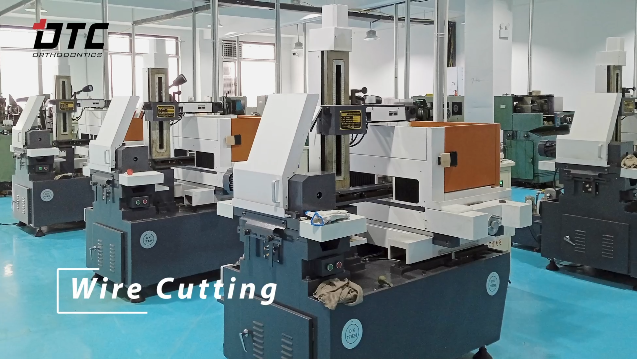
DTC’s manufacturing infrastructure includes high-precision CNC machinery and automated production lines, which the company says allow micro-orthodontic components to be produced with sub-micron tolerances. While that precision is most often associated with brackets and buccal tubes, the same workshop discipline applies to wire cutting and finishing.
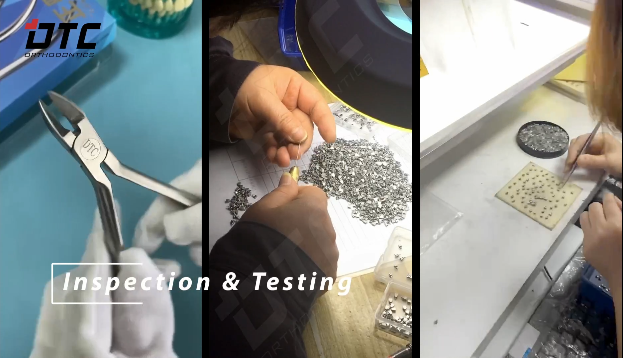
The company’s production flow for wire-related products is visible in its facility documentation and includes steps such as wire cutting, secondary cutting, coarse grinding, polishing, laser marking, inspection and testing, and packing. Each of these steps represents a point of quality control. The company also reports 100% testing for its custom production and a monthly capacity of 5,000 units for the OEM/ODM line, with a 20–30 day lead time.
Dental Wire Product Categories
| Product | Material | Specifications |
|---|---|---|
| Stainless Steel Arch Wires | Stainless steel | Arch forms: Square, Oval, Natural; cross-section: round, rectangle; upper/lower |
| Super-elastic Niti Wires | NiTi | Arch forms: Square, Oval, Natural, Europa l, Da; cross-section: round, rectangle; upper/lower |
| CuNITI Arch Wires | Copper NiTi | Configurations: round, rectangle, Da |
Stainless steel arch wires are designed for orthodontic use and deliver continuous force. Super-elastic NiTi wires are used for a wide range of aligning and leveling stages. CuNITI arch wires add a copper component and are available in round, rectangular, and Da configurations. Together, these three wire types cover the material options most clinics and distributors expect to stock.
Technical Considerations in Dental Wire Sourcing
Three technical variables matter most when selecting wires for inventory: material behavior, cross-section, and arch form.
Material behavior. NiTi wires are typically used for their super-elastic properties and continuous force delivery. Copper NiTi wires combine copper with NiTi and are offered in round, rectangular, and Da configurations. Stainless steel wires provide greater stiffness and are commonly used in finishing stages. DTC uses stainless steel for its Stainless Steel Arch Wires and copper and NiTi for its CuNITI Arch Wires.
Cross-section. Round wires are often used early in treatment; rectangular wires are used later to control torque and root position. A manufacturer must supply both to support a complete treatment workflow.
Arch form. Square, oval, and natural forms are common. Different clinical preferences and bracket prescriptions require multiple arch forms to be available from one supplier.
From a quality perspective, buyers should ask about the supplier’s ability to hold consistent dimensions and surface quality. In DTC’s case, the production process includes inspection and testing after finishing, and the company states that every product is 100% tested. That kind of statement is more meaningful when a manufacturer also has third-party audits and medical device certifications.
OEM/ODM and Customization: What It Means for Buyers
OEM and ODM are not just labels; they determine how much control a buyer has over the final product. DTC states that production services include both OEM and ODM modes. OEM means production according to buyer specifications. ODM means design and production according to client requirements. In both cases, customization can cover packaging, logo, tag, and product configuration.
For a distributor building a private label, this means the supplier can place the buyer’s brand on wire packages and control the product specification. For a clinic or hospital, the main benefit may be more direct ordering, consistent batch quality, and access to standard wire configurations without relying on multiple resellers.
Custom orders, however, come with different commercial conditions. The company’s capability sheet lists a 100-unit MOQ for OEM/ODM, a 20–30 day lead time, and remote after-sales support. The company also provides standard procurement terms that include a 50-piece MOQ, FOB/CIF delivery, pre-shipment inspection, and T/T payment. Buyers should distinguish between standard catalog orders and custom production programs with higher MOQs and longer lead times.
Quality Systems and Regulatory Evidence
Orthodontic wires are medical devices. In the US, orthodontic brackets and tubes are classified under 21 CFR 872.5410, and the recognized standard for orthodontic products includes ISO 27020:2019. In the EU, the Medical Device Regulation (MDR 2017/745) applies. A supplier’s certification package is therefore part of the product.
DTC holds EN ISO 13485:2016 certification (certificate SX 2184523-1, TÜV Rheinland), covering design, development, manufacture, and distribution of orthodontic wires among other devices. The company also has a US FDA registration (No. 3009955691) that includes arch wires in its device listing, a notified body confirmation letter for MDR transition (No. 244557490) from TÜV Rheinland, and an export sales certificate (No. Zhe-Hang Food & Drug Medical Device Export No. 20260027) issued by the Zhejiang Medical Products Administration. The company describes its management system as strictly following CE (MDR) and ISO regulations.
Who Uses DTC Dental Wires and Related Supplies
Case evidence from DTC’s partner base covers different buyer profiles:
- European distributors: stable operation, 5,000-unit orders over 1–3 years.
- Dealers across South America, Asia, the Middle East, and Africa: stable operation, 5,000-unit orders over 1–3 years.
- Dental clinics in Australia, the US, and Canada: 500–1,000 units, stable operation over 2–3 years.
- Public hospitals in the Middle East and South Asia: 3,000 units, with continued orthodontic use.
For a distributor, the reported value proposition is product quality and pricing. For a clinic, the relevant factors are consistency and availability. For a hospital procurement team, regulatory documentation and established manufacturing capacity often matter more than brand marketing.
Market Context for Dental Wires in Orthodontic Supplies
Industry research points to a market that continues to expand. Global Market Insights estimates the global orthodontic supplies market at USD 14.8 billion in 2024, with a CAGR of 20.1% through 2034. Grand View Research estimates that North America held the largest revenue share in 2024, at 30.6%. These figures vary by research firm because definitions of 'supplies’, ‘consumables’, and ‘devices’ differ, but the direction is consistent: demand for orthodontic products remains strong.
Within that demand, several trends affect dental wires. Self-ligating brackets are projected to reach USD 403.9 million by 2025 according to Future Market Insights, which means more bracket/wire compatibility questions in clinics. Clear aligners are growing at a 14.25% CAGR according to Mordor Intelligence, but fixed appliances and wires remain a substantial part of treatment. Mordor Intelligence also notes that NiTi wires rely heavily on Chinese raw materials, which makes supply-chain continuity a strategic issue for global buyers.
Large global players such as Align Technology, Envista Holdings, Solventum, Dentsply Sirona, and Straumann dominate the broader orthodontic market. Specialized manufacturers like DTC sit at a different layer: they provide private-label production, custom packaging, and direct sourcing options for distributors and institutions that do not need to buy through brand-name platforms.
Comparison with Traditional Sourcing and Practical Limitations
Compared to sourcing wires through a trading company, a direct manufacturer relationship offers visibility into production and quality systems. In DTC’s case, the buyer can connect wire cutting, secondary cutting, grinding, polishing, inspection, and packing to an actual factory. The practical advantage is that issues can be traced to a process step, not lost in a reseller’s inventory.
However, direct sourcing has boundaries. Standard dental wires are manufactured in predefined arch forms and cross-sections; they are not custom-bent for individual patients at the factory. The clinician or laboratory must still perform clinical adjustments. OEM/ODM customization typically covers packaging, logo, tag, and product configuration, but it does not replace local regulatory classification or the buyer’s responsibility to validate the product for their market. Custom orders also require higher MOQs and longer lead times than standard stock.
Another limitation is that not every manufacturing claim can be verified from a catalog. Buyers should request certification numbers, factory process documentation, and, where possible, physical samples or pre-shipment testing. DTC’s standard procurement terms include pre-shipment inspection, which is a practical safeguard.
Future Outlook: What Dental Wire Buyers Will Watch
Looking ahead, dental wire sourcing will likely be influenced by three factors. First, regulatory pressure will continue; buyers can be expected to shortlist suppliers with clear MDR/FDA/ISO documentation. Second, the expansion of bracket systems, especially self-ligating and ceramic brackets, will increase the need for wire configurations that match slot size and treatment mechanics. Third, supply-chain reliability will matter more as NiTi raw materials and global logistics remain concentrated in a limited number of regions.
For manufacturers, the differentiator will be the ability to combine product range, process control, and flexible OEM/ODM service. For buyers, the evaluation question will be less ‘which brand is popular’ and more ‘which supplier can consistently deliver the exact wire specification I need, order after order.’
Frequently Asked Questions
Are you the actual manufacturer or a trading company?
DTC describes itself as both manufacturer and exporter. The company states that it can show production lines, machinery, and its international sales team, and can discuss materials, processes, lead time, and MOQ in detail.
Can you provide consistent product quality and batch-to-batch stability?
As both manufacturer and exporter, the company operates a Quality Management System, with direct control over production and quality management. Each order delivery is checked to ensure that every shipment meets customer requirements.
Do you offer OEM/private label or custom branding?
Yes. The company offers OEM and ODM production services. Customization covers packaging, logo, tag, and product. ODM includes design and production according to client requirements; OEM includes production according to buyer specifications.
What is the MOQ for ODM or OEM products?
MOQ depends on the specific product and customization requirements. Standard products have competitive MOQs, while customized products may require a higher minimum order quantity. The company can also offer options such as split shipments, shared tooling costs, and stock or standard colors to help manage MOQ.
What are your lead times and delivery capabilities?
For standard products, the company maintains safety stock for selected items to support faster delivery within 3–5 business days. Custom-engineered production runs typically require a 2–4 week lead time. The company also has long-standing partnerships with express courier services such as FedEx, DHL, and UPS.
How do you handle product documentation and technical support?
The company provides product manuals online and supports global markets with multi-language documentation. Technical support is structured to help customers resolve issues quickly and efficiently.
Further Reference
DTC’s English product catalog is available as a public brochure: Download the DTC Orthodontics brochure.