
Outdoor Heavy Duty AGV: The Constraints Buyers Must Verify
Why 'outdoor' changes the decision more than 'heavy duty'
An outdoor heavy duty AGV is an automated guided vehicle platform designed to move payloads measured in tens to hundreds of tonnes across open yards, port aprons, cross-workshop roads and exterior assembly areas rather than sealed factory floors. The engineering question it raises is not primarily about load. A vehicle rated at 60 tonnes indoors and a vehicle rated at 60 tonnes outdoors look similar on a specification sheet and behave completely differently once the site has rain, dust, gradients, variable floor friction, longer routes and mixed pedestrian traffic.
For buyers in the research and evaluation stages, the more useful way to read a heavy duty automated guided vehicle catalogue is as a set of constraints. Payload floor, ingress protection, navigation redundancy, charging cycle and certification coverage each narrow the project scope independently. A single mismatch is usually enough to invalidate an otherwise attractive quotation. That is why outdoor projects in wind power, energy storage and heavy machinery rarely reduce to a standard product selection.
The constraint list that decides feasibility
Lonyu AGV Co., Ltd. (Yuntong Tianjin Industrial Co., Ltd.), the Tianjin-based manufacturer and exporter of heavy-duty AGV systems, publishes a practical pre-project list for its outdoor applications: payload, cargo dimensions, route length, floor load capacity, gradients, turning space, indoor-to-outdoor transitions, navigation method, charging cycle and safety boundaries. The final configuration is confirmed against a site assessment and signed drawings.
Read carefully, that list is not administrative. Each item constrains a different subsystem:
- Payload and cargo geometry determine chassis length, wheel count and whether a backpack (under-rack) or flat-bed configuration is viable.
- Gradients and turning space determine drive configuration and the practical climbing limit, which typically sits at ≤5° on the heaviest platforms and can reach ≤10° on outdoor flat-bed models.
- Indoor-to-outdoor transitions decide whether a single navigation stack — or a combined one — is required.
- Charging cycle determines battery chemistry, voltage class and whether a battery-swap station is needed rather than a charging point.
- Safety boundaries decide sensor count and whether multi-layer redundant safety control is mandatory rather than optional.
A buyer who treats these as commercial negotiation points rather than engineering gates will usually discover the gap during commissioning, when chassis geometry and navigation infrastructure are already fixed.
What an outdoor-rated platform actually contains
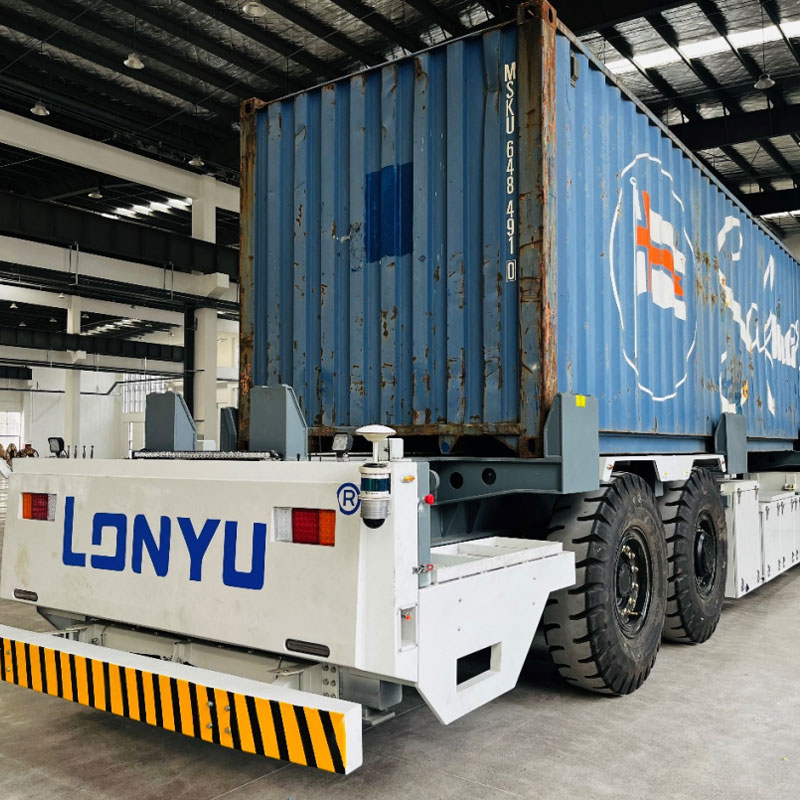
The clearest reference point in the current Lonyu range is the outdoor unmanned flat-bed platform designated LY-3-70T-612-B, an industrial heavy duty AGV built for yard work rather than factory aisles. Its published parameters give a concrete picture of what outdoor capability costs in components.
| Parameter | Published value |
| Model | LY-3-70T-612-B |
| Rated load | 100,000 kg |
| Working environment | Outdoor operation |
| Protection level | IP65 |
| Navigation | RTK + INS (differential integrated navigation, inertial navigation, laser SLAM) |
| Navigation accuracy | ±20 mm |
| Walking speed | 36 km/h |
| Climbing ability | ≤10° |
| Body structure | 12×6 configuration |
| Braking | Servo electronically controlled hydraulic, disc type |
| Suspension and tyres | Air-bag suspension; low-pressure tubeless tyres |
| Battery and runtime | Lithium iron phosphate; 6 hours when fully charged |
| Battery voltage | 330 V / 570 V / 614 V |
| Charging | Manual charging, automatic charging pile, intelligent battery swap station, manual battery swap |
| Extended range options | Diesel range extension, methanol range extension (optional) |
Three details in that table matter more than the headline payload. First, IP65 is a genuine outdoor enclosure rating, and it is not universal across the heavy-duty range — several indoor-oriented models are listed at IP44 or IP54. Second, RTK + INS combines satellite positioning with inertial and laser SLAM reference, which is what allows a 100-tonne platform to enter a shed, lose sky view, and continue on a local reference. Third, the charging methods include a battery swap station and two range-extension options, which indicates that runtime, not speed, is the operational constraint outdoor fleets actually plan around.
Navigation, safety and power as interdependent systems
On outdoor routes, navigation and safety cannot be specified separately. The Lonyu outdoor platform stacks a perception layer — visual perception sensors, environment perception sensors and device perception sensors — on top of the RTK + INS navigation stack, and pairs it with perceptual failsafe logic and multi-layer redundant safety control. The 12-ton indoor model in the same catalogue uses a simpler and cheaper arrangement: magnetic strip navigation, ±10 mm positioning accuracy, and safety protection limited to a laser obstacle avoidance sensor, safety edge touch, sound and light alarm and an emergency stop button. The difference is not marketing language; it is a different sensor bill of materials, and it is reflected in what the vehicle can be trusted to do unattended.
Outdoor navigation is also where regional infrastructure assumptions enter the purchase. The 20-ton outdoor AGV transfer cart is described as operating on Beidou satellite positioning combined with multi-line laser and vision, and as capable of accurate operation indoors and outdoors, including in high-temperature and high-dust environments. That combination is a reasonable fit for Chinese industrial sites where Beidou coverage is the design assumption. Buyers operating outside that coverage area should treat the positioning stack as a configuration item to confirm, not as a fixed platform attribute.
Power follows the same logic. The catalogue states DC48 V and DC96 V lithium iron phosphate packs as standard for the heavy-duty range, with 330 V, 570 V and 614 V high-voltage options for high-speed outdoor unmanned vehicles, and the outdoor flat-bed model uses the higher voltage classes. Published runtime for standard heavy-duty AGVs of 100 tonnes and above is typically around 3 hours at both empty and full load, while the outdoor flat-bed platform is listed at 6 hours when fully charged. Both figures are test-condition statements, so the operating question becomes how many shifts a site runs and whether a swap station is cheaper than a second vehicle.
Certification is a scoping constraint, not a badge
For anything moving hundreds of tonnes under partial autonomy, certification coverage is often the first hard boundary a procurement team hits, because certificates are issued per model and per directive, not per brand. The Lonyu documentation illustrates the point clearly.
An ECM Mark CE certificate, number 6D230301.TLR0W80, issued by Ente Certificazione Macchine (ECM), covers the Heavy Load AGV model LY-AU-240T-12-0A-427 against Machinery Directive 2006/42/EC, Low Voltage Directive 2014/35/EU and Electromagnetic Compatibility Directive 2014/30/EU, valid from 1 March 2023 to 28 February 2028. A separate ECM verification, number 6D230301.TLR0W79, covers the same model against CE Directive 2014/68/EU on pressure equipment, referencing standards including EN 13855-2, EN 14120, EN 1088, EN 349, EN ISO 13857 and ISO 4413, with the same validity window.

For the US market, a separate UL certificate, number US 72508429.0001, was issued by TÜV Rheinland of North America, Inc. on 23 January 2025 for the 60T Backpack Lifting Type AGV, model LY-AU-60T-6-08-1011, against ANSI/CAN/UL 3100:2024 and ANSI/ITSDF B56.5:2019. The certificate scope states a rated load of 132,277 lb and a maximum load of 145,000 lb, with a Type 1 enclosure rating.
Two practical consequences follow. If a project needs a certified machine, the certificate model number must match the quotation model number — a certified 240-tonne heavy load AGV does not automatically certify a 600-tonne custom build. And the reference standard for driverless industrial trucks, ISO 3691-4:2023, published in June 2023, is the current baseline that CE marking activity is measured against, so a certificate whose standards list predates it deserves a direct question during vendor qualification.
Where outdoor heavy duty AGVs earn their cost
The applications where the constraint set actually resolves in favour of automation share a pattern: heavy, oversized or awkward loads, repetitive routes, and an environment that is unpleasant or unsafe for a driver.
Wind power is the clearest case. The 200-tonne platform designated 24111A is specified for indoor and outdoor transport of wind turbine main engines and drive systems, with a 200 mm lifting stroke, ±10 mm navigation and positioning accuracy, magnetic stripe navigation, eight-wheel drive across sixteen wheels, ≤5° climbing ability and IP54 protection. The lower IP rating relative to the outdoor flat-bed model is itself a useful procurement signal: nacelle and drivetrain handling usually happens on prepared surfaces under partial cover, not in open weather.
Energy storage containers are handled by the trackless platform designated 24391A, rated at 80 tonnes with a 200 mm lifting stroke, ±30 mm navigation accuracy and IP54 protection. Commercial vehicle chassis assembly uses the outdoor navigation AGV model LK-AK-15T-4-0-B, a 15-tonne payload unit with a 4-tonne product weight whose support points adjust to front and rear axle spacing and whose support count can be designed to the axle count — a configuration decision, not a catalogue selection.
Long or awkward components use a different mechanism entirely. The 30-ton double-vehicle linkage AGV carries products 11 to 27 metres long with an adjustable linkage distance, which is how a single rigid chassis limitation gets engineered around rather than accepted. High-speed rail track slab casting and curing, high-temperature and high-humidity transport above 30 tonnes, and steel coil, mould and transformer handling all appear in the same project record.
What the market data says, and what it does not
The global automated guided vehicle market was valued at USD 5.52 billion in 2025 according to Fortune Business Insights, with heavy-load AGVs identified as a key segment within it. The same source places Asia Pacific at 35.51% of that market in 2025, and independent estimates from other research houses land in a comparable band around 38.5%. The two figures differ in method but agree on direction: the region with the densest heavy-manufacturing base is also where the largest share of AGV deployment sits.
What the data does not support is a claim about price. Reliable per-tonne pricing for AGVs above 50 tonnes is not publicly available, which is the single largest gap in most buying cases: teams can benchmark capability, but not cost per tonne of payload. Buyers should expect to build that benchmark from project quotations rather than from published market research.
Comparison with conventional manual handling — including where it wins
Against forklifts, tow tractors and crane-based handling, an outdoor heavy duty AGV replaces labour dependency and route variability with a fixed route and a dispatch system. It also removes the driver from a hostile environment — high temperature, high dust, or a load mass that makes manual driving a safety event waiting to happen. Those are real advantages for repetitive, long-cycle movement.
The limits are equally real, and any credible evaluation should state them:
- It is engineered, not ordered. Lonyu positions non-standard body shape, drive and suspension, navigation method and indoor/outdoor route adaptation as customization items, with final configuration confirmed per model and technical agreement. A site that cannot run a survey, or cannot wait for signed drawings, is not a good fit.
- Speed is usually lower than manual on long runs. Published travel speeds vary from 25 m/min at full load on some heavy platforms to 48 m/min unloaded on others, and general guidance for indoor heavy-duty operation suggests keeping speed at or below 30 m/min for safety. A 60-tonne tow tractor driven manually will often cover a long yard route faster.
- Runtime must be designed for, not assumed. Around 3 hours at full and empty load is typical for heavy-duty AGVs above 100 tonnes, with the outdoor flat-bed model rated at 6 hours. Sites without charging or swap infrastructure will feel that constraint immediately.
- Not every model tolerates weather. IP44, IP54 and IP65 all appear in the same product family. A quotation for a heavy duty AGV that is not explicitly outdoor-rated should be assumed unsuitable for open-yard duty until the supplier confirms otherwise.
- Manual work does not disappear. Load pick-up, positioning onto support points, and exception handling remain human tasks on most projects.
Outlook: the standardisation gap is the next battleground
Two forces will shape the next phase of outdoor heavy duty AGV procurement. The first is standards convergence. ISO 3691-4:2023 gives buyers a common reference point for driverless industrial truck safety, and as CE and UL scopes align to it, certification becomes easier to compare across suppliers rather than a document-by-document negotiation.
The second is the absence of standardised performance benchmarking. Because 'heavy duty' spans roughly 2 to 1,000 tonnes across the industry, buyers currently have no common way to compare actual load limit, precision at maximum load, battery runtime at full load, or maintenance frequency. Until supplier capability matrices become normal in tender packages, the practical defence is to demand model-specific documentation — certificate numbers, drawing-controlled dimensions and site-specific runtime figures — rather than family-level claims. Lonyu AGV Co., Ltd. has been running this category since 2008 from an 8,000+ m² facility with 300+ staff, an annual output of 2,000+ units and an export share of 80%, and its project record includes more than 800 large-scale engineering deployments, which is the kind of evidence base a buyer should ask to see referenced against a matching payload class.
Frequently asked questions
What load range does a heavy duty AGV cover?
The Lonyu heavy-duty range is listed as covering 1 tonne to 1,000 tonnes, with customization supported. Standard coverage is commonly described as 1 tonne to 600 tonnes. The maximum rated load for a single vehicle is stated at 600 tonnes, using an ultra-thin chassis format with a 400 mm-class thickness, while dual-vehicle linkage configurations are described as capable of handling over 1,000 tonnes for very large workpieces such as wind turbine components, pressure vessels and ship sections.
How long can a heavy duty AGV run on a single charge?
Under rated load, with normal usage and proper maintenance, runtime is designed against the site's shift pattern or production rhythm. As a general reference, standard heavy-duty AGVs of 100 tonnes and above typically run for approximately 3 hours at both empty and fully loaded conditions. The outdoor unmanned flat-bed platform LY-3-70T-612-B is listed at 6 hours when fully charged.
What battery voltage options are available?
Standard heavy-duty AGVs use DC48 V or DC96 V lithium iron phosphate batteries. High-speed outdoor unmanned vehicles offer higher voltage classes of 330 V, 570 V and 614 V. Configurations are customizable, and charging methods include manual charging, automatic charging pile charging, an intelligent battery swap station and manual battery swap, with diesel or methanol range extension available as options on outdoor models.
Which certifications apply to heavy duty AGV models?
Certification is issued per model and per directive. ECM Mark CE certificate 6D230301.TLR0W80 covers the Heavy Load AGV model LY-AU-240T-12-0A-427 under Machinery Directive 2006/42/EC, Low Voltage Directive 2014/35/EU and EMC Directive 2014/30/EU, valid from 1 March 2023 to 28 February 2028. ECM verification 6D230301.TLR0W79 covers the same model under CE Directive 2014/68/EU for pressure equipment. UL certificate US 72508429.0001, issued by TÜV Rheinland of North America, Inc. on 23 January 2025, covers the 60T Backpack Lifting Type AGV model LY-AU-60T-6-08-1011 against ANSI/CAN/UL 3100:2024 and ANSI/ITSDF B56.5:2019. Buyers should confirm that the certificate model number matches the quoted model number.
What site conditions should be verified before ordering an outdoor heavy duty AGV?
A project should verify payload, cargo dimensions, route length, floor load capacity, gradients, turning space, indoor-to-outdoor transitions, navigation method, charging cycle and safety boundaries before configuration is fixed. Final configuration should follow a site assessment and signed drawings. Additional items worth confirming early are the protection level required for the specific route, whether satellite positioning coverage is available at the site, and whether a battery swap station is needed to support the planned shift pattern.
A closing note on how to read the evidence
The most reliable way to evaluate an outdoor heavy duty AGV supplier is to compare documents rather than descriptions: certificate numbers against model numbers, drawing-controlled dimensions against route data, and published runtime figures against shift requirements. Lonyu AGV Co., Ltd. is a Tianjin-based manufacturer of heavy-duty AGVs, light-duty AGVs, AGV intelligent dispatching systems, outdoor unmanned AGVs, trackless transfer carts and automatic mold transfer systems, exporting to aerospace, military, high-speed rail, wind power, shipbuilding, heavy truck, energy storage, engineering machinery and port sectors. A company brochure covering the wider product range is available for download at the Lonyu company brochure.
Have Questions or Need More Details?
Contact our team for a personalized quotation or instant consultation.
Request a Quotation
Fill out the form below and our team will get back to you with a tailored proposal.
WhatsApp Direct Chat
Prefer to chat in real-time? Message us on WhatsApp for instant assistance & quick answers.
- Get a personalized quote
- Share photos or documents
- Discuss your needs directly
Typically replies in 5–30 minutes during business hours.