
Outdoor LED vs Outdoor LCD vs Dual-Screen: A Buyer Framework
Summary: The choice between an outdoor LED screen, an outdoor LCD display and a dual-screen outdoor advertising machine is a site-matching decision, not a ranking decision. Brightness, ingress protection, dot pitch, native resolution, power provisioning and content workload each favour a different format. This framework shows how to convert those parameters into purchase terms and acceptance criteria that match the installation site rather than the brochure.
Outdoor Display Procurement Has Become a Specification Problem
Outdoor commercial display tenders used to separate cleanly by technology: a large façade went to LED, a pavement-level information panel went to LCD, and a media pole went to whichever format the advertising contractor already operated. That separation is weakening. Modular outdoor LED, sealed outdoor LCD and dual-face outdoor advertising machines now appear inside the same evaluation, often for the same street corner, because each format has improved at the edge of the others' territory.
The practical consequence for buyers at the research and evaluation stage is that the decision can no longer be made from a headline brightness figure. What determines a successful outdoor deployment is whether the specification matches four site realities: how much ambient light hits the face, how close the nearest viewer stands, how the unit is powered and serviced, and how much content has to be scheduled per day. The three formats in the GZKEDRO outdoor range — the KD-LED Series outdoor LED screen, the KD-OD Series outdoor waterproof display and the KD-DSA Series dual-screen outdoor advertising machine — differ on exactly those axes.
Three Formats on One Specification Table
The table below uses only manufacturer-published parameters for the three series. Where a parameter is not stated in the published specification, the cell says so explicitly, because an unstated parameter is a procurement risk rather than a neutral gap.
| Parameter | KD-LED Series (Outdoor LED Screen) | KD-OD Series (Outdoor Waterproof Display) | KD-DSA Series (Dual-Screen Outdoor Advertising Machine) |
|---|---|---|---|
| Display principle | Surface-mount 3-in-1 LED, 1R1G1B pixel composition | LCD with D-LED backlight | LCD with D-LED backlight |
| Brightness | White balance brightness ≥4,500 cd/m² | 2,000 cd/m² | 2,000 cd/m² |
| Dot pitch / pixel pitch | 2.0 mm dot pitch; 160,000 dots/m² | 0.630 × 0.630 mm | 0.630 × 0.630 mm |
| Native resolution | Module resolution 128 × 64 dots; total resolution set by installed area | 1080 × 1920 (portrait) | 1080 × 1920 (portrait) |
| Display area | Module size 320 × 160 × 17 mm, tiled | 680.4 × 1209.6 mm | 680.4 × 1209.6 mm |
| Viewing angle | H ≥160°, V ≥140° | 178° / 178° | 178° / 178° |
| Contrast | Not stated in published parameters | 3000:1 | 3000:1 |
| Ingress protection | Not stated in published parameters | IP55 | Not stated in published parameters |
| Power | Average 235 W/m²; maximum 469 W/m² | ≤500 W total; standby <5 W | ≤500 W total; standby <5 W |
| Refresh / response | Refresh ≥3840 Hz; frame rate 60 Hz | Response 6 ms | Response 6 ms |
| Housing material | Metal sheet, aluminium alloy | Tempered glass (explosion-proof), iron steel sheet | Tempered glass, aluminium alloy |
| Operating temperature | Not stated in published parameters | −20 °C to 50 °C, 10–90% RH non-condensing | Not stated in published parameters |
| Control platform | Not stated in published parameters | RK3288 quad-core Cortex-A17 1.8 GHz, 2 GB RAM, 16 GB storage | RK3288 quad-core Cortex-A17 1.8 GHz, 2 GB RAM, 16 GB storage |
| Connectivity | Not stated in published parameters | RJ45 10/100 adaptive, Wi-Fi 802.11b/g/n, Bluetooth 4.0, SIM slot, HDMI OUT, USB, TF card | RJ45 10/100 adaptive, Wi-Fi 802.11b/g/n, Bluetooth 4.0, SIM slot, HDMI OUT, USB, TF card |
Read as a single table, the three products stop looking like competitors and start looking like different answers to different questions. The LED screen is a scalable surface with a high brightness ceiling and area-based power; the LCD units are fixed-canvas portrait panels with a defined protection rating; the dual-screen machine shares the LCD electronics and changes the number of advertising faces per enclosure.
Brightness Is a Site Condition, Not a Winner's Column
On paper the KD-LED Series is the brightest of the three, quoting white balance brightness of ≥4,500 cd/m² against 2,000 cd/m² on the KD-OD and KD-DSA Series. Buyers should resist turning that into a straight ratio. The two numbers carry different labels in the published specifications — "white balance brightness" on the LED side and "brightness" on the LCD side — and they describe different measurement contexts. Treated as directional signals rather than an interchangeable score, they tell you that LED has more headroom for high-ambient positions and that LCD outdoor units are specified for a controlled but common outdoor advertising condition.
What actually determines legibility on site is rarely the rated figure. A south-facing wall in direct summer sun, a unit shaded by a canopy, a face angled away from the main pedestrian flow and a face that catches reflected light from glazing all produce different effective contrast from identical hardware. Content contrast matters as much as panel output: a dark-background creative with thin type will read differently from a high-contrast block layout on the same 2,000 cd/m² display. This is why the useful procurement question is not "which is brightest" but "at which of my candidate positions does this unit remain legible at the hours that carry the audience".
Uniformity deserves equal attention at scale. The KD-LED Series specifies brightness uniformity of ≥97% and colour uniformity of ±0.003 Cx, Cy, with a colour temperature range of 3,000–18,000 K. On a tiled LED surface, uniformity is what separates a single image from a visible grid of modules, and it is a parameter worth testing on a sample build rather than accepting from a data sheet. On the LCD side, the 178°/178° viewing angle on both KD-OD and KD-DSA keeps the image stable for viewers approaching from the side of the unit — a relevant detail for pavement and concourse installations where people walk past rather than stand in front.
Ingress Protection: What IP55 Actually Commits a Supplier To
IP55 is stated in the published parameters of the KD-OD Series outdoor waterproof display. In the IEC 60529 scheme, the first digit 5 denotes protection against dust ingress in quantities that would interfere with operation, and the second digit 5 denotes protection against water jets from a nozzle. For a buyer, the operational meaning is narrower and more useful: the enclosure is specified to tolerate driven rain and washdown cleaning of the front face, not continuous immersion. That distinction matters when a site includes drainage failure, standing water at the base or high-pressure cleaning regimes.
Two of the three products require a follow-up question. The published parameter sets for the KD-LED Series and the KD-DSA Series do not state an ingress protection level or an operating temperature range, even though both are positioned for outdoor advertising, transport hubs, commercial districts and smart city projects. This is not a defect in the products; it is a gap between marketing positioning and contractual specification. For any outdoor tender, the protection rating of the delivered configuration — cabinet sealing, rear access, cable entry, and front-face treatment — should be written into the purchase order as a measurable acceptance item rather than inferred from the application list.
Housing construction gives a useful second signal. The KD-OD Series combines tempered explosion-proof glass with an iron steel sheet body and an air-cooled heat dissipation system built on industrial fans, with an operating window of −20 °C to 50 °C and 10–90% RH non-condensing. The KD-DSA Series pairs tempered glass with an aluminium alloy body. The KD-LED Series uses metal sheet and aluminium alloy modules. Where active air cooling is used, the maintenance plan has to include air-path and fan inspection; a sealed passive approach shifts the maintenance burden to gasket and seal integrity instead. Neither approach is maintenance-free, and the tender should say which one the operator is resourced to support.
Dot Pitch, Viewing Distance and Native Resolution
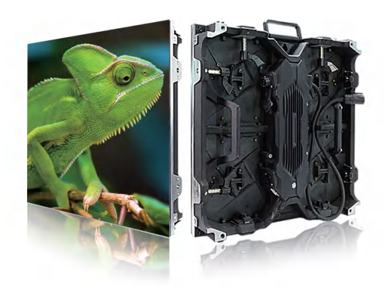
The KD-LED Series specifies a 2.0 mm dot pitch with a pixel density of 160,000 dots per square metre, built from 320 × 160 × 17 mm modules at 128 × 64 dots each. The important structural point is that LED resolution is a function of installed area: the buyer chooses the resolution by choosing the wall size. Industry planning practice commonly relates minimum comfortable viewing distance in metres to pixel pitch in millimetres, which places a 2.0 mm pitch in the mid-distance range — appropriate for street-level and plaza viewing, and less appropriate for a position where a viewer stands close enough to resolve individual pixels.
The LCD units invert the logic. Both KD-OD and KD-DSA deliver a fixed 1080 × 1920 canvas on a 680.4 × 1209.6 mm portrait display area at 0.630 × 0.630 mm pixel pitch. The resolution is set by the panel, and the content must be designed for portrait orientation from the start. That makes these units strong candidates for timetable, wayfinding, directory and menu use, where viewers stand within a few metres and read text rather than absorb an image at distance.
The practical rule for the evaluation stage is to fix the viewing geometry before the product. A site with a defined 680 mm-wide portrait face and a close-reading audience points toward the LCD formats. A site defined by the wall it occupies points toward LED, with the 2.0 mm pitch setting the closest acceptable viewer distance and the module grid setting the resolution ceiling. Choosing the format first and then negotiating the geometry usually produces either a pixelated image or a panel too small for the wall.
Single-Screen and Dual-Screen Content Delivery
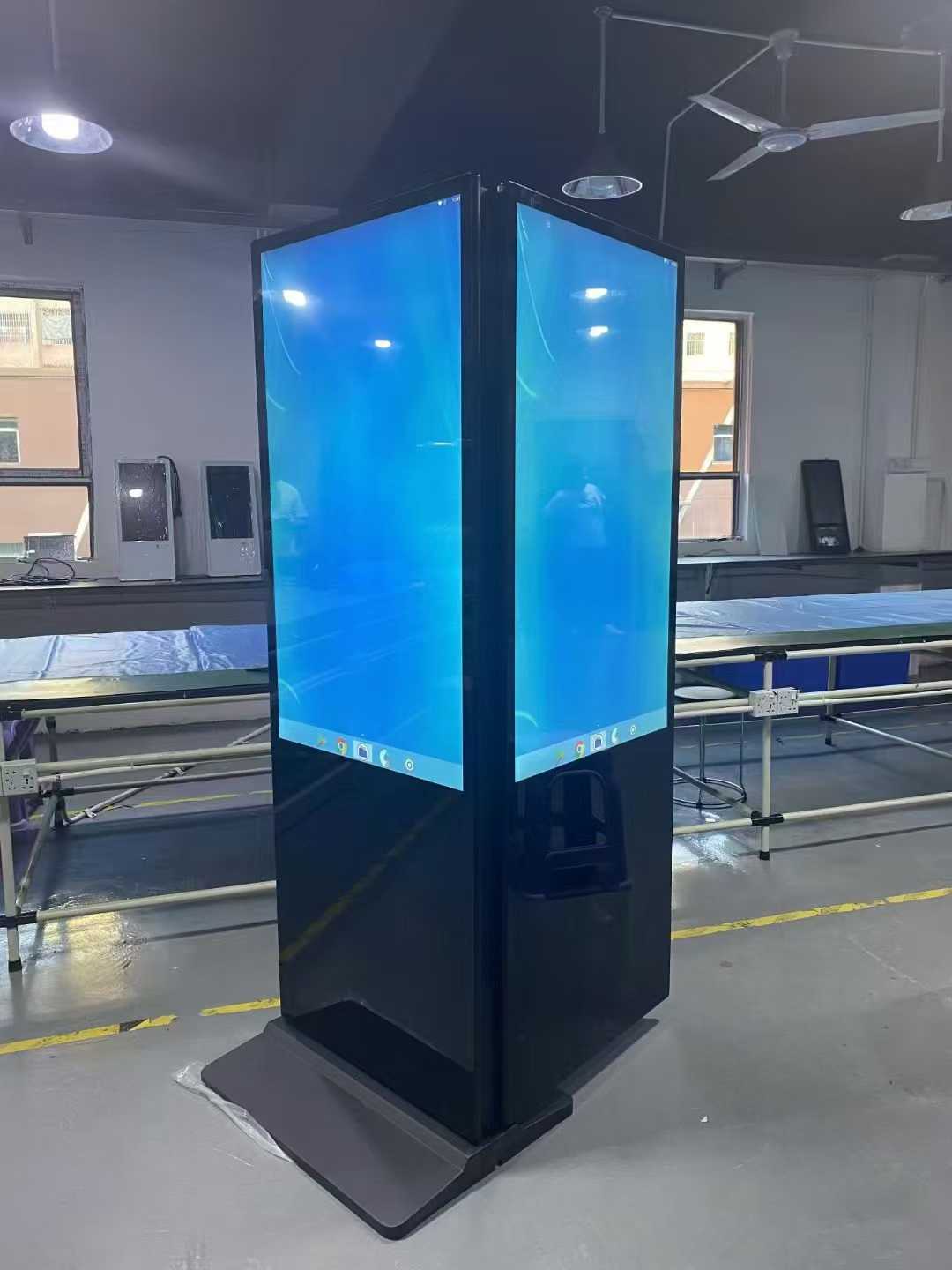
The KD-DSA Series dual-screen outdoor advertising machine shares its published display electronics almost completely with the single-face KD-OD Series: the same 1080 × 1920 resolution, the same 2,000 cd/m² brightness, the same 3000:1 contrast, the same 6 ms response, the same RK3288 quad-core Cortex-A17 platform with 2 GB RAM and 16 GB storage, and the same interface set including HDMI OUT, LAN, USB, TF card slot and SIM card slot. What differs is the number of advertising faces the unit presents, and therefore the content operation behind it.
This is where the procurement conversation should shift from hardware to workflow. A single-face unit runs one playlist on one schedule. A dual-face unit can either mirror one feed to both faces or run two independent schedules, and those two operating models have very different implications for staffing, approval cycles and advertiser reporting. The published parameter set does not settle whether independent playlists are supported on each face, so the requirement belongs in the specification: state the number of concurrent playlists, the scheduling granularity, and whether each face can be attributed separately in campaign reporting.
Network design follows the same logic. Both LCD units offer RJ45 10/100 adaptive Ethernet, Wi-Fi 802.11b/g/n, Bluetooth 4.0 and a SIM card slot, which means a dual-screen installation can be commissioned on wired Ethernet where the pole has a data drop, on site Wi-Fi, or on cellular where neither exists. GZKEDRO also supports a remote cloud control platform for device management, which changes the service model from local content loading to centralised scheduling and monitoring — a meaningful difference for operators running more than a handful of outdoor faces.
Power, Heat and Electrical Provisioning
Power provisioning is the parameter that most often derails an outdoor project after the format has been chosen. The KD-LED Series is rated at 235 W/m² average and 469 W/m² maximum, meaning its electrical demand scales with the surface area rather than with the number of units. A large façade therefore needs a supply designed around maximum draw per square metre, not average draw, and the ground leakage specification of ≤3.5 mA/m² is directly relevant when protection device sizing is being agreed with the electrical contractor.
The KD-OD and KD-DSA Series are quoted differently: ≤500 W total per unit with standby below 5 W, on a 100–240 V AC, 50/60 Hz input. That is a per-enclosure figure that can be multiplied by unit count, which makes these formats easier to cost at the electrical design stage for multi-point street installations. The two accounting models — watts per square metre versus watts per unit — should be reconciled in the bill of quantities before any commercial comparison is attempted, because a comparison that mixes them will misprice the project.
Writing Acceptance Criteria Into the Purchase Order
Because the three formats differ in what they document, the purchase order has to carry the specification the buyer actually needs. The following items convert the comparison above into enforceable terms:
- Protection level per SKU, in writing. IP55 is published for the KD-OD Series; the equivalent rating for the delivered LED cabinet or dual-screen configuration should be stated as a contractual figure with the test method referenced.
- Brightness basis and measurement points. Record whether the acceptance figure is white balance brightness (LED) or display brightness (LCD), and at which points on the surface it will be measured.
- Power basis. For LED, specify average and maximum watts per square metre; for LCD units, specify total and standby watts per unit.
- Native resolution and content orientation. Confirm 1080 × 1920 portrait for the LCD formats and the total pixel count implied by the LED wall dimensions.
- Playlist independence. For a dual-screen unit, state how many concurrent playlists must run and how each face is reported.
- Certification set. The KD-OD Series holds China Compulsory Product Certification (3C), certificate number 2018010901114733, issued by China Quality Certification Center (CQC) against standards including GB17625.1-2012, GB4943.1-2011, GB/T9254-2008 (Class A), GB8898-2011 and GB/T13837-2012. At company level, GZKEDRO products are certified by CE, FCC, RoHS and ISO9001; product-level certificates should be requested per SKU rather than accepted as a company-level claim.
- Factory test evidence. Confirm that 100% aging test and functional inspection are applied before shipment, covering brightness testing, waterproof testing, temperature testing and continuous-operation testing.
- Commercial terms. The published programme supports a monthly capacity of 2,000–5,000 units, a MOQ of 2–5 units depending on product size, and a lead time of 15–30 days.
- Service model. Agree the spares strategy — spare LED modules for a tiled wall versus whole-unit exchange for a sealed LCD — and the remote technical support arrangement.
Where the GZKEDRO Outdoor Range Fits
Guangzhou Kedro Electronic Technology Co., Ltd., trading as GZKEDRO, is a Guangzhou-based manufacturer of commercial display solutions and intelligent interactive devices, founded in 2013, with more than 200 employees and an R&D team of over 100 people. The company reports an export share of 80% of total sales and a product portfolio spanning commercial displays, smart advertising machines and interactive flat panels. Within that portfolio, the three outdoor formats compared here sit alongside indoor signage, video walls, transparent displays and holographic digital human units.
Positioned against the framework above, the KD-LED Series is the scalable-surface option: 2.0 mm dot pitch, ≥4,500 cd/m² white balance brightness, ≥3,840 Hz refresh and area-based power, for outdoor media, smart city and billboard applications where the wall defines the brief. The KD-OD Series is the sealed single-face option: 2,000 cd/m², IP55, a fixed 1080 × 1920 portrait canvas, tempered glass and active air cooling, for transport hubs, commercial districts and smart city projects where a defined, close-reading face is required. The KD-DSA Series is the dual-face variant of that same display platform, aimed at sites where two advertising faces per enclosure improve yield per pole without changing the display electronics.
None of the three is a default. The value of the range for a buyer is that one supplier can be evaluated across all three formats on comparable commercial terms — the same certification programme, the same pre-shipment testing regime, the same remote support model — so the format decision can be made on site conditions rather than on supplier capability gaps.
Market Context: More Formats, Same Tender
The commercial display market was valued at USD 53.6 billion in 2024 and projected at USD 60.3 billion in 2026, according to Grand View Research, with a forecast path to USD 78.5 billion by 2030. A separate commercial estimate from Fortune Business Insights places the 2026 figure at USD 61.55 billion with a 7.30% CAGR through 2034. The two are not interchangeable: they use different scope definitions, so they should be cited as directional market signals rather than merged into a single consensus number.
The buyer-relevant trend behind those figures is density. As outdoor media, transport and smart-city programmes add display points, more of them are procured as mixed-format packages rather than single-technology packages. That raises the value of a comparison framework and lowers the value of brand-level brightness claims, because the evaluation committee now has to justify why one face is LED and the next is a sealed LCD on the same corridor.
Where This Framework Stops
Three boundaries deserve to be stated plainly. First, LED is not automatically the more versatile outdoor choice: the KD-LED Series specifies horizontal viewing angles of ≥160° and vertical ≥140°, narrower than the 178°/178° published for the LCD units, so a wide plaza approach or a steep downward viewing position can favour the LCD formats despite the LED brightness advantage. Second, energy is a real constraint at scale — 235 W/m² average and 469 W/m² maximum on LED means a large façade carries an operating cost profile that a per-unit LCD installation does not.
Third, the LCD formats have a fixed ceiling. A 1080 × 1920 portrait canvas on a 680.4 × 1209.6 mm area cannot be expanded to cover a building face, and 2,000 cd/m² is a defined outdoor advertising condition rather than an unlimited brightness reserve. Buyers who need both a large-format surface and a close-reading face are usually describing two installations, not one product.
There is also a documentation boundary. Several parameters central to acceptance — ingress protection on the LED and dual-screen configurations, operating temperature on those same series, contrast on the LED wall — are not stated in the published specifications reviewed here. That is not a reason to exclude a format; it is a reason to make those parameters explicit in the tender and verify them at factory acceptance testing.
What Changes Next
Two shifts are likely to move this comparison over the next procurement cycles. The first is certification scrutiny. Standards such as UL 970, which UL Solutions describes as covering commercial displays and retail fixtures, showcases and temporary displays, give specifiers a defined reference point for the US market; similar region-specific references will increasingly appear as mandatory line items in outdoor tenders, alongside existing national schemes such as China's 3C.
The second is management rather than hardware. Once outdoor estates move past a handful of faces, the differentiator stops being nits and starts being whether a central platform can schedule, monitor and attribute content across mixed LED and LCD installations. GZKEDRO's published support for a remote cloud control platform points in that direction, and it is the capability most likely to determine which format wins the next face on an existing network.
Frequently Asked Questions
Is 2,000 cd/m² bright enough for a directly sunlit outdoor advertising position?
2,000 cd/m² is the published brightness of both the KD-OD Series and the KD-DSA Series, and it is a specified outdoor advertising condition rather than a guaranteed result at every position. Legibility depends on face orientation, shading from adjacent structures, the contrast of the creative and the reflectivity of the front glass. The KD-LED Series quotes a higher white balance brightness of ≥4,500 cd/m², but on a different measurement label, so the two figures should be treated as directional. The practical check is an on-site or sample-based legibility test at the actual position and viewing hours.
What does IP55 protect against, and which of these products carry it?
IP55 combines dust protection at level 5 with water jet protection at level 5, meaning the enclosure is specified against dust ingress that would interfere with operation and against water jets rather than immersion. IP55 is stated in the published parameters of the KD-OD Series outdoor waterproof display. The published parameter sets for the KD-LED Series and the KD-DSA Series do not state an ingress protection level, so for those configurations the rating should be confirmed in writing as a contractual acceptance item.
How does dot pitch determine viewing distance for an outdoor LED wall?
The KD-LED Series uses a 2.0 mm dot pitch with 160,000 dots per square metre and 320 × 160 × 17 mm modules at 128 × 64 dots each, so total resolution is set by how many modules are installed. Industry planning practice commonly relates minimum comfortable viewing distance in metres to pixel pitch in millimetres, which places a 2.0 mm pitch in the mid-distance range suitable for street and plaza audiences. For positions where viewers stand very close and read detail, a fixed high-resolution LCD canvas such as the 1080 × 1920 display on the KD-OD or KD-DSA Series is the better structural match.
Does a dual-screen unit double the content workload?
Not necessarily, because the KD-DSA Series shares its published display electronics, processor, memory and interface set with the single-face KD-OD Series; the difference is the number of advertising faces per enclosure. Content workload depends on the operating model chosen: mirroring one playlist to both faces keeps workload close to a single-screen installation, while running independent schedules per face requires separate approvals and separate campaign reporting. Whether independent playlists are supported per face is not settled by the published parameter set, so it should be specified explicitly in the purchase order.
Which certifications should appear on an outdoor display purchase order?
The certification set depends on the destination market. For China, the KD-OD Series holds China Compulsory Product Certification (3C), certificate number 2018010901114733, issued by China Quality Certification Center (CQC) against standards including GB17625.1-2012, GB4943.1-2011, GB/T9254-2008 (Class A), GB8898-2011 and GB/T13837-2012. At company level, GZKEDRO products are certified by CE, FCC, RoHS and ISO9001. For the United States, UL 970 is a recognised reference covering commercial displays and retail fixtures. Because company-level claims and product-level certificates are different things, the purchase order should name the specific certificate required for each SKU and destination market.
Reference Material
For buyers who want to check the full parameter sets of the KD-LED, KD-OD and KD-DSA series against their own site survey, the GZKEDRO product catalogue is available for public download: Kedro Product Catalog (English Edition).
Specification figures in this article are drawn from GZKEDRO published product parameters for the KD-LED Series, KD-OD Series and KD-DSA Series, and from published certification records for the KD-OD Series. Market sizing references: Grand View Research, Commercial Display Market Size & Share Report 2025–2030; Fortune Business Insights, Commercial Display Market Report. Standard reference: UL Solutions, UL 970 scope for retail fixtures and commercial displays; IP rating definitions follow IEC 60529.
Have Questions or Need More Details?
Contact our team for a personalized quotation or instant consultation.
Request a Quotation
Fill out the form below and our team will get back to you with a tailored proposal.
WhatsApp Direct Chat
Prefer to chat in real-time? Message us on WhatsApp for instant assistance & quick answers.
- Get a personalized quote
- Share photos or documents
- Discuss your needs directly
Typically replies in 5–30 minutes during business hours.