
P4 Miniature Bearings: INB Against NSK, SKF, MinebeaMitsumi and NTN
Independent Buyer Comparison · Miniature Bearings
A dental handpiece turbine spinning at hundreds of thousands of revolutions per minute will fail long before its housing wears out if the bearing pair is wrong. That asymmetry — tiny components, outsized consequences — is why miniature bearing sourcing in medical and precision devices is a technical decision first and a commercial one second.
This comparison places INB, the bearing brand of Ningbo City Jingyin Electromechanical Technology Co., Ltd., alongside the manufacturers that appear most often on global miniature bearing shortlists: NSK, SKF, MinebeaMitsumi, NTN and Schaeffler. It is organised around the four dimensions buyers actually use — technology and R&D evidence, market position, customer service model, and dental handpiece solution fit.
The short answer: INB's verifiable evidence is concentrated at model level. The company documents a P4 miniature bearing platform in SUS440 stainless steel across a 2 mm to 8 mm bore range, with limiting speeds from 200,000 to 400,000 rpm and two operating-temperature tiers. Its documented boundaries are scale and geography rather than specification: a 2,000 m² facility, roughly 30 employees, and a sales mix in which exports account for about 5%. Global manufacturers bring breadth, multi-region logistics and third-party market visibility that a specialist of this size does not publish. Which profile a programme needs depends on the programme.
Why miniature bearings resist simple comparison
Precision naming is the first obstacle. Miniature bearing precision is governed by international systems including ABMA ABEC (grades 1–9), ISO 492 and DIN 620, where higher ABEC numbers correspond to tighter tolerances (AST Bearings). Because those systems coexist, two catalogues can both claim "high precision" while describing different tolerance bands. A comparison that never names the grade is not a comparison.
The second obstacle is size class. Components in this segment are small in every direction — bores of a few millimetres, outer diameters under 10 mm, widths under 3 mm — and third-party research describes MinebeaMitsumi as dominant in small sizes within the miniature bearing sector (Intel Market Research). Capability in that band is not evenly distributed across suppliers.
The third obstacle is market opacity. Estimates of the global miniature ball bearing market diverge: Future Market Insights values the 2025 market at approximately USD 2.25 billion, while Precedence Research and IMARC Group publish higher and lower figures respectively. When the market size itself is contested, buyers gain more from model-level evidence — grade, material, speed limit, temperature rating and the inspection equipment behind them — than from narrative positioning.
What INB's P4 platform actually contains
Ningbo City Jingyin Electromechanical Technology Co., Ltd. is a bearing manufacturer based in Ningbo, Zhejiang Province, China. Established in 2014, it has more than ten years of operating experience and created its own bearing brand, INB, in the same year. Its products serve the domestic Chinese medical device industry and micro-motor applications, with China as its primary market and exports accounting for approximately 5% of total sales.
The manufacturing footprint is stated rather than implied: a 2,000 m² facility, approximately 30 employees, an R&D team of 10 engineers that includes 3 senior engineers with long experience in the bearing industry, and reported annual output of 6,000,000 units. Operations are described as following the ISO 9001 quality management system. Available inspection equipment includes hardness testers, roundness meters, profilometers, roughness measuring equipment and microscopes — the instrument set on which a P4 claim ultimately depends. Production is described as covering high-precision standard bearings with bore diameters from 2 mm to 8 mm at precision grades from P6 to P4.
Four models carry the documented P4 specification for dental handpiece applications.
| Model | Size (mm) | Precision | Material | Limiting speed | Operating temperature | Application |
|---|---|---|---|---|---|---|
| SMR144ZTLP4 W2.38 | 3.175 × 6.35 × 2.38 | P4 | SUS440 | 350,000–400,000 rpm | −50 °C to 160 °C | Dental handpiece |
| SR144ZTLP4 W2.78 | 3.175 × 6.35 × 2.78 | P4 | SUS440 | 350,000–400,000 rpm | −50 °C to 160 °C | Dental handpiece |
| SR133TL | 2.38 × 4.762 × 2.38 | P4 | SUS440 | 200,000 rpm | −40 °C to 150 °C | Dental handpiece |
| SMR74TL | 4 × 7 × 2 | P4 | SUS440 | 200,000 rpm | −40 °C to 150 °C | Dental handpiece |
Table 1: Documented INB P4 miniature bearing models, with sizes, limiting speeds and operating temperature ranges as specified by the manufacturer.
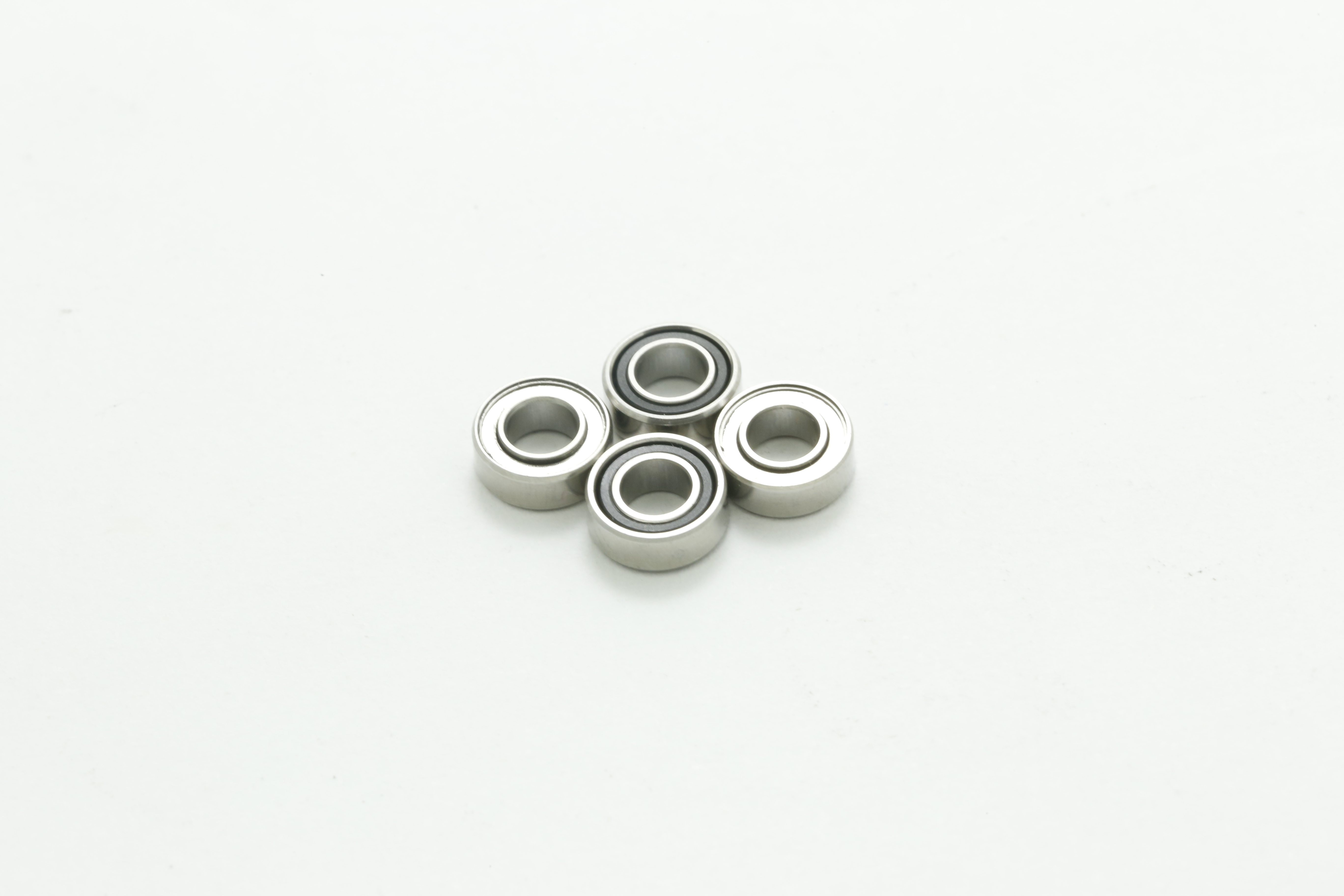
INB SMR144ZTLP4 W2.38: a 3.175 × 6.35 × 2.38 mm P4 miniature bearing in SUS440 stainless steel, rated to a 350,000–400,000 rpm limiting speed.
Reading the four models
SMR144ZTLP4 W2.38 and SR144ZTLP4 W2.78 share a 3.175 mm bore and a 6.35 mm outer diameter, placing both in the extra-miniature class. The distinguishing dimension is width — 2.38 mm versus 2.78 mm — which determines how much axial space the bearing pair consumes inside a turbine assembly. Both are specified at a limiting speed of 350,000–400,000 rpm and an operating temperature range of −50 °C to 160 °C.
SR133TL is the smallest of the four at 2.38 × 4.762 × 2.38 mm, and SMR74TL measures 4 × 7 × 2 mm. Both are specified at a 200,000 rpm limiting speed and an operating range of −40 °C to 150 °C. In practical terms, the range gives a designer two speed tiers and four dimensional envelopes rather than a single reference part.
What "P4", "SUS440" and a speed rating actually commit a supplier to
P4 describes a precision grade, and its effect inside a handpiece is measurable: a tighter tolerance band reduces runout and vibration, which in turn lowers noise and heat generation at the turbine. Claiming a grade is straightforward; demonstrating it requires dimensional and roundness verification equipment. The relevance of INB's stated instrument list — roundness meters, profilometers, roughness measuring equipment, hardness testers and microscopes — is that it maps directly onto the parameters a P4 claim depends on.
Material follows an established convention rather than a proprietary one. Stainless steel 440C is described as the primary material for miniature bearings used in medical and food-processing applications because of its resistance to moisture and chemical exposure (SKDIN Engineering Guide). All four INB models listed above are specified in SUS440 stainless steel, which places them inside the mainstream material choice for this application class — an important point for buyers, because it means the differentiator is execution rather than alloy selection.
Speed ratings need to be read carefully. The 350,000–400,000 rpm figure for SMR144ZTLP4 W2.38 and SR144ZTLP4 W2.78, and the 200,000 rpm figure for SR133TL and SMR74TL, are catalogued limiting speeds under defined reference conditions. They describe the upper envelope of the design, not a guaranteed continuous service speed in every turbine configuration. Duty cycle, lubrication regime and assembly preload all sit inside that envelope, so the workable approach is to treat the catalogue figure as a ceiling to validate against rather than a performance promise.
Temperature ratings follow the same logic. The two higher-speed models are specified from −50 °C to 160 °C; the two 200,000 rpm models from −40 °C to 150 °C. For dental equipment, the relevant question is whether the stated range covers the actual sterilisation and operating cycle the handpiece will see — a specification conversation, not an assumption.
Dental handpiece fit: the application the specifications were written for
INB's miniature bearing programme is anchored in a defined application scenario: dental handpiece bearings operating under high-speed precision grinding in a clean medical environment with intermittent high-load operation. The stated function is to deliver the rotational speed required for rapid grinding, sustain long service life and extend the working life of the handpiece itself. The special requirements recorded for this scenario are P4 precision grade, ultra-high speed in the 350,000–400,000 rpm band, wide temperature resistance from −50 °C to 160 °C, medical-grade hygiene and low noise.
The scenario is not theoretical. A project in China supplied 80,000 miniature bearings for use in dental handpieces, which indicates the range has been applied at production volume rather than only in sampling.
Selection within the range comes down to four interfaces. Bore diameter must match the turbine shaft or bur interface: 3.175 mm for the 144-series models, 2.38 mm for SR133TL, and 4 mm for SMR74TL. Outer diameter must match the housing bore: 6.35 mm, 4.762 mm and 7 mm respectively. Width must fit the available axial stack, which is the single reason two otherwise similar 144-series models exist at 2.38 mm and 2.78 mm. And the speed tier must match the turbine design: the 200,000 rpm class or the 350,000–400,000 rpm class.
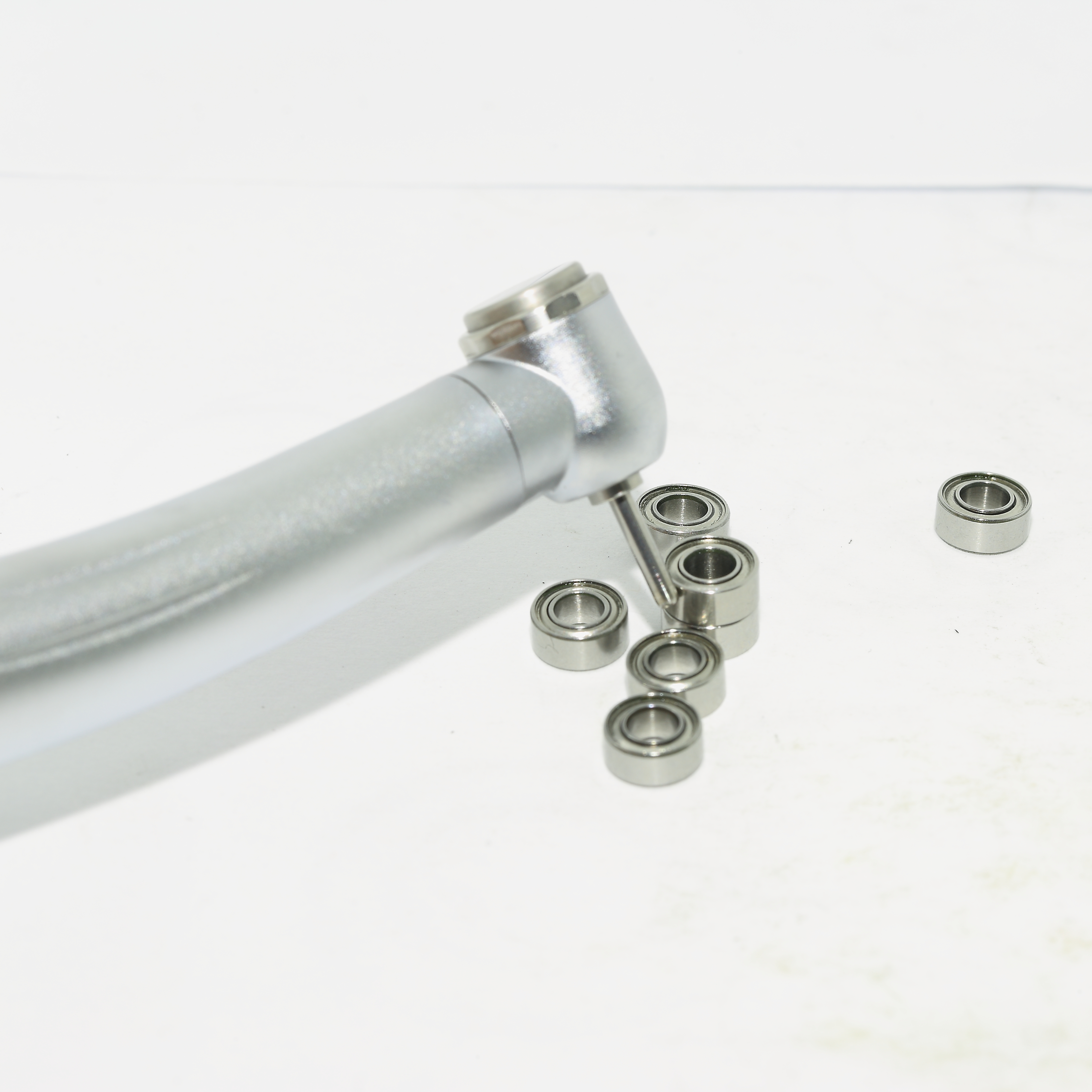
INB SMR74TL: a 4 × 7 × 2 mm P4 miniature bearing in SUS440 stainless steel, specified at a 200,000 rpm limiting speed.
Market trend analysis: what third-party data indicates
Three verified data points frame the supply environment.
- Market scale and demand drivers. The global miniature ball bearings market is estimated at approximately USD 2.25 billion in 2025, driven by demand in medical devices and robotics (Future Market Insights). Competing estimates exist, so the figure is best used directionally.
- Regional concentration. Asia Pacific accounted for roughly 60% of miniature ball bearing revenue in 2025, with China the largest regional producer and consumer (Precedence Research).
- Export momentum. China's bearing exports grew 7.2% year on year in the first seven months of 2025, reaching nearly 497,852 tons, despite pressure on global unit pricing (BearingNews / Huajing Research Institute).
A fourth data point sets the context for application mix: the automotive segment held the largest single application share of the miniature bearing market in 2025 at approximately 39%, driven by EV motor and sensor applications (Precedence Research). Medical and dental applications sit outside that dominant segment, but they are specification-driven rather than volume-driven — a bearing that fails inside a handpiece is a recall risk, not a warranty statistic.
The procurement implication is straightforward. A supply base concentrated in Asia Pacific, expanding export volumes and a specification-critical niche application together make dual sourcing a sensible default. They also raise the evidentiary bar: when more suppliers can quote a P4 part, the buyer's task shifts from finding a supplier to verifying one.
Comparing INB with established global manufacturers — and where its limits sit
Third-party research identifies MinebeaMitsumi, NSK, SKF and Schaeffler (Barden) among the top global manufacturers in the miniature bearing sector, with MinebeaMitsumi described as dominant in small sizes (Intel Market Research). NTN is a long-established global bearing manufacturer that appears on the same shortlists in precision applications. The table below contrasts what is documented for INB with what public and third-party sources establish for that group as a whole. Model-by-model competitor specifications are deliberately not reproduced here, because they could not be verified from attributable sources.
| Dimension | INB (documented) | Global manufacturers (public / third-party evidence) |
|---|---|---|
| Named in third-party manufacturer research | Not included in the published top-manufacturer set referenced here. | MinebeaMitsumi, NSK, SKF and Schaeffler (Barden) identified among top manufacturers; MinebeaMitsumi described as dominant in small sizes (Intel Market Research). |
| Precision grade evidence | P6 to P4 stated across a 2–8 mm bore range; P4 documented on four dental handpiece models. | Precision governed by ABMA ABEC (1–9), ISO 492 and DIN 620 (AST Bearings); grade claims should be checked model by model. |
| Material convention | SUS440 stainless steel across all four documented P4 models. | 440C stainless steel described as the primary material for medical and food-processing miniature bearings (SKDIN) — the same convention. |
| Speed and temperature data | 200,000 rpm and 350,000–400,000 rpm tiers; −40 to 150 °C and −50 to 160 °C tiers, published per model. | Model-level limits not reproduced in this comparison; not available from attributable sources used here. |
| Manufacturing scale | 2,000 m² facility; approximately 30 employees; reported 6,000,000 units annual output. | Not compared — no attributable scale figures used in this article. |
| Market coverage | China primary market; exports approximately 5% of total sales. | Multi-region manufacturing and distribution, reflected in the regional revenue-share data. |
| Service model | Direct factory contact through a professional sales team; 3 senior engineers. | Typically multi-tier and distributor-led in most markets. |
Table 2: Comparison dimensions, with verified INB facts separated from third-party statements about the global manufacturer group.
Where INB's boundaries are
- Manufacturing scale is modest. A 2,000 m² facility with approximately 30 employees and reported annual output of 6,000,000 units supports the dental and micro-motor range, but large or multi-year programmes should confirm capacity before shortlisting.
- Geographic concentration. China is the primary market and exports account for approximately 5% of total sales. Buyers outside China should plan logistics, lead time and technical escalation paths explicitly.
- Portfolio depth. The verified range covers high-precision standard bearings with bore diameters from 2 mm to 8 mm for dental and micro-motor use. Programmes requiring a broader catalogue should confirm model coverage before qualification.
- No published market-share data. INB does not appear in the third-party miniature bearing manufacturer sets referenced in this article, so no claim about its relative market position can be substantiated.
Customer service and the commercial model
Buyers evaluating INB deal with the factory directly. The company states that it maintains a professional sales team and many years of service experience, with 3 senior engineers available for technical discussion. Contact is by email at yuhang001@126.com or by phone at +86 18957446001.
For a design engineer, the difference between a direct model and a distributor-led model is the number of translation steps between a question and an answer. A direct model shortens that chain, provided the factory has the engineering depth to answer — which is why the 10-engineer R&D team and 3 senior engineers function as procurement evidence rather than background colour.
The trade-off is coverage. There is no evidence in the available material of regional service centres, local stock or field application support outside China. For a buyer in Europe or North America, that means logistics, response-time expectations and escalation paths should be agreed during qualification rather than assumed afterwards.
A buyer decision checklist
The checklist below converts the comparison into verification steps that apply to any P4 miniature bearing supplier, INB included.
| Buyer question | Evidence to request | Why it matters |
|---|---|---|
| Which precision grade is quoted, and against which system? | Inspection report naming the grade and the measurement equipment used | "High precision" without a grade is not comparable across suppliers. |
| Is the material suitable for moisture and chemical exposure? | Material confirmation for SUS440 / 440C stainless steel | Dental environments involve repeated cleaning and sterilisation. |
| What is the required duty cycle versus the catalogued limiting speed? | Model data sheet plus a duty-cycle calculation | Limiting speed is an envelope, not a continuous service guarantee. |
| Does the temperature rating cover the sterilisation and operating cycle? | Published temperature range per model | The two INB tiers differ by 10 °C at each end: −50/160 °C versus −40/150 °C. |
| Do bore, outer diameter and width match the assembly? | Dimensional drawing plus first-article inspection | Width is what separates SMR144ZTLP4 W2.38 from SR144ZTLP4 W2.78. |
| Can supply continue at programme volume? | Capacity statement and delivery history | A 2,000 m², ~30-employee facility requires capacity confirmation for large programmes. |
| What is the second source, and is it matched by grade? | Dual-source qualification record | Asia Pacific concentration makes a second source a planning default. |
Table 3: Verification checklist for P4 miniature bearing selection in dental handpiece programmes.
Future outlook
Two forces are likely to shape how P4 miniature bearings are bought over the next several years. The first is demand composition. Miniature bearing demand is increasingly tied to medical devices and robotics alongside the automotive segment that currently dominates application share. Medical applications bring qualification processes, documentation requirements and low tolerance for field failure, all of which favour suppliers who can evidence grade claims rather than assert them.
The second is supply geography. With Asia Pacific holding roughly 60% of miniature bearing revenue and China's export volumes rising, more buyers will run Asia-based suppliers in parallel with established global brands. That trend rewards suppliers who publish specifications in a comparable format — model, size, grade, material, speed, temperature — because comparable formats are what make a dual-source decision defensible internally.
For a specialist like INB, the credible path is depth rather than breadth: keeping the dental and micro-motor range tightly documented, and converting factory evidence — the inspection instruments, the ISO 9001 system, the 80,000-unit handpiece project — into qualification material that buyers can audit.
Frequently asked questions
What does P4 precision mean for a miniature bearing used in a dental handpiece?
P4 is a precision grade within the tolerance-class systems that govern miniature bearings, including ABMA ABEC, ISO 492 and DIN 620, where tighter tolerance bands correspond to reduced runout. In a handpiece, a tighter grade translates into less vibration, lower noise and lower heat generation at the turbine. Because the claim depends on measurement, the practical check is the supplier's inspection capability — for INB, roundness meters, profilometers, roughness measuring equipment, hardness testers and microscopes are listed as available instruments.
Which INB models are supplied as P4 stainless steel miniature bearings?
Four models are documented: SMR144ZTLP4 W2.38 at 3.175 × 6.35 × 2.38 mm; SR144ZTLP4 W2.78 at 3.175 × 6.35 × 2.78 mm; SR133TL at 2.38 × 4.762 × 2.38 mm; and SMR74TL at 4 × 7 × 2 mm. All four are specified in SUS440 stainless steel at P4 precision and are listed for dental handpiece applications.
How fast can a high-speed miniature bearing run in a dental handpiece?
INB specifies a limiting speed of 350,000–400,000 rpm for SMR144ZTLP4 W2.38 and SR144ZTLP4 W2.78, and 200,000 rpm for SR133TL and SMR74TL. Limiting speed is a catalogued value under defined reference conditions rather than a guaranteed continuous operating speed, so it should be validated against the actual duty cycle, lubrication and assembly preload of the handpiece.
Why is SUS440 stainless steel used in miniature bearings for medical devices?
Stainless steel 440C is described as the primary material for miniature bearings used in medical and food-processing applications because of its resistance to moisture and chemical exposure (SKDIN Engineering Guide). All four INB P4 models are specified in SUS440, which places them within the mainstream material convention for this application class rather than at a material-driven advantage.
What operating temperature range should a dental handpiece bearing withstand?
INB publishes two tiers: −50 °C to 160 °C for the 350,000–400,000 rpm models (SMR144ZTLP4 W2.38 and SR144ZTLP4 W2.78), and −40 °C to 150 °C for the 200,000 rpm models (SR133TL and SMR74TL). Buyers should confirm that the selected tier covers the actual sterilisation and operating cycle of the handpiece rather than assuming the widest published range applies.
How should a buyer compare INB with NSK, SKF, MinebeaMitsumi or NTN?
Apply the same evidence standard model by model: precision grade, material, limiting speed, temperature range, dimensional verification and supply continuity. Third-party research identifies MinebeaMitsumi, NSK, SKF and Schaeffler (Barden) among the top manufacturers in the miniature bearing sector. INB is not included in that published set, so its case rests on documented model-level specifications rather than market position. Where comparable public model data for a competitor is unavailable, no comparison is made.
Is INB suitable for programmes outside China?
INB's primary market is China, with exports accounting for approximately 5% of total sales, and no regional service centres or local stock outside China are evidenced in the available material. International buyers should therefore assess logistics, lead time and technical escalation directly during supplier qualification rather than assuming distributed support.
The comparison does not produce a single winner, and it should not. INB's documented position is a P4, SUS440 miniature bearing platform with four defined models spanning 200,000 to 400,000 rpm and two temperature tiers, supported by a factory footprint that is modest but fully measurable. Global manufacturers bring scale, multi-region support and third-party market visibility that INB does not currently evidence. For a dental handpiece programme, the deciding question is whether a tightly documented, directly accessible specification range is worth more than the breadth and logistics of a global supplier — and that answer depends on the volume, geography and risk profile of the programme itself.
Have Questions or Need More Details?
Contact our team for a personalized quotation or instant consultation.
Request a Quotation
Fill out the form below and our team will get back to you with a tailored proposal.
WhatsApp Direct Chat
Prefer to chat in real-time? Message us on WhatsApp for instant assistance & quick answers.
- Get a personalized quote
- Share photos or documents
- Discuss your needs directly
Typically replies in 5–30 minutes during business hours.