
P500 vs Pw500 vs OPS-10000-I: High-Polymer Produced Water Buyer Comparison
P500 vs Pw500 vs OPS-10000-I: High-Polymer Produced Water Buyer Comparison
Comparing P500, Pw500 and OPS-10000-I for high-polymer produced water is not a like-for-like shortlist, and treating it as one is the most common way buyers misread the quotation. In the supplier record, the three designations describe three different jobs: an inlet physical-demulsification module, a wastewater-stage module carrying an eight-month continuous field record, and a project-scale unit that appears in a 40,000 m³/d high-polymer regeneration and reinjection station as four parallel sets.
That difference sets the real decision. High-polymer produced water forms stable oil-in-water emulsions that gravity settlers handle poorly, so the buyer's question is rarely which unit is better in the abstract. It is narrower: which stage of my treatment train am I buying, at what verified unit capacity, and what must be true upstream for that unit to perform to its stated outlet figures. This comparison sets out what is documented for each designation, where the boundaries sit, and which points to have confirmed in writing before a purchase order.
What each designation actually is
P500 — the P-module inlet position
In the supplied field material, P500 appears as the P-module inlet unit, photographed at the module inlet. The P stands for Physics: the module breaks oil-in-water emulsions mechanically rather than chemically. A polymer nanoscale demulsification material is arranged so that fluid flowing across it creates local velocity and pressure differences. On the higher-velocity, lower-pressure side, emulsified droplets rub and impact the surface and release; on the lower-velocity, higher-pressure side, released droplets coalesce into larger ones, and microbubbles carry the coalesced oil to the surface for separation. Suspended solids acquire charge through friction and are polarised in the same flow field.
The procurement consequence is simple: the P-module is an oil-removal and solids-release device. It is not a sterilisation step, and it is not a fine-filtration step. Buyers who expect a single P-module to deliver reinjection-grade bacteriological control are describing a different unit in the same family.
Pw500 — the wastewater-stage module with a field record
Pw denotes the oily-wastewater variant of the same physical family, positioned downstream of primary separation. The supplied record includes one specific operational datapoint for a Pw500: a sludge-sampling record taken from the bottom of the oil-suspension module after eight months of continuous operation on site. That is a durability and solids-handling observation, and it should be read as exactly that. It shows the module stayed in service for eight months and that accumulated bottom solids can be sampled and removed; it does not, on its own, certify outlet oil or suspended solids for a different field with different polymer content, water cut or temperature.
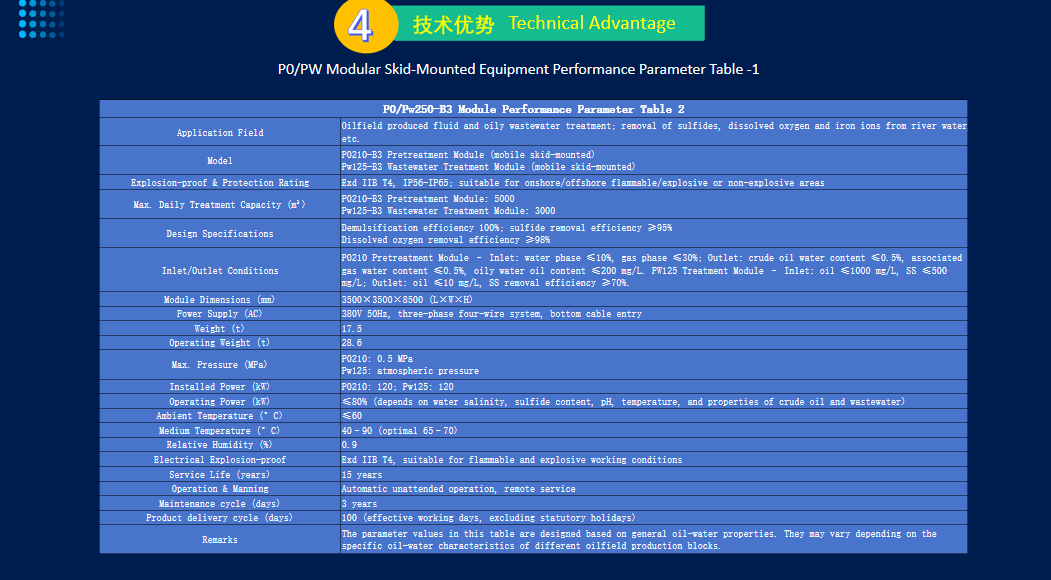
Model-level selection guidance in the same material places the Pw series at up to 3,000 m³/d per module, with an inlet envelope up to 1,000 mg/L oil and an outlet indicator of 5 mg/L oil. Those are the numbers a buyer should anchor to when the wastewater stage is the scope, and they should be confirmed against the specific model code quoted.
OPS-10000-I — the project-scale unit in the Shengli Gudao record
OPS-10000-I is not a module position inside a train; it is a unit named in a project record. At Sinopec Shengli Oilfield Gudao Oil Production Plant, Guwu Joint Station, the record lists four OPS-10000-I units serving a 40,000 m³/d high-polymer oil-production wastewater regeneration and reinjection project. This is the only deployment of that designation in the supplied material, and it is a large one — high-polymer service, regeneration plus reinjection duty, four parallel sets.
What the record does not contain is a standalone OPS-10000-I datasheet. Dividing 40,000 m³/d by four sets gives 10,000 m³/d per unit on an even-split basis, a calculated figure that is consistent with the model code but is not a published nameplate rating. It should be treated as derived, and the per-unit capacity, inlet limits and outlet guarantees obtained in writing for the exact configuration being offered.
Why high-polymer water changes the comparison
High-polymer flooding leaves water-soluble polymer in the produced water, and that single fact reorganises the whole treatment comparison. Emulsions become more stable and resist gravity settling; the water phase becomes more viscous; oil droplets and fine solids separate more slowly. A conventional train responds in the only way it can — longer residence time in larger vessels and heavier dosing of demulsifier, flocculant and water clarifier.
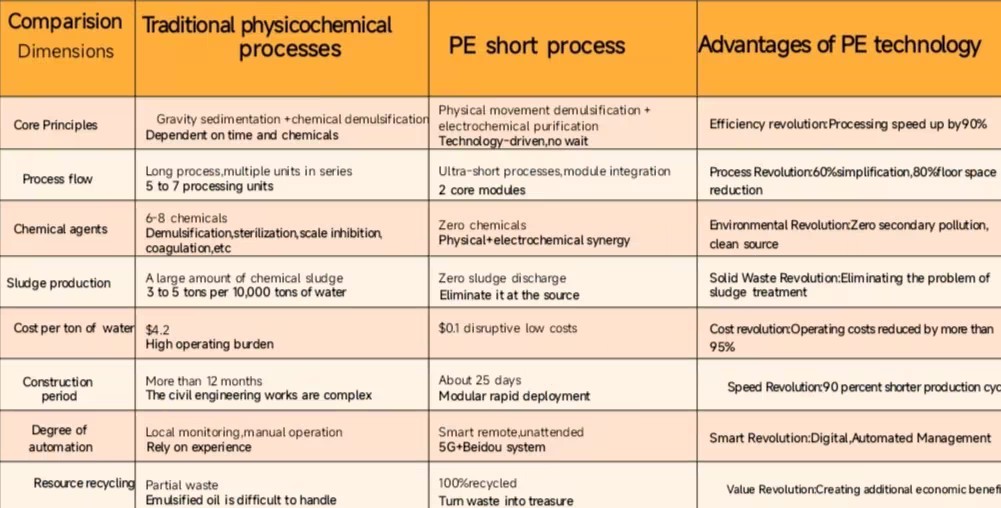
Each of those responses carries a cost the buyer pays twice. The chemicals are a direct operating expense, and the sludge they generate is a disposal liability. In the company's comparison record, chemical sludge treatment accounts for RMB 10.00 of a RMB 15.00 per-tonne conventional treatment cost — by far the largest single line. That is why a modular physical route competes on operating cost rather than on vessel price, and why the comparison below has to be read at the level of the whole train rather than a single skid.
Documented comparison of the three designations
The table below restricts itself to what the supplied record states or directly implies. Where a value is absent, the correct action is to request it rather than to interpolate from a sibling model.
| Item | Documented role | Documented capacity evidence | Documented water-quality evidence | Documented operating record | Gap to close before ordering |
|---|---|---|---|---|---|
| P500 | P-module at the inlet; physical turbulent demulsification, oil removal, suspended-solids release | Module record states up to 3,000 m³/d; the wider P family spans P0 pretreatment at up to 5,000 m³/d and Pw wastewater at up to 3,000 m³/d per module | Module record states outlet oil ≤20 mg/L; P0 inlet envelope up to 70% oil | Inlet-position photography from an operating site | Confirm which code is quoted and which capacity/inlet/outlet triple attaches to it |
| Pw500 | Wastewater-stage physical module; deep demulsification and suspended-solids removal after primary separation | Up to 3,000 m³/d per module; parallel combination for higher volumes | Inlet up to 1,000 mg/L oil; outlet indicator 5 mg/L oil (Pw series selection guidance) | Eight months of continuous on-site operation, with bottom sludge sampling after that period | Site-specific outlet guarantee at your inlet oil, polymer content and temperature |
| OPS-10000-I | Project-scale unit in a high-polymer regeneration and reinjection station | Four sets serving 40,000 m³/d; 10,000 m³/d per unit is a calculated even split, not a published nameplate | Not published in the supplied record | Shengli Oilfield Gudao, Guwu Joint Station, 40,000 m³/d high-polymer project | Unit datasheet, scope boundary (does the supply include sterilisation and fine filtration?), per-unit rating |
Capacity, footprint and the scale-up arithmetic
The P family scales by parallel combination, not by building a larger vessel. P0 pretreatment modules are rated up to 5,000 m³/d each and handle the front-end oil-gas-water separation duty with an inlet oil envelope up to 70%. Pw wastewater modules are rated up to 3,000 m³/d each and take the downstream duty with an inlet up to 1,000 mg/L oil and an outlet indicator of 5 mg/L. Above those single-module figures, capacity is added in modules.
The Gudao station shows what that means at scale. Forty thousand cubic metres per day of high-polymer produced water regeneration and reinjection is delivered by four OPS-10000-I sets rather than by one very large vessel. For an offshore platform or a space-constrained onshore station, that architecture is the decisive characteristic: skid-mounted modules are prefabricated and tested before shipment, and the site work is connection rather than civil construction. The company's comparison claims an 80% footprint reduction and a construction period of about 25 days against more than 12 months for the conventional route, alongside a 60% simplification of process flow.
Those figures should be read as the difference between a two-module short process and a five-to-seven-unit conventional train with large settling tanks. In high-polymer service the footprint argument is not cosmetic: deck area and foundation load are frequently the binding constraint on an offshore upgrade, and a shorter installation window reduces production deferment.
The constraint chain: inlet quality decides which unit you can actually use
Modular systems do not remove the need for process discipline; they concentrate it into inlet specifications. The supplied operating limits form a chain, and a buyer who plans the train backwards from the reinjection specification will design a different — and cheaper — configuration than one who buys unit by unit.
- Fine filtration (EF module): inlet oil ≤30 mg/L and inlet sulphide ≤5 mg/L; suspended solids removal of 98% for particles above one micron, with outlet suspended solids ≤2 mg/L and outlet oil ≤5 mg/L. A single EF module reaches 30,000 m³/d, with online self-cleaning triggered by differential pressure above 0.4 MPa, so no shutdown backwash cycle is required. If inlet oil is above 30 mg/L, upstream P treatment is mandatory, not optional.
- Sterilisation and anti-corrosion (E module): 100% SRB sterilisation and 98% sulphide removal, 98% scale inhibition, electrode life ≥20,000 hours. High-sulphide water must pass through the P module first; low salinity reduces sterilisation efficiency; inlet temperature must be ≤60°C; high-oil water requires caution. A single E module also reaches 30,000 m³/d.
- Physical demulsification (P module): the upstream stage that makes the other two viable in high-polymer service. It is also the stage where operators most often break the process, because adding flocculant to speed settling creates sticky flocs that clog the internals and interfere with physical demulsification. Chemical-free operation is a design condition, not a preference.
Read together, those limits define the fit boundary. A Pw500 alone is a wastewater polishing device; it is not a substitute for an OPS-10000-I train that combines separation, polishing and reinjection duty across four sets. Conversely, a single OPS-10000-I set in a small station would be specified far above the duty, and the modular architecture means the buyer can right-size with one or two smaller modules instead.
What the field records do and do not prove
Three records in the supplied material are worth separating, because they carry different evidentiary weight.
The Pw500 record is an endurance observation: eight months of continuous operation, followed by sampling of the solids that settled at the bottom of the oil-suspension module. It supports a claim that the module remains serviceable over a multi-month campaign in real produced water and that accumulated solids are accessible for removal. It does not establish an outlet guarantee for a new site, and it should not be presented to an approval committee as one.
The Gudao record is a scale record: four OPS-10000-I units, 40,000 m³/d, high-polymer produced water, regeneration and reinjection. Its value to a buyer is that the parallel-module approach has been executed at that throughput in exactly the water chemistry class this comparison concerns.
The Jidong record is a scope-boundary reference. At CNPC Jidong Oilfield Nanpu Oil Production Plant, Nanbao No.1 Island, 10,000 m³/d of produced wastewater sterilisation and reinjection duty is served by two electrochemical sterilisation skids. That is a sterilisation and reinjection project, not an oil-removal project, and it illustrates why the scope line has to be drawn explicitly in the enquiry: a proposal that covers separation but not sterilisation leaves the buyer to procure the reinjection stage separately.
One additional site record in the supplied material states that outlet oil content was verified at 0.0 mg/L by a third-party testing centre at the wellhead and outlet comparison point. That is a single-site analytical result. It demonstrates what the process achieved under those conditions; it is not a transferable performance guarantee.
Cost per tonne: what the headline figure includes and leaves out
The company's comparison puts conventional treatment at about US$4.2 per tonne of water against roughly US$0.1 per tonne for the short process, a reduction of more than 95%. The itemisation is more useful to a buyer than the headline, because it shows where the money actually goes.
On the conventional side, the RMB 15.00 per-tonne breakdown allocates RMB 1.00 to bactericide, RMB 2.00 to corrosion inhibitor, RMB 2.00 to demulsifier, flocculant and water clarifier, and RMB 10.00 to chemical sludge treatment. Two-thirds of the cost sits in sludge disposal, which is a waste-handling charge rather than a treatment charge — and it is the line most sensitive to local regulation and landfill pricing. On the short-process side, the RMB 0.20 per-tonne breakdown allocates RMB 0.05 to sterilisation, RMB 0.05 to corrosion inhibition, RMB 0.10 to water purification, and zero to chemical sludge.
Two honest qualifications belong beside those numbers. First, the comparison explicitly excludes additional revenue from recovered good oil, so it does not flatter the short process with a by-product credit. Second, the baseline is a conventional physicochemical train; a site that already runs an efficient mechanical separation stage will not see the full delta. Buyers should rebuild the calculation with their own chemical contract prices, their own sludge-disposal tariff and their own labour rate, because the labour line is also claimed to fall by 50% through automatic unattended operation and 5G plus BeiDou remote monitoring.
Where each option fits
- Choose the P500 inlet module when the binding problem is emulsified oil and the downstream stages are already specified. It is the front-end fix for stable emulsions, and it protects the filtration and sterilisation stages from inlet excursions.
- Choose the Pw500 wastewater module when the scope is deep demulsification and suspended-solids removal after primary separation, at up to 3,000 m³/d per module, in a station where the oil-removal stage is already in place or is being procured separately.
- Choose the OPS-10000-I route when the project is a large high-polymer regeneration and reinjection station in the tens of thousands of cubic metres per day, where parallel project-scale units are the proven configuration and where a single-vendor scope across the train reduces interface risk.
- Do not choose any of them for a duty that is primarily bacteriological. That is the E module's job, and it carries its own constraints: sulphide pre-treatment, temperature ≤60°C, adequate salinity and caution on high-oil water.
A restrained next step, if the technical fit is plausible, is to request the unit-level datasheet for the exact model code quoted, together with a written statement of whether the supply scope ends at separation or continues through filtration and sterilisation to the reinjection specification.
Verification checklist for the decision file
- Model code confirmed against the datasheet, not against a sibling model in the same family — the P family spans 5,000 m³/d pretreatment and 3,000 m³/d wastewater ratings, and quoting the wrong envelope distorts the whole comparison.
- Per-unit capacity stated in writing for OPS-10000-I rather than derived from the 40,000 m³/d station total.
- Inlet limits for oil, sulphide, temperature and salinity stated for every module in the train, since a downstream guarantee is conditional on the upstream stage holding its own envelope.
- Outlet guarantees tied to a named analytical method and sampling point, and to the buyer's own inlet data rather than to a reference site.
- Explosion protection and materials confirmed for the installation: Exd IIB T4 and IP65 protection with salt-fog resistance are relevant where the unit goes onto an offshore platform or into a hazardous area, and proper earthing is an operating requirement, not a commissioning detail.
- Management-system certificates reviewed for scope, not just existence. The supplier holds ISO 9001:2015 (certificate 72225Q10141R0S), ISO 14001:2015 (72225E10109R0S) and ISO 45001:2018 (72225S10097R0S), issued by HUA LONG INTERNATIONAL CERTIFICATION (BEIJING) COMPANY LTD. with CNAS and IAF marks; the certified scope covers sales of specialised environmental protection equipment and assembly of the rapid-ion sterilisation equipment, which is narrower than a general manufacturing certification.
- Chemical-free operation written into the operating procedure, with a named responsible party, because a single flocculant addition can clog a P module and is explicitly prohibited.
Outlook
The direction of travel in produced water is toward tighter reinjection specifications and less chemical handling, and both pressures favour short, modular trains. Onshore, that shows up as a footprint and sludge-disposal argument; offshore, as a deck-space, weight and installation-window argument, where a 25-day connection programme against a 12-month construction programme is a materially different project risk. None of this makes the modular route universal. It remains conditional on inlet quality being controlled upstream, on operators accepting a chemical-free discipline, and on the buyer verifying per-unit ratings rather than inheriting them from a reference project. Where those conditions hold, the three designations in this comparison stop competing with each other and start composing a train.
FAQ
Which of the three units handles high-polymer produced water?
All three operate in high-polymer service, but at different positions. The P500 works at the inlet, breaking stable emulsions physically so that downstream stages can function. The Pw500 works on the wastewater stream after primary separation, at up to 3,000 m³/d per module. OPS-10000-I appears as a project-scale unit in a 40,000 m³/d high-polymer station using four sets. The selection question is therefore about stage and scale rather than about polymer tolerance alone.
Can one large unit replace several smaller modules?
The supplied material describes scaling by parallel combination rather than by enlarging a single vessel. P0 pretreatment modules are rated up to 5,000 m³/d and Pw modules up to 3,000 m³/d each, with multiple units combined for larger volumes; EF and E modules each reach 30,000 m³/d per unit and are likewise combined in parallel. A 50,000 m³/d filtration duty, for example, is described as two 30,000 m³/d units in parallel rather than a single oversized unit.
What capacity and water-quality figures should appear in a tender?
Per-unit capacity for the exact model code, the inlet envelope for oil, sulphide, temperature and salinity, and the outlet indicator with its sampling point and analytical method. Reference figures in the supplied material include up to 5,000 m³/d for P0, up to 3,000 m³/d with inlet up to 1,000 mg/L oil and outlet 5 mg/L oil for the Pw series, suspended solids ≤2 mg/L and oil ≤5 mg/L for the EF module with inlet oil ≤30 mg/L, and 100% sterilisation with 98% sulphide removal for the E module. OPS-10000-I per-unit ratings are not published in the supplied record and should be provided by the supplier directly.
What happens if operators add flocculant to improve separation?
It is explicitly prohibited. Flocculants form sticky flocs that clog the module internals and interfere with physical turbulent demulsification, which is the mechanism the P module depends on. Chemical-free operation is a design condition of the short process, and it is also the source of the claimed consumable and sludge savings, since the process eliminates demulsifiers, coagulants, flocculants, bactericides, corrosion inhibitors, scale inhibitors and viscosity reducers.
Have Questions or Need More Details?
Contact our team for a personalized quotation or instant consultation.
Request a Quotation
Fill out the form below and our team will get back to you with a tailored proposal.
WhatsApp Direct Chat
Prefer to chat in real-time? Message us on WhatsApp for instant assistance & quick answers.
- Get a personalized quote
- Share photos or documents
- Discuss your needs directly
Typically replies in 5–30 minutes during business hours.