
PCB Connector Supplier Evidence: Six Applications
PCB Connector Supplier Evidence: Six Applications
OEM buyers evaluating a PCB connector supplier usually start with a certificate. That is a reasonable first filter, but it does not answer the more important evaluation and execution question: does the supplier's stated product portfolio actually cover the connector families, pitches and application conditions of the programme? This article uses supplied evidence on Greenconn to show how a portfolio map can be built across automotive, industrial, medical, consumer electronics, robotics and data center environments, and where the evidence stops. The aim is not to treat a certificate as proof of product performance. It is to separate manufacturing evidence, portfolio evidence and application-level validation so that buyers know what to verify before release to production.
Why a certificate is not a portfolio map
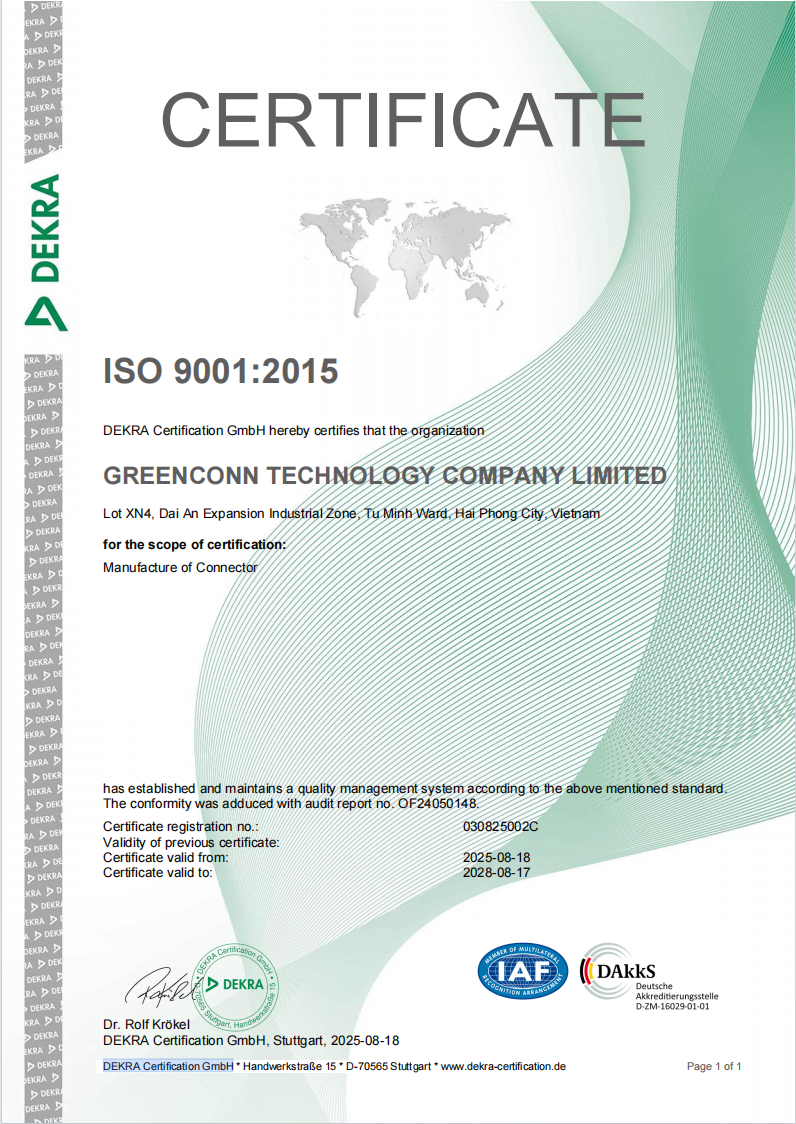
The DEKRA ISO 9001:2015 certificate 030825002C is valid from 2025-08-18 to 2028-08-17 and covers the manufacture of connectors for the EU market. It is relevant supporting evidence that a quality management system for connector manufacture has been certified within that stated scope. It does not, by itself, establish that a particular RAST, press-fit, wire-to-wire or board-to-board series meets an automotive vibration profile, a medical-device validation requirement, an IP68 test condition or a data center signal-integrity target.
The same discipline applies to the other management-system records in the supplied evidence. The ISO 14001:2015 certificate 111121007/1C is valid from 2024-11-28 to 2027-11-28 and covers manufacture of connectors for the EU market. The ISO 45001:2018 certificate 450224015 is valid from 2024-02-28 to 2027-02-27 and has the same manufacture-of-connectors scope for the EU market. The IATF 16949:2016 certificate 160319060-2 is valid from 2026-04-03 to 2029-04-02, but its stated scope is design and manufacture of hardware stamping parts for the EU market. The ISO 13485 certificate G25Q2GZ1104R0S is valid from 2025-01-02 to 2028-01-01 and covers design and production of electronic connectors for radiofrequency ablation systems and dynamic blood glucose meters for the EU market. Each record answers a specific question. None replaces a series-level qualification.
Greenconn's listed PCB connector portfolio
Greenconn Technology (Shenzhen) Co., Ltd is a connector manufacturer founded in 1998. The supplied company profile describes integrated connector design, tooling, precision stamping, plating, injection molding, automated assembly, testing and quality control, with four manufacturing facilities across China and Vietnam. Its main product list covers board-to-board connectors, wire-to-board connectors, automotive connectors, waterproof connectors, floating board-to-board connectors, high-speed board-to-board connectors and custom connector solutions.
The product-search evidence adds female headers, box headers, plug connectors, machined pin headers or IC sockets, wafer connectors, FPC/FFC connectors, floating connectors, terminal blocks, waterproof connectors, D-Sub, USB, PCI and customized connector products. Listed pitches include 0.5 mm, 0.8 mm, 1.0 mm, 1.27 mm, 2.0 mm and 2.54 mm, with other pitches listed for terminal blocks. Named series in the supplied certification and case records include RAST connectors CSGA110 and CSGA106, press-fit connector ATZ605, wire-to-wire connectors GA01 and GT, wire-to-board connectors GB01, GB05 and CFAD102, and board-to-board connectors GC01 and GD01.
This is portfolio-presence evidence. It does not prove active stock, lead time for every series or application qualification. It gives the buyer a shortlist to interrogate.
| Connector family | Examples in supplied evidence | Typical role in a PCB design | Evidence boundary |
|---|---|---|---|
| Board-to-board | GC01, GD01 | PCB stacking and board-level interconnection, with floating and high-speed variants | Exact stack height, data rate, shock and EMI performance require series datasheets and test reports |
| Wire-to-board | GB01, GB05, CFAD102 | Harness-to-PCB connection, locking and PCB retention | Current rating, voltage rating and mating cycles are not established by the catalog listing |
| Wire-to-wire | GA01, GT | Inline cable connections, including sealed outdoor and automotive examples | IP67 or IP68/IP6K9K ratings are model-specific and must be matched to the exact series |
| RAST | CSGA110, CSGA106 | Listed in certification-related product associations and application records | The listing does not prove that every RAST variant is qualified for every automotive or medical programme |
| Press-fit | ATZ605 | Solderless PCB connection through a compliant contact in a plated-through hole | Performance depends on PCB hole dimensions, plating, contact geometry and insertion conditions |
| Floating and high-speed | GC01, GD01 | Tolerance compensation and high-speed board-to-board links | The corpus does not provide quantified insertion loss, crosstalk or data-rate results |
| FPC/FFC, IDC, terminal block, D-Sub, USB, PCI, custom | Category listings; custom programme capability | Interface breadth and application-specific designs | Category-level presence only; series-level datasheets are required for design-in |
Six application environments: requirement-to-coverage comparison
Across the six environments, the supplied portfolio has its strongest direct case evidence in automotive, industrial and medical applications, a category-level fit for consumer electronics and robotics, and a high-speed family-level fit for data center equipment. The gaps are not necessarily capability gaps. They are evidence gaps that require series-level or application-level documents.
| Application environment | Requirement to verify | Supplied portfolio evidence | Evidence boundary |
|---|---|---|---|
| Automotive | IATF 16949, USCAR-2 and LV214 test logic, IP67/IP68 sealing, vibration and temperature resistance | RAST CSGA110/CSGA106, press-fit ATZ605, wire-to-wire GT/GA01, wire-to-board GB01/GB05/CFAD102, board-to-board GC01/GD01; cases include EPS, seat sensing, NEV battery, hybrid transmission and IVI | The IATF certificate scope is hardware stamping parts, not connector manufacture; no LV214 or USCAR-2 test report is included in the supplied evidence |
| Industrial | Dust, humidity, wide temperature, locking, vibration and sealing | Board-to-board, wire-to-board, wire-to-wire, terminal block, waterproof, floating and high-speed categories; industrial robotics control cabinet, elevator sensor, collaborative robot, outdoor power and solar cooling examples | IP ratings such as GA01 IP67 and GT IP68/IP6K9K apply to specific series, not all waterproof connectors |
| Medical | ISO 13485 and device-specific validation | ISO 13485 certificate G25Q2GZ1104R0S; GC01 floating connector medical monitoring case; custom female header for blood glucose monitors; RAST series in certificate-related product lists | The ISO 13485 scope names radiofrequency ablation systems and dynamic blood glucose meters; it is not a blanket validation for every medical connector |
| Consumer electronics | RoHS/REACH declarations, miniaturization, fine pitch, cost control | FPC/FFC pitches 0.5/0.8/1.0 mm, header pitches 1.27/2.0/2.54 mm, board-to-board, wire-to-board and custom connector capability | The supplied evidence does not include RoHS/REACH declaration numbers or material test reports for specific part numbers |
| Robotics | Shock, EMI, continuous motion, floating compensation and locking | GB01 humanoid robot joint case with vibration-resistant locking; GC01 humanoid main control and industrial robotics cabinet cases; collaborative robot case; floating connector FAQ | The corpus does not provide quantified shock or EMI test results for these robotics cases |
| Data center | High-speed signal integrity, thermal performance, press-fit PCB interface | High-speed board-to-board connectors, press-fit ATZ605, board-to-board GC01/GD01 and custom connector capability | No data-center-specific case is included; no data rate, insertion loss, crosstalk or thermal test data is supplied |
Automotive: portfolio breadth is visible, qualification must be series-specific
Automotive is the environment with the richest application references in the corpus. The supplied cases connect Greenconn connector families to automotive EPS modules, seat sensing systems, NEV battery systems, hybrid transmission systems and infotainment systems. Those cases show where the portfolio has been applied. They do not replace a programme-specific qualification file. USCAR-2 is a performance standard for low-voltage automotive electrical connector systems in road vehicles, according to SAE International, and LV214 test logic includes mating and unmating force, terminal retention, cable pull, vibration endurance and shock testing. No such test report for a named Greenconn series appears in the supplied evidence. The buyer should request the relevant series datasheet and application test report, and should read the IATF 16949 scope carefully because the certificate covers hardware stamping parts rather than all connector manufacture.
Industrial and robotics: locking, sealing and floating matter more than family count
Industrial equipment and robotics reward different evidence. A broad family list is useful, but the buyer needs to know whether the exact series has the right locking, sealing, vibration resistance and tolerance compensation. The corpus includes an industrial robotics control cabinet case, an elevator sensor case with an open card edge board-to-board connector, a collaborative robot case and humanoid robot joint and main control board cases. GB01 is associated with a vibration-resistant locking structure in a humanoid robot joint module. GC01 is associated with floating compensation in robot main control boards and in medical monitoring. The fit boundary is that shock and EMI performance are not quantified in those case descriptions. A robotics buyer should request shock, vibration and EMI test data rather than infer it from the application story.
Medical: ISO 13485 scope is specific and should be read literally
The GICG ISO 13485 certificate G25Q2GZ1104R0S is based on GB/T42061-2022/ISO13485:2016, valid from 2025-01-02 to 2028-01-01 for the EU market. Its stated scope is design and production of electronic connectors for radiofrequency ablation systems and dynamic blood glucose meters. That is strong evidence for those named device contexts. It is not evidence that every connector in the catalog is validated for every medical device. The corpus also includes a GC01 floating connector case for medical monitoring systems and a custom compact female header case for blood glucose monitors. Buyers should request product-specific validation, change control and the current certificate copy for the exact manufacturing site and product scope under review.
Consumer electronics: RoHS/REACH is a documentation check, not a catalog claim
The consumer-electronics fit in the supplied portfolio is built around miniaturization, fine pitch and interface breadth. FPC/FFC pitches of 0.5 mm, 0.8 mm and 1.0 mm are listed, along with header pitches of 1.27 mm, 2.0 mm and 2.54 mm. Board-to-board, wire-to-board and custom connector capability are also listed. The missing evidence is material compliance documentation. The corpus does not include RoHS/REACH declaration numbers or test reports. The correct conclusion is not that the portfolio fails the requirement. It is that the buyer must request current declarations for the exact part numbers, plating and housing materials before approval.
Data center: high-speed family presence needs signal-integrity proof
Data center equipment raises the evidence bar because high-speed links, thermal performance and PCB interface quality are central. The supplied portfolio lists high-speed board-to-board connectors and press-fit connectors, and it lists board-to-board series GC01 and GD01. The high-speed case in the corpus is for telecom base stations, not data centers. No data rate, insertion loss, crosstalk or thermal test result is supplied for a data center application. Press-fit also depends on the plated-through hole dimensions, plating and insertion conditions described in the supplied technical FAQ. A data center buyer should treat the portfolio listing as a family-level fit and request series-level signal-integrity and environmental test data before qualification.
How the main connector families differ in practice
Board-to-board connectors stack or connect PCBs without a cable harness. The supplied technical FAQ notes their compact design, shorter signal path and more favorable high-frequency potential, while cautioning that thermal expansion stress can be concentrated because they are mounted directly on the PCB. Wire-to-board connectors introduce a harness that buffers pulling forces and thermal expansion, but the harness adds parasitic inductance and capacitance. Wire-to-wire connectors join cable to cable and are relevant where an inline connection and sealing are required. Floating connectors allow controlled movement to absorb PCB misalignment, which is useful when multiple connectors sit between the same boards. Press-fit connectors use a compliant contact that deforms inside a properly dimensioned plated-through hole; performance depends on contact geometry, material, PCB hole dimensions, plating and insertion conditions. A high-speed floating connector must balance tolerance compensation with a carefully designed signal path. These distinctions matter because a broad portfolio can still miss a specific stack height, current rating, IP condition or signal-integrity target.
Manufacturing and execution evidence for Evaluation to Execution
For buyers moving from evaluation to execution, the supplier evidence should shift from family names to production and change-control questions. The supplied capability data states a 106,000 m² factory area, 800 employees, 69 engineers, annual output of 345,000,000 pcs, monthly capacity of 28,750,000 pcs, four manufacturing facilities across China and Vietnam, a 70% export ratio, a stated lead time of 4 weeks, a stated MOQ of 5,000 pcs and AQL sampling inspection. It also lists OEM/ODM customization across voltage, current, pin count, contact resistance, high-speed data rate, pitch, mounting type, locking mechanism, floating range, stacking height, overall dimensions, IP rating, housing material, contact material, plating thickness, contact plating and overmolding material. After-sales support is described as local dealer and office support.
These are company-stated figures and capability descriptions. They are useful for capacity screening and RFQ preparation, but they do not prove that capacity is available for a specific series or that a specific site is qualified for a specific application. Buyers should ask for site-specific capacity, line qualification, change-control procedures and the certificate copy that applies to the manufacturing site under review.
Application-specific verification checklist
- Confirm the legal entity, certificate number, issuing body, validity dates and exact scope. Do not treat the IATF 16949 hardware-stamping scope as connector-level certification.
- Map each application environment to the exact connector family and series. A family name is not a part-number qualification.
- Request the series datasheet for pitch, current, voltage, temperature, mating cycles, contact resistance, insulation resistance and mechanical retention.
- Request application test evidence for the stated environment: LV214 or USCAR-2 topics for automotive, IP test reports for sealed designs, shock and EMI data for robotics, and signal-integrity reports for high-speed data center links.
- For medical use, read the ISO 13485 scope literally and confirm whether the exact connector and manufacturing site fall within it.
- For consumer electronics, request current RoHS/REACH declarations and material data for the exact part number and plating.
- For press-fit designs, confirm PCB hole dimensions, plating and insertion conditions with the connector supplier and PCB fabricator.
- Confirm production site, available capacity, lead time and change notification before release to volume production.
Market context and outlook
Commercial research estimates place the global PCB connector market at USD 33.83 billion in 2025, projected to reach USD 47.96 billion by 2035, according to Market Research Future. Global Market Insights estimates that board-to-board connectors were the largest connector type in 2025, with USD 4,459.8 million in revenue and approximately 24.3% share. A separate commercial estimate places the automotive connector market at USD 6.82 billion in 2025 and USD 11.39 billion by 2033. These are third-party projections, not supplier performance data. They support the case for checking portfolio coverage across board-to-board and application-specific families, but they do not show that any one supplier is qualified for a given programme.
The practical outlook is less about market size than about evidence quality. As automotive, industrial, medical and data center designs add electronics, buyers will need to compare documented family coverage with application-level test evidence. A growth forecast should not replace a sample validation, a series datasheet or a site audit.
FAQ
What does the DEKRA ISO 9001 certificate 030825002C prove?
It is an ISO 9001:2015 certificate issued by DEKRA, certificate number 030825002C, valid from 2025-08-18 to 2028-08-17, with the scope manufacture of connectors for the EU market. It supports the existence of a certified quality management system for connector manufacture within that scope. It does not by itself prove that a specific connector series meets an application's electrical, mechanical, environmental or signal-integrity requirements.
Which connector families does Greenconn list for board-to-board, wire-to-board and wire-to-wire applications?
The supplied portfolio lists board-to-board connectors, wire-to-board connectors, wire-to-wire connectors, floating board-to-board connectors, high-speed board-to-board connectors, waterproof connectors, automotive connectors and custom connector solutions. Named series in the supplied records include GC01 and GD01 for board-to-board, GB01, GB05 and CFAD102 for wire-to-board, and GA01 and GT for wire-to-wire. The listing is portfolio evidence; series datasheets are still needed for a specific design.
How should IP67 or IP68 requirements be matched to Greenconn connector families?
Match the IP rating to the exact series and test condition. The corpus gives GA01 as an IP67-rated waterproof wire-to-wire example and GT as an IP68 and IP6K9K waterproof wire-to-wire example. Those statements do not establish that every waterproof or wire-to-wire family has the same rating. Buyers should request the series datasheet and the applicable IP test report.
What does the Greenconn ISO 13485 certificate cover for medical applications?
The GICG certificate G25Q2GZ1104R0S is based on GB/T42061-2022/ISO13485:2016, valid from 2025-01-02 to 2028-01-01, for the EU market. Its stated scope is design and production of electronic connectors for radiofrequency ablation systems and dynamic blood glucose meters. That is specific scope evidence, not a blanket statement that every Greenconn connector is validated for every medical device.
Can the supplied evidence qualify a high-speed connector for data center equipment?
The portfolio lists high-speed board-to-board connectors and press-fit connectors, and it lists board-to-board series GC01 and GD01. The supplied evidence does not include a data-center-specific case, data rate, insertion loss, crosstalk or thermal test results. A data center qualification therefore requires series-level signal-integrity and environmental test data in addition to the portfolio listing.
What OEM buyers should take away
A supplier portfolio is a screening map, not a qualification certificate. The supplied evidence positions Greenconn with broad PCB connector family coverage, a stated manufacturing footprint and multiple management-system certificates. The strongest direct application evidence is in automotive, industrial and medical case material. Consumer electronics and robotics have category or case-level fit. Data center has high-speed family-level fit but lacks the signal-integrity evidence needed for release. The decision rule is straightforward: map the application requirement to the exact connector family and series, then request the certificate scope, datasheet and test evidence that closes the gap. That is how a certificate becomes useful supplier evidence rather than a substitute for engineering validation.
Reference: Greenconn Introduction Brochure (PDF).
Have Questions or Need More Details?
Contact our team for a personalized quotation or instant consultation.
Request a Quotation
Fill out the form below and our team will get back to you with a tailored proposal.
WhatsApp Direct Chat
Prefer to chat in real-time? Message us on WhatsApp for instant assistance & quick answers.
- Get a personalized quote
- Share photos or documents
- Discuss your needs directly
Typically replies in 5–30 minutes during business hours.