
PCR PP Scenario Fit: Daily Chemical Packaging and Stationery
Post-consumer recycled polypropylene is still routinely specified as though it were a single material. In practice, the two applications that absorb most of Re-mall's PCR-PP output — daily chemical packaging and office stationery — test the same pellet range against almost opposite criteria. A bottle is judged by what a consumer sees through the wall and by the safety file behind direct cosmetic contact; a file tray or a stapler housing is judged by color consistency across visible parts, by odor in an object handled at a desk every day, and by how steadily the material runs across a long production campaign.
Scenario fit, in this context, means the match between a specific grade's melt flow, odor profile, color capability and regulatory documentation and the process and end use it will enter. It is a selection question, not a resin-type question — and it is the question that decides whether a recycled specification survives its first production trial.
This article maps PCR-PP to those two scenarios, sets out how buyers can evaluate fit through material matching and validation support, and identifies the two checks — batch consistency and odor — that should be completed before a grade enters a written specification.
Why Scenario Fit Outranks Resin Type
Four variables separate a grade that works from a grade that only looks right on a data sheet.
- Melt flow band versus process. Melt flow index (MFI) is an inverse indicator of melt viscosity: a lower MFI describes a stiffer melt, a higher MFI a more fluid one. The same nominal range can therefore serve quite different moulding and extrusion environments, and the useful question is not "what is the MFI" but "which point of the range matches my process window".
- Appearance and color capability. Translucency, gloss, black speck count and color consistency are visible to the end user. In packaging they are the product; in stationery they determine whether parts from different moulds look like one set.
- Odor profile. A fragrance bottle cap and a pen barrel are both handled close to the face. Odor is not a cosmetic detail in either scenario; it is a release criterion.
- Documentation and recycled content. The regulatory basis and the stated PCR percentage travel with the grade, not with the resin family, and both must be confirmed at grade level.
What the PCR-PP Designation Covers at Re-mall
Shanghai Re-mall Environmental Protection New Material Co., Ltd. (Re-mall), founded in 2015 and headquartered in Pudong New Area, Shanghai, is a recycler and producer of recycled plastic pellets covering PCR-PP, PCR-PE, PCR-PS and PCR-ABS, with an annual output of 20,000 metric tons and a 22-engineer R&D team.
Within that portfolio, PCR-PP is one model designation in the PCR recycled pellet range offered for daily chemical packaging and office stationery. In the Safety-Focused Recycled Materials range that explicitly lists both applications, the stated melt flow index span is 5 to 70 g/10 min. That span is a description of the range — not a promise that any single lot, or any single grade, covers all of it.
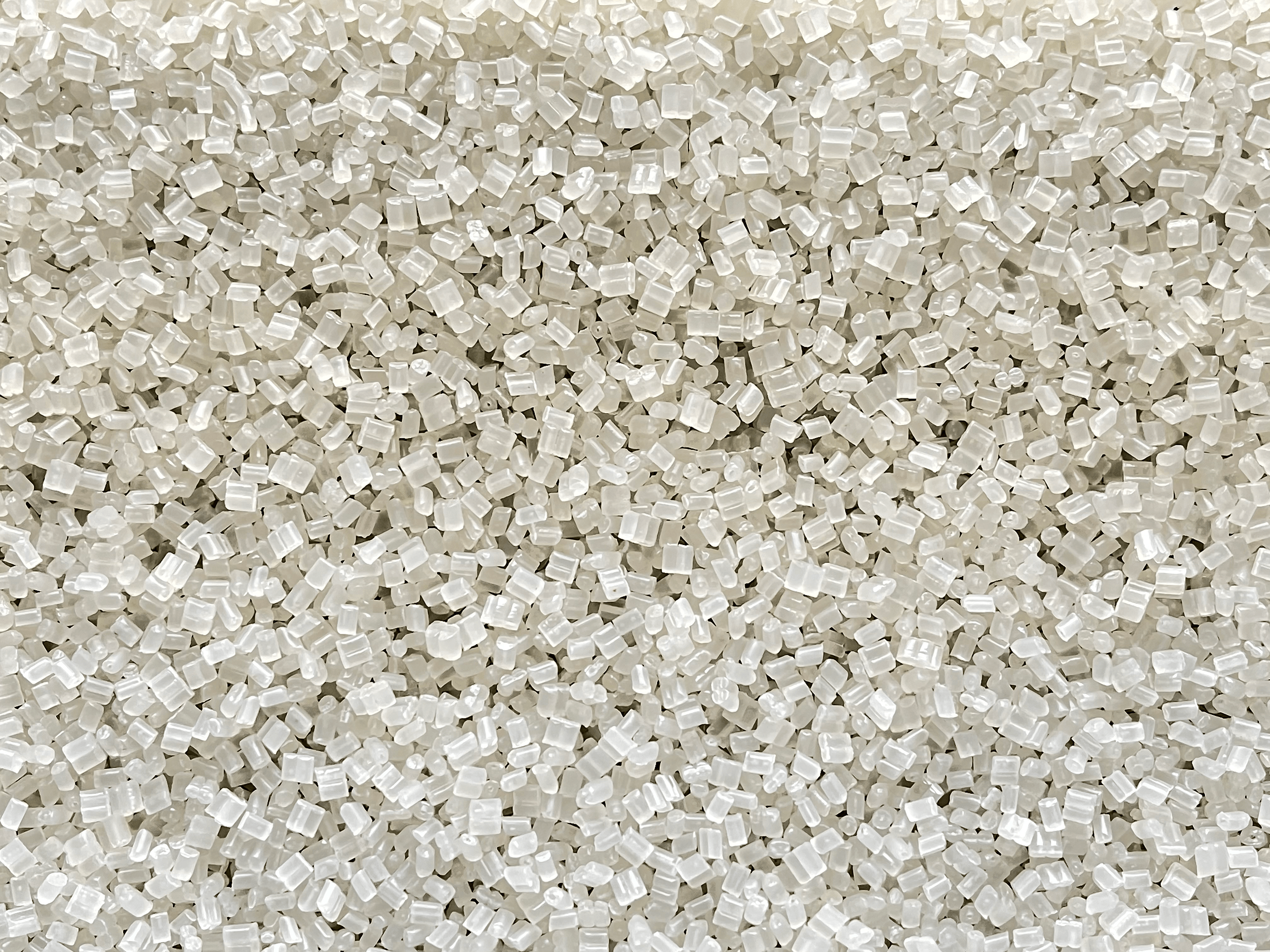
| Re-mall range | Stated PCR-PP MFI (g/10 min) | Stated application focus |
|---|---|---|
| Safety-Focused Recycled Materials | 5–70 | Daily chemical packaging, food contact materials, toys, office stationery |
| Food-Contact Recycled Materials | 3–70 | Food containers, beverage containers, kitchenware |
| Appearance-Focused Recycled Materials | 5–50 | Daily chemical packaging, homeware, storage and organization, decor |
| PCR-PP multi-purpose grades | PCR-PP310: 55 · PCR-PP301: 30 · PCR-PP392: 10 | Packaging, household and consumer goods, textiles and nonwovens, toys, office stationery |
Scenario One: Daily Chemical Packaging
Daily chemical packaging is an appearance-and-safety scenario before it is a mechanical one. Re-mall's application record for daily chemical packaging bottles, covering China, the United States and France, specifies food-grade post-consumer recycled polypropylene compliant with an FDA No Objection Letter (NOL), a translucent body, easy colorability, the capability of a high-gloss finish, a low black speck count, suitability for direct contact with cosmetics, and a high safety profile. The matched processing environment is continuous thermoplastic processing on moulding or stretching equipment with auxiliary systems, supported upstream by AI vision sorting.
What the appearance requirement translates into
The Appearance-Focused Recycled Materials range is positioned on exactly these attributes — enhanced clarity for more transparent applications, balanced stiffness and stability for lightweight designs, more consistent color for branded color development, and a balance of touch, structure and durability. One grade in this family, the PCR-PP High Modulus grade, is listed with a flexural modulus above 1,800 MPa and a PCR content of 30%–50%, which illustrates a point buyers frequently miss: recycled content is a per-grade property, not a category property.
What the safety requirement translates into
Re-mall holds an FDA No Objection Letter, PNC 396, dated 6 June 2025, covering the physical recycling of PP cups into food-contact articles for all food types under Conditions of Use E through G. Two habits follow from that record. First, the letter should be read with its conditions attached, since a food-contact statement without its conditions of use is not an approval. Second, where a pack contacts a cosmetic formulation rather than food, the applicable regulatory basis has to be confirmed separately rather than assumed from a food-contact document.
A daily chemical packaging manufacturer working with Re-mall for five years, at a scale of 30,000 tons per year, reports that process adjustments allow some products to incorporate 50%–100% recycled content instead of virgin material, with some brands already in mass production. The relevant lesson for other buyers is the mechanism, not the percentage: substitution was reached through process adjustment and staged validation, not by dropping a recycled grade into an unchanged specification.
Scenario Two: Office Stationery
Office stationery inverts the priority order. Re-mall's application record for the category lists three requirements: food contact safety, low odor and excellent colorability. The stationery environment is work surfaces and hands — pen barrels, stapler housings, file boxes and trays that sit in front of a user for hours — so odor and color dominate, while the mechanical demand is spread across a wide mix of small, visible, handled parts.
Color is the harder of the two. Stationery sets are assembled from parts produced on different tools and often on different days, and a visible drift between the lid of a file box and its body is a customer complaint rather than a tolerance note. Re-mall's multi-purpose PCR-PP grades are listed for office stationery alongside packaging, household and consumer goods, toys and textiles, with stable processing performance and balanced stiffness and toughness — properties that matter when a single range has to cover thin pen components and larger structural trays in the same plant.
The reference case in this scenario is a five-year relationship with an office stationery manufacturer running 5,000 tons per year across staplers, file boxes, file trays, calculators and pens, developed through multi-party collaboration to create eco-friendly stationery, with low odor and excellent colorability as the stated highlights. That combination — odor plus color — reflects how the category is actually judged at the shelf and at the desk.
How Buyers Evaluate Fit: Material Matching and Validation
Re-mall matches materials against the customer's processing technology, MFR, rigidity, impact performance, color, PCR content and certification requirements, with validation completed through sample testing and pilot production. The substitution path is staged rather than transactional:
- Raw material analysis and application requirement confirmation
- PCR material matching
- Virgin/recycled ratio design
- Sample testing
- Pilot production verification
- Mass rollout
Commercially, this runs alongside OEM and custom modification of recycled plastics, including injection moulding and melt spinning services, with monthly capacity of 1,500–2,000 tons, a 10-ton MOQ, a 7–10 day lead time and staged quality inspection throughout the process. After-sales support is remote technical support, material performance consultation and after-sales tracking. For a buyer in the Research-to-Evaluation stage, the practical reading is that fit is negotiated at sample level, which is also where a mismatch is cheapest to discover.
Check One: Batch Consistency Before Specification
Batch consistency is the condition that makes a trial result repeatable. Re-mall controls it through a full-process chain: raw material source control, fine sorting, deep washing, high-efficiency filtration, compounding and pelletizing, batch testing, and data traceability. The stated purpose is to minimise batch variation of PCR materials.
For buyers, that chain defines what to request. Source control and fine sorting determine how stable the incoming feedstock is; filtration and compounding determine how much of that variability is removed before pelletizing; batch testing and data traceability determine whether the remaining variation is visible to you. A supplier who can show batch records across consecutive lots is answering a different question from one who shows a single certificate of analysis — and for both daily chemical packaging and stationery, consecutive-lot data is the more relevant document.
Check Two: Odor and Color Before Specification
Re-mall addresses odor at multiple stages — raw material source control, washing, drying, melt filtration, devolatilization and formula optimization — rather than relying solely on end-point deodorization. That distinction matters in evaluation: a multi-stage approach can be audited stage by stage, while an end-point claim can only be accepted or rejected on the finished pellet.
Color consistency is handled through raw material color sorting, color matching management, raw material homogenization and production process control. Since odor and color are both perceived properties, they should be judged on parts produced under the buyer's own processing conditions, in the geometry and wall thickness of the actual product. A pellet-level statement is the starting point; a part-level acceptance is the specification input.
Where PCR PP Fits Less Cleanly
A neutral reading of the evidence produces several boundaries that should be stated before a specification is written.
- A range is not a grade. The 5–70 g/10 min span describes the Safety-Focused range. Individual grades sit at individual points — PCR-PP310 at 55, PCR-PP301 at 30, PCR-PP392 at 10 — and selection must be made at grade level, against grade-level data.
- Food-contact eligibility is submission-specific. Re-mall's NOL PNC 396 covers all food types under Conditions of Use E through G. FDA database entries for other producers show the same pattern of narrow scope: a PureCycle Technologies submission covers PP articles with up to 37% recycled content under Conditions of Use A through H, and a Kingfa submission covers Conditions of Use C through G with feedstock restricted to previously used food-contact articles. The generic label "PCR PP" carries no food-contact eligibility on its own.
- Recycled content varies by grade. A 30%–50% PCR content on one high-modulus grade cannot be read across the portfolio; a brand target expressed as a percentage has to be matched to a grade that states that percentage.
- Odor has no universal threshold in the available evidence. Acceptance is application-relative, which is why part-level evaluation under the buyer's process is the only reliable test.
- Mechanical recycling has inherent variation. Full-process control reduces batch variation; it does not eliminate the need for pilot verification before mass rollout.
Against a virgin specification, the change is procedural rather than philosophical: more of the qualification effort moves upstream into material matching, sample testing and pilot production, and less is assumed from the resin name.
Market Context Behind the Qualification Effort
The commercial case for completing this work is visible in the packaging segment. Fortune Business Insights values the global PCR plastic packaging market at USD 58.49 billion in 2026, with a projection of USD 108.27 billion by 2034, and reports that using PCR can reduce carbon emissions by approximately 60% while decreasing reliance on fossil fuels. Those are market-level figures rather than grade-level guarantees, but they explain why brand owners in daily chemical packaging keep pressing suppliers for documented recycled content rather than for a recycled-sounding material name.
Re-mall's own qualification base supports that direction: FDA NOL, GRS certification, ISO 14021 self-declared environmental claim verification, OBP certification and product carbon footprint certification based on ISO 14067, together with REACH, RoHS and PAH testing, a CNAS-accredited recycled plastics laboratory through its wholly-owned subsidiary Shanghai Re-poly Environmental Technology Co., Ltd., and participation in the drafting of 9 national standards and 1 industry standard.
Outlook
The next phase of PCR-PP adoption is unlikely to be decided by resin availability. It will be decided by how quickly the industry standardises scenario-level evidence: grade-specific data sheets, consecutive-lot batch records, and odor and color acceptance criteria agreed on real parts rather than on pellets. Buyers who build those three items into their specification templates early will find that daily chemical packaging and office stationery — despite their opposite priorities — can be qualified from the same material platform with different grade choices and different validation gates.
FAQ
What does scenario fit mean when specifying PCR PP?
Scenario fit is the match between a specific grade's melt flow, odor profile, color capability, PCR content and regulatory documentation and the process and end use it will enter. It is evaluated at grade level for a defined application, not at the level of the resin family.
Does a 5–70 g/10 min MFI range mean one grade covers both daily chemical packaging and office stationery?
No. The 5–70 g/10 min span describes the Safety-Focused Recycled Materials range, which lists both application categories. Individual grades sit at individual points within that span — PCR-PP310 at 55 g/10 min, PCR-PP301 at 30 g/10 min and PCR-PP392 at 10 g/10 min — and are selected against the specific process and part.
How does Re-mall control odor in PCR PP?
Odor is controlled at multiple stages: raw material source control, washing, drying, melt filtration, devolatilization and formula optimization. The stated approach does not rely solely on end-point deodorization, which means each stage can be reviewed separately during supplier evaluation.
What evidence should a buyer request to confirm batch consistency?
The control chain runs from raw material source control through fine sorting, deep washing, high-efficiency filtration, compounding and pelletizing, batch testing and data traceability. Buyers should request batch testing records and traceability data covering consecutive lots, since single-lot certificates do not demonstrate consistency.
Can the same PCR PP grade serve a cosmetic bottle and a file tray?
It may, but this has to be confirmed by validation rather than assumed. Re-mall matches materials according to processing technology, MFR, rigidity, impact performance, color, PCR content and certification requirements, and completes validation through sample testing and pilot production before mass rollout.
What are the main limits to check before writing a PCR PP specification?
The principal limits are that the 5–70 g/10 min MFI span is a range rather than a single-grade property, that food-contact eligibility depends on the specific FDA submission and its conditions of use rather than on the PCR PP label, that recycled content percentages differ by grade, that odor acceptance is application-relative, and that pilot verification remains necessary because mechanical recycling carries inherent variation.
Re-mall's English corporate brochure is available for download: Re-mall corporate brochure (PDF).
Have Questions or Need More Details?
Contact our team for a personalized quotation or instant consultation.
Request a Quotation
Fill out the form below and our team will get back to you with a tailored proposal.
WhatsApp Direct Chat
Prefer to chat in real-time? Message us on WhatsApp for instant assistance & quick answers.
- Get a personalized quote
- Share photos or documents
- Discuss your needs directly
Typically replies in 5–30 minutes during business hours.