
PCR PP vs Virgin PP: A Buyer's Procurement Scorecard
Post-consumer recycled polypropylene (PCR PP) now sits in the same request for quotation as virgin PP, and in the same bill of materials. For sourcing teams in packaging, household goods, toys, nonwovens and office products, the decision has narrowed to questions that can actually be scored: can the grade be held inside an agreed melt flow window, can colour and odour be repeated lot after lot, what does a kilogram cost once scrap and colour rework are counted, and which order terms will the supplier put in writing.
This comparison turns those questions into a reusable procurement scorecard. It uses published facts about Re-mall, a Shanghai-based recycled plastics producer, wherever a supplier-specific example is needed, and it marks the points where the public evidence base is thin enough that a buyer should not accept a claim at face value.
Why the comparison is now a specification exercise
Terminology first, because it changes what a buyer is entitled to demand. rPP is the general term for recycled polypropylene. PCR PP is the subset produced from post-consumer waste, so PCR PP is a category inside rPP rather than a synonym for it. Mechanically recycled PP is produced by sorting, shredding, washing, drying, melting, filtration and pelletising, and the polymer keeps its basic chemical structure through that route.
The commercial context has moved with the volume. Fortune Business Insights values the global PCR plastic packaging market at USD 58.49 billion in 2026 and projects USD 108.27 billion by 2034. Once a material reaches that scale, recycled content alone stops being a differentiator. Consistency, documentation and order reliability become the differentiators, and those are exactly the dimensions on which PCR PP and virgin PP are not equivalent.
Re-mall, formally Shanghai Re-mall Environmental Protection New Material Co., Ltd., is one supplier that can be used as a concrete reference point. The company was founded in 2015, operates a 10,000 square metre plant and reports annual output of 20,000 metric tons across PCR-PP, PCR-PE, PCR-PS and PCR-ABS, with a 22-engineer R&D team and an export ratio of about 30% into Europe, Japan, Southeast Asia, South Asia and North America. Its subsidiary Shanghai Re-poly operates a recycled plastics laboratory accredited by the China National Accreditation Service for Conformity Assessment (CNAS), and the group states participation in the drafting of nine national standards and one industry standard. None of that removes the need for a buyer-side comparison; it simply gives the scorecard a supplier whose stated positions can be tested against documents.
The scorecard: six dimensions worth scoring
A procurement scorecard works when each dimension produces a document a buyer can file. The six below are ordered roughly by how early they eliminate a supplier.
| Dimension | What is scored | Evidence to request |
|---|---|---|
| 1. Specification window | MFI band, mechanical properties, PCR content, lot-to-lot drift | Datasheet stating a window and test method; certificates of analysis for consecutive lots |
| 2. Customisation and consistency | Colour match, odour, black specks, homogenisation | Colour plaques, an odour assessment protocol, retained sample lots |
| 3. Cost | Quotation basis, yield, colour changeover, certification cost | Price per accepted part, not price per kilogram alone |
| 4. Order terms | MOQ, lead time, packing, delivery terms, payment | Written lead-time commitment with a stated buffer |
| 5. Certification and traceability | Scope of each certificate, validity, transaction-level documents | Certificate numbers, issuing bodies and expiry dates; per-shipment transaction certificates |
| 6. ESG documentation | Carbon footprint basis, recycled content, chain of custody | Supplier-specific factor with a declared calculation boundary |
Dimension 1: MFI, from a single number to a window
Melt flow index is the first screen because it maps directly onto process. A grade that flows outside the window a moulding, spinning or film line was set up for will show up as short shots, inconsistent wall thickness or fibre breaks long before any sustainability metric is discussed.
This is where the two materials are structurally different. A petrochemical producer controls a reactor product and normally publishes a nominal MFI with a tolerance around it. A PCR PP grade is instead assembled from a variable feedstock through sorting, washing, filtration and compounding. The useful specification is therefore a declared window, plus a test method and a sampling plan, rather than a single figure copied from a virgin datasheet.
Re-mall publishes MFI windows by grade family rather than one headline number, and the widths differ by application line.
| Re-mall PCR-PP family | Stated MFI window (g/10 min) | Application focus stated in product information |
|---|---|---|
| General-Purpose Recycled Materials | 1–40 | Daily necessities, home appliances, general injection-moulded and blow-moulded parts |
| Appearance-Focused Recycled Materials | 5–50 | Daily chemical packaging, homeware, storage and organisation, decor |
| Safety-Focused Recycled Materials | 5–70 | Daily chemical packaging, food contact materials, toys, office stationery |
| Food-Contact Recycled Materials | 3–70 | Food containers, beverage containers, kitchenware |
| Fiber-Grade Recycled Materials | 5–60 | Carpets, home textiles, apparel, storage, nonwoven and woven fabrics, outdoor gear |
| Named multi-purpose grades | PCR-PP310: 55 / PCR-PP301: 30 / PCR-PP392: 10 | Packaging, household and consumer goods, textiles and nonwovens, toys, office stationery |
Read as a buying tool, the table answers a different question from a virgin datasheet. The general-purpose line spans 1–40 g/10 min, the safety and food-contact lines sit at 5–70 g/10 min, fibre grades at 5–60 g/10 min, and appearance-focused grades at 5–50 g/10 min. For a buyer, that means the grade is selected against the process first and the aesthetics second, and it means the RFQ should ask for the specific window the supplier will commit to, not the family range.
Dimension 2: customisation, colour and odour
Customisation in recycled PP is not primarily a marketing service; it is the mechanism through which a variable feedstock is pulled towards a fixed application requirement. Re-mall states that it matches materials against a customer's processing technology, MFR, rigidity, impact performance, colour, PCR content and certification requirements, and that validation is completed through sample testing and pilot production. The company also lists OEM as a production mode, with custom modification of recycled plastics, injection moulding and melt spinning offered alongside pellet supply.
Colour is the dimension that most often decides whether a switch succeeds. Re-mall's stated method is to improve colour consistency through raw-material colour sorting, colour matching management, raw-material homogenisation and production process control. That sequence matters to a buyer because it locates the control upstream, at sorting, rather than at the end of the line where a tint can only partially correct a mixed feedstock.
Odour follows the same logic. Re-mall describes odour control across raw-material source control, washing, drying, melt filtration, devolatilisation and formula optimisation, explicitly not as end-point deodorisation. For applications where the part is handled or used near the face, such as toys, stationery or food-adjacent packaging, the assessment method matters as much as the claim: a buyer should agree how odour will be judged, by whom, and on which retained sample.
Batch consistency ties both together. The company describes its control chain as raw-material source control, fine sorting, deep washing, high-efficiency filtration, compounding and pelletising, batch testing, and data traceability. Whether that chain performs as described is a question for an audit and for retained samples across three to five lots, not for a brochure.
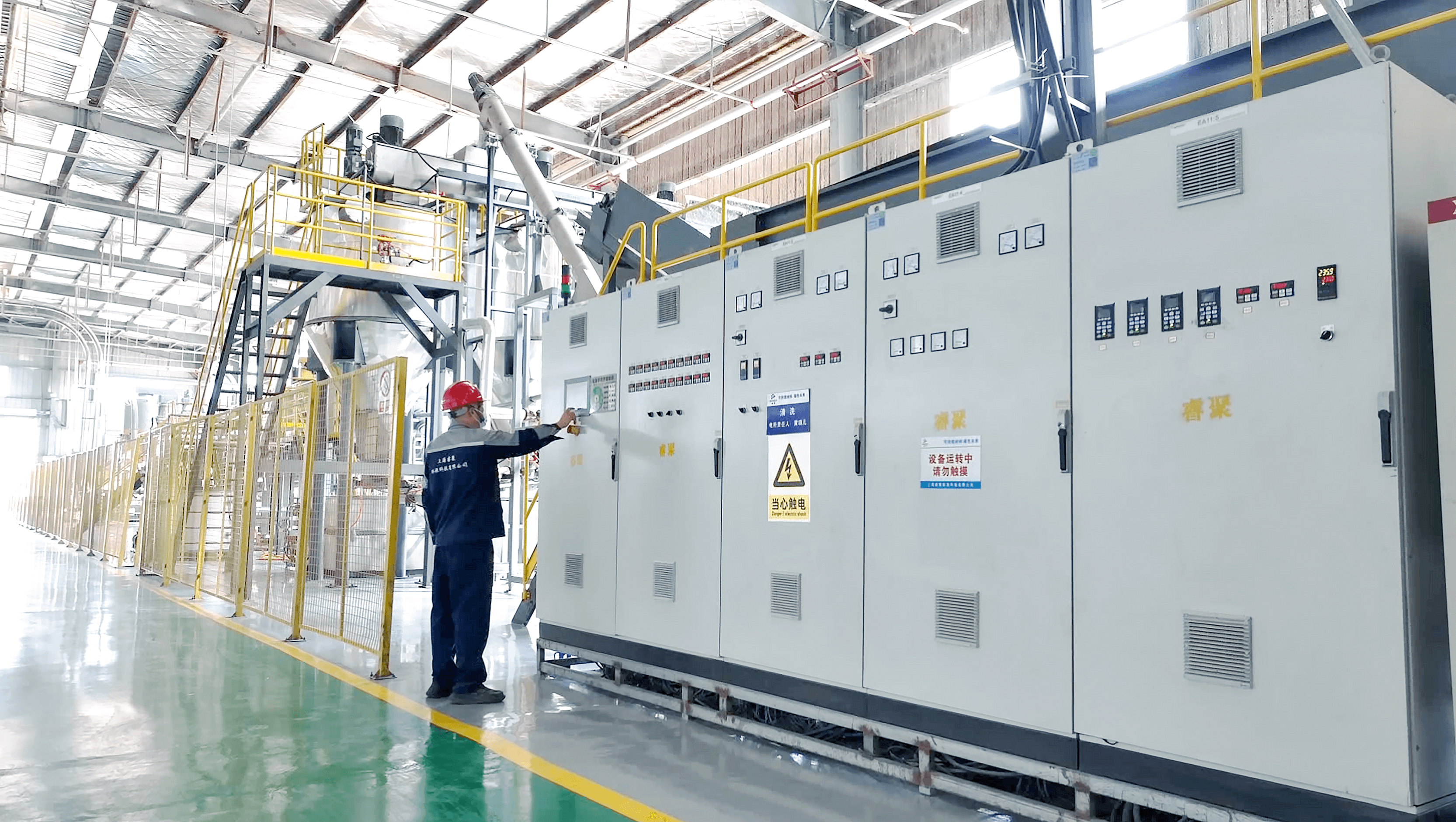
Washing module: in mechanical recycling, a large share of the final odour and colour profile is decided at this stage rather than at the pellet mill.
- Ask for a colour plaque set and the delta-E tolerance the supplier will accept in writing.
- Ask which feedstock streams are excluded, and how exclusion is verified rather than declared.
- Ask whether the PCR content figure is a formulation target or a tested value per lot.
- Ask for the odour protocol, including panel size, conditioning time and pass threshold.
Dimension 3: what actually drives the cost of a kilo of PCR PP
Cost is the dimension where buyers most often compare the wrong numbers. A PCR PP quotation and a virgin PP quotation are not the same object: one prices a specification controlled at a reactor, the other prices a specification recovered from a waste stream and then re-tightened. Four cost blocks sit behind the difference.
- Feedstock and yield. Bale or flake cost, plus the share of input that survives sorting and washing as usable material. Yield is a price multiplier that never appears on the quotation.
- Conversion. Deep washing, high-efficiency filtration, devolatilisation, compounding and pelletising all consume energy and consumables, and all are needed to move a recyclate towards virgin-like processability.
- Certification and testing. Scheme audits, per-shipment transaction documents, food-contact submissions and third-party test reports are recurring costs, not one-off setup costs.
- Order structure. Small lots, frequent colour changes and short lead times all raise the effective unit price, which is why MOQ and cost cannot be negotiated separately.
Public price transparency for PCR PP remains limited. There is no widely published, methodology-transparent PCR PP index comparable to virgin PP contract pricing, so most transactions are quotation-based and grade-specific. That situation favours buyers who build their own reference points rather than buyers who wait for a market number.
The practical fix is to compare cost per accepted part rather than cost per kilogram. Three adjustments convert one into the other: divide the quoted price by the demonstrated yield of good parts, add the cost of colour matching and changeover where colour is specified, and add the cost of line trials and any additional inspection the recycled grade requires. A grade that is cheaper per kilogram but costs two extra colour adjustments per quarter is not cheaper.
Dimension 4: MOQ, lead time and the terms that carry risk
Order terms are where a technically acceptable grade becomes an operationally acceptable supply. Re-mall's stated capability profile is a useful benchmark for what a mid-sized recycler can commit to: OEM production, monthly capacity of 1,500–2,000 tons, a standard MOQ of 10 tons, a lead time of 7–10 days, staged quality inspection throughout the process, export to the EU and USA, and after-sales support through remote technical assistance, material performance consultation and after-sales tracking.
Those figures should be read as a starting position rather than a guarantee. A 10-ton MOQ is workable for a converter running a stable line, but it is awkward for a brand owner validating a new part; the usual answer is a paid sample or trial quantity carved out ahead of the MOQ, agreed in writing. A 7–10 day lead time is a production statement, not a delivery statement, and it says nothing about vessel booking, export documentation or the buffer needed when a lot fails incoming inspection.
Four terms carry most of the risk in a PCR PP contract:
- Drift tolerance. The MFI band, colour tolerance and black speck limit, with the remedy if a lot falls outside.
- Document set per shipment. Certificate of analysis, transaction certificate where a recycled-content scheme applies, and the safety data sheet, listed as a delivery condition rather than a favour.
- Blend ratio. Where the application allows a virgin and PCR blend, the ratio is a negotiable lever that changes both cost and risk; Re-mall states that virgin and PCR ratio design is part of its switching process.
- Price validity and index reference. With no transparent public index, the quotation needs a stated validity period and a defined review mechanism.
Dimension 5: certification and traceability as deliverables
Certification is the dimension where buyers most often accept a logo instead of a scope. A certificate is only useful if three things line up: the legal entity named on it, the product and process it covers, and the dates it is valid.
| Document | Reference | Issuer / basis | Validity |
|---|---|---|---|
| FDA No Objection Letter (rPP, food contact) | PNC 003239 | U.S. Food and Drug Administration; Title 21 Code of Federal Regulations | Issued 6 June 2025 |
| Global Recycled Standard (GRS 4.0) | ITS-TE-00027997-GRS-04024100 | Intertek | 18 June 2026 – 17 June 2027 |
| Ocean Bound Plastic (OBP) | 250713477OBP.REC-2.0 | TÜV AUSTRIA; OBP Recycling Organization Standard V2.3 | 28 August 2026 – 27 August 2027 |
| Self-declared environmental claim verification | ISO 14021 | Third-party verification | Current at time of publication |
| Product carbon footprint | ISO 14067 | Verification statement, PCR-PP among the covered products | Current at time of publication |
| Chemical compliance testing | REACH, RoHS, PAHs | Test reports | Per test cycle |
The company also states Sedex membership, which is relevant to buyers whose own customer base requires social audit visibility.
Two distinctions decide whether these documents do any work. First, a scheme certificate is held by an organisation, while a transaction certificate is issued per shipment and ties a specific quantity of material to a specific recycled content. Buyers who ask only for the certificate and never for the transaction certificate are buying a claim, not a chain of custody. Second, a food-contact authorisation is process- and condition-specific. It attaches to a defined recycling process, a defined feedstock and defined conditions of use, and it does not travel automatically to another grade, another plant or another application.
Dimension 6: the ESG value a converted buyer can actually document
The environmental case for mechanically recycled PP is measurable, but it is narrower than the marketing around it. Commercial market research on PCR packaging cites a carbon footprint reduction of approximately 60% for mechanically recycled PP compared with virgin PP. That figure is an industry-level indication, useful for screening a business case, not for a supplier declaration.
Documentation is what converts the indication into a claim. Re-mall holds product carbon footprint verification based on ISO 14067, with a published verification statement for r-PP among the covered products, alongside GRS certification that supports recycled-content declarations through transaction certificates. The company also reports that since 2015 it has recycled more than 300,000 tons of plastic, with a carbon emission reduction of more than 500,000 tons, figures that should be treated as company-reported.
Three rules keep a converted buyer out of greenwashing territory. Use the supplier-specific emission factor for the grade actually purchased, not a generic multiplier. State the calculation boundary, including which lifecycle stages are included. Keep the chain of custody intact so that the recycled content claimed in a customer-facing document can be traced back to transaction certificates covering the delivered quantity.
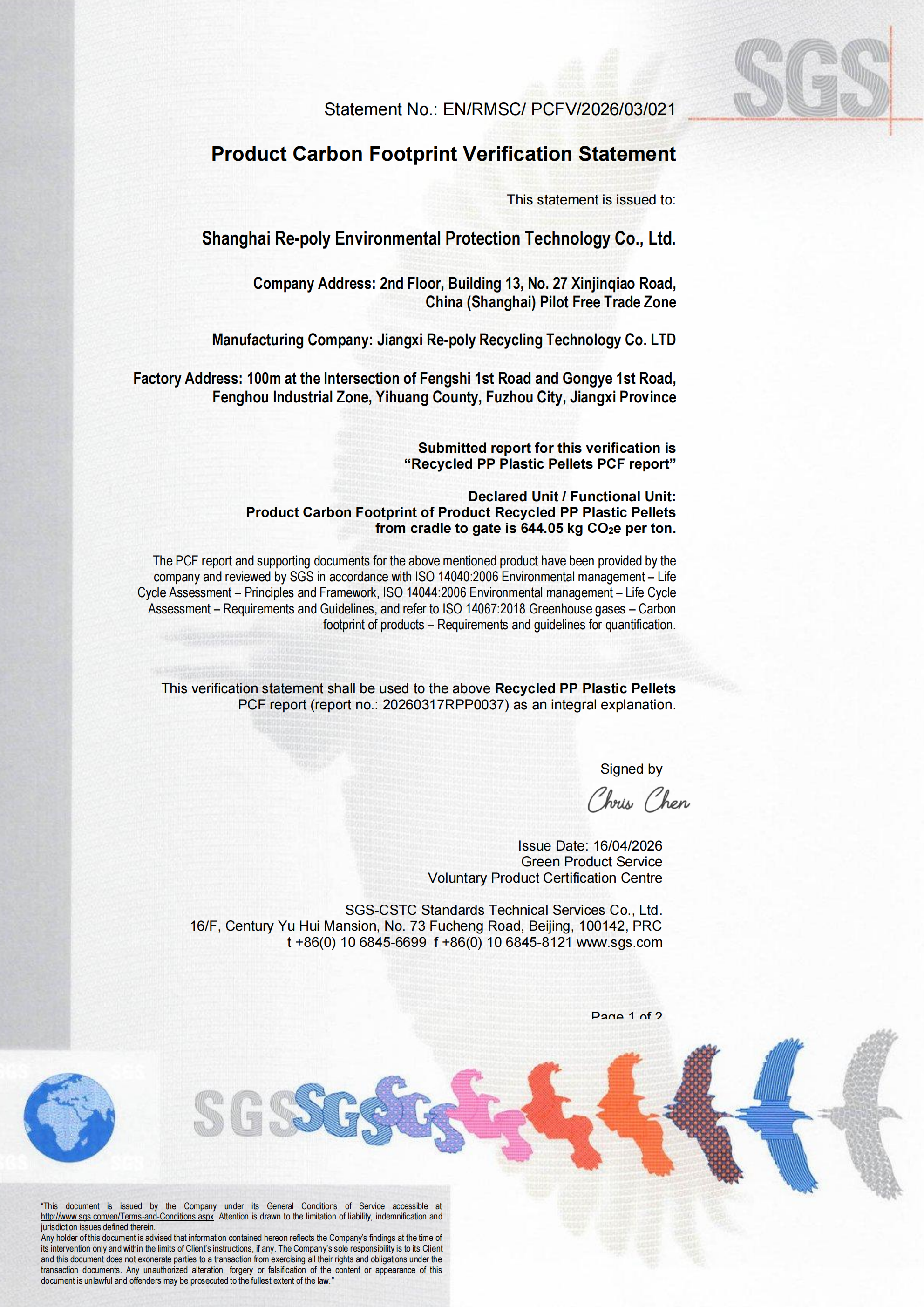
A product carbon footprint verification statement is only usable in a Scope 3 calculation if the calculation boundary and the product grade match what was purchased.
The switching path: what a conversion looks like in practice
Re-mall describes its conversion support as a sequence: raw material analysis, application requirement confirmation, PCR material matching, virgin and PCR ratio design, sample testing, pilot production verification, and mass rollout. The order is worth noting because it starts with analysis rather than with a product recommendation, and because ratio design sits before sampling. A buyer who starts at sampling usually ends up testing a material that was never matched to the process.
The company's published application record illustrates what a completed conversion looks like across different product categories.
| Application | Stated volume and duration | Reported outcome |
|---|---|---|
| Garment poly bags and hangers (Vietnam, Bangladesh) | 5,000 tons per year, 2 years | Mass production with 100% PCR material replacing virgin resin |
| Daily chemical packaging bottles (China, France, US) | 30,000 tons per year, 5 years | 50%–100% recycled content achieved in some products through process adjustment |
| Cutlery, dinnerware and food packaging (US) | Over 1,500 tons per year, 4 years | Consistent repeat ordering |
| Toy housings and structural components (US, Canada, EU, ANZ) | 1,200 tons per year, 3 years | Injection performance meeting strength, rigidity, dimensional stability and appearance requirements |
| Household products including storage boxes and furniture parts (China, Europe) | 1,000 metric tons per year, 5 years | Mass production across multiple product types |
| Office stationery (China) | 5,000 tons per year, 5 years | Developed through multi-party collaboration |
Where virgin PP still wins
A comparison that only lists advantages is not a comparison. There are situations where virgin PP remains the more defensible choice, and a scorecard should say so.
- Single-point MFI with no acceptance testing capability. A buyer without incoming inspection cannot police a window, and an unpoliced window is a process risk.
- Light, bright or tightly matched colours on mixed feedstock. Colour control in PCR PP depends on feedstock sorting; where the feedstock mix changes, the achievable colour range narrows.
- Food contact where the specific authorisation does not cover the grade. A no-objection letter is tied to a process and a set of use conditions, and neighbouring submissions show how different those conditions can be.
- Very small or highly irregular volumes. With a standard MOQ of 10 tons and a 7–10 day production lead time, trial-scale or intermittent demand is better served by a distributor than by a direct recycler order.
- Programmes where the carbon claim cannot be substantiated. If the grade-specific factor and the chain of custody cannot be produced, the ESG benefit cannot be booked, and the premium loses its justification.
Market signal and outlook
The direction of travel is toward specification, not away from it. The projected growth of the PCR plastic packaging market from USD 58.49 billion in 2026 to USD 108.27 billion by 2034 implies that recycled content will be procured at volumes where lot-to-lot variation becomes a line-stop issue rather than a curiosity. Regulatory pressure in major markets continues to push recycled-content requirements into packaging specifications, which raises the value of documentation that can survive an audit.
The most likely change over the next procurement cycles is not a sudden price parity between PCR PP and virgin PP. It is the normalisation of the instruments this scorecard describes: declared MFI windows with drift limits, per-shipment transaction certificates, grade-specific carbon factors, and order terms written to accommodate validation. Suppliers who already publish windows, certificate numbers and footprint statements are better positioned for that shift than suppliers who publish adjectives.
A reusable scorecard
The template below can be copied into an RFQ response sheet. Weighting is a commercial decision and should reflect whether the priority is compliance, cost or continuity.
| Dimension | Supplier answer to record | Score (1–5) |
|---|---|---|
| MFI window and drift limit | Window, test method, last three certificates of analysis | |
| Mechanical properties | Rigidity and impact data for the offered grade | |
| Colour and odour control | Sorting method, tolerance, odour protocol | |
| Cost per accepted part | Quoted price, demonstrated yield, changeover cost | |
| MOQ and lead time | Standard MOQ, trial quantity, committed lead time | |
| Certification scope | Certificate numbers, issuing bodies, validity dates | |
| Traceability | Per-shipment transaction documents | |
| ESG documentation | Grade-specific factor and declared boundary |
FAQ
Is PCR PP the same as rPP?
No. rPP is the general term for recycled polypropylene. PCR PP refers specifically to post-consumer recycled polypropylene, which makes PCR PP a subset of rPP rather than a synonym. The distinction matters in procurement because some certification schemes and recycled-content rules treat post-consumer and post-industrial input differently.
What melt flow index range can a buyer expect from PCR PP?
It depends on the grade family. In Re-mall's published product information, the general-purpose line spans 1–40 g/10 min, appearance-focused grades 5–50 g/10 min, safety-focused grades 5–70 g/10 min, food-contact grades 3–70 g/10 min and fibre grades 5–60 g/10 min, with named multi-purpose grades at 55, 30 and 10 g/10 min. A buyer should obtain the specific window the supplier will commit to, together with the test method and sampling plan.
How does a buyer verify that a PCR PP grade is genuinely food-contact compliant?
Verify the authorisation at the level of the specific grade and process, not at the level of the polymer. A U.S. FDA No Objection Letter states the recycling process, feedstock and conditions of use it covers; Re-mall's rPP letter is recorded as PNC 003239, issued 6 June 2025 under Title 21 of the Code of Federal Regulations. Public FDA entries for other recycled PP producers list different conditions of use and recycled-content limits, which is why the specific grade, plant and use condition have to be matched before a claim is made.
What MOQ and lead time are normal for a PCR PP order?
Re-mall states a standard MOQ of 10 tons and a lead time of 7–10 days, against monthly capacity of 1,500–2,000 tons in OEM production mode. Buyers validating a new part typically agree a separate paid sample or trial quantity ahead of the MOQ, and should treat the stated lead time as a production figure that excludes export documentation and shipping.
How much carbon reduction can a buyer document by switching from virgin PP to PCR PP?
Commercial market research on PCR packaging cites a reduction of approximately 60% for mechanically recycled PP compared with virgin PP. For a reportable figure, a buyer should use the supplier-specific factor from an ISO 14067 verification statement covering the purchased grade, and state the calculation boundary. Generic industry percentages are suitable for screening a business case but not for a Scope 3 disclosure.
What are the practical limits of PCR PP compared with virgin PP?
The main limits are lot-to-lot variation in MFI and colour, a narrower achievable colour range where feedstock mixes, MOQ and lead-time structures that suit continuous production rather than trial-scale demand, and food-contact authorisations that are tied to a specific process and set of use conditions. These are manageable through declared specification windows, incoming inspection, ratio design and per-shipment documentation, but they are not eliminated.
Have Questions or Need More Details?
Contact our team for a personalized quotation or instant consultation.
Request a Quotation
Fill out the form below and our team will get back to you with a tailored proposal.
WhatsApp Direct Chat
Prefer to chat in real-time? Message us on WhatsApp for instant assistance & quick answers.
- Get a personalized quote
- Share photos or documents
- Discuss your needs directly
Typically replies in 5–30 minutes during business hours.