
PED and ISO 14001: Reading Rolled Ring Forgings Certificates
PED and ISO 14001: Reading Rolled Ring Forgings Certificates
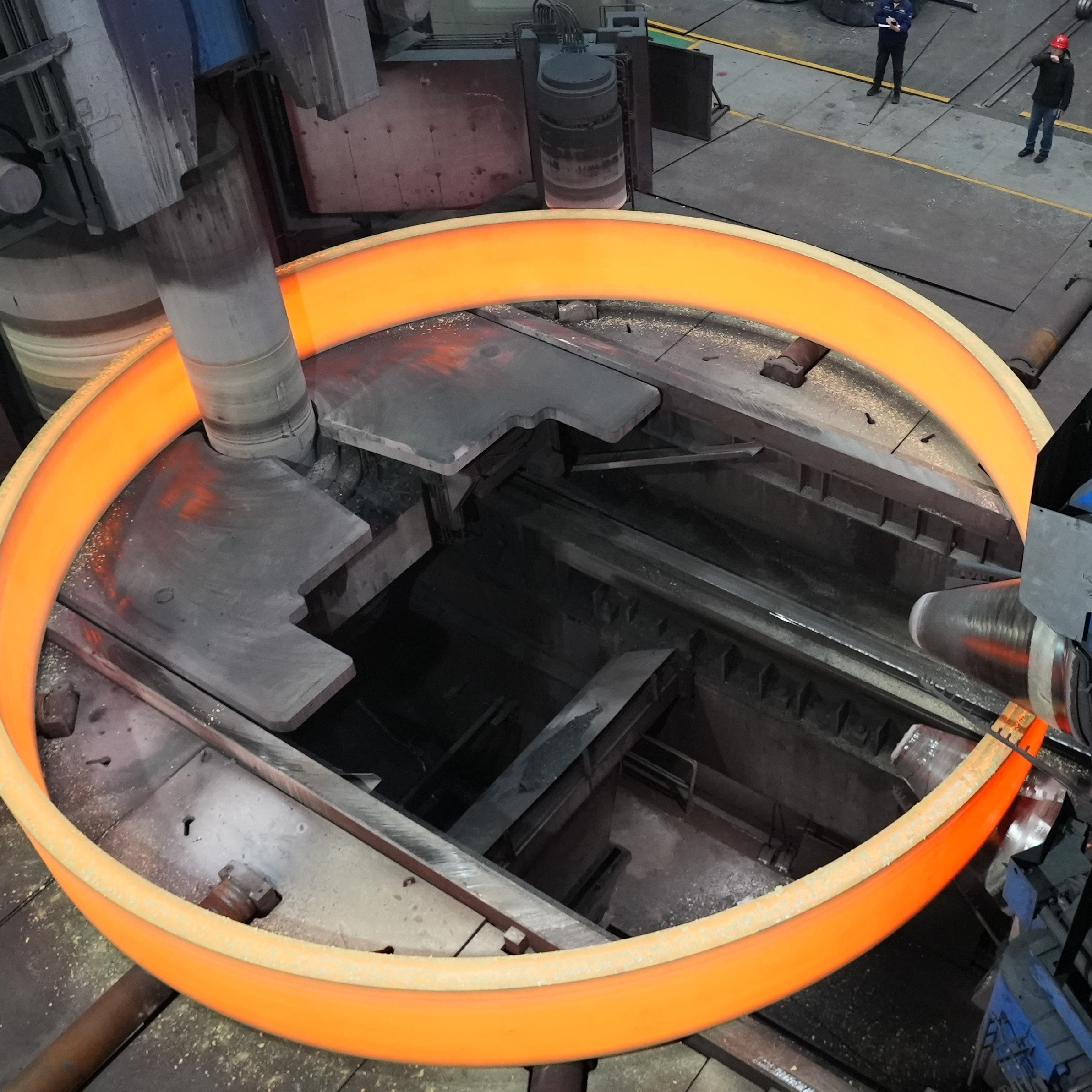
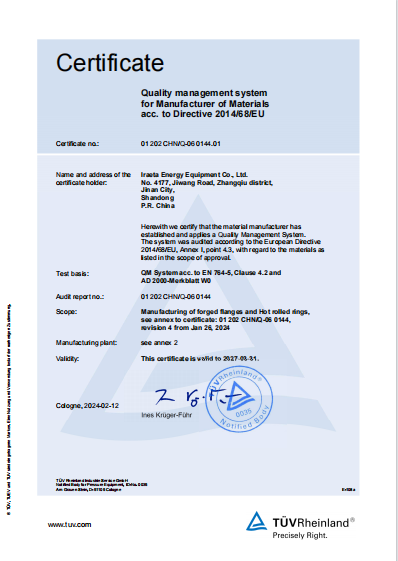
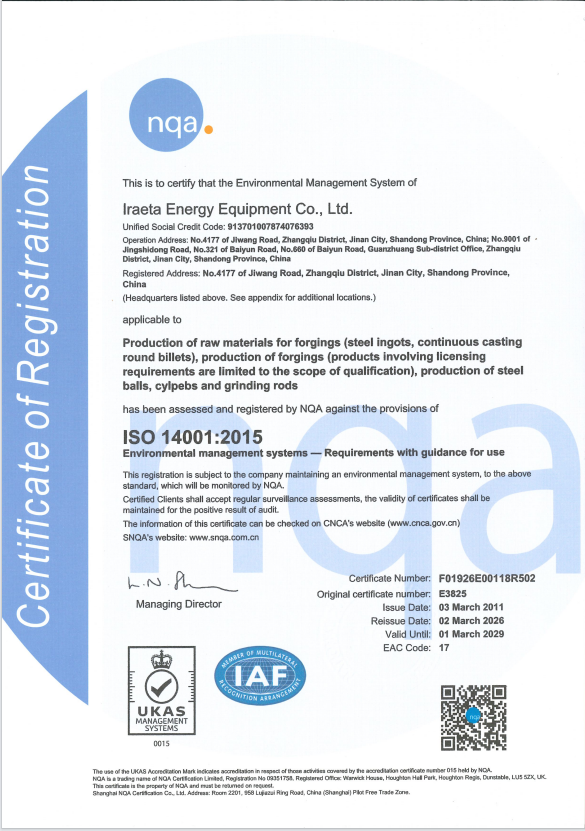
The two certificates that travel with rolled ring forgings answer different questions, and reading them correctly begins with refusing to read them as a pair. The compliance record for the forgings and seamless rolled rings produced by Iraeta Energy Equipment Co., Ltd., a forging manufacturer with production facilities in China and Spain, lists a PED 2014/68/EU certificate for the EU market (certificate number 01 202 CHN/Q-06 0144.01, issued by TUV) and an ISO 14001:2015 certificate for the global market (certificate number F01926E00118R502, issued by NQA Certification Co., Ltd., Shanghai). One document sits inside a pressure-equipment market-access framework. The other describes an audited environmental management system. Neither is a substitute for the other, and neither replaces the order-specific documents that a purchase order should specify.
For buyers in the research and evaluation stages, the practical difficulty is rarely that the certificates are absent. It is that the two documents look alike — same paper, same signatures, same block of numbers — while carrying entirely different weight. A buyer who accepts an environmental certificate as evidence of pressure-equipment fitness, or who assumes that a pressure certificate also covers every product form in a supplier's catalogue, will build the wrong acceptance criteria into an order and discover the gap at inspection. This article sets out a five-line reading method, applies it to both documents, and closes with the purchasing language that keeps certificate scope and acceptance criteria aligned.
Two documents, two different questions
A rolled ring forging certificate is a written answer to a written question. Reading it correctly means first identifying which question the document was issued to answer, then checking whether your order falls inside the answer.
The PED 2014/68/EU certificate answers a market-access question: whether the manufacturing of the covered forged items has been brought within the EU pressure-equipment framework. The ISO 14001:2015 certificate answers a management question: whether an environmental management system has been independently assessed against that standard within a stated scope of activities. The first is specific to one regulated market and one regulatory framework. The second is market-neutral and process-oriented.
| Reading line | PED 2014/68/EU certificate | ISO 14001:2015 certificate |
|---|---|---|
| Question answered | Is the manufacturing of the covered forged items documented inside the EU pressure-equipment framework? | Is there an independently assessed environmental management system across the stated activities and sites? |
| Standard cited | PED 2014/68/EU | ISO 14001:2015 |
| Certificate number | 01 202 CHN/Q-06 0144.01 | F01926E00118R502 |
| Issued by | TUV | NQA Certification Co., Ltd. (Shanghai) |
| Market applicability | EU | Global |
| Stated scope | Manufacturing of forged flanges and Hot rolled rings | Production of raw materials for forgings (steel ingots, continuous casting round billets), production of forgings (products involving licensing requirements are limited to the scope of qualification), production of steel balls, cylpebs and grinding rods |
| Validity recorded | 12 February 2024 – 31 March 2027 | 2 March 2026 – 1 March 2029 |
| What it does not establish | Material grade, mechanical properties, tolerances or inspection results for a specific order | Product conformity, pressure rating or any metallurgical property |
That comparison is the whole argument in miniature. Everything that follows is a way of testing it against an actual order.
Line one: the standard, and what the certificate is a certificate of
The first line to read is the standard or directive cited, because it tells you what kind of claim the rest of the document can make. Two different standards produce two different kinds of evidence, and the difference is not one of degree.
PED 2014/68/EU: a regulatory framework, not a product datasheet
PED 2014/68/EU is the EU directive governing pressure equipment placed on the EU market. It operates through essential safety requirements and conformity assessment rather than through a single prescribed material specification. A forging is a component, not a finished pressure vessel, so the certificate's practical function is narrower than buyers sometimes assume: it records a manufacturing scope brought inside that framework, and it supports the conformity work done further down the supply chain by whoever places the finished equipment on the market.
Read in that light, the PED certificate is a qualifying document. It tells a European buyer that the manufacturing activity behind the forged item has been assessed within the framework the buyer's own pressure-equipment obligations refer to. It does not, and cannot, certify that a particular ring will hold a particular pressure — that determination belongs to the design and conformity assessment of the equipment in which the ring sits.
ISO 14001:2015: a management system standard
ISO 14001:2015 is the international standard for environmental management systems. Certification means an independent certification body has assessed an organisation's environmental management system against the standard's requirements and found it conformant within a defined scope. The claim is about how environmental aspects of the operation are managed, controlled and improved — not about what the operation produces.
This is why an ISO 14001 certificate can legitimately cover a very wide activity list, including raw material production, forging and grinding media, while saying nothing at all about the dimensional accuracy of a ring. The breadth is a feature of the standard, not a sign that the document is vague. It is simply answering a different question.
Line two: the scope sentence decides whether your ring is covered
If one line on a certificate deserves to be read twice, it is the scope. Scope is where a supplier's general capability and a buyer's specific order either meet or fail to meet, and the two certificates in this pair write scope in visibly different ways.
The PED certificate scope is written in product-form language: manufacturing of forged flanges and hot rolled rings. Those are specific mill forms. A buyer sourcing a large rolled ring for a wind tower flange connection, a bearing ring, a hydro-electric ring plate or a rotary kiln tyre should therefore ask a direct question rather than assume: is this product form inside the scope as written? The question is not a challenge to the supplier's capability — it is the ordinary discipline of matching a document to an order. Where the answer is that a particular item sits outside the stated product forms, the buyer can ask what evidence does cover it, and the evaluation can proceed on accurate grounds instead of a misread certificate.
The ISO 14001 scope is written in activity language and is considerably broader: production of raw materials for forgings such as steel ingots and continuous casting round billets, production of forgings, and production of steel balls, cylpebs and grinding rods. It also carries a qualifier worth pausing on — products involving licensing requirements are limited to the scope of qualification. That parenthetical is not boilerplate. It signals that the certificate should be read alongside whatever licensing scope applies to the products concerned, and a buyer who wants certainty can ask the supplier to explain in writing which products that qualifier touches.
This is also where most certificate confusion originates. A buyer sees a rolled ring forging supplier holding both documents, reads the broader scope, and concludes that everything in the catalogue is covered by everything in the pack. The correct reading is the opposite: the two scopes overlap but are not identical, and the narrower one governs the regulated claim.
Line three: who issued it, and why that is not a formality
The issuing body is the next line to check, because a certificate is only as strong as the organisation that signed it and the scheme under which it was issued. In this pair the bodies differ, and that difference is informative rather than problematic.
The PED 2014/68/EU certificate is issued by TUV and applies to the EU market. The ISO 14001:2015 certificate is issued by NQA Certification Co., Ltd., Shanghai, and applies to the global market. There is no requirement that a single organisation issue both, and a buyer should not treat the absence of a single issuer as a weakness. Environmental management systems and pressure-equipment conformity are assessed under different schemes by bodies competent in different areas.
What a buyer can reasonably do is confirm the standing behind each signature. For the management-system certificate, that means asking for the accreditation details that sit behind the issuing body's scope. For the pressure-equipment certificate, it means asking which conformity assessment route applies to the item being purchased and which body performed that assessment, since the applicable route depends on the equipment category and the fluid involved — determinations that belong with the equipment design, not with the forging alone. Neither question is adversarial. Both are the kind of check that separates a documented qualification from a logo on a web page.
Line four: market applicability is not a quality ranking
The market line on a certificate is frequently misread as a measure of seriousness. It is not. It identifies where the document does its work.
The PED certificate is an EU-market instrument. Its value to a buyer outside the EU lies in what it demonstrates about manufacturing control, not in any legal effect in that buyer's own jurisdiction. The ISO 14001 certificate is recorded as applicable to the global market, which is consistent with the nature of a management-system standard: it is not tied to a single regulator's market-access rules.
Two consequences follow for evaluation. First, an EU-market buyer assessing a pressure-related application has a specific reason to read the PED document closely, because it is the one that touches their own regulatory position. Second, a buyer in another market who is using ISO 14001 as part of a sustainability or supplier-conduct screen should not treat the PED certificate as irrelevant, and a buyer using PED as a technical screen should not treat ISO 14001 as a proxy for it. The documents are complementary in a supplier file; they are not ranked against each other.
Line five: the validity window against your delivery schedule
Dates are the least interesting line on a certificate and the one most likely to cause a late-stage problem. A certificate is a snapshot with an expiry, and a project schedule is longer than most buyers assume at the inquiry stage.
The PED 2014/68/EU certificate in this record carries a validity period running from 12 February 2024 to 31 March 2027. The ISO 14001:2015 certificate runs from 2 March 2026 to 1 March 2029. Both are current as of this article, but the useful question is not whether they are valid today — it is whether they will still be valid when the rings are delivered, installed and accepted, and whether the supplier can produce renewal or surveillance evidence if the expiry falls inside the project window.
Version currency matters as much as the expiry date. The standard year printed on the certificate should match what your own tender documents, customer specifications or management-system references cite. A certificate issued against an older edition of a standard is not automatically a defect, but it is a question worth raising early, while there is still time for the supplier to respond in writing rather than at the loading bay.
What neither document tells you about the forging
Perhaps the most valuable reading skill is knowing where a certificate stops. Neither of these two documents describes the physical ring you are buying.
Neither the PED certificate nor the ISO 14001 certificate states a steel grade, a heat treatment condition, a mechanical property set, a dimensional tolerance, a surface condition, an inspection method or a result for a specific heat or serial number. Those are order-level matters, and they are established by the documents your purchase order specifies — chemistry and mechanical test reports, dimensional records, non-destructive examination reports and marking details, as agreed for the item concerned.
This is not a limitation to be worked around; it is the normal division of labour in forged component procurement. The certificates establish standing and scope. The order documents establish conformity of the delivered item. A supplier file that contains the first without the second is incomplete, and an acceptance procedure that relies on the first as if it were the second will not detect a non-conforming ring.
Where the scope line meets real orders
The reading method becomes concrete when applied to the product forms that buyers actually purchase. Rolled ring forgings span a wide range of applications — wind power flanges and bearing rings, hydropower components, pressure-retaining parts, kiln tyres and heavy machinery rings — and each application draws on a different part of the certificate pack.
- Flange-type rings for EU pressure or structural applications. This is the clearest match to the PED scope wording, which names forged flanges and hot rolled rings. A buyer here should still confirm that the specific material and dimensional envelope are inside the supplier's qualified range, and should keep the pressure-equipment conformity route in view.
- Large rings for wind, hydropower and heavy equipment. These sit comfortably inside the ISO 14001 activity scope covering the production of forgings, which is why the environmental credential often appears in supplier questionnaires for these projects. It should be recorded as an environmental management credential, not as evidence of mechanical suitability for a fatigue-loaded application.
- Custom and profile ring forms. Where the cross-section departs from a simple rectangular profile, the scope question shifts from product form to manufacturing route, and the sensible step is written confirmation naming the item rather than an inference from a generic scope line.
- Items outside either scope as written. If a requested item does not clearly fall inside the stated scope, the honest path is to ask what document does cover it. A supplier that answers precisely is easier to qualify than one that answers broadly.
What to request at inquiry, and what to check at delivery
The timing of document requests matters as much as the content. Certificates requested only at delivery arrive too late to influence a shortlist, and certificates requested only at inquiry are often superseded by the time goods ship. A two-stage approach closes both gaps.
| Stage | What to request | Why it belongs at this stage |
|---|---|---|
| Inquiry / pre-qualification | Full copies of the PED 2014/68/EU and ISO 14001:2015 certificates showing number, issuing body, scope, market and validity dates | Lets you verify scope fit before technical evaluation begins, and removes reliance on marketing summaries |
| Inquiry / pre-qualification | Written confirmation that the specific product form and material of your item fall inside the stated certificate scope | The scope sentence, not the catalogue, decides coverage; a written answer becomes part of the evaluation record |
| Inquiry / pre-qualification | Confirmation of the conformity assessment route for the intended application, where the item feeds EU pressure equipment | Establishes what the forging certificate supports and what the equipment maker must do separately |
| Order placement | Certificate numbers and revision cited in the purchase order, with a notification obligation if status changes before shipment | Prevents a lapsed or superseded document arriving with the goods |
| Delivery | Current certificate copies plus the order-specific inspection and test documents defined in the purchase order | Certificates establish standing; order documents establish conformity of the delivered rings |
| Delivery | Renewal or surveillance evidence where a certificate expiry falls inside the delivery or warranty window | Avoids a compliance gap appearing after the rings are already installed |
Writing certificate scope into purchase terms and acceptance criteria
The final step is to move what you have read out of the evaluation file and into the contract. Certificate scope that is not written into purchase terms tends to dissolve into an assumption.
A workable clause structure does four things. It names the documents by number and standard rather than by description, so there is no ambiguity about which certificate is meant. It states that the product form, material and dimensional envelope of the ordered item must fall within the stated scope, and requires the supplier to say so in writing. It sets a notification obligation if the certificate status changes between order and shipment. And it separates certificate evidence from item conformity, so that acceptance of the delivered rings rests on the inspection and test documents the order defines, not on the presence of a certificate in the paperwork.
An illustrative formulation — not a substitute for your own legal review — might read: the supplier shall provide current copies of certificate 01 202 CHN/Q-06 0144.01 (PED 2014/68/EU) and certificate F01926E00118R502 (ISO 14001:2015), confirm in writing that the ordered product form and material are within the stated scope of each, and notify the buyer before shipment of any change in certificate status. Acceptance criteria for chemistry, mechanical properties, dimensions, examination and marking are specified separately in the technical annex.
That separation is the point. Certificate scope tells you what standing a supplier holds. Acceptance criteria tell you what you will accept. Confusing the two is how buyers end up with a compliant-looking document pack and a ring that fails dimensional inspection.
The rest of the pack, briefly
PED and ISO 14001 are the two documents most often read together for rolled ring forgings, but they are rarely alone. The same supplier record lists an ISO 9001:2015 quality management certificate (F02326Q00125R602, issued by BV, global market), an EN 1090 certificate for structural steel components (0035-CPR-1090-1.03389.TÜVRh.2025.003, issued by TUV, EU market) and an ISO 45001:2018 occupational health and safety certificate (F01926S00070R502, issued by NQA Certification Co., Ltd., Shanghai, global market). Each answers a further distinct question — quality management, structural component conformity, occupational safety — and none of them substitutes for the two documents discussed here. Reading a full pack is the same exercise repeated: identify the question, read the scope, check the issuer, check the dates.
FAQ
Does a PED 2014/68/EU certificate mean the rolled ring forging itself is CE marked?
Not in the sense buyers usually mean. Under PED 2014/68/EU the marking obligation follows the pressure equipment or assembly being placed on the EU market, and the forging supplier's certificate is supporting evidence about manufacturing scope rather than the marking itself. Where an item is intended to be placed on the market as a component in its own right, the treatment should be confirmed with the supplier and with the body handling the equipment conformity assessment.
Can an ISO 14001:2015 certificate substitute for PED 2014/68/EU in an EU pressure application?
No. ISO 14001:2015 certifies an environmental management system against that standard, within a stated scope of activities. PED 2014/68/EU sits inside the EU pressure-equipment framework and applies to the EU market. The two documents differ in standard, issuing body, scope and market applicability, and neither one carries the other's claim.
How do I confirm that my ring's product form is covered by the certificate scope?
Read the scope sentence and compare it with the item. The PED certificate in this record is scoped to manufacturing of forged flanges and hot rolled rings, so a buyer of a different product form should ask for written confirmation rather than infer coverage. The ISO 14001 certificate is scoped to a list of production activities, including raw material production and forging, and carries a qualifier limiting products with licensing requirements to the scope of qualification. Scope fit is a written question with a written answer.
What should I do if a certificate expires during my project?
Raise it before the order is placed. The PED certificate in this record is valid to 31 March 2027 and the ISO 14001 certificate to 1 March 2029; where a delivery, installation or warranty window extends past either date, ask for renewal or surveillance evidence as a condition of the order and require notification of any change in certificate status before shipment. A certificate that has lapsed by the time goods arrive creates a compliance gap that is difficult to close retrospectively.
Do the two certificates need to come from the same issuing body?
No. The PED 2014/68/EU certificate in this record is issued by TUV and the ISO 14001:2015 certificate by NQA Certification Co., Ltd., Shanghai. Management-system certification and pressure-equipment conformity assessment are different schemes, and different competent bodies are normal. What matters is the standing behind each signature and the scope each document states, not whether a single organisation issued both.
Which document should a buyer request first — at inquiry or at delivery?
Both, for different purposes. At inquiry, request full certificate copies with number, issuer, scope, market and validity, plus written confirmation that the ordered product form and material fall inside scope; this supports shortlisting and technical evaluation. At delivery, request current copies together with the order-specific inspection and test documents that establish conformity of the delivered rings. Certificates establish standing; order documents establish conformity, and an acceptance procedure needs both.
Have Questions or Need More Details?
Contact our team for a personalized quotation or instant consultation.
Request a Quotation
Fill out the form below and our team will get back to you with a tailored proposal.
WhatsApp Direct Chat
Prefer to chat in real-time? Message us on WhatsApp for instant assistance & quick answers.
- Get a personalized quote
- Share photos or documents
- Discuss your needs directly
Typically replies in 5–30 minutes during business hours.