
PET Preform Machine Buyer Decision: YJPT-260 to YJHB-400
PET preforms are an intermediate product through which bottle manufacture is achieved: the preform fixes the neck finish, the weight and the eventual wall distribution, and the injection machine that molds it sets the practical ceiling on what a converter can produce. For a buyer who has moved past discovery into evaluation, a PET preform injection machine shortlist usually narrows on four published numbers — clamping force, tie bar spacing, screw diameter and shot weight.
Yongjiang (Ningbo Yong Jiang Machine Co., Ltd.), a Ningbo-based injection molding machine manufacturer, publishes all four parameters across its high-speed PET preform series. That makes the YJPT-260, YJPT-318, YJPT-360 and YJHB-400 comparable on specification rather than adjectives — and it makes them a workable example for any buyer trying neither to over-specify nor under-specify a preform line.
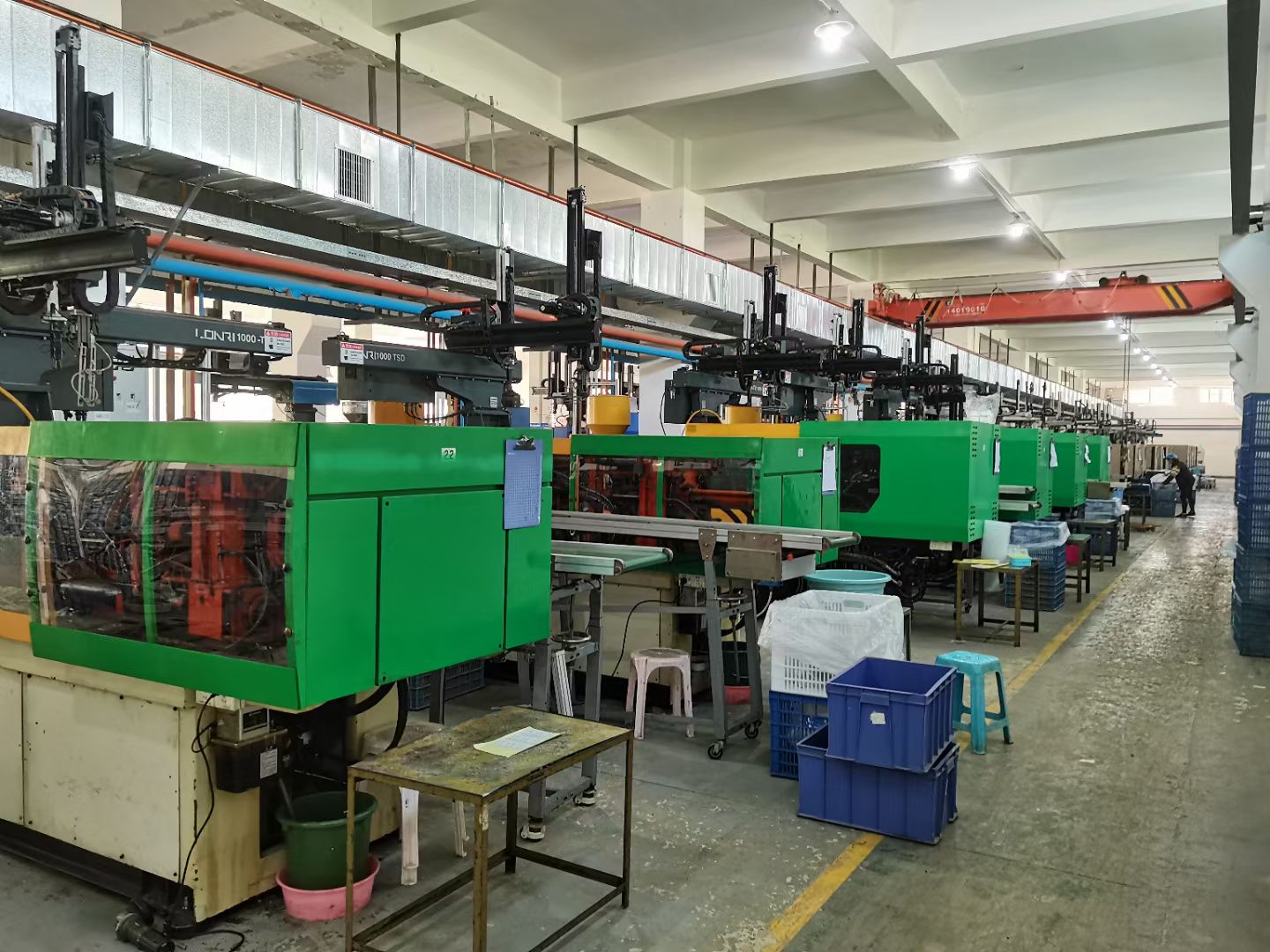
A PET preform injection machine installation inside a bottle-making plant. Image: Yongjiang.
1. The published parameter set, side by side
The four models share a common architecture but sit in different size classes. The table below uses the parameters Yongjiang publishes for each model; nothing has been estimated.
| Parameter | YJPT-260 | YJPT-318 | YJPT-360 | YJHB-400 |
|---|---|---|---|---|
| Clamping force | 260 T | 318 T | 360 T | 400 T |
| Tie bar spacing | 580 × 580 mm | 620 × 620 mm | 680 × 680 mm | 720 × 720 mm |
| Screw diameter | 72 mm | 77 mm | 95 mm | 95 mm |
| Shot weight | 1,400 g | 1,900 g | 3,450 g | 3,450 g |
| Motor power | 42 kW | 80 kW | 80 kW | 80 kW |
| Heat power | 35 kW | 65 kW | 65 kW | 65 kW |
| Machine weight | 9 t | 13 t | 16 t | 16 t |
| Frame / platen material | QT500-A7 | Steel | QT500-A7 steel | QT500-A7 steel |
Two patterns matter commercially. First, the series is not evenly spaced: the jump from 260 T to 318 T adds 48 mm of tie bar clearance and 500 g of shot weight, while the step from 318 T to 360 T adds 60 mm of clearance and 1,550 g of shot weight. Second, YJPT-360 and YJHB-400 share the same 95 mm screw, the same 3,450 g shot weight, the same 80 kW / 65 kW power package and the same 16 t machine weight. What separates them is 40 t of clamping force and 40 mm of tie bar spacing — a distinction that is only meaningful if your mold is physically large or demands high mold-holding force.
2. Reading the four parameters against each other
Clamping force governs mold-holding capacity
Clamping force must resist the cavity pressure that tries to push a mold open during injection. That force scales with the projected area of the parts plus the runner system, so higher cavity counts and larger preform diameters push the requirement upward. The series spans 260 T to 400 T, a 1.54× range. Below approximately 260 T, PET preform tools with meaningful cavity counts become difficult to hold reliably; above 400 T, the frame is usually sized for tooling the preform line does not need.
Tie bar spacing sets the physical mold envelope
Tie bar spacing is a hard geometric limit, not a performance preference. A hot runner mold has to pass between the tie bars and locate on the platens, so the mold plate footprint plus locating rings and clamping allowance must sit inside 580 × 580 mm on the YJPT-260 and inside 720 × 720 mm on the YJHB-400. The linear clearance grows about 24% from the smallest to the largest frame (580 mm to 720 mm), which is the difference between carrying a moderate-cavity tool and carrying a large multi-cavity hot runner stack.
Screw diameter drives plasticizing volume
The 72 mm screw on the YJPT-260, the 77 mm on the YJPT-318 and the 95 mm shared by the YJPT-360 and YJHB-400 reflect how much PET the barrel must melt and deliver per cycle. Larger diameter means more volume per stroke, which is why the 95 mm models reach 3,450 g of shot weight while the 72 mm model reaches 1,400 g.
Shot weight is the arithmetic ceiling
Shot weight is the total mass of resin the machine can deliver in one cycle. It must cover every cavity plus the runner or hot runner volume. This is the parameter that most often disqualifies a model that otherwise looks suitable: a tool with many cavities simply asks for more grams per shot than a smaller machine can supply.
Power and machine weight affect plant planning
The published motor and heat power values total roughly 77 kW on the YJPT-260 and roughly 145 kW on each of the three larger models. Machine weight moves from 9 t to 13 t to 16 t, which feeds directly into floor loading, rigging and foundation planning. Yongjiang states that its machines support 380/400 V 50 Hz industrial power supply, a relevant check for buyers in different grid regions.
3. Matching the machine to mold size and cavitation
Cavity count is not a specification the machine carries; it is a consequence of the tool and the preform weight. The published public tender specification issued by CIPET for a PET preform injection molding machine uses a maximum preform weight of 20 g and a minimum of 32 cores and cavities, with a minimum shot capacity of 750 g. Using that 20 g figure purely as a worked example, the shot requirement per cycle becomes cavity count multiplied by preform weight:
| Illustrative tool | Shot required per cycle | YJPT-260 (1,400 g) | YJPT-318 (1,900 g) | YJPT-360 (3,450 g) | YJHB-400 (3,450 g) |
|---|---|---|---|---|---|
| 32 cavities × 20 g | 640 g | Within ceiling | Within ceiling | Within ceiling | Within ceiling |
| 48 cavities × 20 g | 960 g | Within ceiling | Within ceiling | Within ceiling | Within ceiling |
| 72 cavities × 20 g | 1,440 g | Exceeds ceiling | Within ceiling | Within ceiling | Within ceiling |
| 96 cavities × 20 g | 1,920 g | Exceeds ceiling | Exceeds ceiling | Within ceiling | Within ceiling |
Three practical conclusions follow from that arithmetic:
- All four models clear a 32-cavity, 20 g tool on shot weight. Every published shot weight exceeds 750 g, the minimum shot capacity in the same public tender specification, so shot weight does not separate the models at that scale.
- Tonnage clears public procurement thresholds across the board. The same specification requires a machine tonnage of 150–200 T; all four models, at 260 T to 400 T, sit above it.
- Separation starts at higher cavity counts or heavier preforms. A 72-cavity, 20 g tool already exceeds the YJPT-260 ceiling, and a 96-cavity tool at the same weight exceeds both the YJPT-260 and the YJPT-318. Heavier preforms reach the ceiling with fewer cavities, which is the mechanism that pushes 5-gallon or thick-wall oil bottle tooling toward the 1,900 g and 3,450 g classes.
Shot weight is only the first filter. A buyer must then check that the mold plate fits the tie bar window, that the platens and clamping frame can hold the projected area, and that the hot runner manifold and valve-gate wiring find room inside the envelope. Yongjiang states that rigid clamping frames are designed to adapt to multi-cavity hot runner molds for 24-hour continuous mass production, which is the operating mode most PET preform lines actually run.
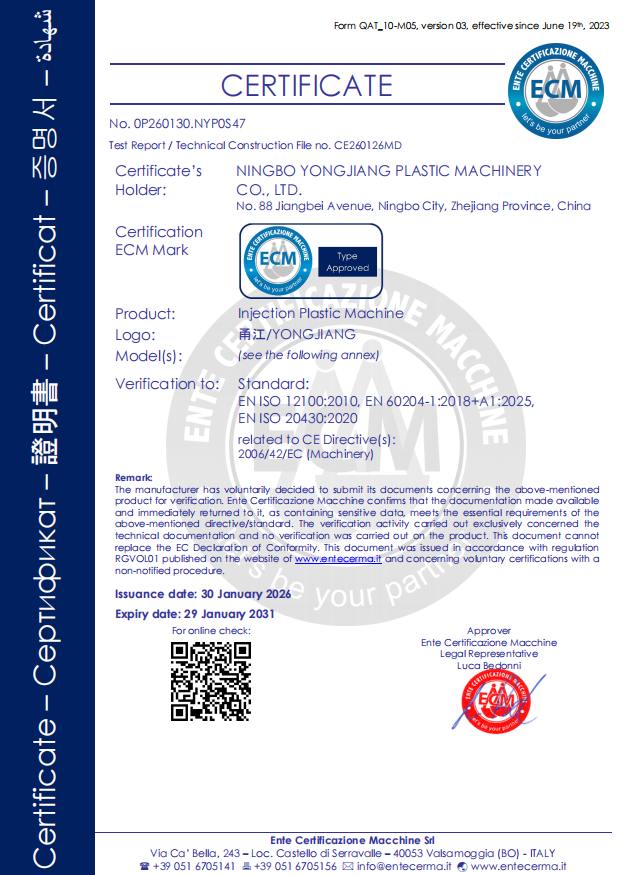
CE documentation for the PET preform injection molding machine series. Image: Yongjiang.
4. Where each model tends to fit
The PET preform industry serves product categories that include bottled water, carbonated soft drinks, juices, edible oils and sauces. Those categories map onto different preform weights, wall thicknesses and cavity counts, and therefore onto different points in this model range. The mapping below is a sizing logic, not a fixed rule:
- Standard water and beverage preform tools at moderate cavity counts: the YJPT-260 offers 1,400 g of shot and a 580 × 580 mm envelope, which covers a 48-cavity tool at the illustrative 20 g weight.
- Higher-cavity water preform tools and CSD preform programs: the YJPT-318 adds 500 g of shot weight and 40 mm of tie bar clearance over the YJPT-260, which is where a physically larger hot runner stack starts to fit.
- Large multi-cavity tools for packaging and carbonated soft drink volumes: the YJPT-360 and YJHB-400 share the 3,450 g ceiling, which covers a 96-cavity tool at the illustrative 20 g weight.
- Molds that are wide rather than heavy: the YJHB-400's 720 × 720 mm tie bar spacing is the deciding parameter when the shot weight is already sufficient on the YJPT-360 but the mold plate is not.
Buyers should note that the four models are part of a broader Yongjiang lineup covering clamping forces from 40 T to 1,600 T, including servo energy-saving, high-speed precision and two-color types. That matters for the boundary case: a preform program that needs less than 260 T, or more than 400 T, is not addressed by this comparison set, and the correct next step is a different frame size rather than a compromise here.
5. A five-step buyer decision sequence
- Fix the preform first. Weight, neck finish and wall thickness come from the bottle design, not the machine. The public tender benchmark for a 1,000 ml bottle, for example, is a 28 mm neck size.
- Calculate the shot requirement. Multiply cavity count by preform weight, then add allowance for the runner or hot runner system.
- Compare against the shot weight column. Eliminate any model whose published shot weight cannot cover the calculated requirement with headroom.
- Check the mold envelope. Confirm the mold plate and any hot runner manifold fit inside the tie bar spacing of the surviving models.
- Validate the shortlist technically. Request injection pressure and plasticizing capacity figures, then confirm them in a mold trial under your own tooling and resin.
Step five is not optional. The published public tender specification sets a minimum injection pressure of 1,200 bar and a minimum plasticizing capacity of 50 g/sec. Those two values are not part of the four-model parameter set discussed above, so they cannot be compared from the specification table alone — they have to be requested and verified for the exact configuration being quoted.
6. Compliance and market access
The models carry CE documentation issued under certificate number CE20260126MD by ECM, dated 30 January 2026 and valid to 29 January 2029 with a five-year validity to 29 January 2031 under the recorded terms of the certificate schedule. The recorded standards are the 2006/42/EC Machinery Directive, EN ISO 12100:2010, EN 60204-1:2018+A1:2020 and EN ISO 20430:2020, and the recorded scope names the PET Preform Injection Molding Machine with models YJPT-260 and YJHB-400.
That scope wording matters for procurement. A certificate is only useful if the model on your purchase order appears inside the scope of the certificate the supplier sends you. Buyers in the EU should request the certificate copy together with the quotation and match the model string character for character before releasing a deposit.
7. Commercial terms, testing and acceptance
The published purchasing terms for Yongjiang PET preform machines are straightforward and can be planned against directly:
| Item | Published term |
|---|---|
| Minimum order quantity | 1 unit |
| Delivery term | FOB Ningbo |
| Payment terms | 30% deposit, 70% before shipment |
| Acceptance criteria | Pre-shipment test |
| Quality control | 100% test one week before shipment |
| Lead time | 30–45 days |
| Monthly production capacity | 200 units |
| Customization | OEM production; voltage and logo customization |
| After-sales | 24/7 service support |
The pre-shipment test window is the buyer's best point of leverage. Because 100% testing is scheduled one week before shipment and the payment balance falls due before shipment, a buyer can align a witnessed test protocol with that window rather than trying to resolve issues after the machine has left Ningbo. A practical protocol covers dry-cycle timing, heater and servo function, clamping force verification, safety circuit checks against EN ISO 12100:2010 and EN 60204-1:2018+A1:2020, and—where a mold is available—a short preform run.
A full technical brochure covering the YJPT and YJHB series is available for download: Yongjiang injection molding machine brochure (PDF).
8. What the installed base suggests
Yongjiang's own case record describes an installation of 20 units of PET preform injection machines used for PET preform making and water bottle making, with clients from multiple countries including Ethiopia, Spain, France and Hungary, and a 20-year service record described as stable operation with low electricity consumption. The same manufacturer reports an annual output of 2,000 units, a 130,000 m² facility, 200 employees, a 25-engineer R&D team and a 59% export ratio, with export markets listed for the EU, the Middle East and Africa.
For a buyer, the relevant signal is not the numbers themselves but the operating profile they describe: long-duration water bottle preform production on multi-cavity tooling, which is precisely the duty cycle that stresses clamping rigidity, screw and barrel wear, and energy cost per kilogram of resin.
9. Market trend: what is growing, and what is not measured
Two different markets are often quoted as if they were one. The PET preform machines market — the equipment category — was projected to grow from USD 8.38 billion in 2022 to USD 14.73 billion by 2032 according to Acumen Research and Consulting. Separately, the PET preform product market, meaning the preforms themselves sold downstream to bottle converters, was reported at USD 24.33 billion in 2026, growing at a CAGR of 2.17% to reach USD 27.08 billion by 2031 according to Mordor Intelligence. These are different scopes and must not be combined or presented as one figure.
Trade data gives a third, narrower reference point: global exports under HS code 847710, which covers injection-molding machines, totalled USD 7.21 billion in 2023. PET preform machines sit inside that broader machinery flow rather than forming a separate customs category, which is one reason machine-level market sizing remains less precise than product-level sizing. The practical takeaway for a buyer is directional: downstream preform demand is growing slowly but steadily, so capacity decisions should be driven by your own bottle program and tooling plan rather than by headline growth rates.
10. Where this specification set stops
An honest comparison has to state its limits, and this one has four:
- The published parameter set is incomplete for full technical validation. Injection pressure, plasticizing capacity in g/sec and real cycle time are not published, so a buyer cannot close the loop against a tender specification such as the 1,200 bar injection pressure and 50 g/sec plasticizing minimum without requesting datasheet values or witnessing a trial.
- Published figures are a screening tool, not a performance guarantee. Actual cycle time and energy consumption depend on the mold, cooling circuit, hot runner design, resin grade and ambient conditions, none of which are captured by clamping force or shot weight.
- The range has edges. Programs below 260 T or above 400 T fall outside this comparison set, and the same applies to needs that a general-purpose machine rather than a PET preform-specialised machine would serve better.
- Company-stated efficiency figures require local verification. Yongjiang describes its machines as delivering 30%–50% lower power consumption and shorter molding cycles; those are manufacturer-reported claims and should be checked against your own metered baseline on comparable tooling before they are used in a payback model.
11. Future outlook
Two forces look likely to shape PET preform machine purchasing through the end of the decade. The first is gradual downstream volume growth in preform applications — water, carbonated soft drinks, juices and edible oils — which supports incremental cavity-count upgrades rather than wholesale line replacement. The second is operating cost, where energy per kilogram of processed resin and cycle time per cavity increasingly decide whether a line is competitive. For a buyer choosing today between a 260 T and a 400 T frame, the safest posture is a specification that carries headroom on shot weight and tie bar spacing, because tooling tends to grow heavier and wider over the life of a machine, not lighter.
FAQ
How do I choose between the YJPT-260 and the YJPT-318 for a 48-cavity water bottle preform tool?
Shot weight does not separate them at that scale. A 48-cavity tool running 20 g preforms requires 960 g per cycle, which sits below both the 1,400 g YJPT-260 ceiling and the 1,900 g YJPT-318 ceiling. The separating parameters are tie bar spacing, 580 × 580 mm against 620 × 620 mm, and clamping force, 260 T against 318 T. If the mold plate and hot runner fit the smaller envelope and the projected area is adequately held, the YJPT-260 applies; if the tool is wider or the projected area needs more holding force, the YJPT-318 applies. Machine weight and connected power differ too — 9 t and roughly 77 kW against 13 t and roughly 145 kW.
How many cavities can these machines run?
Cavity count follows from two published limits. The shot weight ceiling sets how many cavities multiplied by preform weight can be filled in one cycle, and the tie bar spacing sets whether the mold physically fits. Using the 20 g preform weight from the cited public tender specification as a worked example, a 48-cavity tool requires 960 g and fits all four models on shot weight, a 72-cavity tool requires 1,440 g and exceeds the YJPT-260, and a 96-cavity tool requires 1,920 g and exceeds both the YJPT-260 and the YJPT-318. Buyers must recalculate with their own preform weight and confirm mold plate dimensions against the tie bar spacing of the selected model.
What are the purchasing terms?
The published terms are a minimum order quantity of 1 unit, delivery on FOB Ningbo terms, and payment of 30% deposit with 70% before shipment. Lead time is stated at 30–45 days against a monthly production capacity of 200 units. Acceptance criteria are a pre-shipment test, and quality control is described as 100% testing one week before shipment.
How is the machine accepted before shipment?
Acceptance is defined as a pre-shipment test, with 100% testing carried out one week before shipment. That timing allows a buyer to schedule a witnessed test in the same window. A practical protocol covers dry-cycle timing, heater and servo function, clamping force verification and safety circuit checks against the standards listed on the CE documentation, plus a short preform run if a mold is available.
Which models does the CE certificate cover?
Certificate CE20260126MD was issued by ECM, dated 30 January 2026 and recorded as valid to 29 January 2031, against the 2006/42/EC Machinery Directive, EN ISO 12100:2010, EN 60204-1:2018+A1:2020 and EN ISO 20430:2020. The recorded scope names the PET Preform Injection Molding Machine with models YJPT-260 and YJHB-400. Buyers should confirm that the exact model on their purchase order appears within the scope of the certificate copy supplied with the quotation.
What customization and after-sales support are offered?
Yongjiang provides OEM production services, with technical customization covering voltage and logo. Machines are stated to support 380/400 V 50 Hz industrial power supply, which is relevant for buyers in different grid regions, and after-sales support is described as 24/7 service support.
Have Questions or Need More Details?
Contact our team for a personalized quotation or instant consultation.
Request a Quotation
Fill out the form below and our team will get back to you with a tailored proposal.
WhatsApp Direct Chat
Prefer to chat in real-time? Message us on WhatsApp for instant assistance & quick answers.
- Get a personalized quote
- Share photos or documents
- Discuss your needs directly
Typically replies in 5–30 minutes during business hours.