
PG vs Metric Cable Glands: Size and Certification Compared
PG and Metric cable glands perform the same sealing job through two different thread systems and two different evidence trails. In Gutai’s nylon gland catalogue, the PG series spans PG7–PG48 with a thread outside diameter of 12.5–59.3 mm, while the Metric series spans M12–M63 with a thread outside diameter of 12–63 mm. Both use nylon PA66 with NBR seals, both cover a 3–45 mm cable range, and both use a 9–21 mm thread length. What separates them in a purchase decision is not performance on paper but certification coverage: UL 514B evidence supports North American acceptance, and EN 62444:2013 evidence supports the EU market.
For buyers in the evaluation-to-execution stage, the PG-versus-Metric question almost never arrives alone. It arrives together with a panel drawing that already has an aperture cut into it, an installed base of legacy equipment in one thread family, and a compliance folder that a distributor or an OEM customer is asking to review before releasing a purchase order.
Zhejiang Gutai Connector Co., Ltd. (Gutai) is a Wenzhou-based manufacturer of waterproof cable glands, solar MC4 connectors, mini waterproof boxes and connectors, and hose fitting series, operating a 5,000 m² facility with 80 employees, a 10-engineer R&D team, and an annual output of approximately 10,000,000 units. Around 80% of that output is exported, with the Middle East, Southeast Asia, India, Pakistan, the EU, the UK, and the USA listed among its main markets — which is precisely why the two thread families sit side by side in the same catalogue rather than one replacing the other.
Why PG and Metric Diverge in a Purchase Order
The two families answer the same engineering question — how to bring a cable through an enclosure wall without letting water, dust, or mechanical strain through with it — but they answer it against different regional conventions. Metric threads align with equipment designed around ISO metric panel hardware. PG threads persist because a large installed base of European industrial equipment, control cabinets, and legacy tooling was built around them.
That history produces three practical consequences for procurement:
- Interchangeability is not partial — it is absent. A PG-threaded gland will not seat in an aperture cut for the nominal Metric equivalent, and vice versa. Mixing the two on a single panel means either two tooling setups or an adapter in the assembly.
- Spares logic splits. A site that runs both families carries two seal, body, and locknut inventories for what is, physically, the same sealing function.
- Certification does not transfer automatically. A document issued against one thread family and one model scope does not necessarily cover the other model in the same catalogue; the scope statement has to be read line by line.
This is why the comparison below is built around measurable size data and certificate scope statements rather than around general claims about which thread is preferable.
Size Comparison: PG7–PG48 Against M12–M63
The published specification for Gutai’s plastic cable gland range gives a direct side-by-side view. The two series are not scaled versions of each other; they are two ladders that happen to converge on cable coverage.
| Parameter | PG series | Metric series |
|---|---|---|
| Thread size range | PG7 – PG48 | M12 – M63 |
| Thread outside diameter | 12.5 – 59.3 mm | 12 – 63 mm |
| Cable range | 3 – 45 mm | 3 – 45 mm |
| Thread length | 9 – 21 mm | 9 – 21 mm |
| Body and seal material | Nylon PA66 & NBR | Nylon PA66 & NBR |
| Product type listing | Plastic / PG / Metric / Eco-friendly / Nylon cable gland | Plastic / PG / Metric / Eco-friendly / Nylon cable gland |
How to read this table before quoting
Three observations matter more than the numbers themselves. First, the cable range is identical at 3–45 mm across both series, so a buyer is rarely choosing between families on the basis of what cable the gland can accept. Second, thread length is likewise identical at 9–21 mm, which means wall thickness assumptions and locknut engagement behave the same way for both. Third, the thread outside diameter span differs — the Metric ladder reaches 63 mm at the top end against 59.3 mm for PG — and the mapping between a nominal size label and its actual outside diameter is not linear in either family.
That last point is the one that produces expensive mistakes. The dimension that must match the enclosure aperture is the thread outside diameter, not the number in the product name. A buyer comparing a PG-size gland against an M-size gland by label alone will frequently select the wrong aperture requirement. The correct comparison is always: aperture diameter against listed thread outside diameter, then cable diameter against listed cable range.
The Shared Material Platform: Nylon PA66 with NBR Seals
Both Gutai gland series are specified as nylon PA66 with NBR sealing material. For a specification engineer, this is a meaningful convergence: the two families behave similarly under chemical exposure, cleaning regimes, and normal industrial temperature cycling, and the same sealing principles apply when the gland is torqued into position.
It also simplifies spares planning where a site genuinely runs both families. If body and seal material are shared, the difference between a PG and a Metric spare part reduces to the thread interface and the specific cable entry dimension, rather than to two different material specifications requiring two different maintenance instructions.
The boundary to note is that this shared material specification applies to the plastic gland range. Where a project requires a different body material, Gutai handles that as a customization rather than as a separate catalogue series — the documented customization scope covers materials such as nylon, brass, and stainless steel, alongside size and thread specifications, colour, packaging and OEM labelling, multi-hole layouts, and specific seal configurations.
Certification Comparison: UL 514B Against EN 62444
Certification is where the PG-versus-Metric comparison stops being a drawing-room discussion and becomes a release condition. The two standards address different regulatory systems and should never be treated as substitutes for one another.
EN 62444 (and its IEC counterpart, IEC 62444) sets out construction and performance requirements for cable glands used in electrical installations, and replaced the older BS EN 50262. UL 514B is the North American standard framework under which Gutai holds a Notice of Completion from UL Solutions for liquid-tight flexible cord fittings.
| Evidence document | Issuing body | Standard | Scope statement | Market | Reference and date |
|---|---|---|---|---|---|
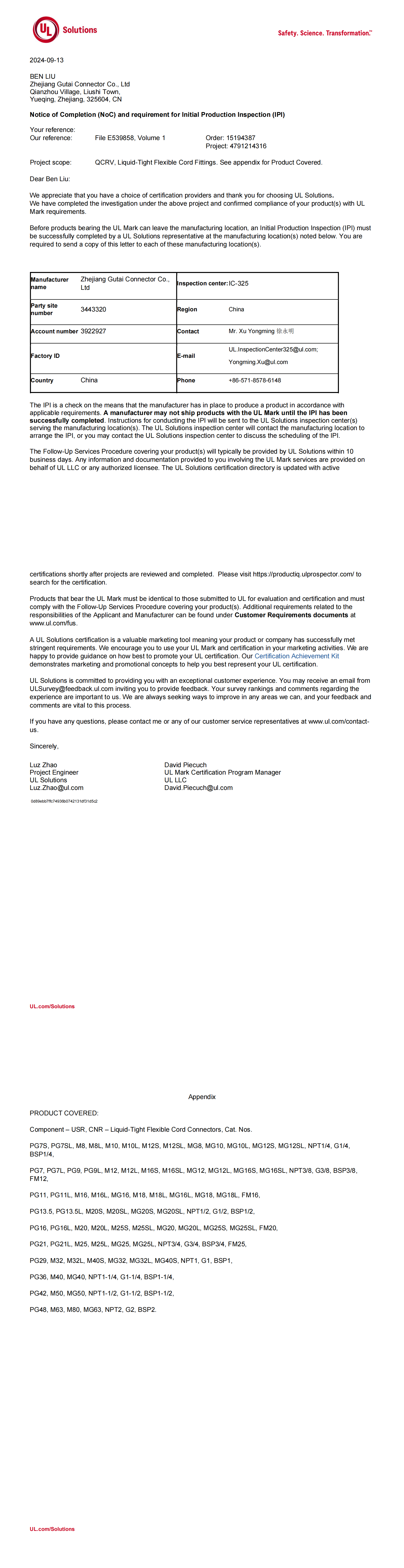
| Notice of Completion, QCRV liquid-tight flexible cord fittings | UL Solutions | UL 514B | Liquid-tight flexible cord fittings (USR, CNR series); full catalogue numbers in appendix | US and Canadian markets | File E539858, Volume 1; Order 15194367; Project 4791214316; issued 2024-09-13 |
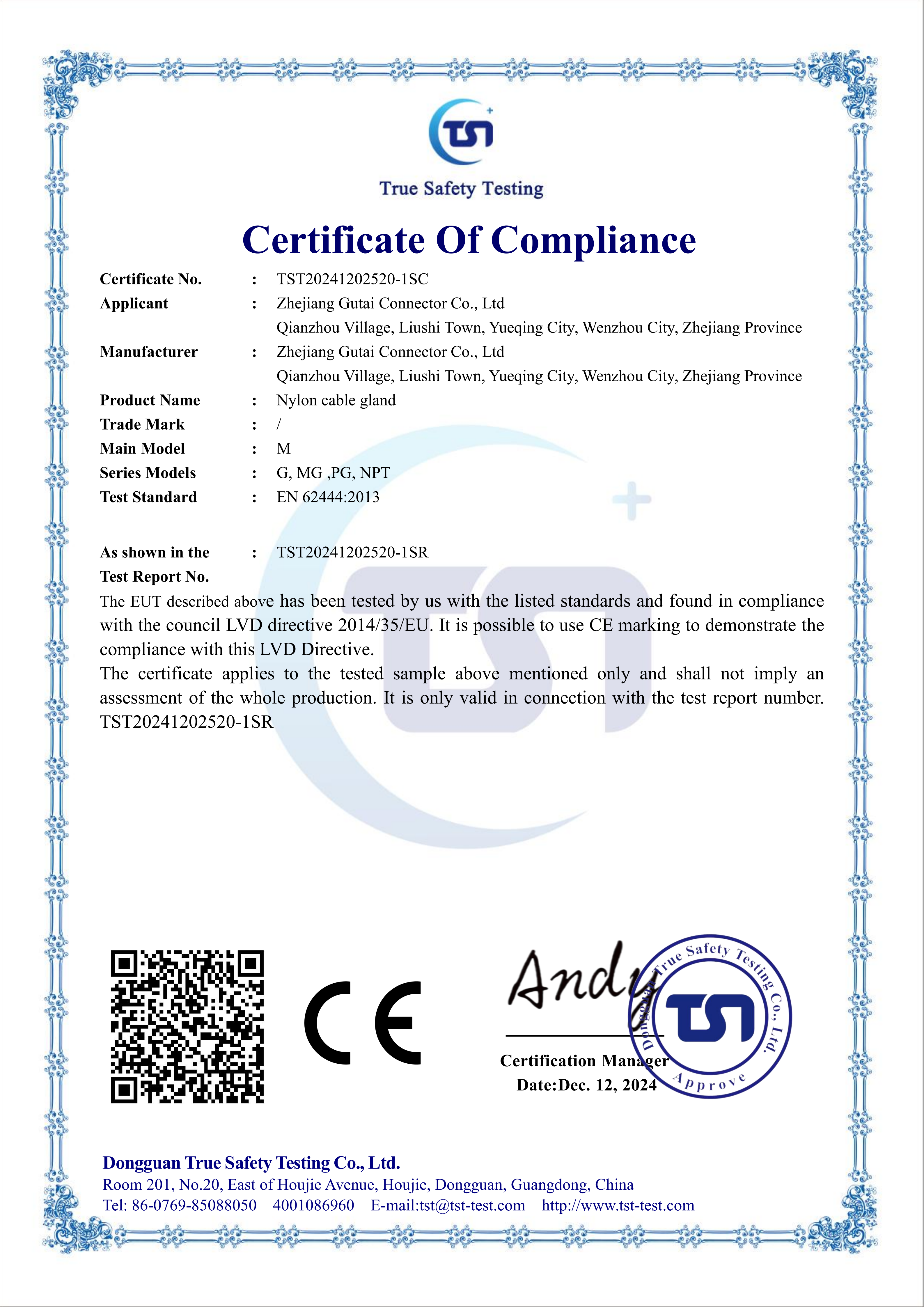
| Certificate of Compliance (CE) | Dongguan True Safety Testing Co., Ltd. | EN 62444:2013 | Nylon cable gland, Model M; Series: G, MG, PG, NPT | EU | TST20241202520-1SC; issued 2024-12-12 |
| SGS Test Report (RoHS) | SGS-CSTC Standards Technical Services (Ningbo) Co., Ltd. | EU RoHS Directive (EU) 2015/863 amending Annex II to Directive 2011/65/EU | Nylon cable gland | EU | NGBEC26005747401; issued 2026-07-13 |
| Quality management system certificate | Beijing United Intelligence Certification Co., Ltd. | GB/T19001-2016 / ISO9001:2015 | Production of cable waterproof joints | Global | 04324Q31620R0S; issued 2024-07-02, valid to 2027-07-01 |
What the two standards do not do for each other
A CE certificate issued against EN 62444:2013 does not establish acceptance in the United States or Canada, and a UL Notice of Completion under UL 514B does not establish conformity for the EU market. They sit in different folders, are reviewed by different authorities, and answer different questions. A supplier that presents one as evidence of the other is giving the buyer an incomplete file.
The second point is scope granularity. The CE certificate lists its scope as nylon cable gland, Model M, across series G, MG, PG, and NPT — which is why it can cover both thread families in this comparison. The UL Notice of Completion, by contrast, is scoped to liquid-tight flexible cord fittings in the USR and CNR series, with the complete catalogue numbers held in its appendix. A buyer purchasing a gland model that is not in that appendix cannot assume coverage merely because the supplier holds a UL document for a different fitting type.
Mapping Certification to Market: A Selection Rule
Because the two thread families carry different evidence requirements, the practical selection rule is market-first rather than size-first.
| Destination market | Evidence to request | Practical note |
|---|---|---|
| USA and Canada | UL 514B evidence covering the exact fitting series and catalogue number | Confirm the model appears in the appendix of the UL Notice of Completion, not only that the supplier holds a UL document |
| EU and UK | CE Certificate of Compliance to EN 62444:2013; RoHS test report | Check that the certificate scope names the model and series being ordered |
| Global OEM programmes | ISO 9001 quality management certification covering production of cable waterproof joints | Gutai’s ISO 9001 certificate is valid to 2027-07-01 |
| Middle East, Southeast Asia, India, Pakistan | Market-specific requirements vary; project specifications usually govern | These are listed among Gutai’s main export markets alongside the EU, UK, and USA |
For additional European requirements, Gutai states that its core products have passed CE, RoHS, REACH, and IP68 protection level tests, and that it can provide pre-test data and certification path planning for PV connector requirements compliant with IEC 62852 where customers need to complete full testing through authorised laboratories. IP68 itself is defined by IEC 60529 as withstanding continuous immersion in water under specified conditions — a rating whose meaning depends on the test conditions stated in the underlying report.
What Capability Backs the Size Claim
Size tables are statements of intent until production control supports them. The relevant Gutai capability statement for this comparison is 100% full dimension inspection — a control point that directly addresses thread outside diameter and cable range, the two dimensions that decide whether a gland fits an aperture and seals a cable.
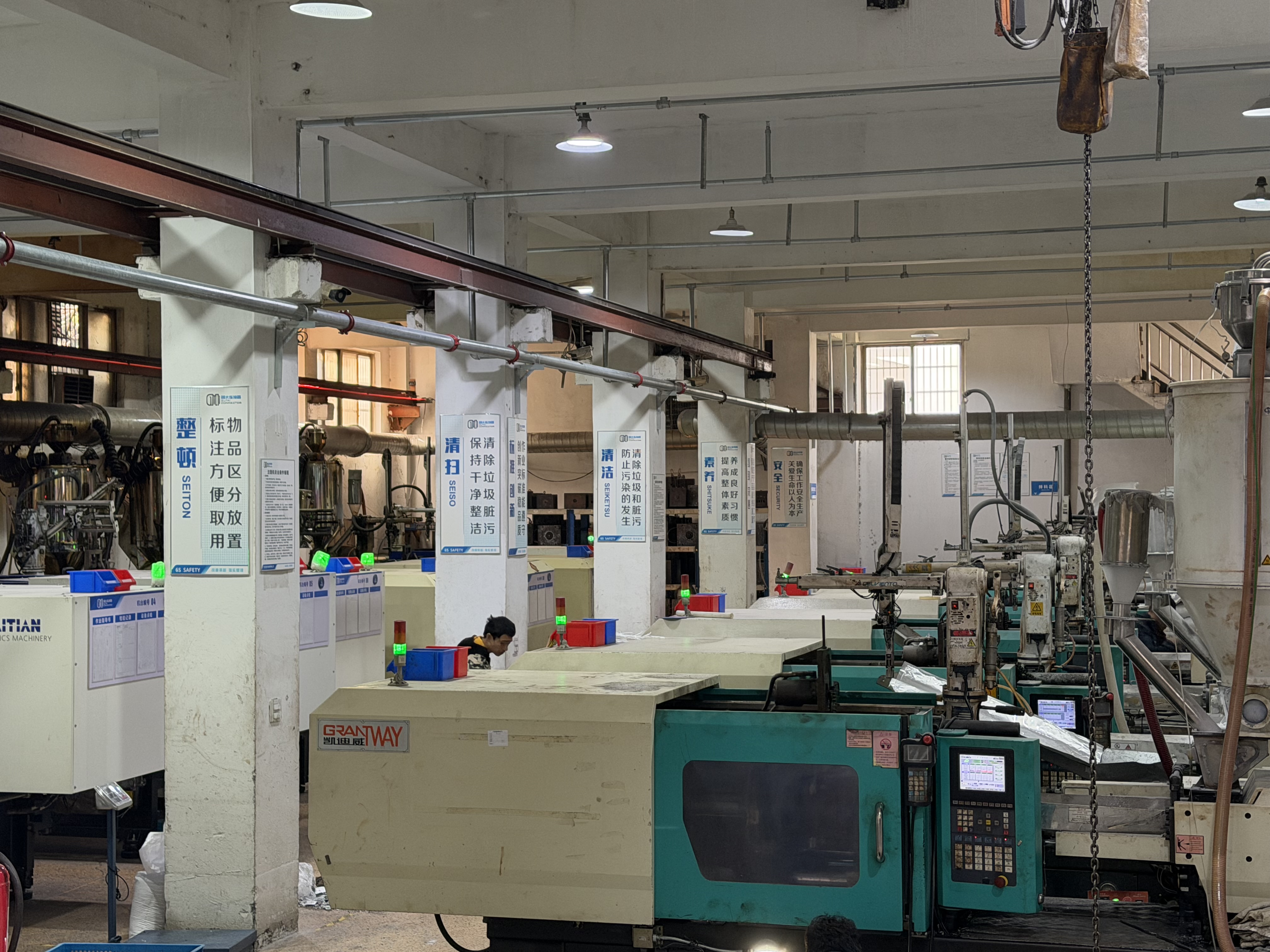
Alongside inspection, the documented production capability covers manufacturing at mass-production scale together with OEM and ODM customization, product development, and export services. Monthly capacity is stated as 500,000 cable gland pieces and 100,000 MC4 sets. Customization scope includes size and thread specifications, materials, colour, packaging and OEM labelling, multi-hole layouts, and specific seal configurations — the practical mechanism by which a buyer who needs a non-catalogue thread or a branded locknut gets one.
Commercial terms are equally concrete: minimum order quantity of 1 unit with small trial orders accepted, FOB or EXW delivery terms, pre-shipment test as the stated acceptance criterion, and payment by T/T, cash, or Alipay. Gutai describes quality-related returns and refunds as available. Lead time is quoted according to order quantity rather than published as a fixed number, which is a boundary worth building into a project schedule rather than treating as a fixed input.
Thread portfolio breadth also has a documented procurement consequence. Gutai states that its thread specifications cover multiple international systems including PG, Metric, NPT, and G-type, supporting one-stop selection across power, signal, and communication interfaces. In one referenced automotive electronics customer case, adopting a single multi-thread supplier reduced inventory categories by 65%, reduced emergency procurement costs by 30%, and shortened new product development cycles by two weeks.
Where the Choice Between PG and Metric Actually Matters
Both series are listed as applicable across the new energy sector, industrial automation and advanced manufacturing, construction and infrastructure, and marine engineering and shipbuilding. The decision between them therefore rarely comes down to industry category. It comes down to what already exists on the equipment being connected.
A retrofit into an existing control cabinet built around PG apertures favours PG glands, because re-cutting threads in an installed enclosure is not a practical option. A new-build panel designed to metric hardware favours the Metric series, because it aligns with the rest of the panel components and avoids adapters. A multi-site operator running both is the case where the shared nylon PA66 and NBR specification becomes commercially useful, since the sealing logic and spare-seal reasoning stay constant even though the thread interface does not.
Environmental severity changes the material conversation rather than the thread conversation. In a referenced European coastal open-air EV charging station project, 5,000 sets of IP68-grade metal waterproof connectors were deployed for outdoor DC fast-charging piles in high-salt fog, strong sea wind, and high-vibration conditions. The selected construction used 304 stainless steel with a dual-seal anti-loosening structure, passing 1,000-hour salt spray tests and IEC 60068-2-6 vibration tests. Connector-related electrical failure rates fell from 18% annually to 2.6%, annual maintenance cost per station moved from over 500 RMB to below 80 RMB, and new station installation efficiency increased by 35%. The relevant lesson for a gland buyer is that thread family selection and material selection are separate decisions, and the second one is driven by the exposure environment.
Market Trend: Demand Growth and Compliance Divergence
Third-party market data points to a category that is expanding steadily while its compliance landscape continues to fragment along regional lines. Straits Research and Spherical Insights place the global cable glands market at approximately USD 2.16 billion to USD 2.25 billion in 2024–2025, with forecasts ranging between USD 3.07 billion and USD 4.96 billion by 2034 depending on methodology. Methodologies differ, but the direction does not.
Regionally, Dataintelo and Straits Research estimate that Asia Pacific accounts for approximately 38% to 42% of global cable gland revenue, driven primarily by industrialisation in China and India. The adjacent waterproof connector market is larger still: industry intelligence cited by AOHUA Connector places it at approximately USD 13.4 billion in 2024, projected to reach USD 25.48 billion by 2033 at a CAGR of 7.4%. Solar PV connectors, a related but distinct segment, were valued at USD 1.31 billion in 2024 according to Global Market Insights, with MC4 connectors holding a 68% share — a useful reminder that cable glands and PV connectors sit in adjacent rather than identical demand pools.
On the standards side, the replacement of BS EN 50262 by IEC 62444 and EN 62444 has consolidated technical requirements for cable glands across a large part of the European market. In practice this means buyers still encounter legacy references in older project documentation, and the question of which revision applies is worth settling before a certificate review rather than during it.
Competitive context
The cable gland and connector sector includes established multinational suppliers such as ABB Ltd., Eaton Corporation, Amphenol Corporation, LAPP Group, and HUMMEL AG. For a buyer evaluating a manufacturer like Gutai, the practical comparison dimensions are not brand scale but specification fit: whether the thread families required are offered from one source, whether certification evidence covers the exact models in the order, and whether dimensional control is stated as full inspection rather than batch sampling.
Comparing Three Sourcing Routes — and Their Limits
A buyer facing both thread families on a single bill of materials has three realistic routes, each with a real boundary.
Route one: dual-family inventory. Stock both PG7–PG48 and M12–M63. This preserves fit with legacy and new equipment without adapters, but doubles the SKU count for the same cable range and doubles the certification file that has to be maintained and re-verified at each audit.
Route two: standardise on Metric. New designs align with metric panel hardware and simplify the future bill of materials. The boundary is the installed base: existing PG apertures cannot be converted by selecting a different gland, so those positions continue to require PG parts or an adapter that adds a mechanical joint to the sealing path.
Route three: standardise on PG. This maintains compatibility with legacy European equipment. The boundary is that it locks new panels to a thread family that is less aligned with metric-designed hardware arriving from other supply chains, which can slow integration on mixed-vendor projects.
Future Outlook
Two forces are likely to shape how buyers approach this choice. The first is compliance consolidation. As IEC 62444 and EN 62444 continue to displace older national references, the technical content of cable gland evidence becomes more comparable across Europe, which shifts the buyer’s scrutiny from which standard applies to whether the certificate scope covers the exact model being purchased.
The second is supply-side consolidation of thread portfolios. Where a single manufacturer can supply PG, Metric, NPT, and G-type threads from one production base with one quality system — ISO 9001 certification covering production of cable waterproof joints, valid to 2027-07-01 in Gutai’s case — the cost of running two thread families falls to inventory and tooling rather than to supplier management. The referenced automotive electronics case, where inventory categories dropped by 65%, illustrates the direction of that calculation.
For buyers in the evaluation and execution stage now, the durable approach is to settle thread family at the aperture level, settle material at the exposure level, and settle certification at the model level. Those three decisions are independent, and treating them as one decision is where specification errors originate.
FAQ
Are PG and Metric cable glands interchangeable?
No. PG and Metric are separate thread standards, and a PG-threaded gland will not seat in an aperture cut for the nominal Metric equivalent, or the reverse. Both Gutai series cover the same 3–45 mm cable range and the same 9–21 mm thread length band, so the sealing task can be identical — but the thread interface is not. Panels that mix both families require either separate apertures and tooling or adapter fittings. Gutai additionally lists NPT and G-type threads within its specification coverage, which is relevant on projects mixing regional standards.
Which number matters more when specifying, thread size or cable range?
They answer different questions and both are required. Thread size (PG7–PG48 or M12–M63) determines whether the gland fits the enclosure aperture. Cable range (3–45 mm across both Gutai series) determines whether the gland seals the cable actually being used. The dimension to compare against the aperture is the thread outside diameter — 12.5–59.3 mm for the PG series and 12–63 mm for the Metric series — not the nominal size label, because the relationship between label and outside diameter is not linear in either family.
Does a CE certificate to EN 62444 make a cable gland acceptable in North America?
No. CE marking and the EN 62444:2013 Certificate of Compliance address the EU market. Acceptance of liquid-tight flexible cord fittings in the United States and Canada is supported by UL 514B evidence, for which Gutai holds a Notice of Completion from UL Solutions (File E539858, Volume 1). The two documents serve different regulatory systems and should be requested separately, each covering the exact model being purchased.
Do PG and Metric glands use the same material?
In Gutai’s plastic cable gland specification, both the PG series and the Metric series are listed as nylon PA66 with NBR sealing material. That shared platform means comparable sealing behaviour, comparable assumptions about chemical and temperature exposure, and a consistent spare-seal logic on sites running both thread families. Where a different body material is required, Gutai handles nylon, brass, and stainless steel options as customization rather than as separate catalogue series.
How can a buyer confirm that a specific model is inside the certificate scope?
By comparing the scope statement on the certificate with the exact model and catalogue number on the order. Gutai’s CE certificate TST20241202520-1SC, issued by Dongguan True Safety Testing Co., Ltd. against EN 62444:2013, lists its scope as nylon cable gland, Model M; Series: G, MG, PG, NPT. The UL Notice of Completion covers liquid-tight flexible cord fittings in the USR and CNR series, with complete catalogue numbers held in its appendix. A model outside those scope statements requires separate evidence, regardless of whether it comes from the same manufacturer.
What are the minimum order and acceptance terms for a trial order?
Gutai lists a minimum order quantity of 1 unit and states that small trial orders are acceptable. Delivery terms are quoted FOB or EXW, and the stated acceptance criterion is pre-shipment test. Payment terms are T/T, cash, or Alipay. Quality control is described as 100% full dimension inspection, which is directly applicable when validating thread outside diameter and cable range on a first article. Lead time is quoted based on order quantity rather than published as a fixed figure, so it should be confirmed per order.
Third-party market and standards references in this article: Straits Research and Spherical Insights (cable glands market size), Dataintelo (regional revenue share), AOHUA Connector industry intelligence (waterproof connector market), Global Market Insights (solar PV connector market and MC4 share), IEC and BSI (IEC 62444 / EN 62444 replacing BS EN 50262), and IEC 60529 (IP rating definitions). Company specifications, certificates, capability data, and case references are drawn from Gutai’s own documentation.
The complete Gutai product range, including the PG and Metric cable gland series covered above, is documented in the supplier’s downloadable catalogue: Gutai product brochure (PDF).
Have Questions or Need More Details?
Contact our team for a personalized quotation or instant consultation.
Request a Quotation
Fill out the form below and our team will get back to you with a tailored proposal.
WhatsApp Direct Chat
Prefer to chat in real-time? Message us on WhatsApp for instant assistance & quick answers.
- Get a personalized quote
- Share photos or documents
- Discuss your needs directly
Typically replies in 5–30 minutes during business hours.