
PID Controller Compliance & Certification: Cakeen vs. Eurotherm, Watlow, Omron
Compliance is now a selection criterion in its own right for PID temperature controllers. A controller that delivers the required control accuracy but cannot produce a current declaration of conformity for the exact model being purchased will still stall an OEM qualification review — because market access in the EU and North America is granted by documents, not by datasheets.
This reference examines the certification frameworks that govern PID temperature controller sourcing, how mandatory and voluntary schemes differ, and how a Chinese semiconductor controls manufacturer — Cakeen (Wuxi Cakeen Technology Co., Ltd.) — sits against established suppliers such as Eurotherm, Watlow, Omron and Yokogawa in terms of documented evidence rather than asserted superiority.
Two Different Gates: Mandatory Market Access vs. Voluntary Equipment Safety
Buyers frequently treat all certification as one category. In practice there are two gates, and they fail in different ways.
The first gate is mandatory market-access law. Industrial control panels, including PID controllers, must comply with UL 508A for North American safety listing and with IEC 60947 for international markets, according to UL Solutions, a standards and certification body. In the European Union, electrical safety and electromagnetic compatibility are demonstrated through CE marking under the relevant directives. A product without the applicable conformity route cannot be legally placed on those markets, regardless of how well it performs in the process.
The second gate is voluntary but commercially binding. SEMI S2 is an equipment safety guideline for semiconductor manufacturing equipment, covering electrical safety, mechanical safety and hazard mitigation. It is not a legal market-access requirement in the way CE marking is, yet semiconductor tool owners often treat it as a precondition before a component is admitted into a fab environment. Voluntary schemes like SEMI S2, and quality-management standards such as ISO 9001, are what allow a supplier to pass a customer audit rather than a customs check.
Why Certification Is Earned Upstream, Not Added at Inspection
Compliance is usually treated as an output of final testing. In engineering terms it is an input. A controller passes EMC testing because the printed circuit board layout, grounding strategy and filtering were designed for it — not because the unit was re-tested more often.
Cakeen's documented service portfolio reflects that logic. The company, established in 2011 and headquartered in Huishan District, Wuxi, Jiangsu Province, develops and manufactures semiconductor industrial control electronics, electrical cabinet systems, AI system software and AI embedded systems. Alongside its PID temperature controller line, it offers a PCB circuit board design service (Semi-PCB, schematic to PCB layout and routing) whose documented certification target is UL and EMC, and an electrical drawing design service whose stated design standards are IEC and UL508A, delivered as DWG, PDF and BOM Excel files on a 2–4 week design cycle with Chinese and English language support.
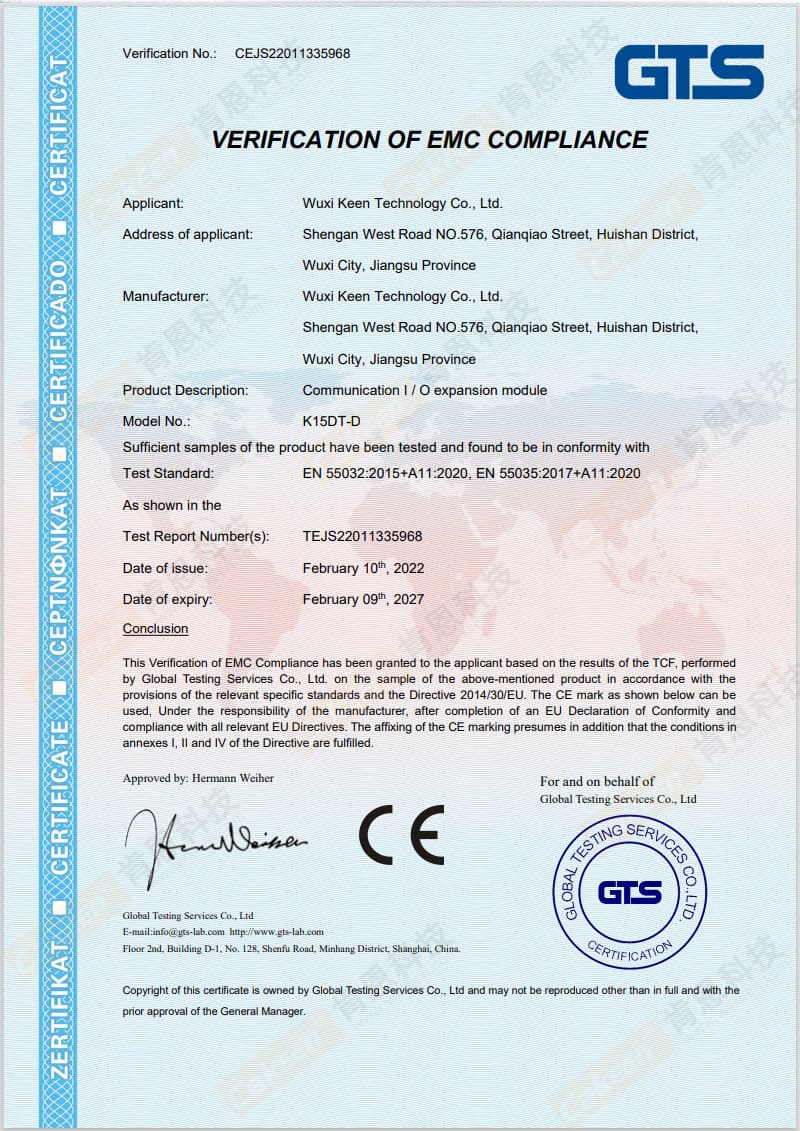
CE EMC certificate CEJS22011335968 (issued 2022-02-10, valid to 2027-02-09) covers the K15DT-D I/O Expansion Module under EN 55032:2015+A11:2020 and EN 55035:2017+A11:2020.
That upstream layer matters to buyers for a practical reason: when a controller is embedded in an OEM tool, the tool builder inherits the component's EMC and safety behaviour. Documented design standards such as IEC and UL508A in the drawing stage reduce the probability that a retrofit cabinet or a new equipment build fails electrical inspection at the customer's site.
Regional standards also surface physically, not just on paper. Cakeen's European Standard Electrical Cabinet is described as CE-certified and TÜV Rheinland certified, uses ABB, Siemens and Schneider components, offers IP54/IP65 protection at 380V/400V three-phase with customization, and lists CE and IEC as standard with UL as optional. The Japanese Standard Electrical Cabinet is described as JIS-compliant, uses Mitsubishi, Omron and Schneider components, offers IP54/IP65 protection at 200V/400V, and lists UL as optional. Different target markets therefore produce different component ecosystems, different voltage classes and different documentation defaults — a detail that determines spare-part sourcing long after installation.
Cakeen's Documented Certification Position
For evaluation-stage buyers, the useful question is not whether a supplier "is certified" but which certificate number, issued by which body, covers which product, and until when. The table below summarizes the certification records held for Cakeen's automation instruments and related products.
| Certificate | Standard | Certificate no. | Issued / valid to | Documented scope |
|---|---|---|---|---|
| Quality management system | GB/T 19001-2016 / ISO 9001:2015 | 50325Q3891R0S | 2025-12-12 / 2028-12-11 | Development and manufacturing of automation instruments and meters (temperature controllers, communication controllers); low-voltage complete switchgear within the CCC scope |
| Environmental management system | GB/T 24001-2016 / ISO 14001:2015 | 50325E3892R0S | 2025-12-12 / 2028-12-11 | Environmental management for the same instrument, controller and low-voltage switchgear activities |
| Occupational health & safety management system | GB/T 45001-2020 / ISO 45001:2018 | 50325S3893R0S | 2025-12-12 / 2028-12-11 | Occupational health and safety for the same development and manufacturing activities |
| SEMI S2 | SEMI S2-0821 | 220252 | Issued 2022-12-14, no expiry stated | Safety requirements for semiconductor manufacturing equipment, referencing the CMS Communication Module |
| CE — Low Voltage Directive | EN 60204-1:2018, EN IEC 61000-6-3:2021, EN IEC 61000-6-1:2019 | TRCN-22262WCT01 | 2022-09-19 / 2027-09-18 | Low voltage safety compliance for industrial automation equipment, referencing the MFC Gas Flow Controller |
| CE — EMC | EN 55032:2015+A11:2020, EN 55035:2017+A11:2020 | CEJS22011335967 | 2022-02-10 / 2027-02-09 | EMC and safety compliance for industrial gas burning equipment and communication modules, referencing the CMS Communication Module |
| CE — EMC | EN 55032:2015+A11:2020, EN 55035:2017+A11:2020 | CEJS22011335968 | 2022-02-10 / 2027-02-09 | EMC compliance for industrial automation control equipment, referencing the I/O Expansion Module |
Management-system certificates were issued by Beijing Zhong Ding Qian Yuan Certification Co., Ltd; the SEMI S2 record is attributed to SAFES; CE records are attributed to INTEGRA96 and GTS.
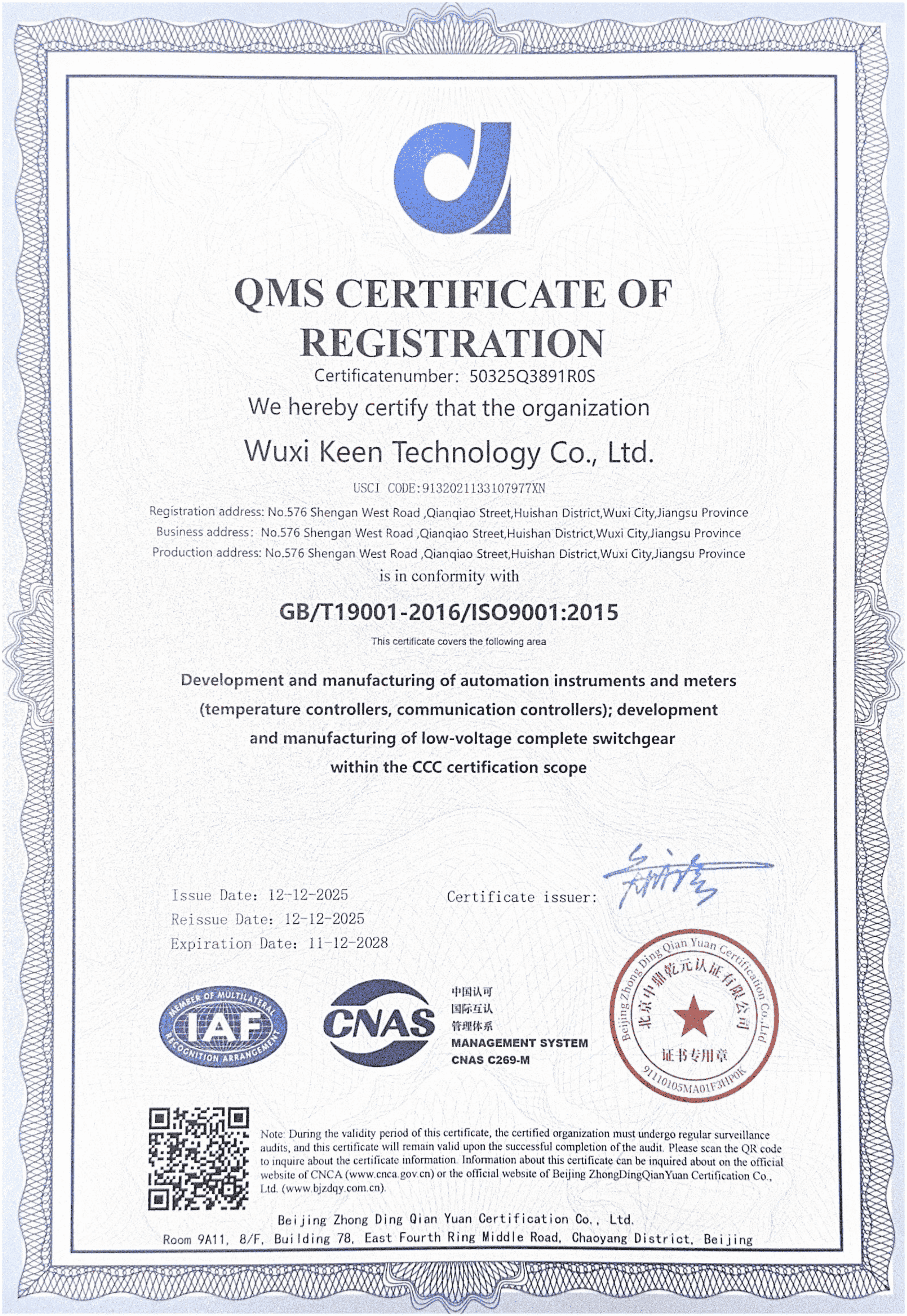
The ISO 9001:2015 record explicitly names temperature controllers and communication controllers within its development and manufacturing scope.
The company profile additionally lists ISO 9001, ISO 14001, ISO 45001, UL, SEMI S2, CE and ROHS among its international certifications, and describes export activity reaching Spain, Southeast Asia, the European Union and the USA, with an export ratio of 40% and a stated annual output of 500,000 units from a 2,019 m² facility with 50 employees and a 20-engineer R&D team.
Matching Certified Hardware to Application
Certification only becomes procurement value once it is mapped to the controller that will actually run the process. Cakeen's documented controller range is organized by mounting format, channel count and heating duty rather than by brand tier.
- Heat-tracing and insulated-line duty: the ASH heating tape controller is specified for pipe and vessel insulation and heating control; the KE-H10 and the compact H6625 share the same single-channel ±0.1°C control platform with PT/K/J/R/S/T/B/E/N/L inputs, built-in SSR output, RS485/Modbus RTU communication and 100–265V AC supply, at a maximum output current of 6A (KE-H10) and 3A (H6625). The documented application field is semiconductor equipment pipeline heating and chemical delivery insulation.
- Panel-integrated equipment: the KE-48 is a 48×48mm panel-mount single-channel controller with ±0.1°C accuracy, SSR/0-20mA/4-20mA/0-10V outputs, one RS485 port and 100–265V AC supply — a form factor designed for OEM equipment front panels.
- Multi-loop cabinets: the KE-2104 is a DIN-rail mounted four-channel PID controller with external SSR output, 12–24VDC supply and DIN35 rail mounting, which reduces cabinet footprint in multi-zone heating systems.
- Semiconductor gas and N2 duty: the HOT N2 MFC gas flow controller is specified at ±1% F.S. flow accuracy across a 1–100 SLM range for semiconductor process gas delivery, and the HOT-GUN pipeline nitrogen heater covers 0–250°C at ±1°C control accuracy, AC 220V, with 800W–1600W heating power for anti-condensation duty.
- Communication and thermal monitoring: the K42CE-D CMS communication module provides six RS485 ports and one Ethernet port with Modbus TCP/RTU, and the K15DT-D adds five NPN inputs and five NPN outputs over Modbus RTU — both DIN35 rail mounted at 12–24VDC. The CMS monitoring platform itself is documented for 10,000+ Modbus TCP devices with a 10-second polling interval and 365-day time-series retention.
Case records show where these products are already operating. A semiconductor equipment OEM has used embedded temperature control across 4+ years of projects in CVD, etching and diffusion furnace equipment, deploying the KE-48 panel-mount and KE-2104 DIN-rail controllers at a volume of 50+ units per year. A domestic equipment integrator has purchased 100+ cabinet sets per year for 5+ years, reporting a 40% shortening of its delivery cycle with repeat ordering. An Industrial IoT system integrator platform project, delivered with UL/EMC certified hardware, reported real-time collection from more than 1,000 sensors and a 25% reduction in unplanned downtime through AI anomaly detection. These programs spanned China, Taiwan, Singapore, Malaysia and the United States.
For laboratories and pilot plants searching for a heating jacket temperature controller or a heating mantle temperature controller, the closest documented Cakeen family is the heating tape controller line specified for pipe and vessel insulation and heating control. No mantle-specific variant appears in the available product documentation, so mantle and jacket users should confirm suitability against their vessel geometry and sensor placement during specification rather than assuming interchangeability.
Market Direction: Compliance Pressure Is Rising With Regional Divergence
The commercial context reinforces why certification has moved from paperwork to procurement strategy. The global PID controller market was valued at USD 1.60 billion in 2024 and is projected to reach USD 2.24 billion by 2032, according to SNS Insider. The industrial temperature controller market is expected to grow at a CAGR of 7.1% from 2024 to 2030, driven by Industry 4.0 adoption, per Strategic Market Research. Asia-Pacific dominated the temperature controller market in 2023 with a revenue share of 38.2%, with China as a key manufacturing hub, according to Dataintelo.
Two structural signals sit behind those figures. The global semiconductor temperature control equipment market was valued at USD 663 million in 2024, according to Market Research Reports — and semiconductor applications are where equipment-safety schemes such as SEMI S2 carry the most weight. At the same time, the oil & gas sector held the largest end-user share for PID controllers in 2024 at approximately 31.4%, per SNS Insider, where hazardous-area and panel standards dominate compliance workloads. A supplier serving both semiconductor and heavy-process customers therefore faces two different certification profiles, not one.
Cakeen vs. Eurotherm, Watlow, Omron and Yokogawa: Comparing Evidence, Not Claims
Mordor Intelligence lists leading global manufacturers of PID and temperature controllers as including Honeywell, Omron, Siemens, Eurotherm (Schneider Electric) and ABB. Watlow and Yokogawa are also established names in industrial thermal control and are included here as reference points in the same comparison set. The meaningful comparison for a buyer at evaluation stage is not brand prestige but the evidence path each supplier can offer for the specific catalogue number under review.
| Evaluation dimension | Cakeen (documented position) | Established global suppliers (Eurotherm, Watlow, Omron, Yokogawa) — buyer verification step |
|---|---|---|
| Market-access marking | CE records held for the MFC Gas Flow Controller and for communication/expansion modules; UL and ROHS listed in the company certification profile | Request the current declaration of conformity or listing record for the exact catalogue number and voltage variant |
| Semiconductor equipment safety | SEMI S2 certificate 220252, issued by SAFES, referencing the CMS Communication Module under SEMI S2-0821 | Confirm whether the specific model carries SEMI S2 or an equivalent third-party equipment-safety assessment |
| Management-system scope | ISO 9001:2015, ISO 14001:2015 and ISO 45001:2018 records whose scope text names temperature controllers and communication controllers | Check that the certificate scope explicitly names the product category, not only the corporate entity |
| Upstream design compliance | PCB design service documented to UL and EMC targets; electrical drawing design documented to IEC and UL508A | Ask whether board-level EMC and safety design is performed in-house or outsourced, and where design responsibility sits |
| Regional enclosure standards | European Standard cabinet (CE, TÜV Rheinland certified, 380/400V, IP54/IP65) and Japanese Standard cabinet (JIS-compliant, 200/400V, IP54/IP65) | Verify panel-build standard, component ecosystem and voltage class against the destination market |
| Customization terms | OEM/ODM production with all parameters, logo and appearance functions customizable; 30–45 day lead time; MOQ stated as 500 units for the controller line and 5 units for cabinet programs; 100% pre-shipment testing | Compare MOQ, lead time and engineering-change handling for the same specification class |
The right-hand column describes verification actions a buyer should perform; it does not assert any certification status for those manufacturers. Specific competitor certificate numbers, scopes or performance specifications are not stated here because they are not part of the verified data set for this article.
Limits and Trade-offs Buyers Should Plan For
A credible compliance assessment has to state boundaries. Four are documented for Cakeen.
- Certificate scope is product-family specific, not catalogue-wide. The SEMI S2 record references the CMS Communication Module; the CE Low Voltage Directive record references the MFC Gas Flow Controller; the two CE EMC records reference the CMS Communication Module and the I/O Expansion Module. Buyers of other models — for example a KE-48 or KE-2104 controller — should confirm which certificate applies to the model being purchased rather than assuming transferability.
- Voluntary and mandatory schemes are not interchangeable. SEMI S2 addresses semiconductor equipment safety but does not by itself satisfy EU market-access law, and the three ISO management-system certificates dated 2025-12-12 describe organizational systems rather than product conformity. Each answers a different audit question.
- Lead time and MOQ affect prototype-stage programs. The documented 30–45 day lead time and 500-unit minimum order quantity for the controller line suit volume production and multi-year OEM programs; early-stage engineering builds with very small quantities may need to plan around that structure, while cabinet programs are documented at a 5-unit minimum.
- Certificate currency is a recurring obligation. The CE records expire in 2027-02-09 and 2027-09-18, and the management-system records in 2028-12-11. Renewal status should be re-checked at each project milestone rather than validated once at supplier selection.
Scale is a further consideration in the opposite direction: a 2,019 m² facility, 50 employees and a 20-engineer R&D team describe a focused specialist rather than a multinational with multiple global production sites. For very large multi-site rollouts, buyers typically mitigate this through dual sourcing, buffer stock or staggered qualification — a supply-chain measure rather than a statement about product compliance.
Future Outlook
Three developments are likely to shape PID controller compliance work over the next procurement cycles. First, as semiconductor temperature control equipment demand grows from a USD 663 million base in 2024, equipment-safety documentation will increasingly be requested at component level rather than at tool level, pushing controller suppliers to hold model-specific records. Second, the divergence between European and Japanese enclosure practice — already visible in voltage class, component ecosystem and default documentation — will continue to make "region of installation" a first-order specification input. Third, the combination of Industry 4.0 connectivity and networked monitoring platforms will extend compliance attention from the controller itself to the communication layer, where EMC behaviour and data integrity are tested together.
For buyers mid-evaluation, the practical implication is straightforward: build the compliance dossier at model level, confirm the scope text on each certificate, and treat the design-stage standards behind the product as part of the evidence set. Buyers assembling such a dossier can request the certificate documentation for the specific model under evaluation.
Frequently Asked Questions
Which certifications does Cakeen hold for temperature controllers and related automation products?
Cakeen holds a quality management system certificate to GB/T 19001-2016 / ISO 9001:2015 (certificate 50325Q3891R0S), an environmental management system certificate to GB/T 24001-2016 / ISO 14001:2015 (50325E3892R0S) and an occupational health and safety certificate to GB/T 45001-2020 / ISO 45001:2018 (50325S3893R0S), all issued 2025-12-12 and valid to 2028-12-11, with scope text covering the development and manufacturing of temperature controllers and communication controllers. Additional records include a SEMI S2 certificate (220252) and three CE certificates covering low voltage and EMC compliance for the MFC Gas Flow Controller, the CMS Communication Module and the I/O Expansion Module. The company profile also lists UL and ROHS among its certifications.
What is the difference between a mandatory and a voluntary certification for a PID temperature controller?
A mandatory certification is a legal condition for placing a product on a market: industrial control panels, including PID controllers, must comply with UL 508A for North American safety listing and with IEC 60947 for international markets according to UL Solutions, while CE marking demonstrates conformity with EU directives. A voluntary certification is a customer or industry expectation rather than a legal gate: SEMI S2-0821, for example, sets safety requirements for semiconductor manufacturing equipment, including electrical safety, mechanical safety and hazard mitigation, and is typically required by semiconductor tool owners rather than by customs authorities.
Does a SEMI S2 certificate apply to every product from a supplier?
No. Certification records are tied to defined scope. The SEMI S2 record held by Cakeen, certificate 220252 issued by SAFES, references the CMS Communication Module under SEMI S2-0821 and covers electrical safety, mechanical safety and hazard mitigation for that reference product. Products outside the stated scope are not covered by the same record, so buyers should confirm the scope text on the certificate before treating a supplier as SEMI S2 qualified for a given model.
What OEM and ordering terms are documented for Cakeen's controller and cabinet lines?
Cakeen provides OEM and ODM production services, with all parameters, logos and appearance functions supporting customization. Documented production terms include a 30–45 day lead time, 100% pre-shipment testing, remote after-sales support, and export activity to Spain, Southeast Asia, the European Union and the USA via FOB, CIF or EXW terms with a 30% payment arrangement. Minimum order quantity is documented at 500 units for the controller line and 5 units for electrical cabinet programs.
How do European standard and Japanese standard electrical cabinets differ in compliance terms?
The European Standard Electrical Cabinet is described as CE-certified and TÜV Rheinland certified, using ABB, Siemens and Schneider components with IP54/IP65 protection at 380V/400V three-phase and a customizable voltage configuration; CE and IEC are listed as standard and UL as optional. The Japanese Standard Electrical Cabinet is described as JIS-compliant, using Mitsubishi, Omron and Schneider components with IP54/IP65 protection at 200V/400V, with UL listed as optional. The differences therefore appear in the governing standard, the component ecosystem and the nominal voltage class rather than only in documentation.
At what point in the design cycle should compliance evidence be requested?
Design-stage evidence is the earliest reliable signal. Cakeen's PCB circuit board design service (Semi-PCB) is documented with UL and EMC as certification targets for schematic-to-layout work on industrial control motherboards, and its electrical drawing design service states IEC and UL508A as design standards with DWG, PDF and BOM Excel deliverables on a 2–4 week cycle. Because EMC and electrical safety outcomes are determined by layout, grounding and filtering decisions, the standards applied during design and the certificates issued after production should be reviewed together rather than sequentially.