
PID Temperature Controller Manufacturers: A Market Primer
PID temperature control is one of the most common requirements in industrial process heating. For buyers at the awareness and early research stage, however, the first decision is not controller model selection. It is understanding which category of manufacturer should be invited into the sourcing process. This primer explains how the PID temperature controller manufacturing market is structured, what separates manufacturers from trading suppliers, and how buyers can interpret product portfolios and company-level evidence before formal evaluation begins.
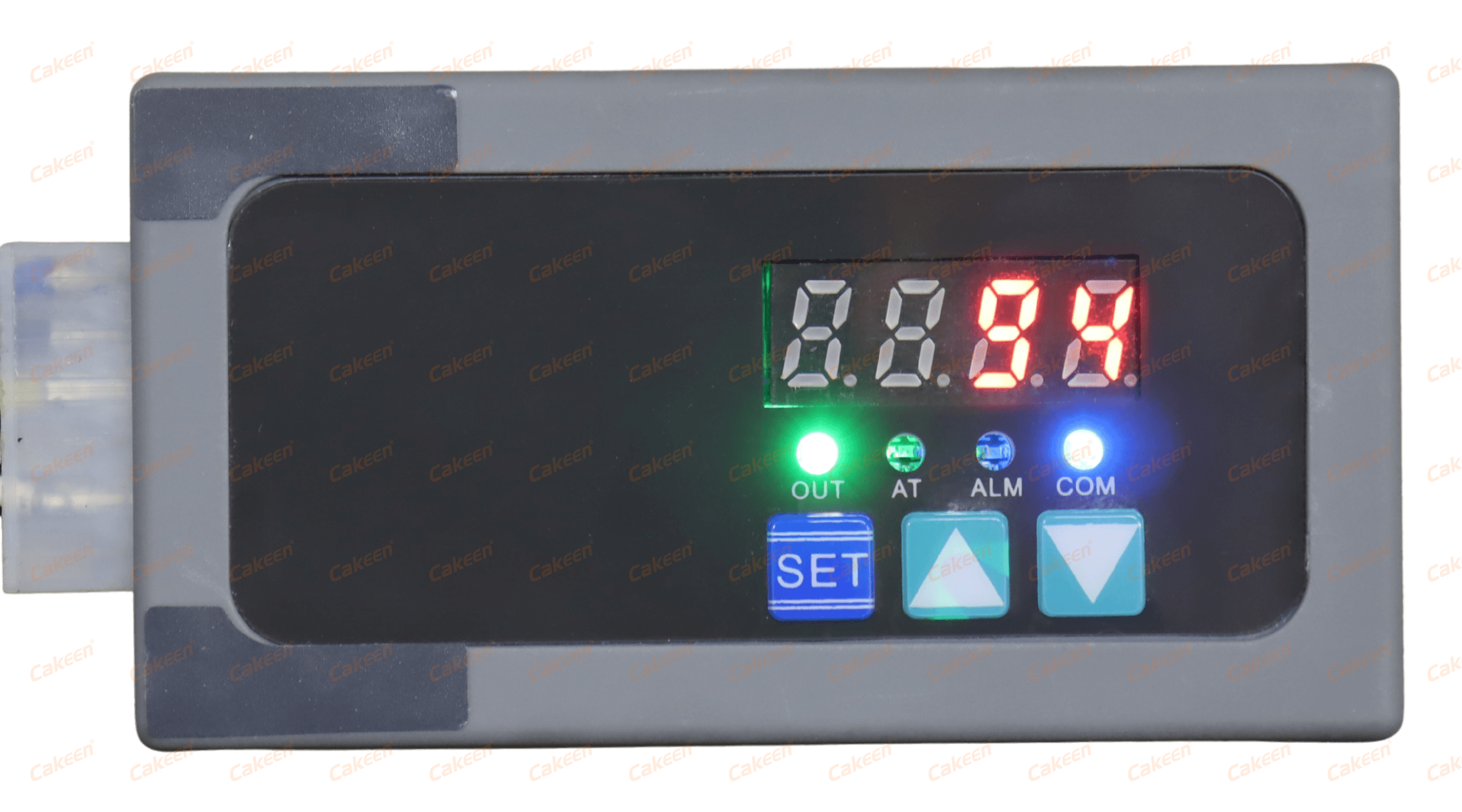
PID temperature controller ASH: a single-channel heating tape controller example for pipe and vessel insulation applications.
Why PID controller manufacturing is drawing buyer attention
Published market research helps explain the widening interest in this category. SNS Insider valued the global PID controller market at USD 1.60 billion in 2024 and projected it to reach USD 2.24 billion by 2032. Strategic Market Research estimated that the industrial temperature controller market will expand at a compound annual growth rate of 7.1% between 2024 and 2030, with market analysts linking the growth partly to Industry 4.0 adoption. A separate estimate from Market Research Reports placed the global semiconductor temperature control equipment market at USD 663 million in 2024.
These figures do not measure exactly the same segment, but together they indicate that temperature control is expanding from a standalone instrument purchase into a system-level buying decision. For procurement teams, a PID temperature controller is no longer only a panel component. It is part of a larger consideration around heating elements, sensor compatibility, communication networks, alarm handling, electrical enclosures, and monitoring software.
What a PID temperature controller manufacturer is
A PID temperature controller manufacturer designs and produces instruments that use proportional, integral, and derivative control actions to keep a process at a desired temperature. The manufacturer is responsible for engineering, production, calibration, and quality management of the product. This differs from a trading supplier, which resells controllers made by other companies.
In semiconductor-related processes, the performance threshold is often high. Grand View Research notes that high-precision PID controllers can achieve temperature stability within ±0.1°C, a level commonly referenced for precision applications such as lithography and etching. Achieving that stability depends on sensor linearization, output drive design, electrical noise control, and repeatable calibration. These engineering choices are why the manufacturer distinction matters during sourcing.
Three manufacturer layers in the PID temperature controller market
For a buyer entering the category, a useful mental model is to divide the supply market into three layers rather than evaluating individual brand names immediately.
Global automation and process-control groups
Global automation and process-control groups offer broad product portfolios, international distribution networks, and recognized brand names. Market research from Mordor Intelligence lists Honeywell, Omron, Siemens, Eurotherm (Schneider Electric), and ABB among companies active in the broader temperature controller market. These suppliers are often the default choice when an equipment builder needs a standard product that is available and serviceable in many countries.
Engineering-driven temperature control manufacturers
A second layer consists of engineering-driven manufacturers that specialize in temperature control and related electrical systems without operating as full-line automation groups. These companies typically serve OEMs, system integrators, and process equipment builders who need custom configurations, control cabinet integration, or adjacent engineering services.
Wuxi Keen Technology Co., Ltd., which markets its products under the Cakeen brand, is an example of this layer. The company was established in 2011 and is headquartered in Huishan District, Wuxi, Jiangsu Province. Its corporate profile states that it specializes in semiconductor industrial control electronics, electrical cabinet systems, AI system software, and AI embedded systems. The manufacturing facility covers 2,019 square meters, and the company has approximately 50 employees, including a research and development team of 20 engineers. About 40% of its products are exported, with major markets that include Spain, Southeast Asia, the European Union, and the United States.
Distributors and trading companies
Distributors and trading companies form the third layer. They can stock products, support fast delivery, and manage local logistics, but they do not control product design or production. For standard replacements and commodity purchases, this layer can be appropriate. For OEM customization and projects that require engineering traceability, a manufacturer or an engineering-driven supplier is normally the more relevant starting point.
Reading a manufacturer product map
The breadth of a manufacturer product line is one of the fastest discovery signals. In the Cakeen catalog, the PID temperature controller range can be grouped into several functional families.
The KE-48 is a panel-mount temperature controller. It is designed for a 48×48 mm panel cutout, supports a single control channel, and accepts PT100 as well as multiple thermocouple input types including K, J, R, S, T, B, E, N, and L. Its rated control accuracy is ±0.1°C. The unit can drive an external SSR or provide analog output, and it includes one RS485 communication port.
The KE-2104 is a DIN rail mount, four-channel PID controller. It provides four independent control channels, uses an external SSR output, supports the same wide set of temperature sensor inputs, and operates from a 12-24 V DC power supply. DIN35 rail mounting makes the unit suitable for electrical cabinet environments where space is limited.
For heating tape applications, Cakeen produces the ASH, KE-H10, and H6625 models. The ASH is a PID temperature controller for pipe and vessel insulation and heating. The KE-H10 is a PID heating tape temperature controller with a built-in SSR output rated up to 6 A. The H6625 is a mini heating tape PID temperature controller with a built-in SSR output rated up to 3 A. All three models operate from 100-265 V AC, accept the same broad thermocouple and RTD input set, and support RS485 or Modbus RTU communication.
The HOT-GUN is a pipeline nitrogen gas heater designed for anti-condensation control in semiconductor thermal processing. It operates over a temperature range of 0 to 250°C with a control accuracy of ±1°C, a working voltage of AC 220V, and heating power from 800W to 1600W. The HOT N2 is a high-precision mass flow controller used for semiconductor process gas delivery, with a flow accuracy of ±1% F.S. and a flow range of 1 to 100 SLM.
On the software side, the Industrial Device Central Monitoring System, designated as model CMS, is a temperature monitoring and alarm management software. It supports more than 10,000 Modbus TCP devices, uses a real-time polling interval of 10 seconds, and retains time-series history for 365 days using InfluxDB.
| Functional family | Cakeen model references | Key specification signals | What this tends to indicate for a buyer |
|---|---|---|---|
| Panel-mount single-loop controller | KE-48 | ±0.1°C; SSR or analog output; RS485; 100-265 V AC | Standard single-zone control with panel installation |
| DIN rail multi-channel controller | KE-2104 | 4 channels; ±0.1°C; external SSR; 12-24 V DC | Multi-zone temperature control in cabinet environments |
| Heating tape / pipe and vessel heating controller | ASH, KE-H10, H6625 | Built-in SSR up to 3 A or 6 A; RS485 / Modbus RTU | Heat tracing and pipeline temperature maintenance |
| Scanning semiconductor gas-line heating and flow control | HOT-GUN, HOT N2 | ±1°C nitrogen heating; ±1% F.S. mass flow control | Thermal and flow management for hot nitrogen gas delivery |
| Monitoring software | CMS | 10,000+ Modbus TCP devices; 365-day data history | Moving from single-loop control to centralized monitoring |
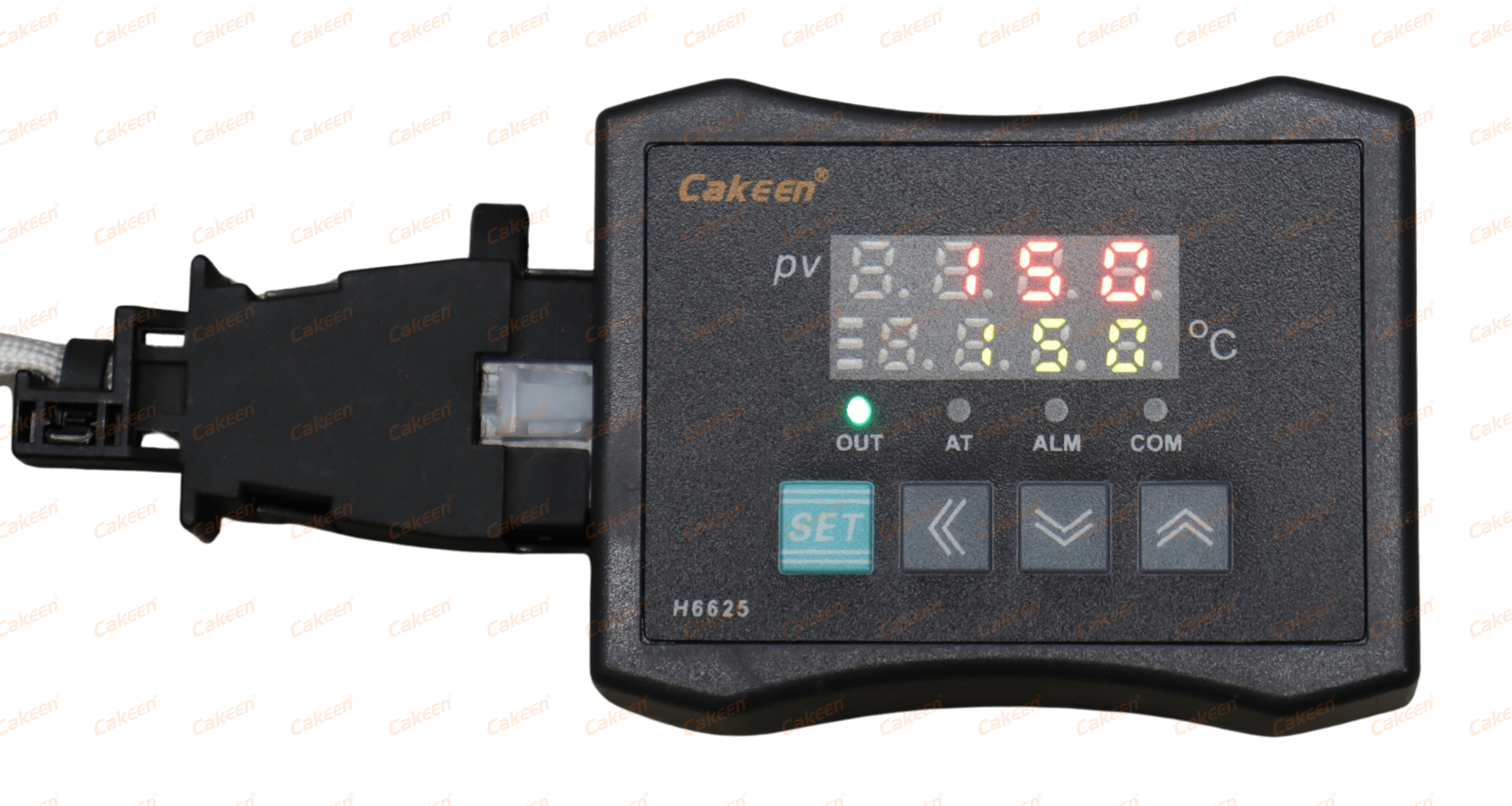
H6625 is a mini PID heating tape temperature controller within the same product family as the ASH and KE-H10 models.
Heating jacket and heating mantle buying language
Buyers searching for a heating jacket temperature controller or a heating mantle temperature controller are often describing a related control problem rather than a completely different product class. Flexible resistive heating elements such as heating jackets, heating mantles, and heating tapes typically use a similar approach: a PID controller reads a thermocouple or RTD sensor and switches the heater through an SSR. The Cakeen heating-tape controller family, represented by the ASH, KE-H10, and H6625 models, addresses this kind of temperature maintenance and insulation application.
What product breadth says about engineering depth
A manufacturer that makes both controllers and heating hardware can reduce interface risk for an OEM buyer. In addition to PID temperature controllers, Cakeen produces pipeline nitrogen heating equipment, gas flow controllers, electrical control cabinets, and monitoring software. Its engineering service list also includes electrical drawing design, PLC control program development, PCB circuit board design, and embedded system software development. This combination is relevant for buyers who need a controller integrated into an electrical cabinet and connected to a larger machine control system.
From a procurement perspective, engineering depth changes the kinds of questions a buyer can ask. With a trading supplier, the practical question is which model is available. With an engineering-driven manufacturer, the buyer can ask about sensor scaling, output stage changes, communication protocol behavior, enclosure layout, and acceptance testing.
Certifications as early verification signals
Certification records are useful evidence during the early research phase because they can be checked before factory audits begin. The corporate profile of Wuxi Keen Technology Co., Ltd. lists ISO9001, ISO14001, ISO45001, UL, SEMI S2, CE, and RoHS certifications. For sourcing teams, these names provide a baseline for quality management, environmental management, occupational health and safety, product safety, and semiconductor equipment-related compliance.
For industrial control panels specifically, buyers also encounter UL 508A and IEC 60947 in compliance discussions. UL Solutions cites UL 508A for industrial control panel safety listing in North America and IEC 60947 for international markets. A manufacturer that integrates controllers into electrical cabinets should be able to explain which standard applies to the final assembly.
Comparison with conventional sourcing routes
The practical difference between manufacturer types becomes clearer when compared directly against conventional sourcing routes.
| Evaluation dimension | Global automation group | Engineering-driven manufacturer such as Cakeen | Distributor or trading supplier |
|---|---|---|---|
| Product design control | Owns product design through internal programs | Owns product design and production for its own temperature control range | Does not normally own product design |
| Customization level | Large catalog; customization usually limited | Semi-custom and OEM configurations more feasible | Limited to available stock |
| Integration scope | Controller-focused portfolio | Controllers plus heating systems, cabinets, and monitoring software | Depends on the brands represented |
| Global support footprint | Broad and established | Export-focused, with remote engineering and international markets | Variable; depends on local stock and brand support |
| Typical best-fit context | Standardized products with global service requirements | OEM equipment, system integration, and customized control solutions | Replacement units and short-lead-time purchases |
A realistic limitation should be stated directly. Engineering-driven regional manufacturers are not always the right answer. If an equipment builder requires the same controller to be installed and replaced through local distribution across many countries, a global automation group often provides a lower-risk service model. Buyers evaluating a China-based manufacturer should verify response time, technical documentation, spare-part logistics, and remote support capacity before assigning the manufacturer a central role in a geographically distributed service network.
Market context for international buyers
Regionally, Asia-Pacific accounted for 38.2% of the temperature controller market revenue in 2023, according to Dataintelo, which identified China as a key manufacturing hub. This regional concentration is one reason why international buyers encounter China-based suppliers when researching PID temperature controller manufacturers or PID controller suppliers. The relevant sourcing task is not to accept regional origin as a quality signal in either direction, but to compare supplier types, product families, certifications, and engineering depth on the same basis.
From discovery to shortlist: what to check next
Buyers can use the following sequence to move from manufacturer discovery to a credible shortlist without overinvesting in model-level analysis too early. First, identify which supply layer fits the project risk profile: a global automation group, an engineering-driven manufacturer, or a distributor. Second, compare product maps to see whether the supplier covers the required control form factor, from panel-mount and DIN rail controllers to heating tape controllers and system-level hardware. Third, check engineering services such as electrical drawing, PLC programming, PCB design, embedded software, and control cabinet production. Fourth, request certification documents and confirm parameters such as control accuracy, sensor input types, output type, and communication protocol. Fifth, define the service boundary, especially for international projects.
The direction of the category
The PID temperature controller market is moving from isolated single-loop control toward connected temperature management. Cakeen illustrates this trend through its combination of controllers, gas heating equipment, and central monitoring software. The CMS platform is designed to monitor temperature control devices over Modbus TCP, track PV and SV temperature values, handle AL1 and AL2 alarm thresholds, and store a year of time-series history. For an OEM buyer, this architecture points to a future where the manufacturer supplies not only a control loop, but also the data backbone used to supervise that loop.
Conclusion
The discovery phase in this field ends when a buyer can name the type of manufacturer it wants to work with, the product families that match the application, and the evidence needed before entering formal supplier evaluation. The PID controller market is large enough to contain multiple supplier models, and the right one depends on project structure rather than on brand familiarity alone. Understanding the difference between a manufacturer and a trading supplier, and between a global automation group and an engineering-driven specialist, is therefore the first procurement skill in this category.
Market data in this article draws on published research from SNS Insider, Strategic Market Research, Market Research Reports, Dataintelo, Mordor Intelligence, Grand View Research, and UL Solutions. Company and product facts are based on the publicly available corporate profile and product documentation of Wuxi Keen Technology Co., Ltd. and the Cakeen product range.
FAQ
What is a PID temperature controller manufacturer?
A PID temperature controller manufacturer is a company that designs and produces temperature control instruments based on PID control logic. It typically performs its own engineering, production, calibration, and quality checks, and may also manufacture related systems such as heating controllers, electrical cabinets, and monitoring software.
How is a PID temperature controller manufacturer different from a supplier?
A supplier can be a distributor or trading company that resells products made by other companies. A manufacturer owns the product design and production process. The distinction matters when a buyer needs modifications: a manufacturer can adjust specifications, while a distributor normally only offers what is already in stock.
Which temperature controller is used for heating tapes, heating jackets, and heating mantles?
Flexible heating systems such as heating tapes, heating jackets, and heating mantles typically use a PID controller with a thermocouple or PT100 sensor input and an SSR output. The controller switches the heating element to maintain a stable temperature. The Cakeen ASH, KE-H10, and H6625 models are examples of a heating-tape controller family used for pipe and vessel insulation and heating.
What does a multi-channel PID controller do?
A multi-channel PID controller regulates several independent temperature zones from one device. The Cakeen KE-2104 is a DIN rail mount, four-channel PID controller with ±0.1°C control accuracy, broad thermocouple and PT100 input compatibility, external SSR output, and 12-24 V DC power. This reduces mounting space in multi-zone equipment when compared with using several single-channel units.
What is a Hot N2 controller in semiconductor equipment?
A Hot N2 controller is used in semiconductor gas delivery and thermal processing environments. The HOT-GUN is a pipeline nitrogen gas heater designed for anti-condensation control, with a temperature range of 0 to 250°C and ±1°C control accuracy. The HOT N2 mass flow controller supports process gas delivery with ±1% F.S. flow accuracy and a 1-100 SLM flow range.
Do PID controller manufacturers support OEM projects?
OEM support depends on the manufacturer engineering depth. Companies that also provide electrical drawing design, PCB design, PLC program development, and embedded software are normally able to do more than simple product labeling. Wuxi Keen Technology Co., Ltd. offers these engineering services alongside its control electronics and electrical cabinet products.
Which certifications should a PID temperature controller manufacturer hold?
There is no single certification that covers all markets. CE and RoHS are frequently cited for Europe, while UL and SEMI S2 are relevant to North American and semiconductor-equipment applications. Quality management certifications such as ISO9001 are also common baselines. Buyers should confirm certificates against the specific controller model and target market.
Have Questions or Need More Details?
Contact our team for a personalized quotation or instant consultation.
Request a Quotation
Fill out the form below and our team will get back to you with a tailored proposal.
WhatsApp Direct Chat
Prefer to chat in real-time? Message us on WhatsApp for instant assistance & quick answers.
- Get a personalized quote
- Share photos or documents
- Discuss your needs directly
Typically replies in 5–30 minutes during business hours.