
PID Temperature Controller Procurement FAQ: Modbus, DIN Rail, Panel Mount and I/O Expansion
PID Temperature Controller Procurement FAQ: Modbus, DIN Rail, Panel Mount and I/O Expansion
In semiconductor and industrial thermal systems, a PID temperature controller is rarely specified as an isolated component. Mounting format, fieldbus, discrete I/O count and the path for adding channels later are all decided at the same time as control accuracy — and each of those choices changes cabinet layout, wiring labour and the cost of monitoring the loop afterwards.
This procurement FAQ addresses the practical questions engineers, equipment builders and buyers raise when comparing a DIN rail mount controller with a panel mount controller, and when planning Modbus networking and remote I/O expansion. The reference products are the Cakeen (Wuxi Keen Technology Co., Ltd.) KE-2104 DIN rail mount 4-channel PID temperature controller and the KE-48 48×48 mm panel mount temperature controller, together with the K15DT-D I/O expansion module, the K42CE-D CMS communication module and the Industrial Device Central Monitoring System (CMS).
The Four Decisions Behind Every PID Controller Purchase
Procurement questions about temperature controllers cluster around four decisions rather than one. The first is mounting: whether the loop is controlled from inside the cabinet on a DIN rail or from the front of a panel. The second is protocol: whether the device joins a Modbus RTU serial bus, a Modbus TCP network, or both. The third is I/O: how many analogue control channels and how many discrete signal points the application actually needs. The fourth is expansion: whether additional channels arrive by installing another controller or by extending an existing one with a module.
Treating these as one decision matters because the controller itself is usually a small fraction of the cost of rewiring a cabinet or re-engineering a communication layer. A specification that answers only the accuracy question leaves the integration questions open. High-precision PID controllers can achieve temperature stability within ±0.1°C, a level associated with semiconductor lithography and etching requirements, but that figure describes the controller's measurement and control behaviour rather than the accuracy of the finished thermal system.
DIN Rail Mount or Panel Mount? Matching the Format to the Cabinet
Cakeen's published range covers both formats, and the two reference models differ in more than their housing. The table below compares the parameters published in the product specifications.
| Parameter | KE-2104 (DIN rail mount) | KE-48 (panel mount) |
|---|---|---|
| Control channels | 4 channels | Single channel |
| Control accuracy | ±0.1°C | ±0.1°C |
| Input type | PT / K / J / R / S / T / B / E / N / L | PT / K / J / R / S / T / B / E / N / L |
| Output | External SSR | SSR / 0-20 mA / 4-20 mA / 0-10 V |
| Communication | Not listed in the published specification | 1x RS485 |
| Power supply | 12-24 V DC | 100-265 V AC |
| Mounting | DIN35 rail | Panel mount, 48×48 mm |
| Housing material | Flame-retardant engineering plastic | Flame-retardant engineering plastic |
| Applicable industry | Temperature control systems; process monitoring | Temperature control systems; process monitoring |
KE-2104 is classified as a DIN rail mount 4-channel PID controller. Four loops on one DIN35 rail device is the configuration that suits multi-zone machine cabinets, retrofit projects and skid-mounted process equipment, where panel space is already committed to other instruments. Two integration details follow directly from the published specification: the output is an external SSR, so the solid-state relay is a separate line item and a separate thermal consideration inside the cabinet; and the device runs on 12-24 V DC, which means the cabinet needs a DC supply rail.
KE-48 is a 48×48 mm standard panel mount temperature controller with a single control channel. Its output options include SSR drive as well as 0-20 mA, 4-20 mA and 0-10 V analogue signals, which allows it to drive analogue actuators rather than only a switching element, and it accepts 100-265 V AC directly. The trade-off is space and channel count: it occupies a panel cutout and controls one loop, so a four-zone installation would use four KE-48 units against one KE-2104.
The decision rule that follows is straightforward. Choose DIN rail mount when channel density, internal cabinet mounting and DC-powered control electronics are the priority. Choose panel mount when operators need front-of-panel visibility, when an analogue output is required, or when the loop must run directly from AC mains without a DC supply layer.
Modbus TCP and Modbus RTU: Questions to Settle Before Wiring
Modbus questions arrive early in evaluation because the answer determines cable type, network topology and the number of gateways in the cabinet. Modbus RTU runs over RS485 as a two-wire serial bus, so device count, cable length, termination and polling rate all need planning; Modbus TCP carries the same register model over Ethernet and is generally easier to segment and route. A system that supports both can keep fast local serial loops while presenting a single Ethernet interface upward.
The K42CE-D CMS communication module is the device that answers most of these questions in a Cakeen system. It is published with 6x RS485 ports, 1x Ethernet port, Modbus TCP/RTU support, 2x NPN I/O, a 12-24 V DC supply and a DIN35 rail mount in a flame-retardant engineering plastic housing. Six RS485 ports is an unusual specification, and its practical meaning is that several serial segments can terminate on one module instead of on several converters. In plants where temperature controllers of different generations or vendors each expose a single RS485 port, that consolidation reduces the number of gateways and the number of failure points in the communication chain. The Ethernet port provides the route from the serial cluster into a supervisory network using Modbus TCP.
Four questions are worth putting to any supplier before the communication layer is frozen: how many separate RS485 ports the module provides; whether Modbus TCP and RTU are both supported on the same hardware; how the register map is documented; and what the module's power and mounting requirements are. Cakeen's PLC control program design service, delivered under the Semi-PLC model, supports Siemens S7-1200/1500, Mitsubishi Q/L series and Omron NJ/NX controllers using Modbus TCP and Modbus RTU, with Python as the programming language and documentation plus executable files as deliverables. That service layer matters when the controller has to be integrated into an existing PLC architecture rather than operated as a stand-alone instrument.
I/O Expansion with the K15DT-D: When Controllers Are Not Enough
Temperature control is analogue in nature, but the surrounding system is discrete. Valve position feedback, interlock signals, alarm beacons and enable commands all need digital points that a PID controller does not provide on its own.
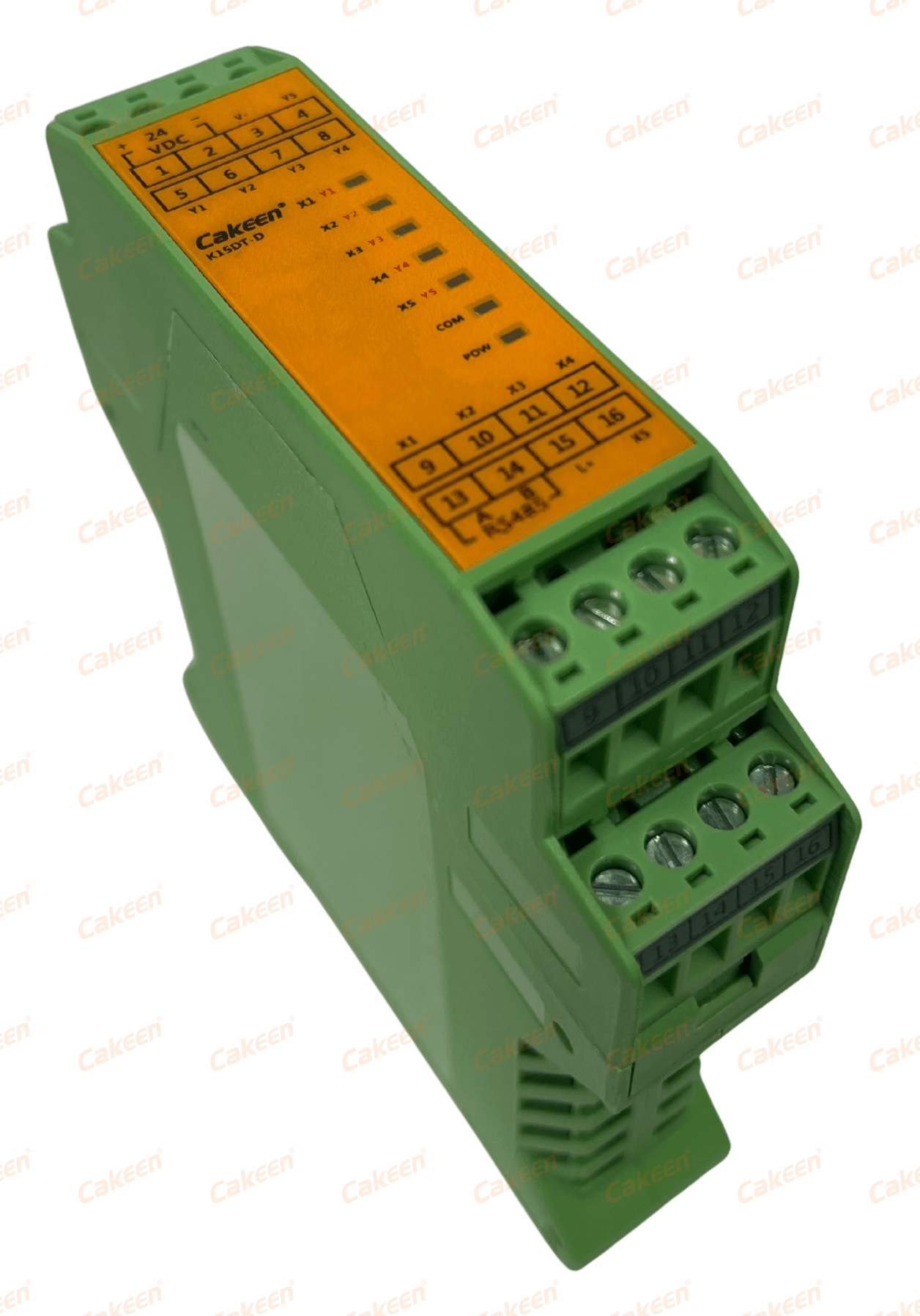
The K15DT-D is an I/O expansion module with 5 NPN inputs and 5 NPN outputs, Modbus RTU communication, a 12-24 V DC power supply and DIN35 rail mounting, in a flame-retardant engineering plastic housing. Its documented applications are switching control and remote I/O expansion. In practice this is the module that answers the question “the loop already controls temperature — how are the discrete signals around it handled?” It extends an existing Modbus network rather than adding another controller, and its DIN35 format means it can sit on the same rail as the controller it supports.
One boundary deserves attention during selection: NPN transistor outputs are DC sinking outputs, not relay contacts. Loads must be compatible with that output type, and where a relay contact or a high-current load is required, an external relay or interposing device remains part of the design. The K42CE-D module carries 2x NPN I/O of its own, so a small number of discrete points can be handled at the communication module without a separate expansion unit.
The Monitoring Layer: Where CMS Fits
Controllers and I/O modules solve the control problem; the Industrial Device Central Monitoring System (CMS) addresses the visibility problem. CMS is published as temperature monitoring and alarm management software supporting 10,000+ Modbus TCP devices, with a 10-second real-time polling interval, monitoring of PV/SV temperature values, AL1/AL2 thresholds and TC BK sensors, and 365-day time-series history retention in InfluxDB.
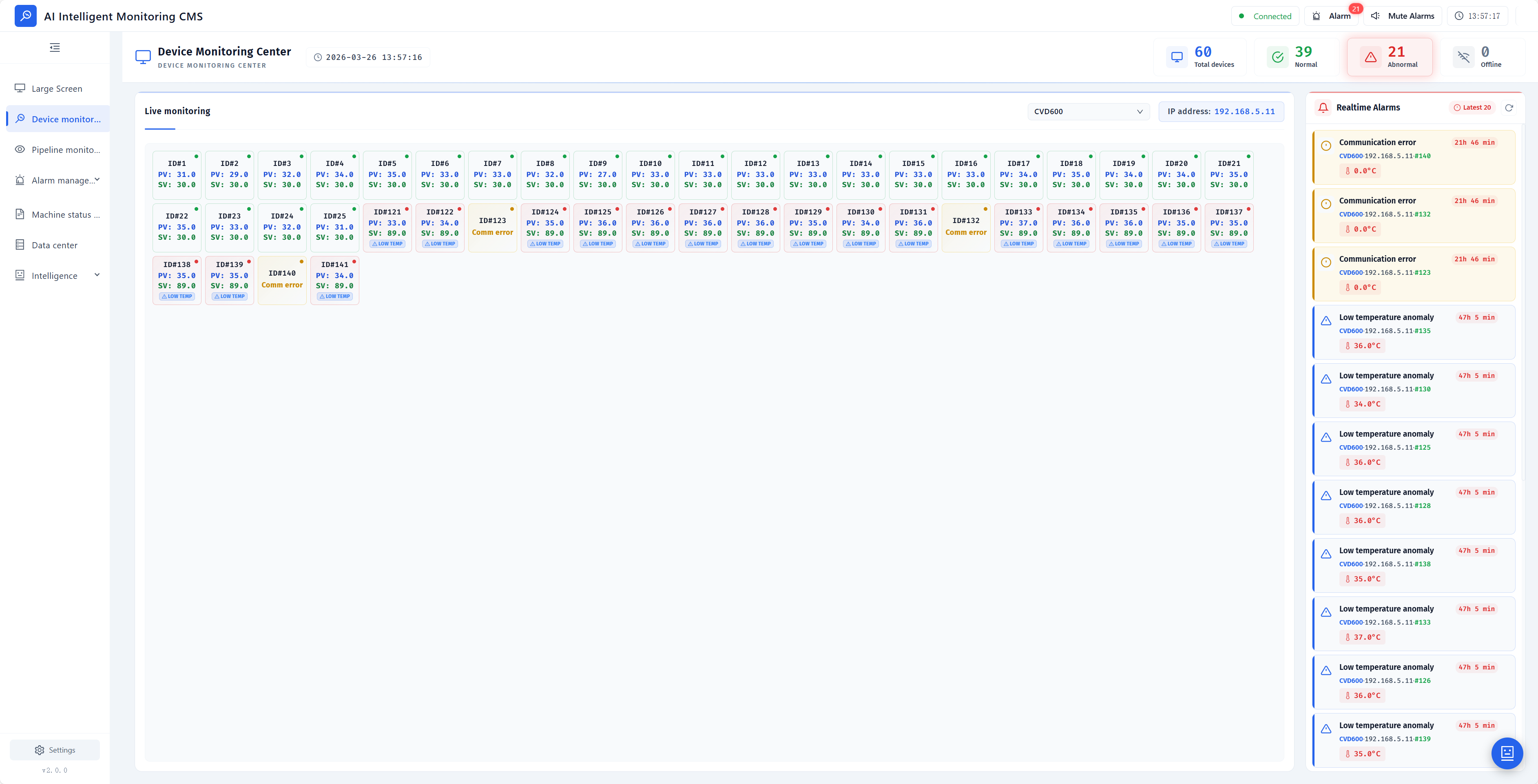
At deployment level the documented scenario describes a web-based platform with real-time WebSocket data push, batch monitoring of 500+ devices per IP across multiple IPs, JWT-based role access control, and preset operating modes including high performance, balanced and energy saving. Supported application areas include display and panel manufacturing, rail transportation, industrial temperature control and process manufacturing.
For a buyer, the relevant point is that CMS uses Modbus TCP as its data protocol. That makes the protocol decision upstream of the monitoring decision. An installation planned with Modbus TCP from the start can be brought under central monitoring without a protocol conversion layer, while an installation built purely on isolated serial loops will need gateways before the same visibility is available.
Worked Example: Pipeline Nitrogen Heating in Semiconductor Thermal Processing
Pipeline nitrogen heating is a useful case because it forces the mounting, protocol, I/O and monitoring decisions to be made together. In semiconductor thermal processing, nitrogen delivered through pipework can condense on pipe walls, and heated delivery is used to prevent it. The HOT-GUN is documented as a pipeline nitrogen gas heater for anti-condensation control, classified as a pipeline N2 heating controller and built in stainless steel or high-temperature alloy. Its published figures are a temperature range of 0–250°C, control accuracy of ±1°C, working voltage of AC 220 V and heating power of 800 W–1600 W.
Two accuracy figures sit side by side in this application and they should not be confused. The controllers used in the loop are specified at ±0.1°C control accuracy, while the HOT-GUN nitrogen heating system is specified at ±1°C. The gap is the difference between instrument accuracy and end-to-end system accuracy, and it is influenced by sensor placement, heater geometry, gas flow rate and the thermal mass of the pipework.
A reference architecture for this case combines one or more PID temperature controllers in the appropriate mounting format; the K15DT-D for discrete signals around heaters and valves; the K42CE-D for RS485 aggregation and the Ethernet link; and CMS for central monitoring. Where gas flow also needs control rather than only heating, the HOT N2 MFC gas flow controller is published with ±1% F.S. flow accuracy and a 1–100 SLM range in a stainless steel body.
Integration work around such a system is often as significant as the hardware. Cakeen provides a PLC control program design service for semiconductor equipment automation; electrical drawing design compliant with IEC and UL508A, delivered as DWG, PDF and BOM Excel over a 2–4 week design cycle in Chinese and English; PCB circuit board design from schematic through layout and routing with UL and EMC scope; and embedded system software development covering IoT connectivity, edge computing and AI analysis as a full-stack solution from hardware to application layer. Whether that service layer is available is a legitimate procurement question, because it determines whether the buyer receives components or a documented, integrated control package.
How Cakeen Compares with Established International Suppliers
No single supplier profile fits every project, and the four dimensions buyers usually use — R&D capability, industry solutions, customer service and market presence — produce different answers depending on the scale of the installation. The table below summarises publicly known positioning.
| Supplier | Portfolio emphasis (public positioning) | Where it is typically considered |
|---|---|---|
| Cakeen (Wuxi Keen Technology Co., Ltd.) | Semiconductor-focused industrial control electronics: DIN rail and panel mount PID controllers, RS485/Ethernet communication module, I/O expansion module, electrical cabinet systems, plus PLC, electrical drawing, PCB and embedded software engineering services | Semiconductor thermal processing, industrial automation and equipment builders that want controller, I/O, cabinet and monitoring hardware from one technical source |
| Siemens | Broad industrial automation platform, including the S7-1200/1500 PLC families that appear in Cakeen's PLC programming scope | Large automation architectures where the PLC platform is already standardised |
| Omron | Industrial automation components and controllers, including the NJ/NX controller families that appear in Cakeen's PLC programming scope | Machine and factory automation with an existing Omron component standard |
| Watlow | Thermal solutions — heaters, sensors and temperature controllers | Thermal subsystems where heater and sensor selection is bundled with control |
| Yokogawa | Process automation and measurement instrumentation | Large process plants with centralised instrumentation and control standards |
| Eurotherm (Schneider Electric) | Temperature and process control instruments; named among leading global temperature controller manufacturers in third-party market reporting | Process and industrial heating loops in established global installations |
Profile descriptions summarise each supplier's publicly known positioning and are not performance rankings, scores or measured comparisons. No performance data is implied or claimed. Buyers should validate current specifications, regional support and certifications directly with each vendor.
R&D capability. Cakeen publishes a 20-engineer R&D team within an organisation of roughly 50 employees, covering semiconductor industrial control electronics, electrical cabinet systems, AI system software and AI embedded systems. The practical consequence for a controller buyer is that the same engineering organisation that builds the controller also writes PLC programs (Siemens S7-1200/1500, Mitsubishi Q/L, Omron NJ/NX; Modbus TCP/RTU), produces electrical drawings to IEC and UL508A, and designs PCBs with UL and EMC scope. Larger international suppliers typically deliver comparable engineering capability through regional application teams and authorised system integrators; the difference is the delivery channel rather than the existence of engineering support.
Industry solutions. Cakeen's documented application footprint covers semiconductor, industrial automation and AI industries, with deployment references in China, Taiwan, Singapore, Vietnam, Malaysia, the United States, Mexico, Japan and South Korea. The broader suppliers listed above span more verticals because they serve many industries simultaneously. A narrower portfolio can be an advantage where the requirement is specifically a semiconductor thermal loop with Modbus integration, and a disadvantage where the project also needs unrelated process instrumentation from the same purchase order.
Customer service. Cakeen works through direct technical contact and delivers electrical design documentation in Chinese and English, with approximately 40% of output exported. For a first-time overseas buyer, the practical question is whether technical response comes from the engineering team that wrote the specification or from a reseller layer, and that should be confirmed in the evaluation stage rather than after the purchase order.
Market presence. The company's verified footprint — roughly 50 employees, a facility of 2,019 m², and markets in Spain, Southeast Asia, the European Union and the USA — is smaller than the global operations of Siemens, Omron, Watlow, Yokogawa or Eurotherm. Buyers with multi-region spare-part stocking, local training or on-site service requirements should confirm explicitly how those needs would be met before standardising on a specialist supplier of this scale.
Limits, Boundaries and Trade-offs to Confirm Before Ordering
- External SSR requirement. KE-2104 provides an external SSR output, so the SSR is not part of the controller and must be specified separately, including its thermal derating inside the cabinet.
- DC supply dependency. KE-2104, K15DT-D and K42CE-D all operate on 12-24 V DC, while KE-48, ASH, H6625 and KE-H10 accept 100-265 V AC directly. Mixed installations need both supply architectures or a deliberate choice between them.
- Output type limits. Built-in SSR output models are rated at a maximum of 3 A (ASH, H6625) or 6 A (KE-H10). Higher-power heaters require an external SSR or contactor rather than the controller's built-in output.
- NPN-only discrete I/O. K15DT-D and the discrete points on K42CE-D use NPN transistor I/O, which suits DC sinking loads but does not replace relay contacts.
- Serial bus realities. Modbus RTU over RS485 is a two-wire bus, so segment count, cable length and termination must be designed rather than assumed, even though K42CE-D provides six RS485 ports.
- Monitoring cadence. CMS polls at a 10-second interval with 365-day history retention. It is a supervisory layer, not a substitute for the controller's own closed-loop execution.
- Instrument accuracy versus system accuracy. A ±0.1°C controller specification does not make a ±1°C thermal system more accurate; the system figure is set by sensor placement, heater design and process conditions.
Market Context and Future Outlook
Third-party market reporting places the global PID controller market at USD 1.60 billion in 2024, projected to reach USD 2.24 billion by 2032 (SNS Insider). The industrial temperature controller segment is reported to be growing at a CAGR of 7.1% from 2024 to 2030, with Industry 4.0 adoption identified as a driver (Strategic Market Research). Asia-Pacific held a 38.2% revenue share of the temperature controller market in 2023, with China as a key manufacturing hub (Dataintelo). Estimates of the base market size vary between sources depending on whether system-level or component-level scope is counted, so these figures are best read as directional rather than exact.
The semiconductor temperature control equipment market was valued at USD 663 million in 2024, reflecting how much of the requirement is tied to wafer fabrication precision (Market Research Reports). Oil and gas remained the largest end-user vertical for PID controllers in 2024 at approximately 31.4% of the market (SNS Insider). On the compliance side, industrial control panels, including PID controllers, are expected to comply with UL 508A for North American safety listing and IEC 60947 for international markets (UL Solutions) — a requirement that reaches the controller selection process through the panel builder rather than the instrument datasheet.
The direction of travel is toward fewer isolated instruments. Because the controller market is expanding while panel space and engineering hours are not, the value of a temperature controller increasingly depends on how it connects: how many RS485 segments a module can aggregate, whether Ethernet is native, and whether data can be pulled into a monitoring layer without a bespoke gateway. The second shift is the merging of discrete and analogue I/O into the same Modbus topology, which is the reason modules such as K15DT-D and K42CE-D are published as distinct products rather than as optional extras.
Frequently Asked Questions
What is the difference between a DIN rail mount and a panel mount PID temperature controller?
A DIN rail mount controller such as KE-2104 is installed inside a cabinet on a DIN35 rail; its published specification covers 4 control channels, ±0.1°C control accuracy, PT/K/J/R/S/T/B/E/N/L inputs, external SSR output and a 12-24 V DC supply. A panel mount controller such as KE-48 is installed through a 48×48 mm panel cutout and provides a single control channel, the same input type range, output options of SSR, 0-20 mA, 4-20 mA or 0-10 V, one RS485 port and a 100-265 V AC supply. The decision affects channel density, operator visibility, output type and power architecture.
Should a PID temperature controller system use Modbus RTU, Modbus TCP, or both?
Modbus RTU runs over RS485 as a two-wire serial bus and is the interface used by controllers such as KE-48, ASH, H6625 and KE-H10. Modbus TCP carries the same register model over Ethernet. Systems that need both typically use a communication module such as K42CE-D, published with 6x RS485 ports, 1x Ethernet port, Modbus TCP/RTU support, 2x NPN I/O and a 12-24 V DC DIN35 rail supply requirement. Modbus RTU suits local serial loops; Modbus TCP suits supervisory networks and central monitoring, because CMS uses Modbus TCP as its data protocol.
How many RS485 ports does a multi-controller installation actually need?
The answer depends on how many serial segments must remain separate. Each single-port device such as KE-48, ASH, H6625 or KE-H10 occupies one RS485 segment. The K42CE-D communication module provides 6x RS485 ports plus 1x Ethernet port, which allows several segments to terminate on one DIN35 rail module instead of several converters. A multi-zone installation therefore trades converter count and cabinet wiring against the cost of a single multi-port module, and the correct number is the number of segments the plant intends to keep electrically independent.
When is an I/O expansion module such as K15DT-D required?
It is required when the temperature loop is already solved but the discrete signal count is not. K15DT-D provides 5 NPN inputs and 5 NPN outputs over Modbus RTU in a 12-24 V DC DIN35 rail module, and is documented for switching control and remote I/O expansion. It is not required where the application's discrete points are already covered — for example, by the 2x NPN I/O available on the K42CE-D communication module.
What accuracy should buyers expect from a high-precision PID temperature controller?
The published Cakeen controllers — KE-2104, KE-48, ASH, H6625 and KE-H10 — are all specified at ±0.1°C control accuracy. That figure describes the controller's measurement and control behaviour. End-to-end system accuracy is a different specification: the HOT-GUN pipeline nitrogen heating system is published at ±1°C, and that figure reflects sensor placement, heater geometry, flow and pipework. Buyers should state controller accuracy and thermal system accuracy as separate requirements.
What conditions suit a pipeline nitrogen heating arrangement using HOT-GUN?
Pipeline nitrogen heating is used in semiconductor thermal processing where nitrogen delivered through pipework would otherwise condense on pipe walls. HOT-GUN is documented as a pipeline nitrogen gas heater for anti-condensation control, with a 0–250°C temperature range, ±1°C control accuracy, AC 220 V working voltage and 800 W–1600 W heating power, in stainless steel or high-temperature alloy. The scenario is common in China, Taiwan, Singapore, Vietnam, Malaysia, the United States, Mexico, Japan and South Korea.
What This Means for Procurement
Mounting format, protocol, I/O count and expansion path should be answered in the same specification document as control accuracy, because they determine the cabinet, the network and the monitoring layer that surround the controller. A buyer who defines those four points before requesting quotations collects comparable offers and can price the integration work; a buyer who does not will compare controllers on accuracy figures alone and discover the integration cost after the purchase order is placed.