
PIOON ENT and Dental Laser Portfolio: Capability Evidence
PIOON ENT and Dental Laser Portfolio: Capability Evidence
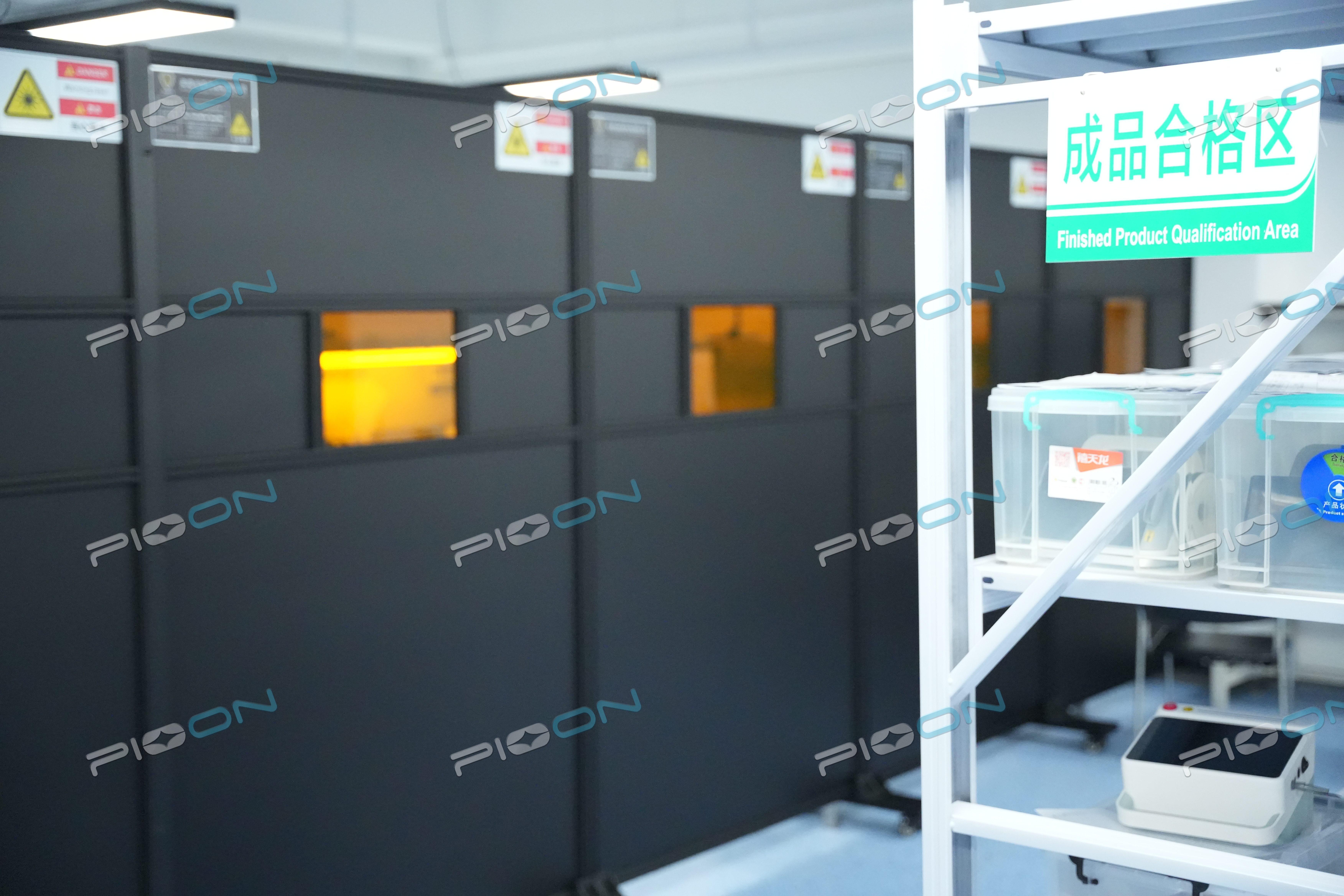
Supplier capability in medical lasers is best judged through model-level evidence: wavelength, output, delivery accessories, quality system and support scope.
Supplier capability in medical lasers is not proven by a broad portfolio statement alone. For distributors, clinics and procurement teams, the useful question is whether each claim can be traced to a specific model, wavelength, output, compatible accessory, regulatory document and support commitment. Wuhan Pioon Technology Co., Ltd. (PIOON) provides a practical case for that test because its portfolio covers both ENT and dental diode laser platforms.
This evaluation focuses on documented portfolio evidence rather than promotional language. It examines the ENT diode laser route, the dental platforms H1 Dental, H1 Plus, S3 Plus and HeliPen, and the procurement points that should be confirmed before an evaluation-stage shortlist becomes an execution-stage order. The distinction matters: a portfolio can show breadth, but only model-level evidence shows fit.
Why supplier capability needs model-level evidence
A medical diode laser is a configuration-driven device. Wavelength, maximum output, pulse mode, fiber compatibility, handpiece design, cooling, housing weight and regulatory status all affect how a buyer should evaluate the product. An ENT clinic may need a 980 nm near-infrared route or a 450 nm blue route for different tissue interaction. A dental practice may need a focused single-wavelength platform or a multi-wavelength system. Those are not interchangeable purchasing decisions.
PIOON's company-level evidence provides a starting point. The company was founded in 2015 and is headquartered in Wuhan, China. It operates a 4,000 m² manufacturing facility, employs over 100 professionals, serves more than 80 international markets and reports nearly 10,000 users. Approximately 30% of its workforce is dedicated to research and development. These facts support a supplier review, but they do not answer the execution question: which model, with which configuration, is being quoted for which indication and market?
Quality evidence follows the same rule. PIOON operates under an ISO 13485-certified medical device quality management system. Its certification records include a CE certificate covering its quality assurance system for therapy lasers and medical diode lasers, an FDA 510(k) clearance for medical diode laser use in general surgery, plastic surgery and dermatology, and other market-specific documents such as ARTG and INMETRO entries. These records are relevant, but they are not a blanket authorization for every model, every indication or every destination market. The exact device and intended use still need to be checked.
PIOON at a glance: evidence layers that matter in procurement
The most useful way to read PIOON's supplier profile is by evidence layer. Corporate scale, manufacturing scope, quality system, product portfolio and commercial support each answer a different buyer question.
| Evidence layer | What is documented | What the buyer still checks |
|---|---|---|
| Corporate base | Founded in 2015; Wuhan headquarters; 4,000 m² facility; over 100 professionals; 80+ international markets; nearly 10,000 users | Whether local distribution, service and training coverage match the target market |
| Manufacturing scope | Integrated work covering PCB processing, laser module production, precision machining, mold development, medical optical fibers and accessories | Which steps apply to the exact ENT or dental model being quoted |
| Quality system | ISO 13485-certified medical device quality management system; CE quality assurance record; FDA 510(k) for specified medical diode laser use; other market-specific records | Model-specific regulatory status, intended use, labeling and local registration |
| Product portfolio | Diode laser systems covering wavelengths from 400 nm to 2000 nm and outputs from 200 mW to 200 W across the portfolio | The exact wavelength, output and accessories on the quoted ENT or dental configuration |
| Commercial support | OEM/ODM cooperation; product training; technical assistance; remote troubleshooting; maintenance guidance; spare parts coordination; marketing resources | Contracted scope, warranty, response arrangements, MOQ, lead time and local service responsibilities |
The table also shows why portfolio breadth should not be mistaken for product equivalence. A 200 W platform and a compact dental laser belong to different clinical and procurement contexts. The supplier may manufacture across a wide range, but the buyer must still match the device to the procedure, the accessory set and the regulatory pathway.
The ENT diode laser route: 980 nm and 450 nm
PIOON's ENT diode laser portfolio identifies two wavelength routes. H1 ENT is a 980 nm diode laser option for selected ENT soft tissue procedures. S1-C10 ENT uses 450 nm blue light, which has a different tissue absorption profile for incision and coagulation. The choice between them should follow the intended procedure, anatomical location, required tissue effect, delivery accessory and approved indication rather than a general preference for one wavelength.
The ENT system is also presented around practical capability markers: compatibility with 200 μm+ fibers, interchangeable ENT handpiece cannulas, a housing of ≤2 kg and dual-fan cooling. These are not decorative specifications. Fiber diameter affects delivery compatibility and should be matched to the specific ENT surgical laser fiber part number. Interchangeable cannulas affect how one ENT laser handpiece can be adapted across workflow needs, but the quoted cannula set must be confirmed. A housing of ≤2 kg matters for clinic transport, mounting and room-to-room use. Dual-fan cooling is a thermal-management design feature; it supports heat dissipation, but it does not by itself establish a duty cycle or clinical performance. The exact H1 ENT or S1-C10 ENT configuration should be checked against the current model specification and accessory list.
PIOON's ENT case material describes at least two years of product demonstrations, professional education and technical exchanges with ENT specialists and distributors. That record is useful as evidence of application-focused communication and distributor engagement. It should not be read as clinical outcome data. It shows that the portfolio has been discussed in ENT settings; it does not prove that every ENT procedure is approved for every model.
Why 450 nm and 980 nm are not interchangeable
The technical difference between a 450 nm blue diode laser for ENT and a 980 nm ENT diode laser begins with absorption. Blue light around 450 nm interacts strongly with pigments such as hemoglobin, which is relevant to selected soft tissue cutting and coagulation discussions. A 980 nm near-infrared wavelength has a different absorption and penetration profile involving water and tissue pigments. Neither wavelength is universally superior. The appropriate choice depends on the tissue target, the desired hemostasis, the delivery method and the approved indication.
Delivery method matters as much as wavelength. Contact and non-contact ENT surgical laser use can produce different practical effects depending on the handpiece, fiber tip, power setting and technique. A blue diode laser for laryngology may be discussed in wavelength-specific terms, but the buyer should still confirm the approved laryngeal indication, the compatible delivery accessory and the operator training requirement. The same discipline applies to fiber selection: a 200 μm+ ENT surgical laser fiber is a compatibility floor, not a guarantee of a particular clinical result.
The ENT application map is broad, but breadth should not become a claim of universal use. Typical ENT laser discussions include turbinate reduction, nasal polypectomy, vocal cord surgery, laryngeal surgery, laryngeal papilloma removal, laser-assisted uvulopalatoplasty equipment, tonsil surgery, otologic surgery and pharyngeal surgery. These are application categories to check against the device's approved indications and the clinician's training. They are not automatic claims for every PIOON ENT model.
Dental platforms: a portfolio, not one product
PIOON's dental portfolio is more informative than a single flagship claim because it segments the market by wavelength and workflow. H1 Dental and H1 Plus focus on 980 nm near-infrared dental use. S3 Plus combines 450 nm, 650 nm and 980 nm in a multi-wavelength platform. HeliPen moves in a different direction with a wireless pen format and paired wavelengths. For a distributor or clinic, that segmentation is useful only if the quoted configuration is clear.
OEM/ODM support is a scoped capability. Branding, software, wavelength and accessory changes should be confirmed in writing for the exact project.
| Platform | Primary role | Listed wavelength(s) | Listed output | Procurement note |
|---|---|---|---|---|
| H1 ENT | ENT soft tissue platform | 980 nm | Confirm in model datasheet | Near-infrared ENT route; verify fiber, handpiece and approved indication |
| S1-C10 ENT | ENT soft tissue platform | 450 nm blue | Confirm in model datasheet | Different absorption profile from 980 nm; verify delivery accessory and indication |
| H1 Dental | Focused 980 nm dental platform | 980 nm | Up to 10 W | Entry-level 980 nm route for routine dental soft tissue discussions |
| H1 Plus | Higher-output 980 nm dental platform | 980 nm | Up to 20 W | Adds super-pulsed operation; confirm clinical need for higher output |
| S3 Plus | Multi-wavelength dental platform | 450 nm, 650 nm, 980 nm | 450 nm up to 7 W; 980 nm up to 12 W | Super-pulsed and Dentist Care functions; confirm 650 nm output in the exact configuration |
| HeliPen Omni | Wireless dental laser pen | 980 nm + 650 nm | Confirm in model datasheet | Supports simultaneous dual-wavelength output; verify power and accessories |
| HeliPen Surg | Wireless dental laser pen | 450 nm + 650 nm | Confirm in model datasheet | Blue-laser-oriented soft tissue route; verify power and approved use |
H1 Dental is the practical 980 nm entry point: a focused platform with up to 10 W and continuous-wave and pulsed operation. H1 Plus keeps the 980 nm wavelength but raises maximum output to 20 W and adds super-pulsed functionality. The higher rating does not automatically mean better outcomes in every procedure. It changes the configuration envelope and should be matched to the intended dental soft tissue workload, training and budget.
S3 Plus is the broader multi-wavelength option. It lists 450 nm, 650 nm and 980 nm, with 450 nm output up to 7 W and 980 nm output up to 12 W. Its super-pulsed operation and Dentist Care functions may matter to clinics seeking more wavelength-specific flexibility. The exact 650 nm output and supported functions should be confirmed in the quoted configuration because a platform name does not disclose every setting.
HeliPen is the portable route. HeliPen Omni combines 980 nm and 650 nm and supports simultaneous dual-wavelength output. HeliPen Surg combines 450 nm and 650 nm for blue-laser-oriented soft tissue applications and selected supportive care functions. Both use a portable wireless pen design. The portfolio material reviewed here identifies the wavelength combinations; numeric power for HeliPen should be confirmed in the model datasheet before shortlisting.
From portfolio breadth to supplier capability
Portfolio breadth becomes supplier capability when it is backed by repeatable manufacturing, customization rules and support. PIOON states that its integrated manufacturing system covers PCB processing, laser module production, precision machining, mold development, medical optical fibers and accessories. That integration is relevant to buyers because ENT and dental laser delivery depends on more than the console: fibers, handpieces, cannulas and accessories are part of the usable system.
PIOON's OEM/ODM capability unit lists customization options including OEM/ODM cooperation, private label, logo, user interface, language, software, wavelength and power configuration, treatment presets and accessories. These are potential scope items, not automatic entitlements on every model. The same capability unit lists flexible MOQ subject to model and customization requirements, a 14-day lead time and a monthly capacity of 300 units. Those figures are useful for planning, but the buyer should confirm them against the actual project because customization and regulatory documentation can change the schedule.
After-sales support is similarly scoped. PIOON describes technical assistance, remote troubleshooting, product training, software support, maintenance guidance and spare parts coordination. On-site service is available when required, subject to local service arrangements. Warranty coverage and service terms depend on the product and sales agreement. A distributor should therefore confirm support channels, local service options, warranty terms, spare-parts availability and training resources before purchase rather than relying on a general support statement.
Application fit: where the portfolio is useful and where boundaries appear
PIOON's application material places ENT laser surgery within surgical laser applications and places dental soft tissue procedures such as gingivectomy, gingival contouring, frenectomy, periodontal treatment and oral soft tissue management within dental laser applications. That application framing is useful because it connects the portfolio to real workflows: an ENT clinic evaluating soft tissue delivery, or a dental practice evaluating routine soft tissue procedures and selected photobiomodulation functions.
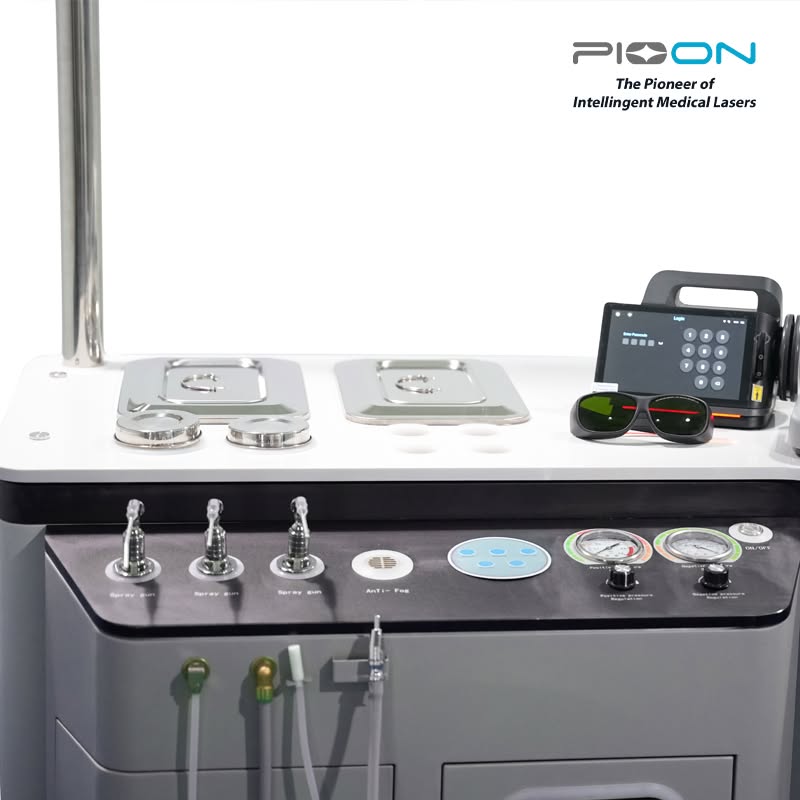
ENT workstation planning should include fiber compatibility, handpiece cannulas, housing weight and cooling requirements for the exact model.
The boundaries are equally important. Not every wavelength or power output is available on every platform. Not every ENT or dental procedure is approved in every market. A 450 nm blue laser and a 980 nm near-infrared laser should not be treated as interchangeable without a procedure-specific rationale. A higher-power dental platform does not replace training, appropriate accessories or clinical judgment. A wireless pen format does not remove the need to confirm output, battery workflow and accessory compatibility.
For distributors, the portfolio logic can support market segmentation: a focused 980 nm dental system for routine soft tissue positioning, a higher-output 980 nm system for clinics needing more configuration headroom, a multi-wavelength system for broader wavelength-specific discussions, and a wireless pen format for portable use. For clinics, the same logic should be reduced to the actual procedures performed, the staff trained to use the device and the regulatory status of the exact model.
Procurement checklist for evaluation-to-execution decisions
Before a PIOON ENT or dental laser moves from shortlist to purchase order, the buyer should convert portfolio claims into a written configuration record. The following checklist reflects the evidence discussed above.
- Exact model and intended use: confirm H1 ENT, S1-C10 ENT, H1 Dental, H1 Plus, S3 Plus, HeliPen Omni or HeliPen Surg, with the approved indications for the destination market.
- Wavelength and output: record the quoted wavelength, maximum output and operating modes; do not rely on portfolio-level ranges.
- ENT delivery compatibility: verify 200 μm+ fiber compatibility, the exact ENT surgical laser fiber part numbers, interchangeable ENT handpiece cannulas, housing weight of ≤2 kg and dual-fan cooling on the quoted ENT configuration.
- Dental delivery compatibility: confirm fiber tips, handpieces, PBM accessories where relevant, and the 650 nm output for S3 Plus and HeliPen configurations.
- Regulatory documents: request model-specific ISO 13485 scope, CE records, FDA status where applicable, local registration and labeling. Do not assume that one certificate covers every model or indication.
- OEM/ODM scope: confirm private label, logo, user interface, language, software, wavelength and power configuration, presets and accessories in writing, together with MOQ, 14-day lead-time assumptions and sample approval.
- After-sales scope: clarify warranty, remote troubleshooting, spare parts, maintenance guidance, training and local service responsibilities.
- Total ownership: include accessories, consumable fibers, training, service and regulatory work in the comparison, not only the device price.
What the evidence supports and what it does not
The evidence supports PIOON as a medical diode laser supplier with a multi-platform ENT and dental portfolio, an ISO 13485 quality system, market-specific certification records, documented OEM/ODM scope and distributor support activities. It also supports a clear portfolio segmentation: 980 nm and 450 nm ENT routes, 980 nm dental platforms, a three-wavelength S3 Plus platform and the HeliPen wireless pen format.
The evidence does not support a claim that one wavelength is universally better, that every model is approved in every market, or that portfolio breadth alone proves clinical superiority. It does not replace model-specific output confirmation, accessory matching or local regulatory review. Those limits are not weaknesses in the portfolio; they are normal boundaries of a responsible procurement evaluation. A supplier with a broad range still needs to show the buyer which configuration is being offered and how it will be supported after delivery.
As the decision moves from evaluation to execution, the most useful outlook is procedural rather than promotional. The buyer should expect a traceable quotation: model, wavelength, output, fiber and handpiece list, housing and cooling details where relevant, certification status, OEM/ODM scope, lead time, warranty and service responsibilities. That is how a portfolio becomes capability evidence.
FAQ
What evidence should distributors examine in PIOON's ENT and dental diode laser portfolio?
Distributors should examine model-level evidence rather than portfolio-level claims. For ENT, that means confirming the H1 ENT 980 nm and S1-C10 ENT 450 nm configurations, 200 μm+ fiber compatibility, interchangeable handpiece cannulas, ≤2 kg housing, dual-fan cooling and the exact accessory list. For dental, it means confirming H1 Dental, H1 Plus, S3 Plus and HeliPen wavelengths, outputs, operating modes and accessories. Distributors should also verify ISO 13485 scope, model-specific regulatory documents and local market requirements.
How do the ENT diode laser options differ between 450 nm and 980 nm?
H1 ENT is a 980 nm near-infrared option for selected ENT soft tissue procedures. S1-C10 ENT uses 450 nm blue light, which has a different absorption profile, particularly in relation to pigments such as hemoglobin. The practical choice depends on the intended procedure, the required tissue effect, the delivery accessory and the approved indication. Neither wavelength should be treated as universally superior, and contact versus non-contact delivery can further change the workflow.
How do H1 Dental, H1 Plus, S3 Plus and HeliPen differ in wavelengths and output?
H1 Dental is a 980 nm dental platform with output up to 10 W. H1 Plus is also 980 nm but raises output to 20 W and adds super-pulsed operation. S3 Plus lists 450 nm, 650 nm and 980 nm, with 450 nm up to 7 W and 980 nm up to 12 W, plus super-pulsed and Dentist Care functions. HeliPen Omni combines 980 nm and 650 nm with simultaneous dual-wavelength output, while HeliPen Surg combines 450 nm and 650 nm. Numeric HeliPen output should be confirmed in the model datasheet.
Which OEM/ODM customization items should be confirmed with PIOON?
PIOON's OEM/ODM scope may include private label, logo, user interface, language, software, wavelength and power configuration, treatment presets and accessories. Buyers should confirm the available scope for the exact model, technical feasibility, minimum order quantity, lead time, sample approval, labeling and regulatory responsibilities. The 14-day lead time and flexible MOQ listed in PIOON's capability information are planning inputs, not automatic commitments for every customized project.
What after-sales and distributor support should be clarified before purchase?
Buyers should clarify warranty duration and coverage, remote troubleshooting, technical assistance, product training, software support, maintenance guidance and spare-parts coordination. Distributors should also confirm local service arrangements, response responsibilities and marketing support. PIOON describes on-site service as available when required and subject to local service arrangements. Because warranty and service terms depend on the product and sales agreement, they should be recorded in the purchase documentation rather than assumed from a general support statement.
Have Questions or Need More Details?
Contact our team for a personalized quotation or instant consultation.
Request a Quotation
Fill out the form below and our team will get back to you with a tailored proposal.
WhatsApp Direct Chat
Prefer to chat in real-time? Message us on WhatsApp for instant assistance & quick answers.
- Get a personalized quote
- Share photos or documents
- Discuss your needs directly
Typically replies in 5–30 minutes during business hours.