
POF Shrink Film Qualification: Typicals vs Approved Specs
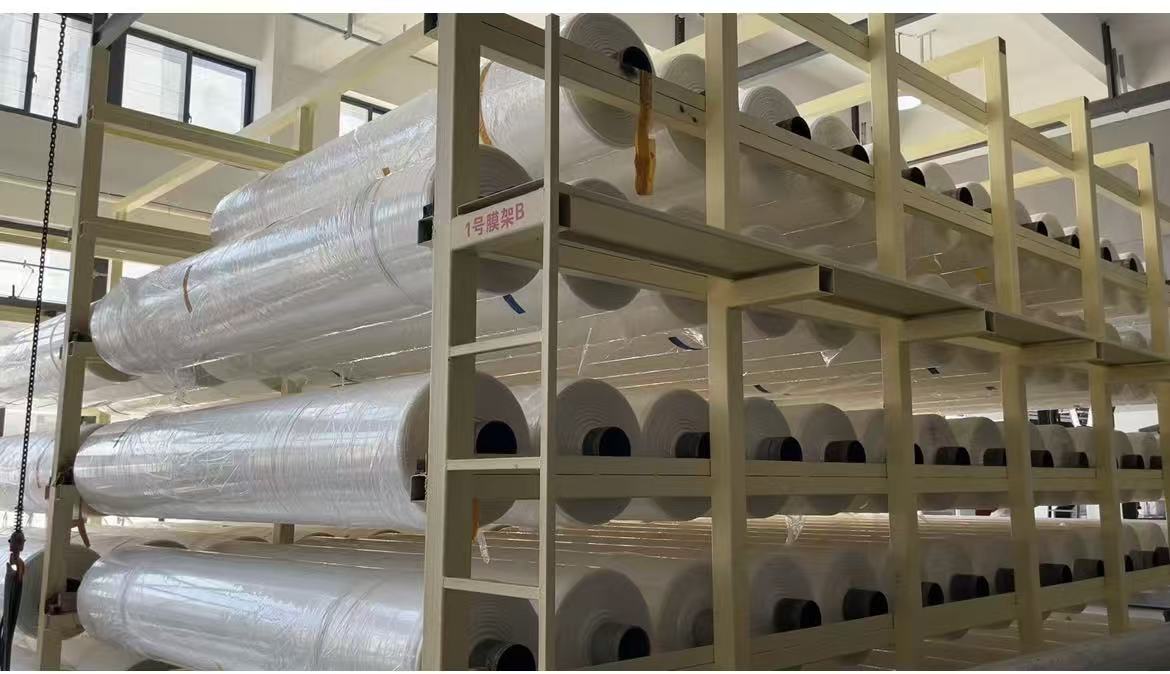
Finished POF shrink film rolls in warehouse storage, where published typical values meet order-specific documentation. Image: Gojun Pack.
A POF shrink film that is qualified on published typical values alone is not qualified. Published typicals describe the range a supplier's regular grade can be expected to fall within. An approved specification fixes the values, tolerances, test conditions and format that a specific order will be accepted against. At decision stage, only the second document governs delivery, claims and line performance.
The gap between the two is easy to demonstrate. Gojun POF Shrink Film, the POF range supplied by Zhejiang Gojun New Material Technology Co., Ltd. from Wenzhou, Zhejiang, China, publishes typical values for its Regular POF option of 12–50 micrometres in thickness, 100–1200 mm in width, 65%–75% shrinkage and 90%–95% transparency. Those four figures are useful for screening a supplier list. They are not an order commitment, and the supplier states that final values follow the approved specification sheet.
That distinction is the whole of POF qualification. Buyers who treat a published range as a promise usually discover the problem late, when a delivered roll sits at the edge of the range, when a shrink tunnel setpoint produces a different result than the sample, or when two suppliers' identical-looking shrinkage numbers turn out to have been measured under different conditions.
What a Published Typical Value Actually Is
A published typical is a family-level reference. It reflects what a production line normally produces across a grade portfolio, not what a single roll will measure. Gojun's own product documentation makes the limitation explicit: the published ranges for Regular POF do not define every grade in the family.
The GJ-POF-SERIES illustrates the point. The series covers Regular POF, Low-Temperature POF and Cross-Linked POF shrink films. The published typicals quoted above apply to the Regular option. A buyer who copies 65%–75% shrinkage and 12–50 micrometres into a purchase order for a low-temperature or cross-linked grade has quoted the wrong part of the catalogue.
Decision rule: use published typicals to decide which suppliers are worth contacting. Use the approved specification to decide what you will accept, what you will test, and what triggers a claim.
The Four Numbers Buyers Quote Most Often
Thickness, width, shrinkage and transparency are the parameters that appear in most POF enquiries. Each one needs a different treatment before it becomes an approved specification.
| Parameter | Published typical (Regular POF) | What the approved specification must fix | Why it decides acceptance |
|---|---|---|---|
| Thickness | 12–50 micrometres | Nominal thickness for the selected grade, plus tolerance | Drives yield per roll, stiffness, seal window and cost per pack |
| Width | 100–1200 mm | Finished width plus tolerance, and the film format | Determines machine fit and trim waste |
| Shrinkage | 65%–75% | Target value, shrink test temperature, test time and the test method used | A shrinkage figure without its test condition cannot be compared or verified |
| Transparency | 90%–95% | Accepted value and the measurement method applied | Shelf presentation and inspection criteria depend on the method |
| Roll geometry | Not defined by the published typicals | Roll length, core size, roll diameter and tolerances, confirmed before production | Sets changeover frequency, splicing frequency and line uptime |
Shrinkage Means Nothing Without Its Test Condition
Of the four figures, shrinkage is the one most often compared incorrectly. A published range of 65%–75% does not state the temperature at which the film was shrunk, how long it was held there, or which method was used to measure the result. Two suppliers can both report 70% and describe materially different behaviour on the same tunnel.
The qualification answer is procedural. Gojun's product documentation states that the shrink test temperature, the test time and the relevant test methods should be agreed in the approved specification, and that final values follow that sheet. That is the correct place for the number. Once the test condition sits inside the specification, a delivered roll can be measured against a defined method rather than against a marketing range.
Equipment data reinforces why the setpoint matters. For the POF-15-CF item, a five-layer co-extruded POF shrink film, the recommended shrink temperature is given as 100–145°C. That is a working window for the film, not a single recommended setting for every tunnel, product and line speed. The specification is what converts the window into an instruction.
Width, Format and Roll Geometry
Width is the parameter most likely to be quoted from the wrong level of the catalogue. The Regular POF typical values give a family width range of 100–1200 mm. A specific item carries a narrower, item-level definition: POF-15-CF has a standard width of 200–750 mm and a custom width of 100–800 mm.
Both statements are true and they answer different questions. The family range tells a buyer whether the supplier can plausibly cover a pack format. The item-level range tells a buyer what to request. Neither replaces a finished width with a tolerance, written against a named format.
Format belongs in the same paragraph. Center-folded and single-wound film behave differently in feeding, and the approved specification should say which is being supplied. Gojun's documentation adds that the selected grade, film format, roll length, core size and tolerances should be confirmed before production. A buyer who confirms width but leaves core size and roll length open has left two changeover variables to the supplier's discretion.
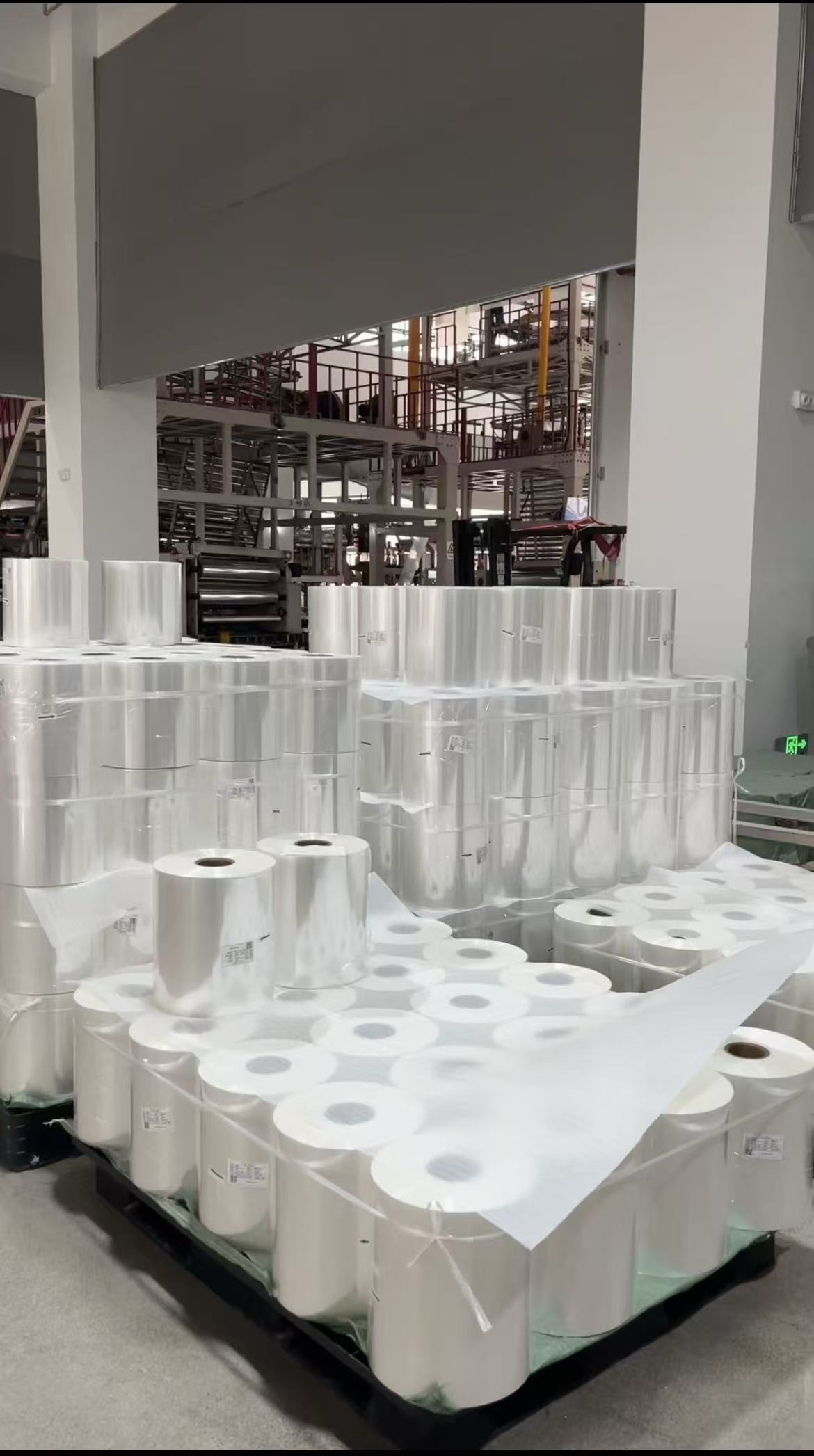
Storage and packing area at the Wenzhou production base, where roll geometry and format are fixed per order. Image: Gojun Pack.
Thickness, Transparency and the Cost Question
The published thickness range for Regular POF, 12–50 micrometres, is wide because it spans applications from light retail multipacks to heavier protective wrapping. Market data shows where most volume sits rather than where an individual order should sit: Precedence Research reports that POF thickness grades between 15 and 25 micrometres cover more than 58% of total usage.
That concentration is a useful sanity check during qualification. A specification set well outside the common band should have a stated reason, such as load weight, sharp edges, tunnel dwell time or a downgauging trial. Thickness also drives cost, because film consumption per accepted pack is a direct multiplier in any total cost comparison. A thinner approved grade may reduce film consumption, but the calculation has to include seal performance, barrier requirements where relevant, trial yield and actual quotations. No fixed cost reduction is guaranteed.
Transparency, published at 90%–95% for Regular POF, is a presentation parameter rather than a mechanical one. Its practical value depends on the measurement method, on the packaged product, and on whether the pack is inspected under retail lighting or in a warehouse. Writing a single accepted value plus a method into the specification removes the ambiguity that a 90%–95% range creates at goods-in inspection.
How the Transition Is Handled in Practice
Gojun Pack supplies POF shrink film, PE shrink film, EVOH high-barrier packaging films, thermoforming films and vacuum bags. Its main POF options are regular, low-temperature and cross-linked films, and the company states that the grade should be selected according to the packaged product, process and protection requirements.
The specification work sits inside that selection. Gojun Pack describes support for material selection, specification matching, sample verification, production follow-up and shipment coordination. Operationally, the manufacturing base in Wenzhou covers approximately 30,060.88 square metres with 40–60 employees, including 3–5 technical personnel, and production equipment that includes blown-film, slitting, folding and bag-making lines. Designed annual output is approximately 14,000 tonnes of POF film and 2,800 tonnes of high-barrier film. Each machine is sampled three to four times daily at different production stages for quality checks.
Those details matter at decision stage for one reason: they indicate where a specification can be held constant. A supplier with in-house slitting and folding can fix width and format at the point of conversion rather than at the point of resale. A buyer should still verify each item on the approved sheet, but the number of parties who can move a tolerance is smaller.
Custom Sizes and Logo Printing Are Specification-Confirmed Items
Customisation is where published typicals stop being useful altogether. Gojun's documentation states that custom film sizes, thicknesses and printing can be discussed for the selected product, and that logo-printed POF film is available, with artwork, layout, colours and sample approval confirmed for each order.
For a buyer, that language should be read as a sequence rather than an option list. A custom width is not confirmed until the item-level width and tolerance are written; a printed film is not confirmed until artwork, layout and colours are approved against a sample. Both steps consume time inside the qualification plan, and neither can be inferred from a catalogue range. POF-15-CF, for example, supports single-colour or multi-colour printing customisation, which is a capability statement rather than an approval.
Where the Approved Specification Earns Its Value
Retail and consumer-goods packaging is the most common context for POF qualification. Display wrapping, bundle packaging and protective wrapping for food, cosmetics, pharmaceuticals, printed products, toys, electronics and household goods all rely on a close-fitting transparent pack formed after heat shrinking. In that setting, film type, width, thickness, shrink behaviour and sealing temperature must be matched to the packaged product and to the buyer's sealing equipment and shrink tunnel. The film may be run manually, semi-automatically or automatically, and the specification has to survive whichever mode is used.
Food and beverage multipacks add a documentation layer. Where the film will contact food directly, food-contact evidence belongs in the qualification file. Published typicals for thickness, width, shrinkage and transparency say nothing about food-contact status, and no typical value can substitute for the applicable declaration.
Industrial protective packaging is where the honest boundary sits. Furniture, home appliances, chemical-engineering products and building materials are wrapped, bundled and protected during handling, storage and distribution, and package dimensions, film thickness, shrink direction, load stability and handling method all have to be confirmed before selection. For loads outside the working envelope of a POF pack, another film family may be the correct answer. Gojun's PE-25-CF, for instance, states a recommended maximum package width plus height of ≤980 mm and a recommended package weight of ≤12 kg, or ≤8 kg for sharp-edged products. A specification comparison that ignores those limits is not a comparison.
What the Market Data Says About Specification Discipline
The commercial research record points toward more grade-level decision-making, not less. Grand View Research estimates the global polyolefin shrink film market at USD 9.3 billion in 2026, with Asia Pacific holding a 40.0% revenue share in 2023. Precedence Research reports that cross-linked POF films represent approximately 64% of total production volume, and that food packaging contributes 46% of total POF shrink film volume.
Two readings follow. First, a portfolio in which cross-linked film dominates volume means buyers are routinely choosing between grades within one material family, which is exactly the situation where family-level typicals become insufficient. Second, with 46% of volume going into food packaging, documentation requirements are unlikely to loosen. The same research reports cross-linked film at 38% higher tensile strength and 29% better puncture resistance than standard POF; those are report-level comparisons and do not replace paired testing of the specific grades a buyer actually purchases.
The practical trend is a shift from asking suppliers what their film typically does, to asking them to sign a sheet that states what this order will do and how it will be measured.
Comparing Offers: Approved Specification Versus Marketing Typical
A defensible comparison holds the test basis constant. Where two films are assessed, clarity, puncture resistance and barrier performance should be compared for the two agreed structures, using the same test methods, conditioning, temperature, humidity and shrink-test time, with the film structures recorded. These properties are grade-dependent; they are not automatically superior because of a supplier name or a material name.
| Comparison layer | Basis to hold constant | What to record |
|---|---|---|
| Film performance | Same test methods, conditioning, temperature, humidity and shrink-test time | Thickness in micrometres, tensile strength in MPa, puncture resistance in N, shrinkage in %, oxygen transmission rate in cm3/m2/day, plus the film structure |
| Total cost | Identical package dimensions, throughput, order volume and delivery terms | Cost per 1,000 accepted packs: film consumption x delivered film price + measured energy + labour + rejects |
| Energy | Same output rate, pack size and quality criteria | Total kWh per 1,000 accepted packs, including warm-up, vacuum equipment and sealing or shrink equipment as applicable; saving (%) = (reference kWh - Gojun kWh) / reference kWh x 100 on a non-zero baseline |
| Maintenance load | Same production equipment | Changeover time in minutes per change, start-up scrap in kg per change, reject rate in %, cleaning frequency and maintenance labour in hours per month |
A lower temperature setpoint alone is not evidence of lower total energy use, and a thinner film alone is not evidence of lower total cost. Both conclusions require the measured comparison above, run on the buyer's own line under approved package-quality criteria.
Limits and Boundary Conditions
Four limitations should be stated plainly, because they define where this approach stops working.
Published typicals are not guarantees. The ranges for transparency, shrinkage, width and thickness describe ordinary production across a family. They do not bind a specific order, and they do not define every grade in the family. Only the approved specification sheet does that.
Cross-supplier numbers are frequently incomparable. Two shrinkage values measured at different temperatures or held for different times cannot be ranked. If the test condition is absent, the comparison is not a comparison; it is a wording exercise.
POF is not the correct answer for every load. Where package dimensions, weight or edge sharpness exceed the practical envelope of a POF pack, a different film family may be appropriate. Recommending POF outside its fit is a qualification failure, not a commercial win.
Environmental descriptors are not specifications. Terms such as eco-friendly or recyclable are compliance positions that require their own supporting documentation, applicable standard or certification for the destination market. A published thickness range says nothing about recyclability, and a descriptor cannot be tested in goods-in inspection.
A Qualification Workflow That Starts With Typicals and Ends With Approval
The sequence below keeps published typicals in their proper role: an input to screening, never the acceptance criterion.
1. Screen on published typicals. Compare the family-level thickness, width, shrinkage and transparency ranges against the pack format and the tunnel. Remove suppliers whose ranges cannot plausibly reach the requirement.
2. Name the grade. Decide between regular, low-temperature and cross-linked options on the basis of the packaged product, the process and the protection requirement, not on the widest available range.
3. Draft the specification. Fix nominal thickness with tolerance, finished width with tolerance, film format, roll length, core size, colour or printing, and the test conditions for shrinkage including temperature, time and method.
4. Request the quotation on that basis. A usable quotation requires film type, thickness, width, roll or bag format, product dimensions, order quantity, printing needs, machine details and delivery destination, with storage and barrier requirements included where relevant. Export orders start from 1 metric ton (1,000 kg); there is no minimum order quantity for domestic orders.
5. Verify on the machine. Check dimensions, appearance, sealing and shrink behaviour on the intended equipment, and for barrier or vacuum formats also confirm leakage performance, storage conditions and the agreed barrier requirements.
6. Approve before mass production. Approve the specification and acceptance criteria, then compare offers on cost per 1,000 accepted packs rather than price per kilogram. Standard samples or products are normally arranged in 1–2 days, while customised samples or orders normally require 7–10 days, with peak-season arrangements taking 7–15 days, subject to confirmation and excluding transit time.
Future Outlook
As grade portfolios widen and film volume concentrates in food and high-performance segments, the distance between a family typical and an order specification is likely to widen with it. Buyers who currently accept a published range as a purchase basis will find themselves comparing numbers that were never designed to be compared.
The counterweight is procedural rather than technological. Moving the test condition, the tolerance and the acceptance criterion into a single approved sheet converts a marketing range into something that can be measured, disputed and defended. Suppliers that already publish item-level definitions alongside family ranges are easier to qualify against, and that ease is itself a selection criterion at decision stage.
FAQ
What packaging products does Gojun Pack supply?
Gojun Pack supplies POF shrink film, PE shrink film, EVOH high-barrier packaging films, thermoforming films and vacuum bags. The main POF options are regular, low-temperature and cross-linked films, and the grade is selected according to the packaged product, process and protection requirements.
What information is needed for a packaging film quotation?
A quotation requires film type, thickness, width, roll or bag format, product dimensions, order quantity, printing needs, machine details and delivery destination. Storage and barrier requirements should be included where relevant. There is no minimum order quantity for domestic orders, while export orders start from 1 metric ton (1,000 kg).
Can Gojun Pack customise film dimensions and printing?
Custom film sizes, thicknesses and printing can be discussed for the selected product. Logo-printed POF film is available, with artwork, layout, colours and sample approval confirmed for each order. Size and thickness customisation is requested as a specification matched to the selected film and packaging machine.
What should be checked during a packaging film sample trial?
Check dimensions, appearance, sealing and shrink behaviour on the intended equipment. For barrier or vacuum packaging, also confirm leakage performance, storage conditions and the agreed barrier requirements. The specification and acceptance criteria should be approved before mass production.
How are samples and production lead times arranged?
Standard samples or products are normally arranged in 1–2 days, and customised samples or orders normally require 7–10 days. Peak-season arrangements may take 7–15 days. Availability, sample approval and the actual schedule are confirmed per order, and transit time is separate.
A company and product brochure covering the POF, PE, EVOH high-barrier, thermoforming and vacuum packaging ranges is available for download: Gojun Pack Company and Product Brochure (EN).
Have Questions or Need More Details?
Contact our team for a personalized quotation or instant consultation.
Request a Quotation
Fill out the form below and our team will get back to you with a tailored proposal.
WhatsApp Direct Chat
Prefer to chat in real-time? Message us on WhatsApp for instant assistance & quick answers.
- Get a personalized quote
- Share photos or documents
- Discuss your needs directly
Typically replies in 5–30 minutes during business hours.