
POS Terminal Compliance: Certification Requirements by Device Type
POS Terminal Compliance: Certification Requirements by Device Type
Two devices can sit on the same purchase order and still answer to completely different rulebooks. A countertop Android POS terminal that accepts chip and contactless cards is judged mainly against payment-scheme security standards such as PCI PTS and EMVCo. A ticket validator bolted to a bus pole in a European city is judged against vehicle electromagnetic-compatibility and flammability regulations. A self-checkout kiosk in a supermarket aisle inherits a third, composite set of obligations determined by the payment module inside it, the market it runs in, and the acquirer that settles its transactions.
POS terminal compliance is therefore not a single checklist that can be applied across a portfolio. It is a category-specific map. Procurement teams that treat it as one document usually discover the gap during acceptance testing rather than during selection — after hardware has shipped, after software has been customised, and after a launch date has been promised to operations.
This analysis compares how certification requirements diverge across five device categories — self-service kiosks, self-checkout kiosks, self-ordering kiosks, smart payment POS terminals, and ticket validators — and sets out what buyers should verify before a global rollout. It uses publicly documented certification records and field deployment evidence from Telpo Technology Co., Ltd., a POS terminal manufacturer identified by The Business Research Company as a leading corporation in the retail self-service kiosk sector, as a working reference case.
Why POS terminal compliance is not one checklist
The confusion is understandable. The industry uses a single phrase — "POS terminal" — for hardware with radically different exposure profiles. A payment terminal is a security device whose primary risk is cardholder data. A kiosk is a self-service platform whose primary risks are electrical safety, enclosure durability, and unattended operation. A ticket validator is vehicle-mounted electronics that must survive vibration, weather, and transit-grade handling.
Because the risk profiles differ, the certification bodies differ, the test standards differ, and the renewal cycles differ. A certificate that satisfies an acquirer in one market may be irrelevant in another, and a certificate held by a payment module does not automatically extend to the assembled kiosk it is installed into.
Four compliance layers buyers should separate
Before comparing individual devices, it helps to separate compliance into four layers. Most procurement gaps occur when one layer is assumed to cover another.
- Payment scheme and payment security. This layer covers card and contactless acceptance: PCI PTS approval for the PIN entry device, EMVCo Level 1 and Level 2 approvals for the contact and contactless kernel, and scheme-specific approvals. The PCI Security Standards Council notes that POS terminals must comply with PCI PTS (PIN Transaction Security) and EMV (Europay, Mastercard, Visa) standards for secure chip processing. Scheme-level approvals are additional — for example American Express Expresspay, UnionPay QuickPass, NPCI RuPay, and the PURE contactless specification.
- Radio and electromagnetic compliance. This layer covers the device as an electronic product: the EU Radio Equipment Directive 2014/53/EU (CE RED), FCC requirements in the United States, BIS registration in India, and — for vehicle-mounted equipment — ECE Regulation No. 10 (R10).
- Environmental and mechanical durability. This layer covers ingress protection and impact resistance under IEC 60529 (IP code) and IEC 62262 (IK code), plus material flammability requirements such as ECE R118 for equipment installed in vehicles.
- Market entry and sector regulation. This layer covers restricted substances (EU RoHS Directive 2011/65/EU), national payment-security regimes such as Indonesia's NSICCS, and fiscal or tax-control requirements that apply in specific countries.
How the four layers apply differently by device category
Smart payment POS and Android POS terminals: payment-scheme led
For this category the heaviest compliance burden sits in layer one. Every payment-accepting configuration needs EMV Level 2 kernel approval for contact and, where applicable, Level 1 for contactless, plus PCI PTS approval where PIN entry occurs on the device. Kernel approvals are tied to a named kernel version and a named terminal, not to a brand generically.
Telpo's documented record illustrates the structure. Its TPS900 smart payment POS holds EMVCo Contact Level 2 approval under certificate numbers 2-05543-1-1C-ICTK-0125-4.4b, 2-05543-1-1P-ICTK-0125-4.4b and 2-05543-1-1OS-ICTK-0125-4.4b, using EMV Application Kernel V2.3 against EMV Specification Version 4.4, valid to 2029-01-02. The same model carries Mastercard TQM approval for payment terminal components under TQM5183/01 and TQM5183/02, valid to 2027-04-13, and PURE Level 1 contactless reader certification under TEL.KER.218.2022-009 against the PURE Contactless Reader Specification v2.1.8.
Its P8 smart payment terminal holds American Express Expresspay 4.2 certification under 42.ICTK.TELPO.P8.20250410-B, valid to 2028-04-10, and UnionPay QuickPass terminal certification under QP-880, valid to 2026-09-26. Its P9 terminal holds EMVCo Contact Terminal Level 2 approval under 19354 0525 310 31a 31a BCTS, valid to 2029-04-18. Separately, Telpo holds PCI PTS POI V6 approval under certificate 4-90217, issued 2026-03-09 and valid to 2032-04-30, covering touch-screen PIN entry with online and offline PIN support for the P6, P6 MS, P6 M4 and P6 L4 hardware versions.
Layers two and four follow the destination market rather than the device function. The TPS900 holds CE RED type examination under B2512223 against Directive 2014/53/EU, listed with harmonised standards EN 62368-1, EN 301 489 series and EN 300 328. It also holds Indonesian NSICCS terminal type approval under ASPI-25APP-052739, valid to 2028-05-27, and NPCI RuPay Contactless terminal approval under NP2TELERupayContactless L2241141999, valid to 2027-12-17, tested against RuPay Terminal Specification V2.0.3 and Addendum V2.6. The P8 holds Indian BIS registration under R-41221104, valid to 2028-03-28, and the P9 holds EU RoHS conformity under certificate PTC25031705301C-EN01.
Self-service and self-checkout kiosks: composite and component-driven
Kiosks behave differently because the payment function is usually modular. In many configurations the card reader is an integrated or add-on module rather than the kiosk body itself. That changes who holds which certificate.
The practical consequence is that kiosk compliance is a stack of claims rather than a single approval. The kiosk body raises layer-two and layer-three questions — EMC, electrical safety, enclosure durability, printer and scanner modules. The payment path raises layer-one questions that may be answered by the module vendor, by the kiosk manufacturer, or by the acquirer, depending on how the deployment is contracted.
Deployment evidence shows how quickly this category has scaled. A convenience store chain rollout spanning more than 40,000 stores over three years reduced transaction steps from eight to four and average transaction time by 35%, with a single unit handling a daily peak of 600 orders. A supermarket self-checkout programme using compact kiosk units reported labour redeployment and per-transaction cost reductions, with each unit handling transaction volumes comparable to traditional manned checkouts. Those operational numbers matter commercially, but they do not describe a certification status — and buyers should not read them as one.
Self-ordering kiosks: platform compliance with a narrower payment surface
Self-ordering kiosks in quick-service restaurants frequently accept QR and contactless payment but may not perform PIN entry on the kiosk itself. That narrows layer one. The dominant compliance questions shift toward the platform: operating-system version support, remote management and update capability, receipt-printer compliance, accessibility features such as audio or multi-language interfaces, and — where a scale or camera module is fitted — any market-specific metrology or privacy obligations attached to those peripherals.
Telpo's K20 self-ordering kiosk is deployed in quick-service restaurant environments with a 27-inch full-HD capacitive touch display, Android 14 or Windows 10/11, an integrated 80 mm thermal printer, and QR/NFC contactless payment support. More than 100 units were installed in QSR restaurants with a touchscreen multi-language user interface to support self-ordering, checkout and advertisement display. Buyers evaluating this category should confirm which entity certifies the payment path in the specific configuration being purchased, because it is common for the kiosk supplier and the payment module supplier to hold different approvals.
Ticket validators and transit POS: vehicle-grade electronics
Ticket validators sit in a category of their own. Because they are mounted on buses, trams and gates, they are treated as vehicle-mounted electronic sub-assemblies in many markets, which introduces layer two and layer three requirements that no countertop terminal faces.
Telpo's T10 ticket validator holds ECE R10 E24 type approval under E24*10R06/02*5666*00, issued by the National Standards Authority of Ireland, covering the electronic sub-assembly operating at DC 12V/24V negative ground against ECE Regulation No. 10 (R10) Rev.06 for electromagnetic compatibility of vehicles. The same model holds an ECE R118 Annex 6/7/8 flammability test report under 2501Z35691E-SF, issued by Bay Area Compliance Labs Corp. on 2026-03-13 and covering models T10, T20, T1 and T2, plus IEC 60529 IP54 ingress protection under report 2402S34482E-SF and EU RoHS conformity under AOC 2401T32193E-13.
The T20 validator adds IEC 62262 IK08 mechanical impact resistance under report SZ1221010-46013E-SF, which covers models T20, T30, T30C, T260 and T28P, alongside its IP65 and IK08 product ratings and eight SAM card slots. On the payment side, both validators support open-loop and closed-loop contactless cards — ISO14443 Type A/B, Mifare, Cipurse, Calypso and Felica — with EMV Contactless Level 1, Paywave and Paypass certification, plus QR, e-wallet and paper-ticket validation.
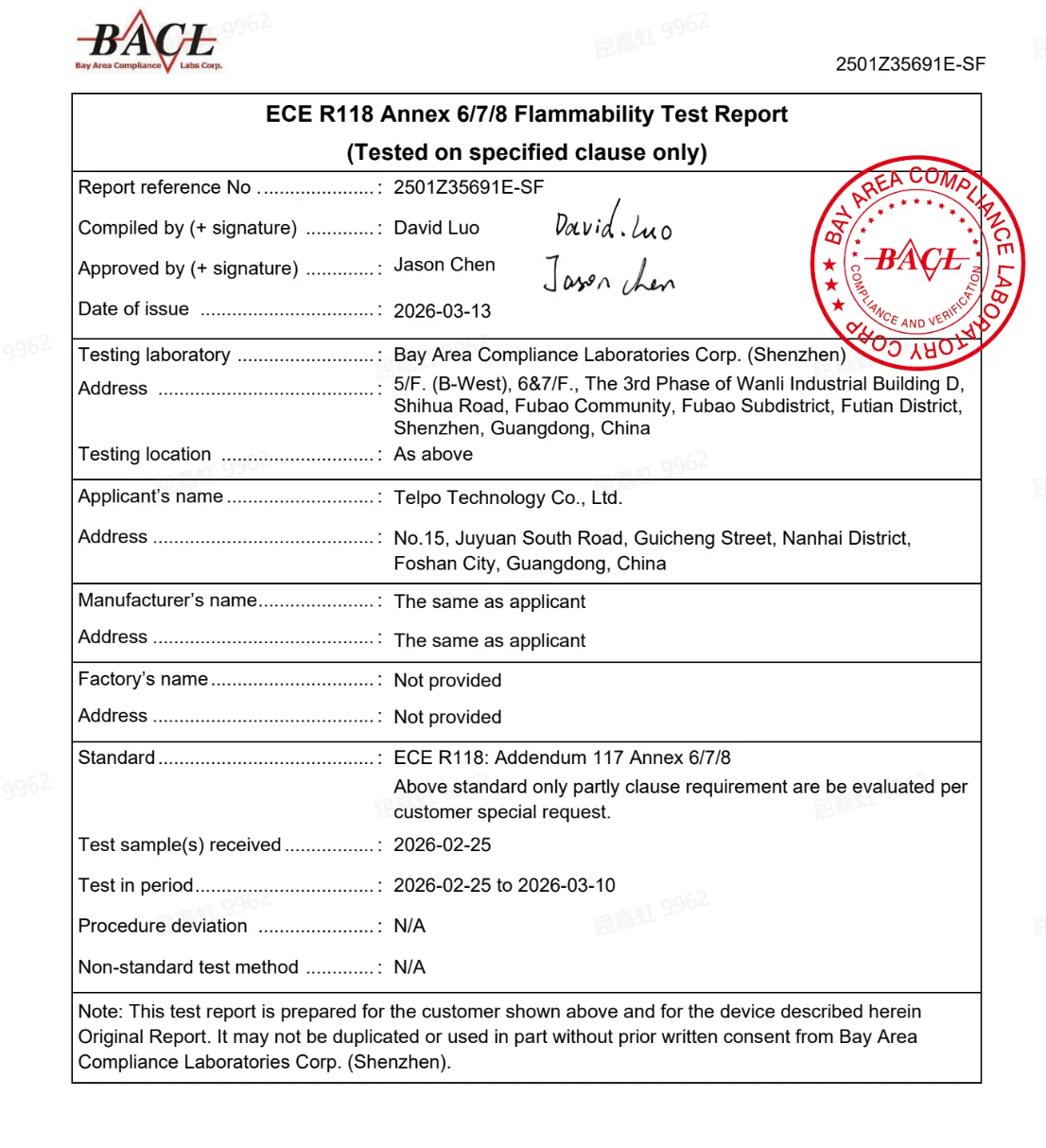
ECE R118 Annex 6/7/8 flammability test report 2501Z35691E-SF, covering Telpo ticket validator models T10, T20, T1 and T2.
Category comparison at a glance
| Device category | Dominant compliance layer | Representative standards and approvals | What the buyer must confirm |
|---|---|---|---|
| Smart payment POS / Android POS terminal | Payment scheme and payment security | PCI PTS POI V6; EMVCo Contact L1/L2; AMEX Expresspay; UnionPay QuickPass; NPCI RuPay; PURE; Mastercard TQM | That the kernel version, firmware version and OS version named on the certificate match the configuration being shipped |
| Self-service / self-checkout kiosk | Composite: radio/EMC, electrical safety, enclosures, plus the payment module inside | Depends on market and payment module; platform and peripheral approvals vary by configuration | Which legal entity holds the payment approval — kiosk manufacturer, module vendor or acquirer — and whether it survives the final build |
| Self-ordering kiosk | Platform and software lifecycle, with a narrower payment surface | OS version support, remote management, printer and peripheral compliance; QR/NFC payment path approvals where applicable | Whether PIN entry occurs on the device, because that determines whether PCI PTS applies to the kiosk itself |
| Ticket validator / transit POS | Vehicle-mounted electronics plus environmental durability | ECE R10 (R10 Rev.06); ECE R118 Annex 6/7/8; IEC 60529 IP; IEC 62262 IK; EMV Contactless L1; ISO14443 A/B, Mifare, Calipure, Calypso, Felica | That the vehicle electrical configuration matches the tested scope, for example DC 12V/24V negative ground |
What a documented certification record looks like
The table below reproduces a set of approvals as recorded, with certificate numbers and validity dates. It is included because buyers evaluating suppliers should be able to compare this level of specificity, not because any single vendor's record transfers automatically to a different configuration.
| Product | Approval | Certificate number | Issuing body | Valid through |
|---|---|---|---|---|
| TPS900 smart payment POS | EMVCo Contact Level 2 | 2-05543-1-1C / 1P / 1OS-ICTK-0125-4.4b | EMVCo, LLC | 2029-01-02 |
| TPS900 | Mastercard TQM (terminal components) | TQM5183/01, TQM5183/02 | Mastercard | 2027-04-13 |
| TPS900 | PURE Level 1 contactless reader | TEL.KER.218.2022-009 | PayCert | Issued 2026-02-20 |
| TPS900 | NSICCS terminal type approval | ASPI-25APP-052739 | Asosiasi Sistem Pembayaran Indonesia | 2028-05-27 |
| TPS900 | NPCI RuPay Contactless L2 | NP2TELERupayContactless L2241141999 | NPCI | 2027-12-17 |
| TPS900 | CE RED 2014/53/EU type examination | B2512223 | Bay Area Compliance Labs Corp. | Issued 2026-01-13 |
| P8 smart payment terminal | AMEX Expresspay 4.2 | 42.ICTK.TELPO.P8.20250410-B | American Express | 2028-04-10 |
| P8 | UnionPay QuickPass terminal | QP-880 | China UnionPay | 2026-09-26 |
| P8 | BIS CRS registration | R-41221104 | Bureau of Indian Standards | 2028-03-28 |
| P6 / P6 MS / P6 M4 / P6 L4 | PCI PTS POI V6 | 4-90217 | PCI Security Standards Council | 2032-04-30 |
| P9 terminal | EMVCo Contact Terminal Level 2 | 19354 0525 310 31a 31a BCTS | EMVCo, LLC | 2029-04-18 |
| P9 | EU RoHS conformity | PTC25031705301C-EN01 | Panyu Testing & Certification (Guangdong) Co., Ltd | Issued 2025-03-27 |
| T10 ticket validator | ECE R10 E24 type approval | E24*10R06/02*5666*00 | NSAI (Ireland) | Issued 2024-05-02 |
| T10 / T20 / T1 / T2 | ECE R118 Annex 6/7/8 flammability | 2501Z35691E-SF | Bay Area Compliance Labs Corp. | Issued 2026-03-13 |
| T10 | IEC 60529 IP54 ingress protection | 2402S34482E-SF | Bay Area Compliance Labs Corp. | Issued 2024-05-20 |
| T20 / T30 / T30C / T260 / T28P | IEC 62262 IK08 impact resistance | SZ1221010-46013E-SF | Bay Area Compliance Labs Corp. | Issued 2022-11-30 |
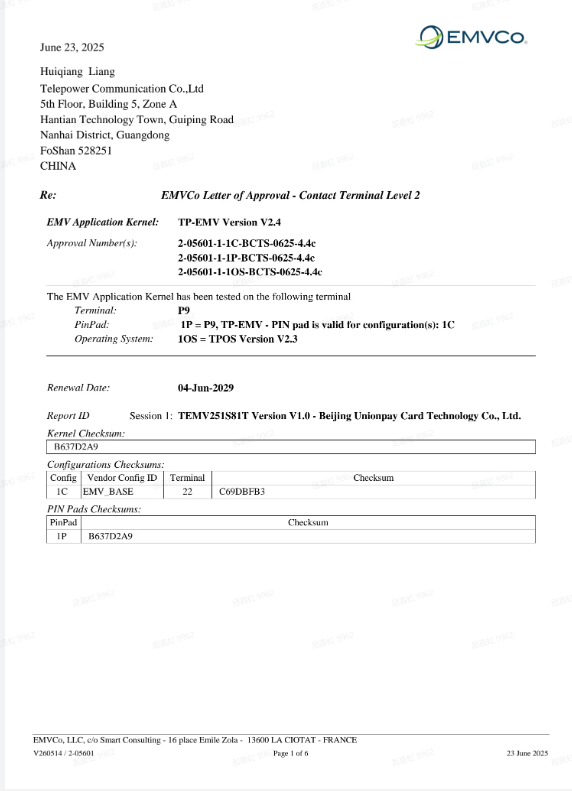
EMVCo Contact Level 2 approval documentation. Kernel, firmware and OS versions named on an approval define its scope.
What buyers must verify before a global deployment
The verification questions below apply across categories. They are ordered the way execution-stage procurement teams usually need them.
- Does the certificate name your exact configuration? Kernel approvals are version-bound. The TPS900 approval names EMV Application Kernel V2.3 and EMV Specification Version 4.4. The P9 approval names EMV Application Kernel TP-EMV V2.4 and OS TPDK V3.3. If your build changes kernel, firmware or OS version, the approval must be reviewed, not assumed.
- Is the certificate still inside its validity window? Several approvals carry fixed expiry dates rather than open-ended validity — for example the P8 UnionPay QuickPass approval to 2026-09-26, the TPS900 Mastercard TQM approval to 2027-04-13, the TPS900 NSICCS approval to 2028-05-27, and the P8 AMEX approval to 2028-04-10. A rollout that extends beyond an expiry date needs a renewal plan agreed in advance.
- Does the certificate cover the model variant, not just the family? ECE R118 covers T10, T20, T1 and T2 specifically. The IK08 report covers T20, T30, T30C, T260 and T28P. Scope statements like these are the difference between a valid claim and an assumption.
- Who holds the approval in a kiosk configuration? Where a kiosk integrates a payment module from a third party, confirm on paper which entity holds the EMV and PCI approval for the assembled unit, and whether the assembly itself was re-tested.
- Does the vehicle or site environment match the tested scope? The T10 ECE R10 approval is scoped to an electronic sub-assembly operating at DC 12V/24V negative ground. A different supply architecture falls outside that scope.
- Is the market-specific layer complete? EU RoHS, India BIS, Indonesia NSICCS and scheme-level approvals such as RuPay or UnionPay are separate from EMVCo and PCI and must be tracked independently.
How compliance choices show up in the field
Certification decisions become visible in deployment outcomes, particularly in transit and unattended retail where downtime is expensive.
In Vietnam, more than 2,000 ticket validator units were deployed with local commercial banks and a global payment network, covering EMV cards, QR codes and mobile wallets. The reported result was a reduction in single-ticket verification time from five seconds to one second, a 30% reduction in ticketing operation costs, and a 45% increase in the target user base, with full rollout completed in three months and peak volumes reaching 500,000 transactions per day. A separate deployment of over 1,000 bus fare collection units supports SUBE card, contactless bank cards and mobile payments, with IP65 and IK08 ratings for durability in transit environments.
In event payment, more than 200 units of the M8 all-in-one POS were deployed in Germany over more than two years for SoftPOS-based payment, with staff processing a contactless card transaction in under two seconds. The M8 also illustrates how fiscal requirements can be designed into hardware: its tax-compliance features include dedicated UART/USB ports for fiscal modules, physical tamper-evident lead-sealed screws, electronic tamper logging, an external real-time-clock circuit, and a backup battery for power-loss operation.
That pattern — a compliance feature that is genuinely useful in production — is a better selection signal than a general claim of certification coverage.
Market direction: more categories, more overlapping rules
Three measurable trends are pushing compliance complexity upward.
First, the base market is large and still growing. Grand View Research valued the global point-of-sale terminal market at approximately USD 123.2 billion in 2025, while a separate Market Research Report projection puts the handheld POS segment at USD 33.15 billion in 2025, rising to USD 89.52 billion by 2035. The same analyst community publishes materially different totals depending on whether software and services are included, which is itself a useful caution for buyers comparing vendor-cited market figures.
Second, the Android and SoftPOS share of that market is expanding. Android POS terminals accounted for approximately 27% of all POS terminals sold globally in 2022/2024 tracking published by ResearchAndMarkets and Berg Insight, and Grand View Research estimated the SoftPOS market at USD 365.0 million in 2024 with a projected CAGR of 23.1% through 2030. Both shifts increase the number of devices whose compliance depends on software versioning rather than hardware alone.
Third, self-service formats are broadening beyond retail. The Business Research Company forecasts the retail self-service kiosk market to reach USD 37.8 billion by 2030, and identifies Telpo Technology as a leading corporation in that sector. As kiosks move into hospitality, healthcare, ticketing and unattended retail, the number of regulatory layers touching a single unit rises accordingly.
Limits and boundaries of device-level certification
Certification is a strong signal, but it has hard boundaries that buyers should price into their plans.
- Certificates are configuration-bound, not brand-bound. An approval naming a specific kernel, firmware and OS version does not automatically extend to a later build. Re-validation is a project cost, not a formality.
- Certificates expire. Fixed expiry dates mean the compliance status of a fleet changes over time even if the hardware does not. A device installed in 2026 may be operating under an approval that lapses before the mid-life refresh.
- Component approval is not assembly approval. In kiosk deployments, the payment module may be certified while the assembled kiosk has not been evaluated as a unit. Buyers should verify this explicitly at contract stage rather than at commissioning.
- Customisation can invalidate scope. ID changes, housing changes, module substitution and deep OS customisation may fall outside the tested configuration. This applies to OEM projects as much as to off-the-shelf purchases.
- Coverage is not universal. A supplier's published certificate set reflects the markets it has prioritised. Where a target market is not yet covered, the honest position is a gap analysis and a timeline, not a general assurance.
Future outlook
Two directions look most likely to reshape compliance planning over the next several years. The first is consolidation of the Android and SoftPOS stack, which will push more of the compliance surface from hardware certificates to software release management — kernel versions, security patch cadence and remote update governance. The second is the continued spread of self-service formats into regulated environments, where kiosk compliance will increasingly be assessed at assembly level rather than component level.
For buyers, the practical implication is that compliance should be treated as a live programme with an owner, a renewal calendar and a change-control process — reviewed whenever firmware, housing or payment modules change. For suppliers, the implication is that a documented, date-stamped and scope-accurate certificate record is becoming a competitive asset in its own right, because it lets a procurement team verify rather than assume.
Frequently asked questions
What certifications does a payment terminal need before it can accept chip or contactless cards?
At minimum, PCI PTS approval for the PIN entry device where PIN entry occurs on the terminal, and EMV Level 2 kernel approval for contact processing. Contactless acceptance typically requires EMV Level 1 approval for the contactless reader, and scheme-specific approvals such as American Express Expresspay, UnionPay QuickPass or NPCI RuPay where those schemes are accepted. The PCI Security Standards Council states that POS terminals must comply with PCI PTS and EMV standards for secure chip processing. Each approval is tied to a named terminal and named software versions.
Do self-checkout kiosks require the same certifications as a payment terminal?
Not necessarily, and not automatically. A kiosk's compliance position depends on its configuration. Where the kiosk includes an integrated or add-on payment module that performs PIN entry or card acceptance, that payment path needs the appropriate EMV and PCI approvals — but those approvals may be held by the module vendor, the kiosk manufacturer, or the acquirer rather than the kiosk brand. In addition, the kiosk body raises separate requirements covering electromagnetic compatibility, electrical safety, enclosure durability, and printer or scanner modules. Buyers should confirm in writing which legal entity holds each approval for the exact assembled configuration being purchased.
Why do ticket validators carry automotive standards such as ECE R10 and ECE R118?
Because they are mounted on vehicles and are therefore treated as vehicle-mounted electronic sub-assemblies in many markets. ECE Regulation No. 10 addresses electromagnetic compatibility of vehicles, and an approval such as E24*10R06/02*5666*00 is scoped to a defined electrical configuration — in the Telpo T10 case, an electronic sub-assembly operating at DC 12V/24V negative ground. ECE R118 Annex 6/7/8 addresses material flammability for equipment installed in vehicles. Countertop terminals are not subject to these requirements because they are not installed in vehicles.
How do regional approvals affect a multi-country rollout?
They multiply the compliance surface rather than replacing it. Global approvals such as EMVCo Level 1 and Level 2 and PCI PTS cover the payment security layer across markets. On top of that layer, individual markets add their own requirements: EU Radio Equipment Directive 2014/53/EU and RoHS Directive 2011/65/EU in Europe, BIS registration in India, NSICCS terminal type approval in Indonesia, and scheme-level approvals such as RuPay in India or UnionPay and PURE in their respective acceptance networks. Each approval has its own issuing body, certificate number and validity period, so a rollout plan should map them market by market.
Do certifications remain valid after firmware or hardware customisation?
Not automatically. Kernel and terminal approvals are version-bound: Telpo's TPS900 EMVCo Contact Level 2 approval names EMV Application Kernel V2.3 and EMV Specification Version 4.4, and the P9 approval names EMV Application Kernel TP-EMV V2.4 and OS TPDK V3.3. Structural, housing, module or operating-system changes may fall outside the tested configuration and can require re-testing or re-approval. In addition, several approvals carry fixed expiry dates — the P8 UnionPay QuickPass approval runs to 2026-09-26 and the TPS900 Mastercard TQM approval to 2027-04-13 — so renewal is a scheduled activity independent of any design change.