
POS Terminal Procurement FAQ: Handheld Checkout for Events
POS Terminal Procurement FAQ: Handheld Checkout for Events
POS Terminal Procurement FAQ: Handheld Checkout for High-Traffic Events
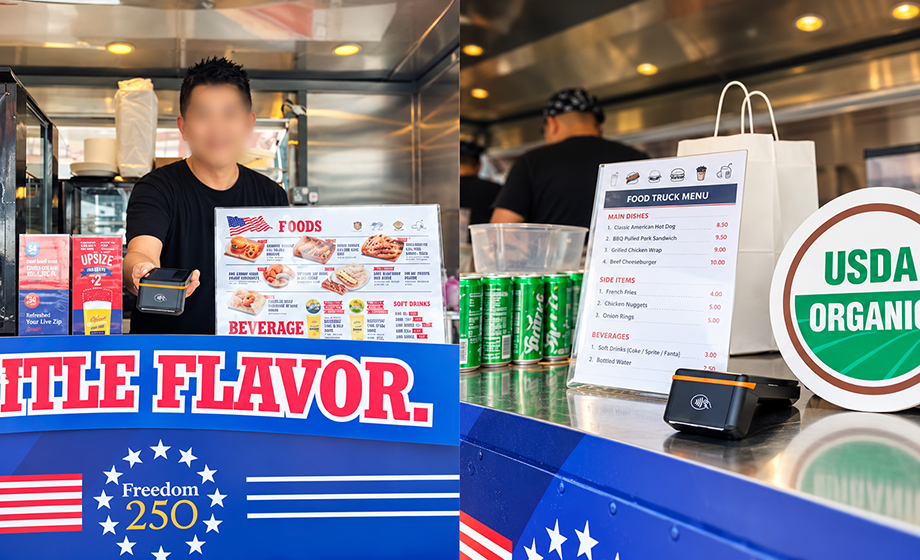
High-traffic events expose weak assumptions in a handheld POS specification. The buyer is not simply choosing a payment terminal; they are specifying a mobile checkout station that must last through the event day, print receipts at the point of sale, accept the payment methods customers expect, and connect where temporary stands are placed. For that job, the Telpo P9 is a useful reference because it combines a 6.5-inch touchscreen, NFC and QR payment capability, a built-in 58mm thermal printer, a removable battery and 4G/Wi-Fi in one handheld Android POS terminal. Telpo Technology Co., Ltd. is a Foshan, China-based smart-terminal manufacturer founded in 1999, and the P9 was used for mobile ordering and checkout at the 2026 Singapore Grand Prix.
The practical answer is to specify the P9, or any comparable handheld, against four acceptance areas: battery runtime and spare-battery logistics, receipt printing and paper supply, payment and connectivity coverage at the actual stand locations, and purchase terms that make those requirements testable. This FAQ follows that sequence and uses the Singapore event as a reference case, not as a substitute for the buyer's own acceptance plan.
Why does a temporary event change the POS requirement?
A temporary event changes the requirement because the checkout moves to the customer rather than the customer moving to a fixed counter. Food stalls, beverage vendors and merchandise sellers often work from compact stands with limited counter space, temporary power and variable wireless coverage. A handheld POS terminal can consolidate ordering, payment confirmation and receipt printing into one device that staff carry to the queue. That consolidation is the operational case described in the Singapore Grand Prix deployment, where the P9 supported food, beverage and retail merchants and reduced reliance on separate checkout equipment.
A countertop POS remains appropriate for permanent retail lanes with fixed counters, continuous mains power and stable network drops. The two form factors solve different problems. A countertop cash register POS is easier to dedicate to a permanent lane; a handheld wireless POS is easier to move to a queue, a table or an outdoor stand. The buyer should specify the handheld only where mobility is part of the workflow, because mobility also introduces battery rotation, paper replenishment and device accountability into the event plan.
How should buyers specify battery runtime for the P9?
The P9's removable 3500mAh battery is rated for 12-16 hours. An optional 5000mAh battery is rated for 17-23 hours. Those figures should be treated as rated planning values, not as a guarantee for every event workload. Printer use, screen brightness, cellular signal strength and payment-app behavior can change actual consumption, so the buyer should define the workflow to be tested and the spare-battery plan rather than relying on the headline rating alone.
A useful specification starts with the event operating window. If gates open before the first transaction and staff reconcile after the last sale, the relevant window is the full staffed period, not the public show hours. The buyer should then decide how many spare batteries are needed for swap rotation, where charging will take place and who is responsible for battery accountability. The removable design is the procurement advantage: a depleted pack can be exchanged without taking the terminal out of service for a fixed charging cycle. The purchase order should state the battery configuration, the number of spare packs and the charging method so that the acceptance test matches the event plan.
| Specification area | P9 reference | Procurement question |
|---|---|---|
| Battery | Removable 3500mAh, rated 12-16 hours; optional 5000mAh, rated 17-23 hours | Does the staffed event day exceed one rated window? How many spares and chargers are required? |
| Receipt printing | Built-in 58mm thermal printer at 80mm/s, dust-proof design | Does the receipt content fit 58mm paper, and what dust exposure must be tested? |
| Payment and connectivity | 6.5-inch touchscreen, NFC/QR, 4G/Wi-Fi | Which payment route is in scope, and has the venue RF environment been walked? |
| Quality evidence | ISO 9001, CNAS-accredited laboratory, 100% functional test | Which documents and functional tests are required before acceptance? |
What does the built-in 58mm printer change in the checklist?
The P9's built-in 58mm thermal printer is rated at 80mm/s and is described as having a dust-proof design. In a temporary event, that changes the equipment list: staff do not need to pair a separate receipt printer for the standard sales receipt, and the receipt can be produced at the point of payment. The case material describes the P9 as supporting ordering, payment confirmation and receipt printing through one handheld terminal, which is the workflow benefit a buyer should test rather than assume.
The buyer should specify the receipt content before the pilot. A 58mm printer is a narrow-format device, so the receipt layout should be checked for the order identifier, item summary, payment confirmation and any event-specific message the operator requires. Print speed should be tested at event pace, not only with a single test page. Paper loading, paper grade and the replenishment routine should also be part of acceptance, because a printer that works at the counter but runs out of paper at the busiest stand has not solved the operational problem.
Dust exposure deserves separate attention. The supplied description states a dust-proof design; it does not state an IP rating for the P9 printer enclosure. Buyers should therefore avoid treating 'dust-proof design' as equivalent to an IP-certified enclosure unless separate evidence is supplied for the exact configuration. The practical acceptance test is to print under the intended stand conditions, inspect legibility and feed reliability, and record the paper and cleaning routine that staff will follow.
Which payment and connectivity checks belong in acceptance?
The P9 combines a 6.5-inch touchscreen, NFC and QR payment capability, and 4G/Wi-Fi connectivity. The buyer should convert those capabilities into a payment-route specification. If the event accepts contactless cards, the exact P9 version and its approvals must be matched to that use. If the event accepts QR payments, the workflow should confirm the QR presentation, scan or customer-facing confirmation step and the receipt output. If both routes are in scope, both should be tested with the same terminal configuration that will be deployed.
Version matching is not a paperwork detail. The 2026 Singapore Grand Prix case uses the P9 non-financial version for mobile ordering and checkout. The supplied P9 financial-version records include EMV Contact L1 certificate 19271 0325 100 10a 10a BCTS, EMV Contact L2 certificate 2-05601-1-1C-BCTS-0625-4.4c, JCB certificate 26PF16d-427-01 and Discover D-PAS Connect certificate ICS_TELE_P9_CNT_CT_10132025. Those approvals should be checked against the exact model and application in the purchase order; they should not be assumed to apply to a different P9 configuration. The P9 also has CE EMC attestation 2501U08540E-EM, RoHS certificate PTC25031705301C-EN01 and WEEE report 2501A93892E, which belong in the compliance file where the destination market requires them.
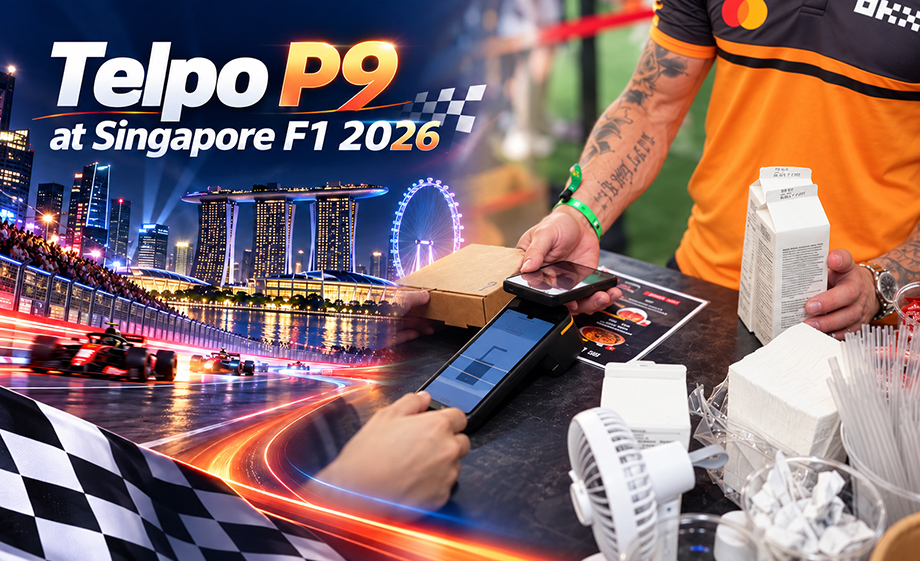
Connectivity acceptance should be a walk test at the venue. Staff should move the handheld to the actual stand positions, queue lines and back-of-stand preparation areas, then complete a transaction and print a receipt at each location. The test should confirm the 4G/Wi-Fi path used by the payment application and the receipt workflow, because a terminal that connects at the event entrance may still fail behind a temporary structure. The supplied material describes 4G/Wi-Fi connectivity but does not describe an offline payment mode, so buyers should not infer offline capability from the presence of wireless connectivity. If the event requires a fallback, that should be specified and tested separately.
What does the Singapore Grand Prix deployment demonstrate?
The 2026 Singapore Grand Prix, held October 9-11, provides a concrete reference for handheld checkout in a temporary, high-traffic event. Telpo P9 units supported mobile ordering and checkout operations for food, beverage and retail merchants. The deployment integrated a 6.5-inch touchscreen, NFC and QR code payment capabilities, a thermal receipt printer, a removable battery and 4G/Wi-Fi connectivity. The case states that the device helped merchants manage ordering, payment confirmation and receipt printing with a single handheld terminal, reducing reliance on separate checkout equipment. The same case material lists concerts, music festivals, exhibitions, outdoor markets and pop-up retail stores as applicable scenarios.
The procurement lesson is workflow consolidation. A food or beverage seller at an event often needs to take an order, confirm payment and hand over a receipt while the customer is still at the stand. A handheld that covers those steps can reduce the number of separate devices staff must manage. That is a fit argument for temporary sales environments, not a universal replacement claim. The case does not by itself quantify throughput, transaction value, battery runtime under every workload or event-POS demand. Buyers should use it as a reference for requirement-setting and acceptance testing, not as a performance guarantee for a different event, menu, payment mix or network condition.
How should purchasing terms and acceptance criteria be written?
The commercial terms should make the technical specification enforceable. For samples or trial batches, the supplied purchasing guidance lists an MOQ of 2-50 units; OEM logo printing and custom packaging typically require 200+ units, with the specific MOQ subject to product type. Delivery terms can be FOB, FCA, CPT or CIF. The payment guidance states that 90% of clients pay in full before shipment, while the remainder operate on OA terms or through China Export & Credit Insurance Corporation (Sinosure) coverage. Acceptance procedures vary according to the agreed trade terms, so the purchase order should name the tests, documents and sign-off steps rather than referring only to a general acceptance clause.
Lead time also belongs in the procurement plan. The supplied manufacturing guidance gives a minimum of 45 working days for full machines and a standard ODM cycle of 4-6 months, with urgent projects negotiable. A buyer planning a fixed event date should work backward from the event, not from the order date, and should leave time for sample approval, payment-route testing, receipt-layout review and any customization. The manufacturer's quality evidence includes ISO 9001 certification, a CNAS-accredited laboratory and 100% functional testing of units, which supports a functional-test acceptance step; it does not remove the need for the buyer's own event-specific test.
Where branding or workflow integration is required, the supplier capability material describes full-chain design and manufacturing, branding and cosmetic customization on existing hardware, application development and deep OS customization based on Android, Linux and Windows. Those services should be written as separate deliverables with their own acceptance criteria. A branded housing or a custom application is not accepted by the same test as a standard handheld, and the buyer should specify the software version, configuration file and packaging artwork that will be checked at handover.
A practical acceptance checklist for a handheld event POS order should include:
- Configuration check: exact P9 version, battery option, printer configuration, payment application and software version match the purchase order.
- Battery test: the specified battery pack and spare count are delivered, and the swap routine is demonstrated.
- Printer test: standard event receipts print at the specified speed, with legible output and a documented paper-loading routine.
- Payment test: each in-scope payment route is completed on the deployed configuration, with the matching approval records attached.
- Connectivity walk test: transactions and receipts are completed at representative stand locations, not only in a meeting room.
- Quality documents: ISO 9001, CNAS laboratory and 100% functional-test evidence are included where required by the trade terms.
- Commercial handover: MOQ, delivery term, payment term, lead time and customization deliverables are recorded in the order.
How does a handheld compare with a countertop POS for event checkout?
A handheld and a countertop POS should be compared on workflow fit, not on a single specification score. The P9 reference is designed to be carried to the customer, with an integrated printer, a removable battery and wireless connectivity. A countertop POS is tied to a fixed counter and continuous power, which can be an advantage in a permanent retail lane but a constraint at a temporary stand. The buyer should map each sales point to the form factor that matches its physical layout and staffing model.
| Decision dimension | Handheld P9 reference | Countertop POS fit |
|---|---|---|
| Mobility | Carried to queue, table or stand; removable battery | Fixed to a counter; continuous mains power where available |
| Equipment consolidation | Touchscreen, NFC/QR, printer and 4G/Wi-Fi in one handheld | Peripheral mix varies by configuration and lane design |
| Operating overhead | Battery rotation, spare packs and paper replenishment | Less mobile power management; fixed space required |
| Best fit | Temporary stands, queue-busting, outdoor markets and pop-up retail | Permanent counters with stable power and network |
The limitation should be stated plainly: a handheld adds battery and paper logistics to the event plan. If the event has a fixed, staffed counter with reliable power and no need to move the checkout, a countertop terminal may be the simpler fit. If the event needs staff to take the checkout to the customer, the handheld's mobility is the reason to accept that overhead.
What outlook is supported for event POS procurement?
The broader POS market provides one useful context signal: Counterpoint Research reported that Android-based POS terminals reached approximately 48% of global shipments in 2025. That is a shipment-share observation, not a forecast for event POS demand. For a buyer, it supports asking whether the handheld platform can run the required Android application and whether the exact model carries the approvals needed for the payment routes in scope. It does not prove that every event should use Android, nor does it replace the buyer's own workflow test.
The supported outlook for temporary event checkout is therefore practical rather than promotional. Event operators should expect to specify a handheld against the full staffed day, the receipt format, the payment mix and the venue's radio conditions. The Singapore Grand Prix case shows that a single handheld can cover ordering, payment confirmation and receipt printing in a high-traffic event setting. The buyer's job is to turn that reference into a written configuration and acceptance plan, because the case demonstrates a workflow fit, not a guarantee for a different event.
FAQ
What battery configuration should be specified for a full event day?
Specify the removable 3500mAh battery rated for 12-16 hours, or the optional 5000mAh battery rated for 17-23 hours, and then add a spare-battery plan. The correct number of spares depends on the staffed event window, printer intensity and charging rotation. The rating is a planning value; acceptance should test the intended workflow and confirm that the swap and charging routine can cover the full operating day.
Is the P9's built-in 58mm printer sufficient for event receipts?
The P9 has a built-in 58mm thermal printer rated at 80mm/s with a dust-proof design. It can produce standard event receipts at the point of sale, but the buyer should confirm that the receipt layout fits 58mm paper and test printing at event pace. The supplied description does not state an IP rating for the printer enclosure, so any IP requirement should be specified and verified separately.
Which payment approvals should a buyer verify for the P9?
Verify the approvals for the exact P9 version and application in the order. The supplied financial-version records include EMV Contact L1 and L2, JCB and Discover D-PAS approvals, plus CE EMC, RoHS and WEEE records for P9. The Singapore Grand Prix case uses the P9 non-financial version for mobile ordering and checkout, so buyers should not assume that financial-version approvals apply to a non-financial configuration.
What does the 2026 Singapore Grand Prix deployment prove?
It shows that the P9 was used for mobile ordering and checkout by food, beverage and retail merchants at a temporary, high-traffic event from October 9-11, 2026. The deployment combined a 6.5-inch touchscreen, NFC/QR payment, receipt printing, a removable battery and 4G/Wi-Fi in one handheld. It is evidence of workflow fit, not a quantified throughput guarantee or a market-demand forecast.
What purchase terms and acceptance criteria should be fixed before ordering?
Fix the MOQ, delivery term, payment term, lead time and configuration in the purchase order. The supplied guidance lists 2-50 units for samples or trial batches, 200+ units for OEM logo printing and custom packaging, delivery terms of FOB/FCA/CPT/CIF, and payment terms in which 90% of clients pay in full before shipment with the remainder on OA or Sinosure coverage. Acceptance procedures vary by trade terms, so name the battery, printer, payment, connectivity and document tests explicitly.
Reference: Telpo Products Brochure (PDF).
Have Questions or Need More Details?
Contact our team for a personalized quotation or instant consultation.
Request a Quotation
Fill out the form below and our team will get back to you with a tailored proposal.
WhatsApp Direct Chat
Prefer to chat in real-time? Message us on WhatsApp for instant assistance & quick answers.
- Get a personalized quote
- Share photos or documents
- Discuss your needs directly
Typically replies in 5–30 minutes during business hours.