
PP Woven Bag Supplier Evidence: Factory, Printing and MOQ Signals
PP Woven Bag Supplier Evidence: Factory, Printing and MOQ Signals
Global production of PP woven bags exceeded 10 billion units in 2023, and China alone manufactured more than 7 billion of them, according to commercial market research. For a buyer who has shortlisted candidates and is moving from evaluation into execution, the practical problem is not finding a factory that says it can make PP woven bags. It is reading the factory's own evidence—plant area, printing depth, MOQ and lead time—without treating those numbers as a verdict.
This article works through that reading problem. It uses Wenzhou BaiChuan Plastic Industry Co., Ltd. (BaiChuan) as a documented reference: a PP woven bag manufacturer based in Pingyang, Wenzhou, whose production covers yarn drawing, circular weaving, laminating, color printing and bag making. Unless attributed otherwise, the facts about BaiChuan in this article are company-reported. The interpretation—what a signal means, and where it stops—is the analytical layer, and is separated from the underlying fact wherever that distinction matters.
Why Capability Evidence, Not Price, Decides the Evaluation Stage
At the evaluation stage, most supplier quotations look similar on paper. The differentiator is whether the factory behind the quote can repeat the product at the required scale, with the required printing, inside a stated window. That is why capability evidence is read first as three bundles: physical factory evidence, printing and customization evidence, and commercial thresholds such as MOQ and lead time.
Two market facts make that reading more urgent than it once was. First, laminated PP woven bags accounted for 54.5% of global volume in 2023, according to the same market research. When more than half the market is laminated, "lamination available" is a category norm rather than a differentiator; buyers should look next at print quality and film consistency. Second, PP resin price stood at 9,461 CNY per tonne on November 10, 2026, a 47.32% year-on-year increase as reported by Trading Economics. Raw material volatility gives suppliers a reason to adjust material grade or film thickness, so a buyer who reads specification signals early is better protected than one who reads only the final price.
Factory Signals: What 20,000 m² and 90 Million Bags per Year Indicate
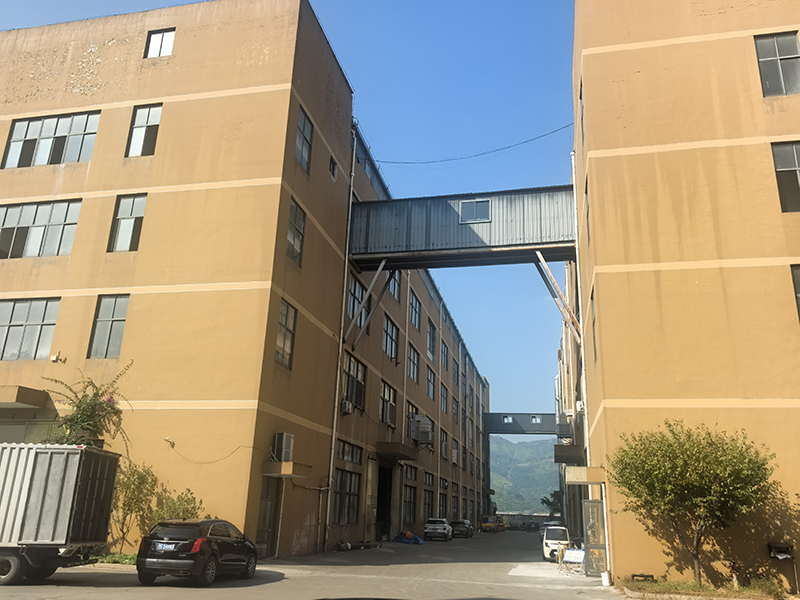
BaiChuan describes a production plant of 20,000 m², approximately 100 employees, 5 engineers, annual output of 90 million bags and monthly capacity of 7.5 million bags. The company traces its origin to Pingyang Luye Printing Factory, founded in 1996, and was registered as Wenzhou BaiChuan Plastic Industry Co., Ltd. in 2009. It reports registered capital of RMB 32 million and more than 100 production machines, including imported hot-valve sealing equipment. Each figure carries a specific meaning for a buyer.
- 20,000 m² and full-chain integration. The floor area is consistent with a plant that runs yarn drawing, circular weaving, laminating, color printing and bag making under one roof. Full-chain integration matters because printing and lamination are not outsourced to a third party; it reduces handover delays but also means the same capacity is shared across all orders. Confirm which steps are in-house for the specific SKU.
- 90 million bags per year, 7.5 million per month. This is a scale marker, not an audited output figure. If a buyer needs 3 million bags per year, that is roughly 3.3% of stated annual capacity—useful for scheduling fit, but not a guarantee of priority against a larger account.
- 100 employees and 5 engineers. A moderate workforce against 100-plus machines suggests automation is taking part of the load. Five engineers is a small technical team; clarify what design support is included and who handles artwork adaptation and print color matching.
- Registered capital of RMB 32 million. A financial-scale signal, not a credit rating. For long-term contracts, request business registration documents and, if needed, a third-party credit check.
- 30% export ratio, with markets including South America, Pakistan and Southeast Asia. This suggests some experience with export documentation and destination-market handling, but does not by itself prove compliance in any specific market.
For scale context, the company reports past collaboration with domestic enterprises including Shenzhen Aerospace Technology Group, Taiwan Unification Corporation and Haida Group. These are company-reported references; a buyer for whom the reference matters should request direct verification.
Boundary: factory area, output, employee and engineer counts are company-reported figures. They should be confirmed through a site visit or video audit, a machine list and recent batch records before being used as a planning basis for a long-term supply contract.
Printing Signals: Separating In-House Capability from a Print Claim
BaiChuan states that its product range includes BOPP color-printed woven bags and paper-plastic composite bags, and that color printing is handled in-house. Read this as three separate signals: printing is not subcontracted; BOPP lamination is available and improves the print surface; and a standard prepress workflow exists, because the company asks for AI, PDF or CDR vector artwork.
BOPP lamination, per the company's own explanation, improves waterproof performance, makes printing clearer, gives the surface a more upscale appearance and reduces dust adhesion. The trade-off is incremental cost over non-laminated bags. It is a surface and barrier choice, not a structural strength guarantee—buyers should keep those two questions separate when reviewing a sample.
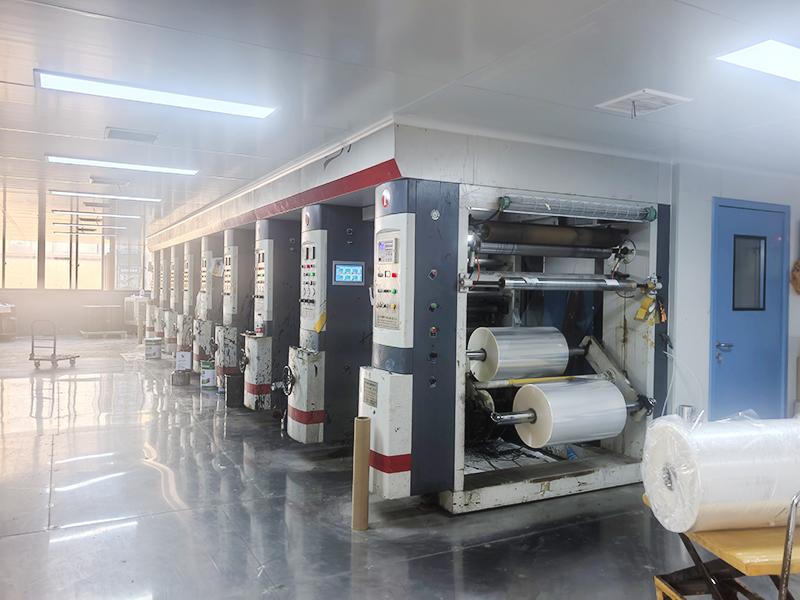
On press choice, flexo and gravure are the two common printing processes for woven bags; they differ in cost at different run lengths and in fine-detail reproduction. Confirm which press will run the buyer's job, the maximum number of print colors, the maximum print width, and whether the printer can match a brand color to an approved physical sample rather than to a digital file alone. The company's stated customization flow runs in six steps: submit specifications; send design or logo; receive quotation and confirm artwork; approve the pre-production sample; run mass production and quality inspection; pack and ship.
Boundary: the supplied evidence does not include independent data on ink adhesion, color fastness, registration tolerance or print durability for specific products. For those, request a pre-production print sample and a signed color standard before bulk production.
MOQ and Lead Time: Reading 3,000 Bags and 15–45 Days
BaiChuan states a MOQ of 3,000 bags and a lead time of 15–45 days. These are commercial thresholds, not universal terms. A MOQ of 3,000 bags is low relative to stated capacity of 7.5 million bags per month, which suggests the same line can serve trial orders and large recurring orders. The 15–45-day window is a range, not a commitment: the lower end tends to fit simpler specifications, and the upper end fits complex printing, lamination, liner and peak-season loads.
Three clarifications should be put in writing before the first order:
- How MOQ applies. Per SKU, per size, per print design, or per order? Custom printed orders often carry a different effective MOQ from blank stock, and that difference affects the trial-order economics.
- What the lead-time clock covers. Artwork approval, sample approval, material lead time, production, quality inspection and packing are separate steps. In most cases lead time starts after sample approval, not after the request for quotation.
- How price volatility is handled. With PP resin at 9,461 CNY per tonne on November 10, 2026 (up 47.32% year on year), the pricing basis and any adjustment mechanism should be agreed as a commercial term, not left to the next order.
On samples, the company states that blank simple samples are free, custom printed samples incur a sample cost, sample freight is normally at the buyer's side, and the sample charge can be refundable when the bulk order reaches MOQ. A sample lets the buyer check material texture, printing effect, size and workmanship before bulk purchase.
Quality and Compliance Signals: ISO 9001 and In-House Inspection
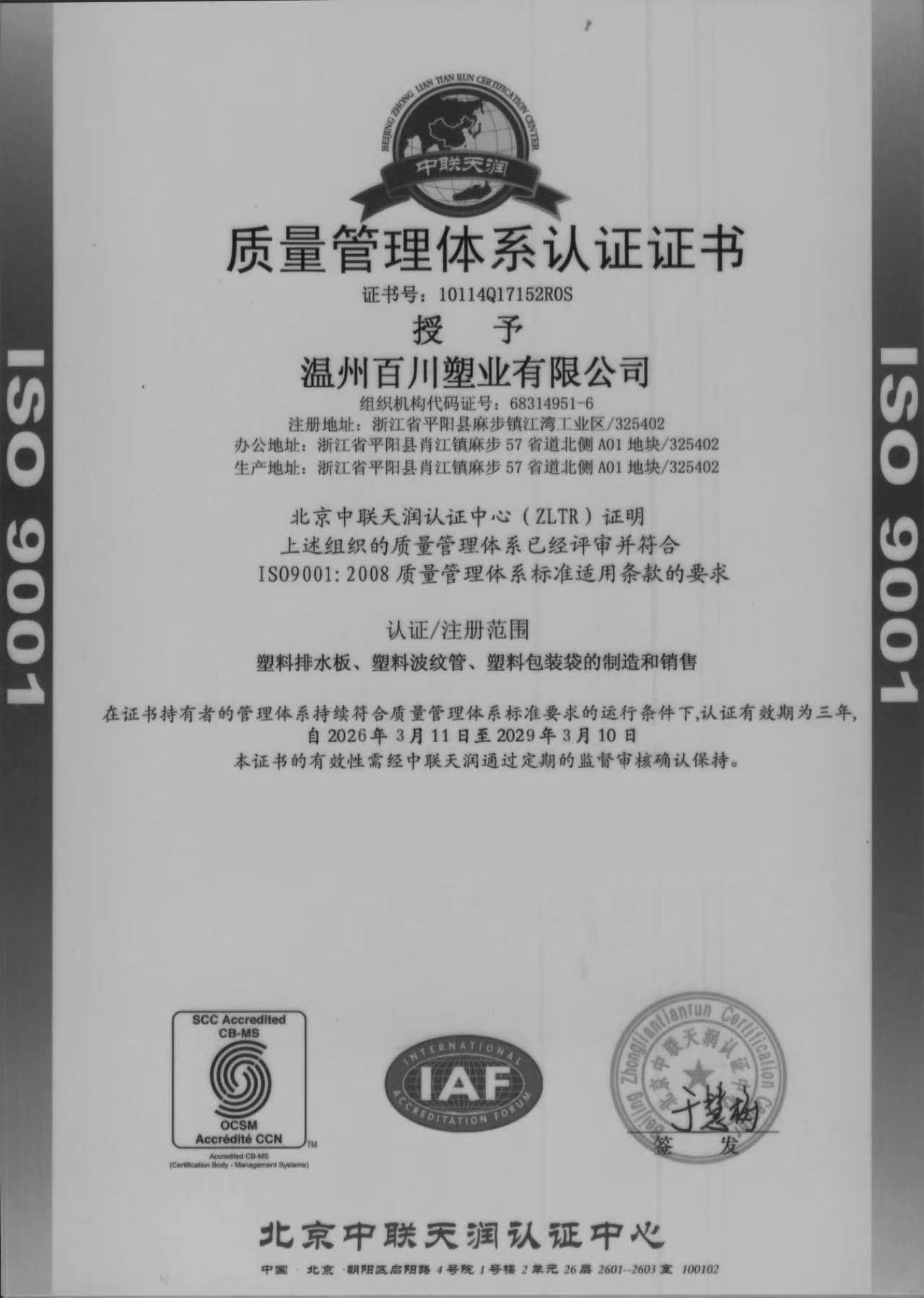
BaiChuan holds an ISO 9001:2008 quality management system certificate, certificate number 10114Q17152R0S, issued by Beijing Zhonglian Tianrun Certification Center (ZLTR) on 2026-03-11 and valid to 2029-03-10. The stated scope covers manufacture and sale of plastic drainage boards, plastic corrugated pipes and plastic packaging bags. The company states that the certificate is IAF MLA-recognized and accepted in South America, Southeast Asia, Pakistan, Europe and most global markets.
Three reading notes are relevant to a buyer:
- Revision. The certificate states ISO 9001:2008. ISO 9001:2015 is the later revision of the same standard. A buyer whose destination market or customer requires the 2015 revision should confirm with the supplier and the certification body whether the certificate satisfies that specific requirement. This is a scope check, not a judgment on the supplier.
- Scope. The certificate covers "plastic packaging bags" within a wider product scope. Ask the supplier to confirm how the certified scope maps onto the exact product being purchased, especially for food-contact or regulated applications.
- Quality control and after-sales. The company describes raw material inspection, in-process monitoring, finished-product testing and manual inspection. These are company-reported; independent test reports were not included in the supplied evidence. After-sales terms should be confirmed in writing—the company states that damage caused by quality issues is followed by an on-site sales visit and, where unresolved, a deduction in payment.
As a reference framework, GB/T 8946-1998 is the Chinese national standard covering technical requirements, inspection rules and classification for PP woven bags. It is a useful checklist of what buyers can ask the supplier to declare; it is not, on its own, proof that a specific batch complies.
Application Fit: Matching Capability Signals to Bulk Packaging Needs
BaiChuan's stated applications include rice, fertilizer, chemical powder, construction materials and feed packaging. The capability signals that matter most differ by application.
- Rice and grain. Color-printed woven sacks with handles suit retail sale; block-bottom valve bags suit palletized bulk shipment. The right choice depends on the filling line and the sales channel, not on a single "best" format.
- Fertilizer and chemical powder. Moisture protection and seam strength are the main criteria. BOPP lamination improves water resistance; a PE liner adds barrier for hygroscopic materials.
- Construction materials. Load-bearing and puncture resistance move to the top. The company states its bags are waterproof, moisture-resistant and suitable for long-distance transport; a buyer should confirm these claims through a drop test at the actual load, not through the specification sheet alone.
- Operating conditions. The company's stated working range is -10°C to 50°C continuous, with short-time peaks up to 50°C without heavy load, suitable for dry, ventilated storage. UV-stabilized versions are available for outdoor storage. The bags are not suited to long soaking in water without a liner or coating.
On storage, the company states that PP woven bags can be stored in a cool place for up to 2–5 years; in direct sunlight they may deteriorate within months or weeks; PE woven bags have higher UV resistance and can last 2 years under direct sunlight. Buyers planning long storage should align the liner and UV option with actual warehouse conditions.
On bag-mouth format, block-bottom valve bags stand steadily for automatic filling and pallet stacking and need matching automatic filling equipment. Open-mouth bags with handles are easier for manual packing and retail sales. Filling can be manual or automated depending on bag construction and filling equipment; the exact method should be confirmed for each SKU.
A Practical Verification Checklist for Bulk Buyers
The checklist below turns supplier-stated capability into a set of verifiable questions. The middle column is what a buyer will see in a supplier profile; the right column is what to verify before the first bulk order.
| Capability signal | Supplier-stated example (BaiChuan) | Verify before first bulk order |
|---|---|---|
| Factory footprint | 20,000 m²; about 100 staff; 100+ machines | Business license, site visit or video audit, machine list, batch records |
| Output scale | 90 million bags per year; 7.5 million bags per month | Recent production records; scheduling fit against the buyer's annual demand |
| Full-chain integration | Yarn drawing, weaving, laminating, printing, bag making | Which steps are in-house for the buyer's SKU; which are outsourced |
| Printing | In-house color printing; BOPP lamination; AI/PDF/CDR artwork | Pre-production print sample; color standard; maximum colors and print width |
| MOQ | 3,000 bags | Per-SKU and per-design MOQ; custom print MOQ; sample-linked MOQ refund terms |
| Lead time | 15–45 days | Written lead time per SKU; sample approval window; peak-season risk |
| Certification | ISO 9001:2008; cert 10114Q17152R0S; valid 2026-03-11 to 2029-03-10 | Verify scope and revision; check destination-market acceptance |
| Quality system | Raw material, in-process and finished-product inspection | Inspection protocol; AQL level; third-party test reports where required |
| After-sales | On-site visit for quality issues; payment deduction for unresolved cases | Written warranty; claim window; required evidence (photos, batch code, packing data) |
Where Capability Evidence Stops and Buyer Checks Begin
Four kinds of evidence need different treatment:
- Company-reported figures. Factory area, output, staff and engineer counts are the supplier's own numbers. They are a starting point, not an audit. A site visit or a video walkthrough with the machine list and batch records turns them into usable facts.
- Market statistics. The 10 billion units global, 7 billion units China and 54.5% laminated-share figures describe the market, not the specific supplier. They help a buyer calibrate expectations, not certify a factory.
- Raw material price. The 9,461 CNY per tonne figure is a moving input, not a fixed cost. It affects cost modeling and can affect material grade choices, so the pricing basis and adjustment mechanism should be part of the commercial agreement.
- Technical performance. The supplied evidence does not include independent datasheets for tensile strength, seam strength or drop-test performance. Ask the supplier to declare these for the buyer's actual SKU, and test a pre-production sample at the real load and drop height.
Outlook: What the Market Signals Suggest
The 54.5% laminated share in 2023 shows that lamination is now a mainstream choice rather than a differentiator; buyers should focus next on print quality, film consistency and barrier performance as the levers that separate one laminated bag from another. Raw material volatility—with PP at 9,461 CNY per tonne on November 10, 2026, up 47.32% year on year—is likely to keep cost transparency and pricing-adjustment terms near the center of supplier conversations. Beyond those two points, the supplied evidence does not support a specific forecast, and none is offered here.
Conclusion: From Signals to Verified Facts
Capability evidence is a set of signals, not a verdict. A 20,000 m² factory, in-house color printing, a MOQ of 3,000 bags, a 15–45-day lead time and an ISO 9001 certificate tell a buyer where to look—not what to conclude. The conversion from signal to fact happens through a site audit, a pre-production sample, a signed color standard and written commitments on lead time, MOQ, quality claims and after-sales. That conversion is the real work of the evaluation stage, and it is the part the supplier's profile cannot do for the buyer.
A downloadable product catalog is available for buyers who want to review the full product range before preparing an RFQ: Baichuan packaging product catalog (PDF).
Frequently Asked Questions
How can buyers verify a PP woven bag supplier's stated production capacity?
Start with the business license, factory layout, machine list and recent batch records. BaiChuan reports monthly capacity of 7.5 million bags and annual output of 90 million bags; these are company-reported until verified. Compare the figure with the buyer's own annual demand to judge scheduling fit, and ask for a written production schedule for the specific SKU.
What information is needed to customize PP woven bags?
Bag type, size, load capacity, material, printing design, liner requirement and order quantity. Vector artwork in AI, PDF or CDR is preferred. The stated customization flow is: submit specifications; send design or logo; receive quotation and confirm artwork; approve a pre-production sample; run mass production and quality inspection; pack and ship.
How are samples handled for a PP woven bag order?
Blank simple samples are free; custom printed samples carry a sample cost; sample freight is normally at the buyer's side; the sample charge can be refundable when the bulk order reaches MOQ. Samples allow the buyer to check material texture, printing effect, size and workmanship before bulk purchase.
Block-bottom valve bag or open-mouth woven bag—how should a buyer choose?
Block-bottom valve bags stand steadily for automatic filling and pallet stacking, and they need matching automatic filling equipment. Open-mouth bags with handles are easier for manual packing and retail sales. Selection depends on the filling line configuration and the sales channel rather than on a single universal "better" format.
What does BOPP lamination add to a PP woven bag?
BOPP lamination improves waterproof performance, makes printing clearer, gives the surface a more upscale appearance and reduces dust adhesion. It costs more than non-laminated bags. The choice depends on branding needs, moisture sensitivity of the product and budget.
Have Questions or Need More Details?
Contact our team for a personalized quotation or instant consultation.
Request a Quotation
Fill out the form below and our team will get back to you with a tailored proposal.
WhatsApp Direct Chat
Prefer to chat in real-time? Message us on WhatsApp for instant assistance & quick answers.
- Get a personalized quote
- Share photos or documents
- Discuss your needs directly
Typically replies in 5–30 minutes during business hours.