
PPWR Audit: Step-by-Step Supplier Verification with EU Waste Rules
A supplier's PPWR compliance claim is a claim, not evidence. Since the EU Packaging and Packaging Waste Regulation moved into its main application phase in August 2026, the practical work of confirming recyclability, recycled content and material sourcing has shifted to the buyer side of the transaction — and that work is a document-and-process audit, not a certificate check.
This industry reference walks through a five-step verification process that procurement teams, brand owners and DTC operators can run against a current or prospective packaging partner. One manufacturer — Qingdao BEJAN GIANT NEW PACKAGING TECHNOLOGY CO., LTD, a paper packaging producer founded in 2014 in Chengyang, Qingdao, China — is used as a worked example of what auditable documentation looks like. The purpose is to show a verification method, not to endorse a supplier.

A supplier verification visit starts on the production floor, not in the certificate folder. In-house printing, die-cutting and gluing determine whether material claims can be traced to a real batch.
Why PPWR Turned Supplier Selection Into a Verification Exercise
The PPWR was adopted on 19 December 2024 and entered into force on 11 February 2025, with major application beginning in August 2026 (Latham & Watkins). The European Commission's requirement is that all packaging placed on the EU market be recyclable by 2030, with specific recycled content targets attached. Extended Producer Responsibility (EPR) rules for packaging now span 63 countries as of 2025 (Mordor Intelligence).
Two consequences follow for buyers. First, the legal obligation generally sits with the organisation that places packaging on the market — usually the brand or importer — while the evidence needed to satisfy it sits upstream with the converter. Second, PPWR is not a credential a supplier either holds or lacks. No certification body issues a single document titled "PPWR compliant". Compliance is assembled from fibre sourcing records, product design specifications, ink and adhesive declarations, material test data and quality-system documentation. That is why verification behaves like an audit.
The Two-Level Verification Model
Most sourcing teams merge two questions that should be asked separately: is this company credible, and is this specific pack compliant? Entity-level evidence and product-level evidence answer different risks and fail in different ways.
| Verification level | What it proves | Evidence to request | Common failure mode |
|---|---|---|---|
| Entity level | The company exists, is audited, and sources fibre responsibly | FSC chain of custody, ISO 9001, SMETA / Sedex report, FDA status | Logo used as proof without checking scope or expiry |
| Product level | The specific pack is made of declared, verifiable materials | Material grade, ink and adhesive declaration, insert material, test reports | Company certificate assumed to cover every SKU sold |
| Production level | The declared supplier actually converts the packaging | Factory access, in-house process list, third-party inspection availability | Documentation from a factory that is not the contracted entity |
| Ongoing level | Claims stay valid after the first shipment | Renewal calendar, pre-shipment inspection records, retained samples | Expired certificate discovered during a retail audit |
Step 1 — Define the Scope: SKU, Material and Market
A PPWR audit begins with a bill of materials, not a certificate request. Before asking a supplier for anything, list every packaging SKU entering the EU, the material it is made from, and the packaging function it performs (primary, secondary, transport).
Paper and paperboard constructions — corrugated mailers, folding cartons, rigid boxes — are the lowest-risk material category, and they held a 38.2% share of the sustainable packaging market in 2024 (Research and Markets / Golden Arrow). Multi-material constructions are where claims most often weaken: window films, laminated surfaces, magnetic closures and plastic tape all sit inside a pack that may be described simply as "paper". Soy-based inks and water-based starch adhesives matter in the same audit because they support fibre recovery during repulping.
The deliverable of this step is a one-page scope table. Without it, every certificate conversation is unanchored, because a certificate covers a defined scope — not the product in your cart.
Step 2 — Verify Entity-Level Certificates Against Their Actual Scope
Four document families matter at entity level, and each addresses a different risk. Using BEJAN GIANT NEW PACKAGING as the worked reference, the checks look like this.
FSC Chain of Custody — fibre sourcing and traceability
Certificate RR-COC-001255, issued by Russian Register, is valid from 21 June 2023 to 20 June 2028 and covers the purchasing of paper materials and the production and sales of paper products under FSC 100%, FSC Mix and FSC Recycled, certified against FSC-STD-40-004 v.3-0. The audit check is not whether the logo exists, but whether the scope statement covers the material you are buying at the volume you are buying.
ISO 9001 — process governance
Two ISO 9001 certificates appear in this reference: 452QMS2100010, issued by QINGDAO GFS CERTIFICATION CO., LTD. and valid from 18 October 2021 to 17 October 2027, covering production and sales of paper products under GB/T 19001-2016 / ISO 9001:2015; and 10422Q01616R0S, issued by SHANDONG SEATONE INTERNATIONAL CERTIFICATION CO., LTD. and valid from 30 August 2022 to 29 August 2028, covering paper handicraft design and paper packaging box sales. A quality certificate indicates that batch control is documented — it says nothing about material recyclability.
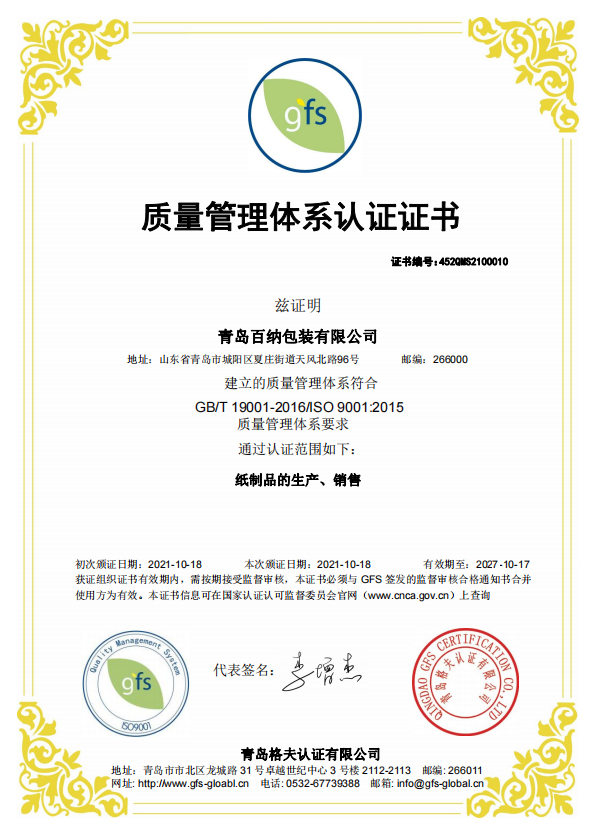
Certificate verification means reading the scope statement, the issuing authority and the validity window — not confirming that a logo exists on a website.
SMETA / Sedex — labour and site conditions
The SMETA 6.1 report ZAA600099300 (Sedex co-reference ZC416599564, site reference ZS416684560), issued by Openview Service Limited, is valid from 18 November 2024 to 17 November 2026 and covers all production areas of the corrugated carton and colour box workshop under two pillars: labour and health & safety. This is the document European and UK retail and supermarket programmes typically request during onboarding.
FDA status and food-contact suitability
The manufacturer states that it holds FDA, FSC and ISO 9001 certification, and that its packaging complies with the latest EU PPWR regulations. FDA status is relevant when cartons and inserts sit directly around chocolate, tea, snacks, cosmetics or supplements; it addresses food-contact suitability under the US framework rather than EU recyclability.
Across all four families, run the same four checks: confirm the certificate number with the issuing body or registry, read the scope statement rather than the seal, verify that the legal entity on the certificate matches the entity on your contract, and record the expiry date for renewal tracking.
Step 3 — Audit Product-Level Compliance, Not Just Paper Certificates
No company certificate can tell a buyer whether one specific box design is recyclable. Product-level verification asks about material grade, ink, adhesive, insert choice and test evidence — for each SKU.
Published product data from this manufacturer illustrates what verifiable specifications look like in practice. The corrugated e-commerce mailer box BP-MAIL-EB01 uses FSC-certified E/B flute corrugated board, a self-locking construction that requires no adhesive tape, food-grade soy-based ink and water-based starch glue, with molded pulp inserts available; unit pricing starts from $0.5 and daily output is stated at 40,000 pieces or more. The folding paper carton box BP-FBB-CARTON03 uses 250–400 gsm FSC-certified FBB/SBS white cardboard or recycled paperboard, has passed a food-contact safety test, and has passed drop and compression testing; pricing starts from $0.3. The rigid gift box BP-RIGID-GIFT02 uses 1.5–3 mm FSC-certified high-density grey board, recycled coated eco wrapping paper, food-grade soy-based ink and water-based starch adhesive, is available in an all-paper plastic-free configuration, and passes FEFCO drop and compression tests; pricing starts from $1.5.
The document set to request per SKU is consistent: material grade and recycled content claim, ink and adhesive declaration, insert material specification, and test reports covering food contact, drop and compression. Where a supplier publishes specifications, the audit is simply a comparison between the published data and the documents issued for your order.
Step 4 — Confirm Where the Packaging Is Actually Manufactured
A certificate is only as reliable as the entity behind it. Factory-based suppliers can be inspected; intermediaries between the buyer and the production floor make material traceability and batch consistency harder to confirm.
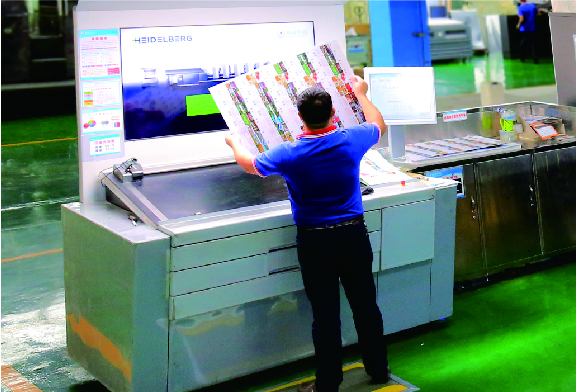
Verifying the production chain: offset printing, die-cutting, lamination and gluing completed in-house allow a buyer to trace a batch back through documented process steps.
Evidence to request at this step includes a production-floor walkthrough or video, a list of in-house processes, availability of third-party inspection, and capacity and lead-time data that can be checked against order history. In the reference case, the manufacturer states a 10,000 m² facility, more than 200 employees, monthly capacity of 30,000,000 units and annual output of 100,000,000 units, a lead time of 7–15 days, a minimum order of 500 units, full inspection before shipment with compression resistance testing, and on-site third-party inspection by SGS as an available option. Its stated export footprint covers Germany, France, the Netherlands, Italy, Spain, Poland, Belgium, Austria, Portugal, Sweden, Denmark and Finland, alongside markets including the United States, the United Kingdom, Japan, Australia, Canada and Korea.
The audit question to answer here is narrow: can a buyer trace a delivered carton back to a documented process, or only to a trading account?
Step 5 — Set Up Recurring Verification
Compliance documentation expires. The SMETA report in the reference case is valid until 17 November 2026, and the FSC certificate until 20 June 2028 — different clocks running on the same supplier file. Buyers should therefore build a renewal calendar at the point of supplier approval, with alerts set 60–90 days ahead of each expiry.
Recurring verification also covers batch behaviour. Pre-shipment inspection with compression resistance testing, retained samples per order, and a documented route for defective mass production are the operational items that keep a paper compliance file honest. In the reference case, the stated after-sales package includes free blank samples, packaging structure optimisation, provision of full certification document sets, 20-hour online project docking and rework service for defective mass production.
How to Read a Certificate Without Over-Reading It
Each certificate family answers a question that is narrower than buyers usually assume. FSC chain of custody covers the sourcing and traceability of wood fibre; a pack can carry FSC Mix board and still be difficult to recycle if it is laminated with an incompatible film. ISO 9001 describes how consistently a process is managed, not how environmentally performant a product is. SMETA addresses labour and health & safety conditions at the production site, and says nothing about materials. FDA status addresses food-contact suitability rather than EU recyclability.
The practical conclusion is that PPWR verification is a documentation chain, not a badge. Recyclability and recycled content are demonstrated at the level of design and material specification, and the declaration obligation remains with the entity placing the packaging on the market.
Application: Where This Audit Process Is Used
This verification model is most relevant to cross-border DTC brands and foreign trade wholesalers who need packaging to clear customs without documentation disputes. In the reference case, clients in Korea, Israel and the United States order cosmetic, wine and food outer packaging in batches of 5,000 to 50,000 pieces, on repeat cooperation running three to five years, with reported outcomes of stable packaging quality and smooth customs clearance. The cited case highlights are full FSC certification, complete pre-shipment inspection support, a stable delivery cycle and transparent cost accounting.
Mapped to product families, the same process produces different document priorities. E-commerce mailers in apparel, beauty and small accessories are verified mainly on board specification, plastic-free closure and insert material. Folding cartons in beauty, chocolate or tea are verified on food-contact test evidence and ink declarations. Rigid gift boxes for premium and holiday sets are verified on board density, wrapping paper source and plastic-free insert configuration.
Comparison With Traditional Sourcing Practice — and the Limits of Verification
| Dimension | Certificate-only sourcing | Audited sourcing |
|---|---|---|
| Evidence base | Supplier statement and certificate image | Scope-checked certificates plus SKU-level material data |
| Timing | Reviewed once, at quotation stage | Reviewed at approval and again at each expiry and spec change |
| Batch risk | Not addressed | Pre-shipment inspection and retained samples |
| Effort | Low | Higher administrative load per supplier and per SKU |
Three boundaries should be stated plainly. First, supplier verification does not transfer legal responsibility: under EPR frameworks now covering 63 countries as of 2025, the obligated party is generally the brand or importer placing packaging on the market, so a complete supplier file reduces risk but does not replace the brand's own declarations. Second, certificates are snapshots of a management system with defined scopes and expiry dates — they are not per-batch proof, which is why inspection regimes remain necessary. Third, verification costs time and money; for very small, low-risk domestic orders, a lighter check may be proportionate, and buyers should scale the audit to the exposure rather than apply the full process universally.
Market Trend Analysis: Why Documentation Demand Is Rising
The commercial context explains why verification is becoming a normal procurement step rather than a specialist exercise. The global sustainable packaging market was valued at USD 272.9 billion in 2023, with Europe holding a 36.2% revenue share (Grand View Research), and is projected to reach USD 448.5 billion by 2030 at a CAGR of 7.6%. Mordor Intelligence estimates a 2026 market size of USD 325.94 billion; the difference between estimates reflects how each firm defines "sustainable" packaging.
Paper is the structural centre of that growth. Paper and paperboard held a 38.2% share of the sustainable packaging market in 2024, and the boxes and cartons segment accounted for 33.6% of the market, supported by e-commerce volumes (Precedence Research). The sustainable e-commerce mailers and envelopes segment is growing at a 9.41% CAGR through 2031 (Mordor Intelligence). On the supply side, China's eco-friendly packaging market reached USD 80.25 billion in 2025 and is projected to reach USD 157.20 billion by 2034 (IMARC Group), with China accounting for 8.22% of the global sustainable packaging market in 2025. Consolidated suppliers including Smurfit WestRock, Amcor and International Paper together hold roughly 20% of the eco-friendly packaging market (Grand View Research / Industry Intelligence), which means most buyers will be verifying smaller regional converters where documentation quality varies widely.
Demand-side pressure moves in the same direction. PDI Technologies reported that 80% of consumers in 2024 were willing to pay more for products with sustainable packaging — a directional signal rather than a precise forecast. Material substitution is also visible in design: molded pulp inserts are replacing plastic vac-forms in premium packaging, a trend already adopted by luxury brands (Intrecore / L'Oréal Finance). Each of these shifts increases the volume of material claims a buyer is asked to accept on trust.
Future Outlook
The direction of travel is toward product-level documentation rather than company-level badges. As recyclability requirements phase in through 2030, EPR fee structures in several markets are expected to differentiate by recyclability, which pushes the evidence requirement down from the converter to the individual SKU. Buyers should expect to maintain per-SKU material records, and should expect their stronger suppliers to publish material and test data proactively rather than on request.
Practically, the suppliers that will be easiest to onboard are those already holding scope-checked entity certifications and publishing design-level material specifications, because the audit becomes a comparison rather than an investigation. The buyers who will be least exposed are those who started a renewal calendar before the first order shipped, not after a retail compliance query arrived.
FAQ
What is the first step in auditing a packaging supplier for PPWR compliance?
Define the scope before requesting documents: list every SKU entering the EU, its material composition and its packaging function (primary, secondary or transport). PPWR-related obligations apply per packaging unit placed on the market, so a company-level certificate cannot be matched to a specific product without this SKU map. Only after the scope table exists should certification and material documentation be requested.
Which certifications support a PPWR-related claim, and which do not?
FSC chain of custody supports fibre sourcing and traceability claims; ISO 9001 supports consistent process management; SMETA covers labour and health & safety conditions at the production site; FDA status relates to food-contact suitability. None of these is a PPWR certificate, and no certification body currently issues a single document titled "PPWR compliant". Compliance is assembled from material records, design specifications and test data.
How can a buyer confirm that a supplier's certificate is genuine and still valid?
Check four items: the certificate number and issuing body, the scope statement, the legal entity holding it, and the validity window. As examples from the documentation referenced in this article, FSC chain of custody certificate RR-COC-001255 was issued by Russian Register and is valid to 20 June 2028; ISO 9001 certificate 452QMS2100010 was issued by Qingdao GFS Certification Co., Ltd. and is valid to 17 October 2027; and SMETA report ZAA600099300 is valid to 17 November 2026. Expiry dates should be entered into a renewal calendar at supplier approval.
Does FSC certification mean a box is recyclable under EU rules?
No. FSC chain of custody covers the sourcing and traceability of wood fibre, including the FSC 100%, FSC Mix and FSC Recycled categories, not the recyclability of a finished design. A laminated or multi-material pack can use FSC-certified board and still be difficult to recycle in practice. Recyclability depends on material composition and construction, including inks, adhesives, inserts and closures.
What product-level documents should be requested before an order is placed?
Request material specifications including grade and recycled content, ink and adhesive declarations such as food-grade soy-based ink and water-based starch glue, insert material specifications such as molded pulp instead of plastic, and test evidence covering food contact, drop and compression. Where a supplier publishes product data — as with mailer box BP-MAIL-EB01, folding carton BP-FBB-CARTON03 and rigid gift box BP-RIGID-GIFT02 — the issued documents should match the published specifications.
Where does supplier verification end and brand responsibility begin?
Under Extended Producer Responsibility frameworks, which now span 63 countries as of 2025, the obligated party is generally the organisation placing packaging on the market — typically the brand or importer. Supplier certificates reduce procurement and customs risk, but they do not discharge the brand's own reporting and declaration obligations. A complete compliance file therefore contains both supplier documentation and the buyer's own records.
Does sourcing from a factory rather than an intermediary change the verification burden?
It changes the auditable chain. A factory operating in-house printing, die-cutting, lamination and gluing can be inspected directly and can support third-party inspection such as an on-site SGS check, which makes material traceability easier to confirm. Intermediaries add steps between the buyer and the production floor, complicating batch consistency checks. The trade-off is that direct factory sourcing places more specification, approval and documentation management responsibility on the buyer.
For readers who want to review the underlying documentation structure in more detail, the manufacturer referenced throughout this article publishes a company brochure: company profile PDF.